Map reading skills Our Planet and Environment Worksheets for Ages 5-8
1 filtered results
-
From - To
Explore our engaging "Map Reading Skills Our Planet and Environment Worksheets for Ages 5-8." Designed for young learners, these printable activities offer hands-on practice with fundamental map reading skills. Children will learn to identify continents, oceans, and environmental features, enhancing their understanding of geography and the natural world. Each worksheet is crafted to develop critical thinking, spatial awareness, and practical knowledge through fun, interactive exercises. Ideal for classroom use or at-home learning, our worksheets make geography approachable and enjoyable for kids. Promote your child's curiosity and environmental awareness with our expertly designed educational resources.
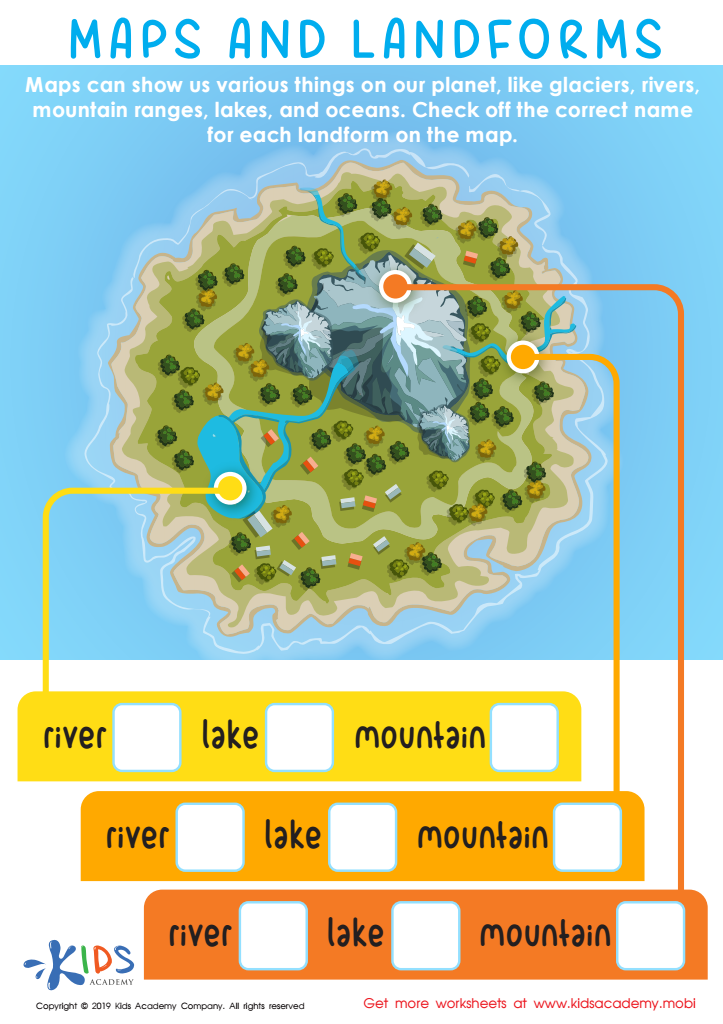
Maps and Landforms Worksheet
 Assign to My Students



Map reading skills are a vital component of comprehensive learning for children ages 5-8, serving as foundational tools that foster spatial awareness, critical thinking, and problem-solving skills. By introducing these concepts early, parents and teachers can help children develop a more profound understanding of the world around them, promoting a strong sense of environmental stewardship.
Learning to read maps encourages children to recognize and interpret symbols, grasp scale concepts, and develop directional awareness. These fundamental geography skills can ignite curiosity about diverse landscapes, cultures, and ecosystems, fostering an appreciation for global connectivity.
Furthermore, understanding maps is crucial for children to relate to their immediate environment and the broader world. For example, mapping local parks, schools, and neighborhoods enhances a child’s navigational competence and sense of belonging. Exposure to larger maps, like those of countries or continents, broadens their horizon, helping them comprehend concepts like climate zones, natural resources, and habitats.
Incorporating map reading into early education cultivates environmentally conscious individuals. As children grasp the impact of geographical features on human life, they become more aware of conservation issues. Ultimately, teaching map reading supports an informed, environmentally aware generation capable of making thoughtful decisions about our planet's future.







