Enhancing Counting Skills Reading Worksheets for Ages 6-7
3 filtered results
-
From - To
Help your young learner master the basics with our "Enhancing Counting Skills Reading Worksheets" designed specifically for ages 6-7. These engaging and educational worksheets combine counting practice with captivating reading exercises to boost your child’s numeracy and literacy skills simultaneously. Whether counting animals in a story or tallying objects in a fun illustration, these activities ensure learning remains dynamic and enjoyable. Foster confidence and proficient counting abilities with tailored exercises that allow your child to learn at their own pace. Visit our website now to download and instantly begin this exciting educational adventure with your youngster.
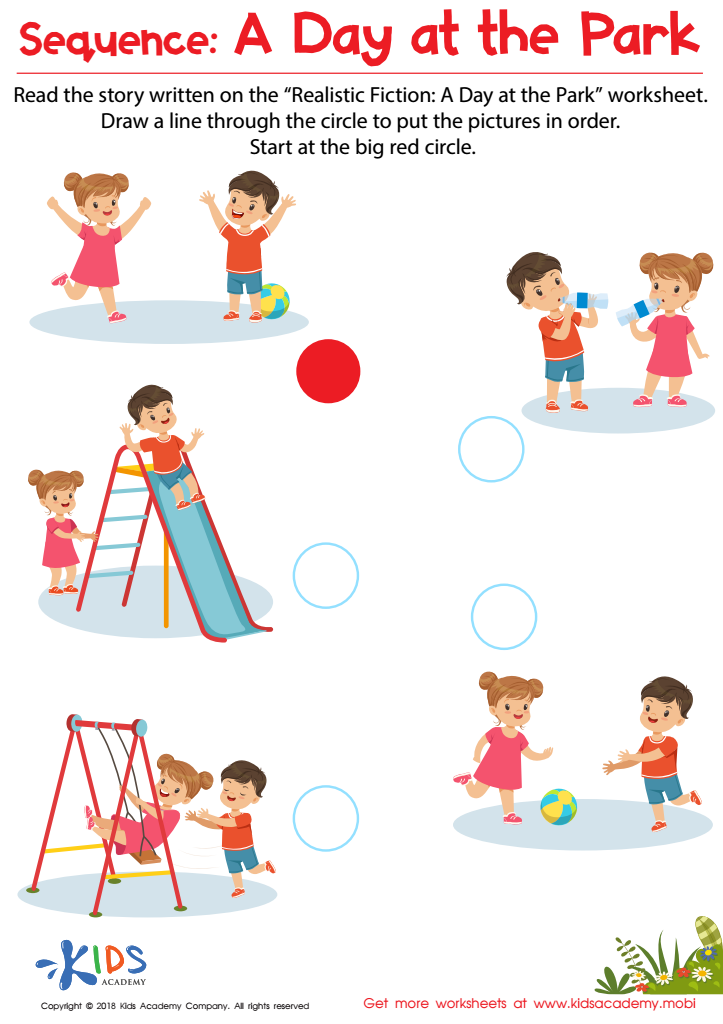
Sequence: A Day at the Park Worksheet
 Assign to My Students







Enhancing counting skills for children aged 6-7 is crucial as it lays the foundation for their overall mathematical development and academic success. At this age, children are transitioning from concrete to more abstract thinking. Mastery of counting serves as their first step toward grasping more complex mathematical concepts such as addition, subtraction, patterns, and number relationships.
Counting is also an essential skill for daily living, assisting children in activities ranging from simple tasks like sharing toys, to more involved activities like measuring ingredients in recipes or determining time and money. Proficiency in counting fosters confidence and reduces math anxiety, encouraging a positive attitude toward learning mathematics.
For parents and teachers, supporting this foundational skill means providing children with consistent and varied counting experiences. Engaging children in playful, practical, and real-life counting activities can enhance their comprehension and retention. It also allows for the application of what they have learned in meaningful contexts, bridging classroom learning with real-world situations. Early intervention in developing strong counting skills can identify and mitigate potential learning gaps or difficulties, ensuring that all children have the support they need to thrive.
In conclusion, parents and teachers should prioritize enhancing counting skills for this age group as it establishes essential numeracy and problem-solving skills pivotal for future academic achievements and everyday tasks.








