Fine motor skills development Tracing Numbers Worksheets for Ages 6-8
3 filtered results
Difficulty Level
Grade
Age
-
From - To
Subject
Activity
Standards
Enhance your child's fine motor skills with our engaging Tracing Numbers Worksheets designed for ages 6-8. These worksheets promote hand-eye coordination and dexterity by encouraging kids to trace and write numbers. Perfect for encouraging independent practice, students will build confidence while mastering number formation. Our activities are crafted to provide a fun and interactive learning experience, transitioning from basic number recognition to more complex math concepts. Ideal for both classroom and home education, these printable worksheets support early numeracy and promote essential writing skills. Download now to help your child develop the fine motor skills needed for academic success!
Favorites
With answer key
Interactive
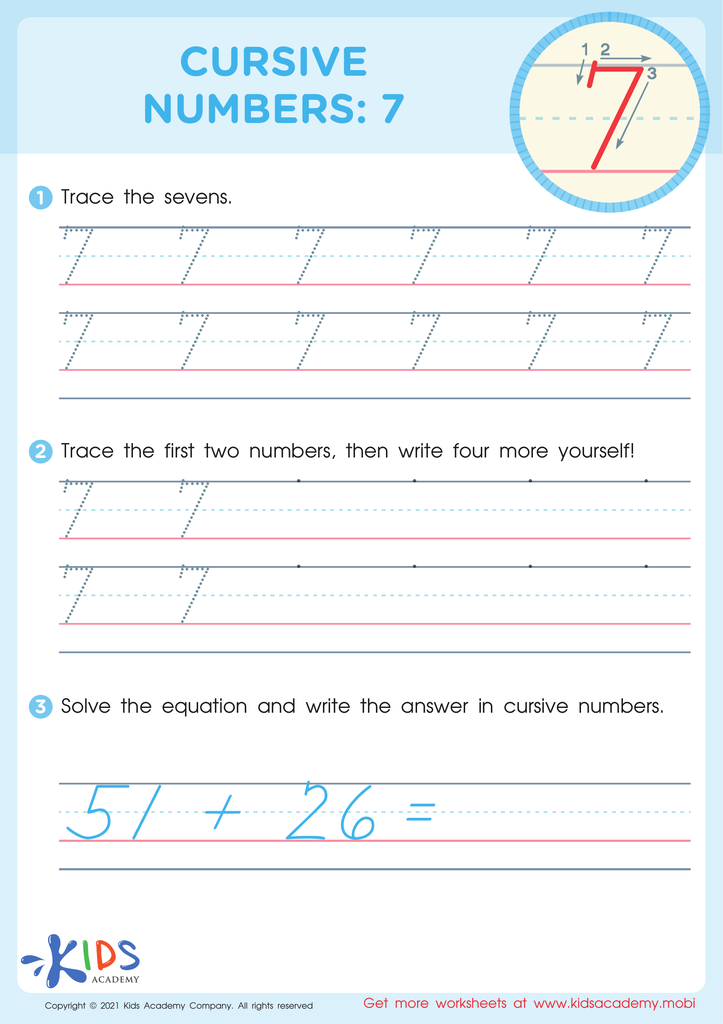
Cursive Numbers: 7 Worksheet
Kids learn best with engaging and easy-to-understand materials. This tracing worksheet is ideal for developing kids' writing skills, with two exercises to help them write the number 7. The first involves tracing the 6s provided and the second asking them to write four cursive 7s independently.
Cursive Numbers: 7 Worksheet
Worksheet
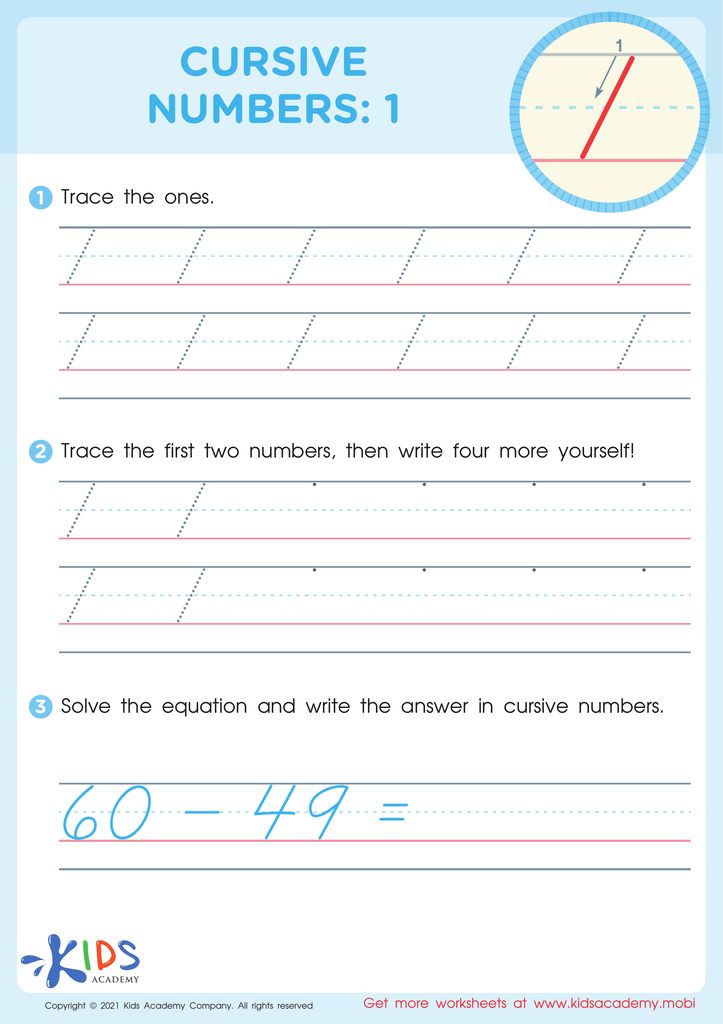
Cursive Numbers: 1 Worksheet
Math and handwriting are connected! Try these traceable worksheets to help your children learn cursive numbers. The tracing lines make it easy to follow, plus there's a simple subtraction exercise at the bottom for them to try. This is perfect for kids who struggle with handwriting and gives them a fun way to practice.
Cursive Numbers: 1 Worksheet
Worksheet
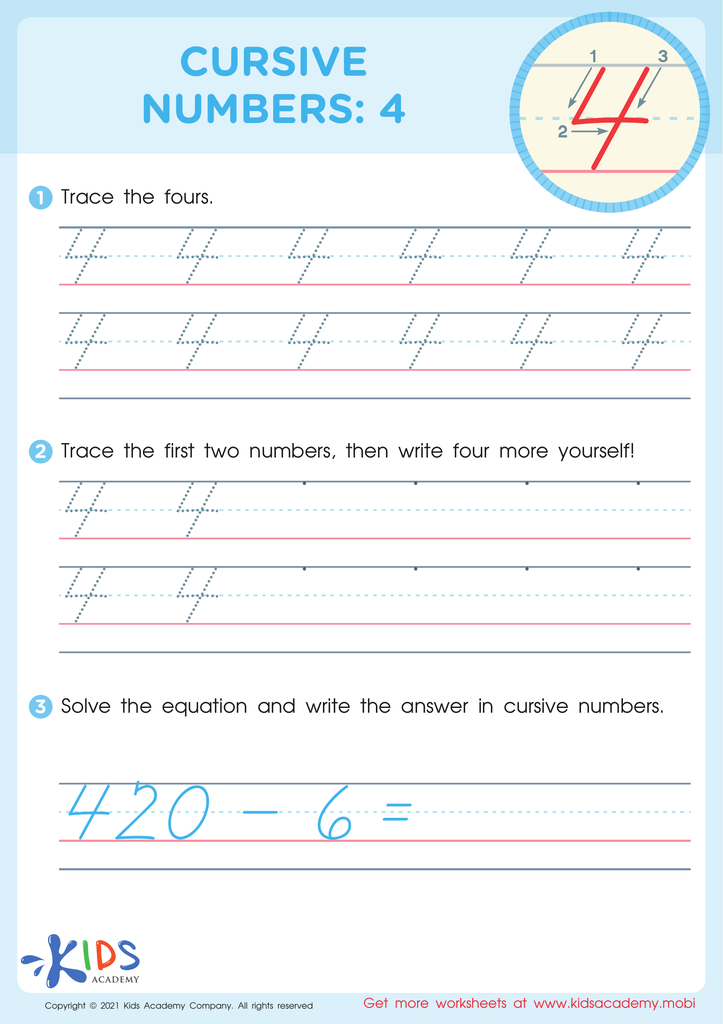
Cursive Numbers: 4 Worksheet
Math is challenging, and teaching cursive alongside it can be overwhelming. Make lessons enjoyable and your child will be more likely to stay engaged. Utilize worksheets to practice tracing the number 4 in cursive. With regular practice, your child can learn to write the number on their own.
Cursive Numbers: 4 Worksheet
Worksheet
Join Kids Academy for Free
Who is primarily going to use this learning content?








Fine motor skills are crucial for children's overall development, especially during the ages of 6 to 8 when they are refining their coordination and control. Tracing numbers is an essential activity that helps enhance these skills. At this age, children are transitioning from basic motions to more precise movements, making it important for them to master fine motor tasks, such as those involved in writing.
When children trace numbers, they practice holding writing instruments correctly, which improves grip strength and hand-eye coordination. This foundational skill not only contributes to better handwriting but also plays a significant role in everyday tasks, such as tying shoelaces, using utensils, and engaging in arts and crafts.
Moreover, tracing numbers can boost cognitive development. It allows children to visually familiarize themselves with numeric shapes, enhancing their number recognition and early math skills. As they trace, they also learn sequential thinking, which is critical for understanding more complex mathematical concepts later on.
When parents and teachers prioritize fine motor skills development through activities like tracing numbers, they empower children to build confidence in their abilities, facilitating a smooth transition into more advanced academic challenges. This investment in skills not only prepares them for academic success but also fosters independence and self-efficacy.