Map reading skills Science Worksheets for Ages 6-8
1 filtered results
-
From - To
Boost your child's learning journey with our engaging Map Reading Skills Science Worksheets designed for ages 6-8. These interactive worksheets are perfect for developing essential map skills, helping children understand spatial relationships, and enhancing their ability to read various maps. With age-appropriate activities that combine fun and education, kids will explore concepts like symbols, directions, and distance estimation through captivating exercises. Our worksheets encourage curiosity and critical thinking, making map skills accessible and enjoyable. Perfect for home or classroom use, these resources lay a solid foundation for geography and science literacy. Download now and watch your child's confidence soar!
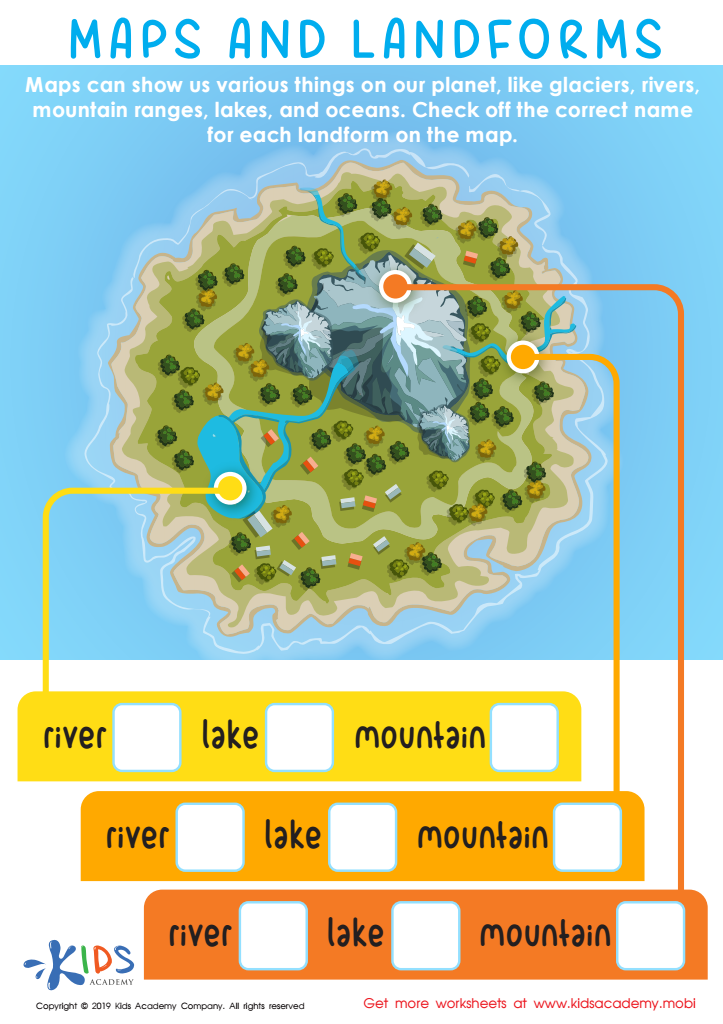
Maps and Landforms Worksheet
 Assign to My Students





Map reading skills are essential for children aged 6-8 as they contribute to fundamental cognitive and spatial reasoning development. Parents and teachers should care about fostering these skills because map reading enhances a child's ability to understand their environment, recognize patterns, and locate places, which is crucial for their overall learning.
At this developmental stage, children are eager to explore and gain independence, making map reading an engaging and practical skill. It supports not only their understanding of geography but also introduces elements of science—such as representing data visually and interpreting symbols, scales, and directions. These skills promote critical thinking and problem-solving, as children learn to navigate and understand various settings.
Moreover, being proficient at map reading allows children to build confidence as they venture out into their communities and beyond. It encourages curiosity and stimulates conversations about geography, culture, and physical science, integrating interdisciplinary learning. Early exposure to such skills fosters lifelong learning habits and appreciation for exploration, helping them become more informed global citizens.
Incorporating map reading into science and daily activities provides meaningful learning experiences, making education more relevant and exciting for young learners.







