Cognitive Development 2D Shapes Worksheets for Ages 6-9
9 filtered results
Difficulty Level
Grade
Age
-
From - To
Subject
Activity
Standards
Our "Cognitive Development 2D Shapes Worksheets for Ages 6-9" are designed to enhance critical thinking and spatial awareness in young learners. Perfect for children aged 6 to 9, these engaging worksheets feature a variety of activities focused on identifying, sorting, and understanding 2D shapes. Your child will learn key concepts such as symmetry, geometry, and problem-solving skills while having fun. These worksheets not only support cognitive growth but also promote a deeper understanding of math fundamentals, making learning interactive and enjoyable. Empower your child's cognitive development and mathematical abilities with our expertly designed 2D shapes worksheets.
Favorites
With answer key
Interactive
Match It up Worksheet
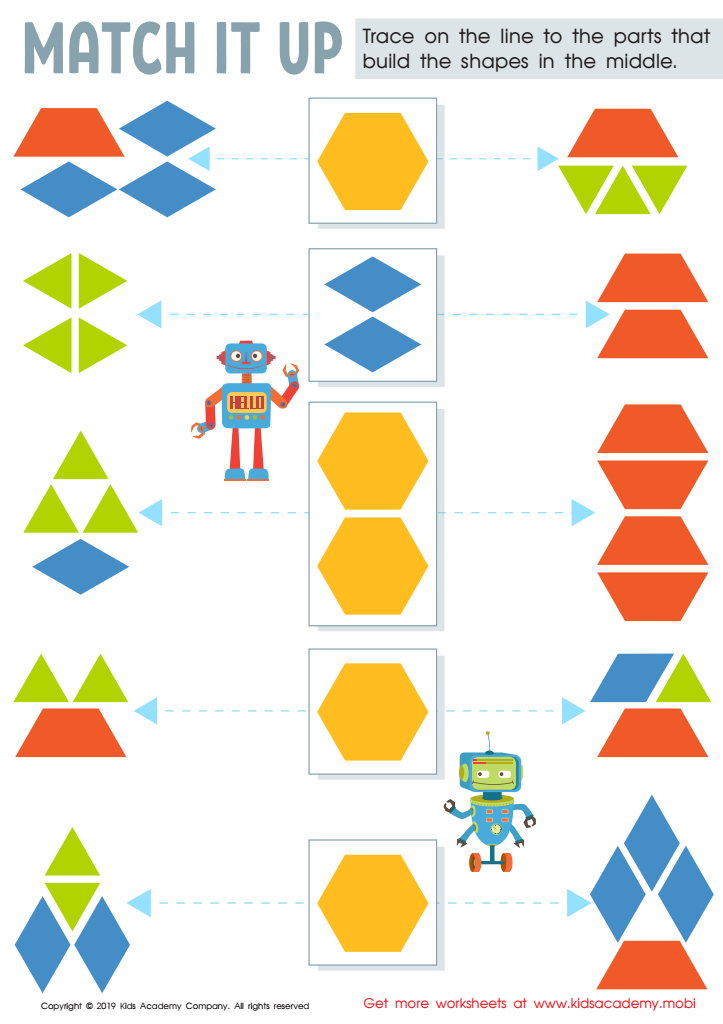
If your kids are into robots, they'll be thrilled to work on this worksheet. Ask them to name shapes they know, and help them draw and identify these shapes. Look at the shapes in the middle, and the sides. Finally, help your kids trace the lines to build the shapes in the middle.
 Assign to My Students
Match It up Worksheet
Worksheet


Twin Shapes Worksheet
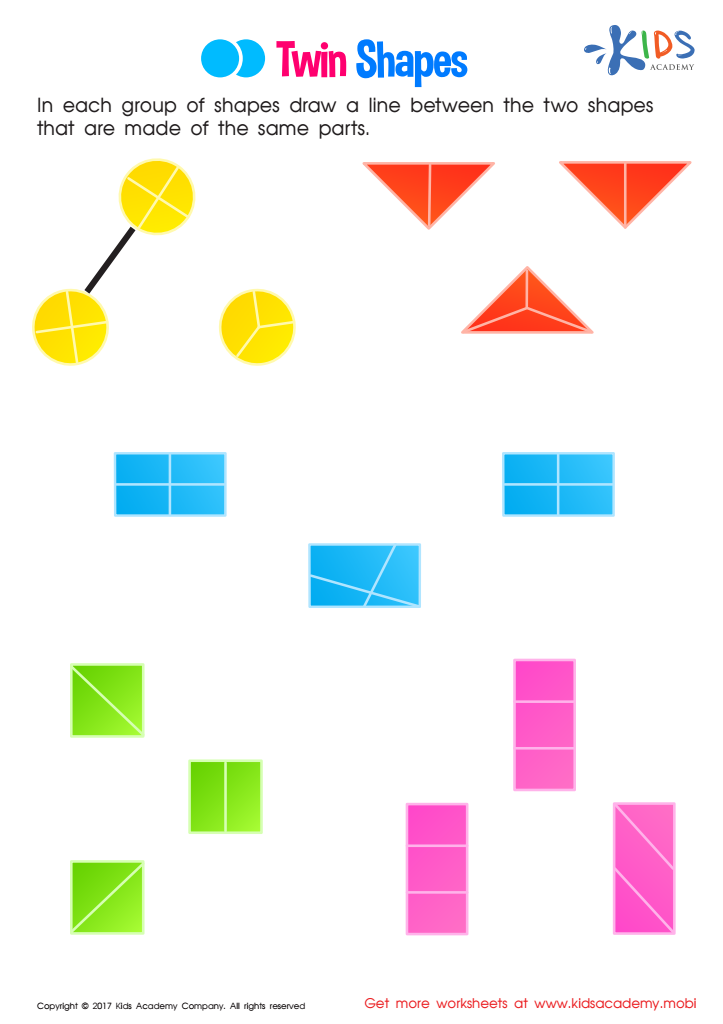
Your students' goal in this worksheet is to find the twin shapes: drawing a line between two shapes made of the same parts. Likely, the first shapes encountered were circles, triangles, rectangles and squares - examples of which are seen frequently in everyday life. Encourage them to apply what they know and work out which is the twin shape!
Twin Shapes Worksheet
Worksheet
Matching: Shapes and Colors Worksheet
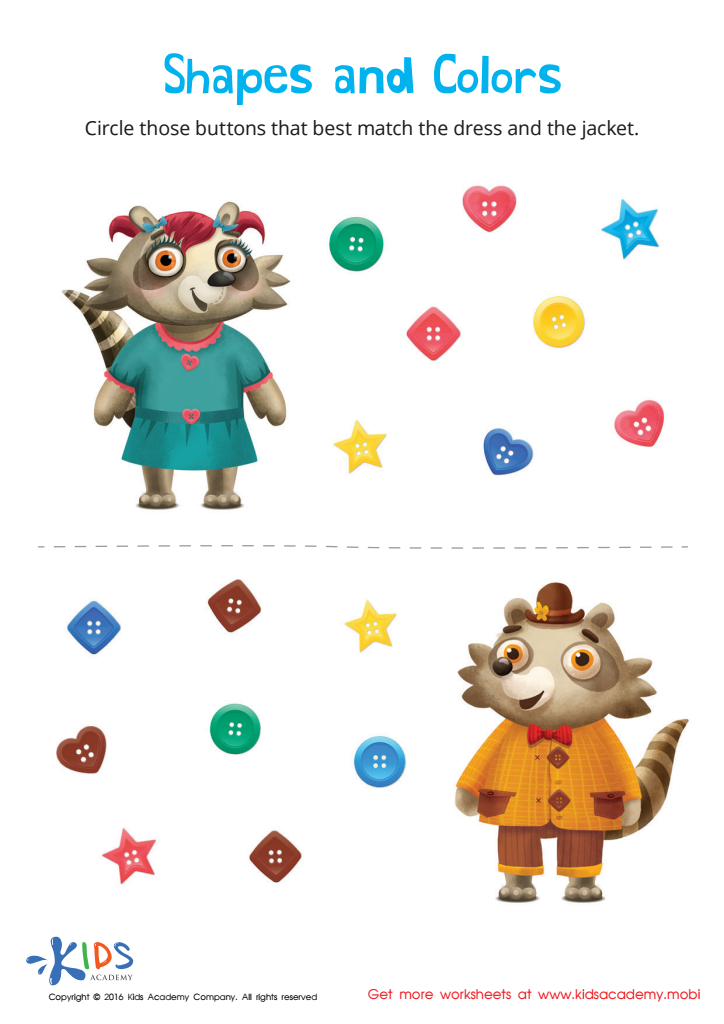
Help Mr. and Mrs. Raccoon find the right buttons to match their shirts! Kids will identify shapes and colors and learn to match them correctly.
Matching: Shapes and Colors Worksheet
Worksheet
Practicing to Draw Circles And Squares Printable
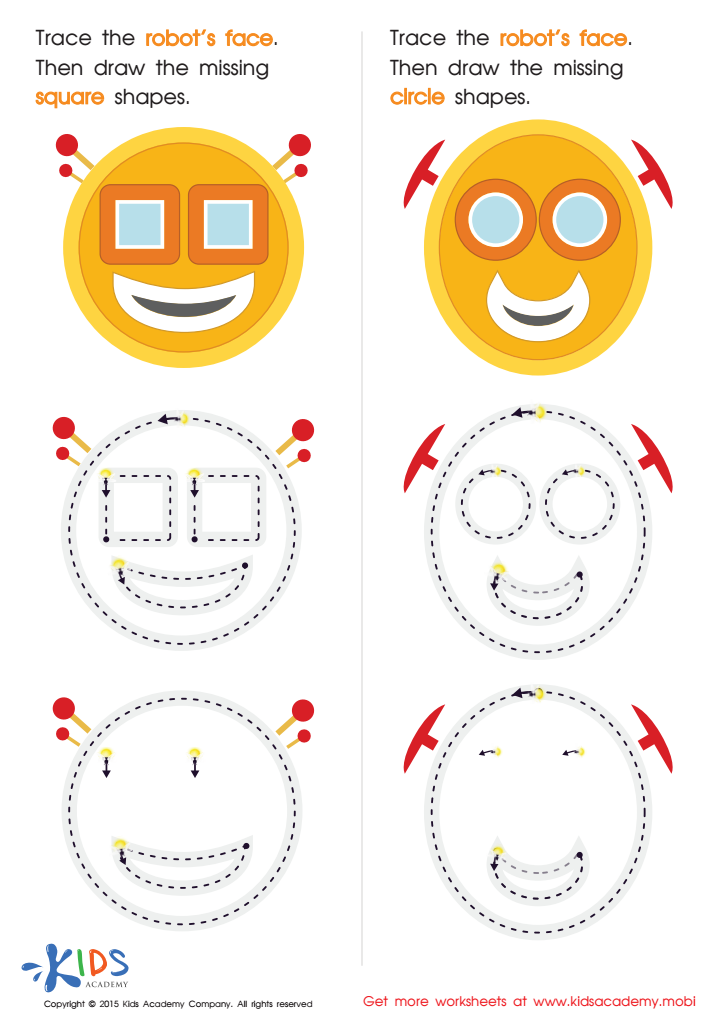
Download our free printable geometry worksheets to learn shapes with your preschoolers. Trace Robot's face, draw the square parts and round shapes, remember the names for each one. Get more materials for kids at Kids Academy and make learning fun with our free printable geometry worksheets.
Practicing to Draw Circles And Squares Printable
Worksheet
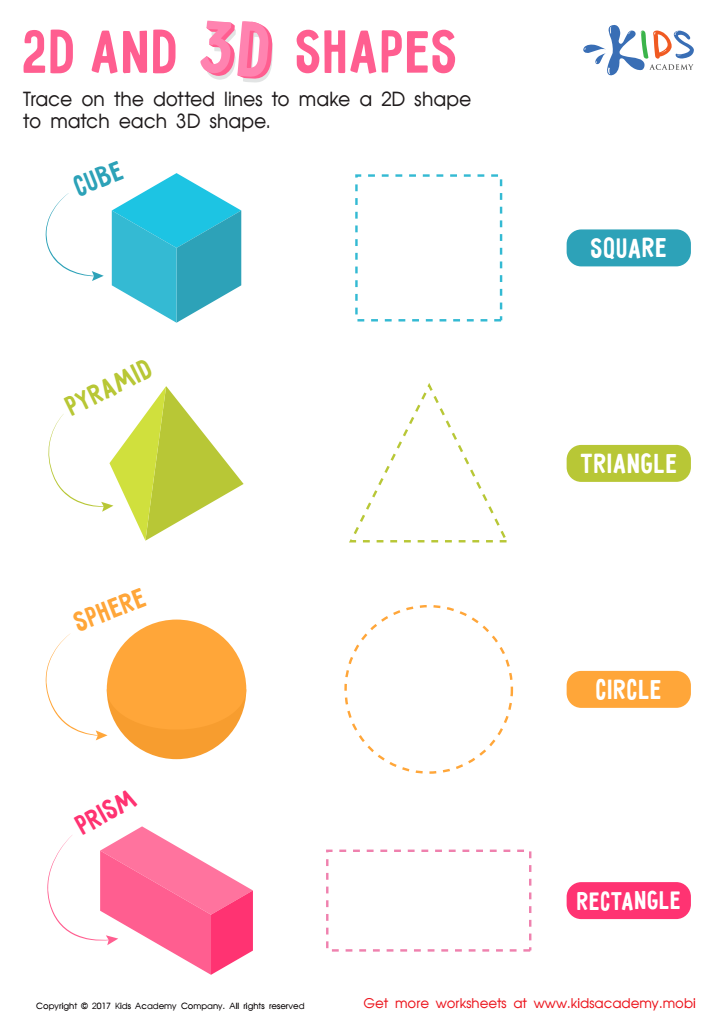
2D and 3D Shapes Worksheet
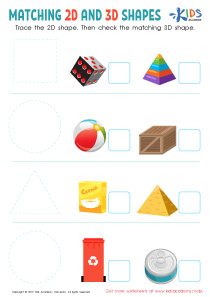
Introduce your child to 3D and 2D with this traceable worksheet. With dotted lines, help them trace and make a 2D shape for each 3D shape: square, triangle, rectangle, and circle. Show them there's more than one way to draw! You may have taken them to a 3D movie, or they've seen some fantastic 3D art. Now they can wonder no more.
2D and 3D Shapes Worksheet
Worksheet
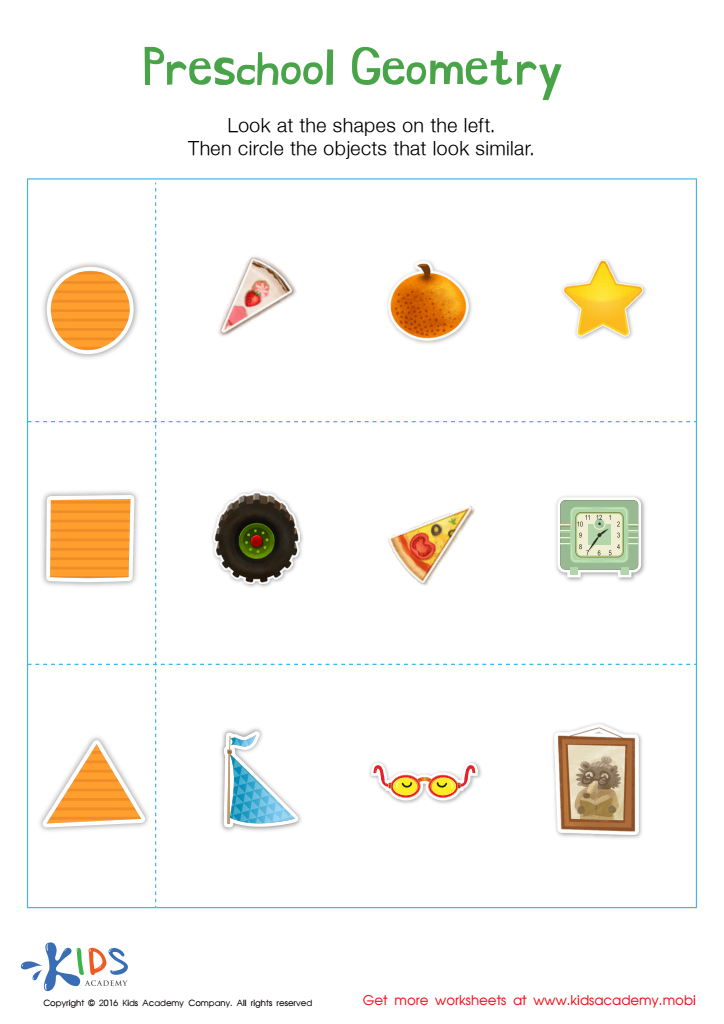
Preschool Geometry Match Up Worksheet
Teach your preschooler geometry using everyday objects. This printable worksheet helps them recognize, match, and follow directions like left and right. Start a conversation to extend their learning and they'll see how shapes appear in the world around them.
Preschool Geometry Match Up Worksheet
Worksheet
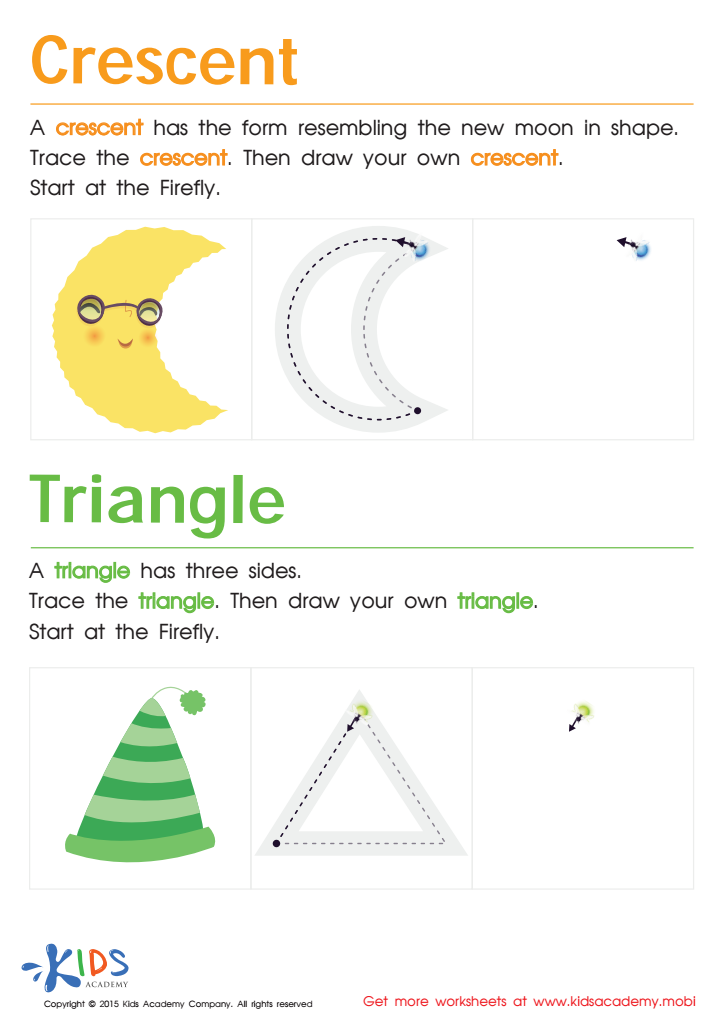
Learning to Draw Crescents And Triangles Worksheet
Help your kids draw a crescent and triangle with this free printable worksheet! Start by tracing a crescent in the form of the new moon, and then teach them that a triangle has three sides and looks like a hat. Find more geometry practice worksheets at Kids Academy!
Learning to Draw Crescents And Triangles Worksheet
Worksheet
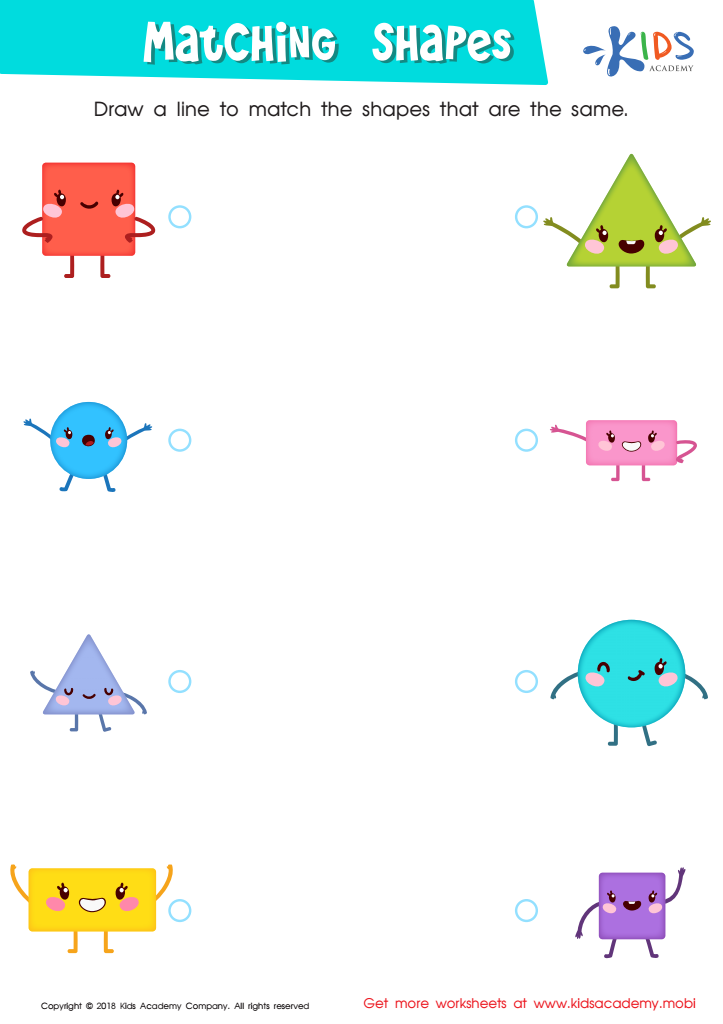
Matching Shapes Worksheet
Introduce your students to the 4 most common shapes: squares, triangles, rectangles and circles. When they progress, show them other shapes like rhombuses and parallelograms. Use this matching shapes worksheet to help them match two identical shapes. Print out the worksheet and instruct them to draw lines connecting them.
Matching Shapes Worksheet
Worksheet

Shapes Worksheet
This fun worksheet will challenge your child to recognize tricky patterns, sort through similar ones, and create strategies to get the right answer. It'll also help them to strengthen problem-solving skills and build confidence. With more challenging tasks, your child will be ready to tackle higher level math and sequencing skills.
Shapes Worksheet
Worksheet
Join Kids Academy for Free
Who is primarily going to use this learning content?








Caring about cognitive development and the understanding of 2D shapes for children aged 6-9 is essential for multiple reasons. At this developmental stage, children are rapidly enhancing their cognitive abilities, which includes spatial awareness, problem-solving skills, and logical reasoning. Introducing 2D shapes plays a crucial role in nurturing these essential skills.
Understanding 2D shapes helps children recognize and classify objects based on their geometric properties. This aids in developing their spatial awareness, allowing them to better navigate and comprehend the space around them. This cognitive skill is not only fundamental for geometry, but also for understanding other subjects such as science, technology, engineering, and math (STEM).
Furthermore, learning about shapes boosts children’s problem-solving and critical thinking skills. When children identify, compare, and analyze the attributes of various shapes, they enhance their ability to make predictions, draw conclusions, and solve problems effectively.
Learning shapes also supports reading and writing skills. Recognizing different shapes helps in letter recognition and understanding the contours and structures of numbers and letters, thereby aiding literacy and numeracy development.
Overall, focusing on cognitive development through 2D shapes lays down a strong foundation for future academic achievements and practical life skills, making it a critical aspect of early education.