
Number Recognition Counting Worksheets for Ages 7-8
4 filtered results
Difficulty Level
Grade
Age
-
From - To
Subject
Activity
Standards
Explore our "Number Recognition Counting Worksheets for Ages 7-8" and boost your child’s math skills! These engaging worksheets are designed to help young learners confidently recognize and count numbers. Tailored for kids aged 7-8, our activities feature fun exercises that enhance learning and keep students interested. From colorful illustrations to interactive tasks, each worksheet provides an enjoyable experience, ensuring that counting becomes second nature. Strengthen your child’s foundation in mathematics with diverse and effective practice that transforms learning into a delightful adventure. Download and start practicing today to support your child’s journey to numerical proficiency!
Favorites
With answer key
Interactive
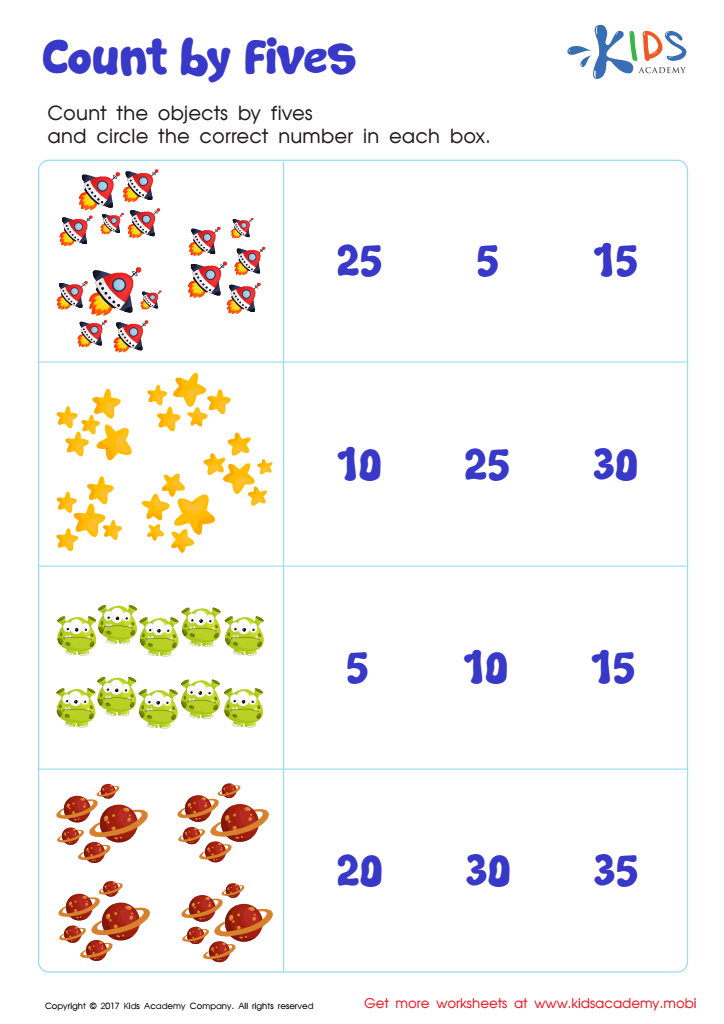
Skip Counting by 5s: Space Math Printable
This worksheet will provide your child with fun and practice counting by 5's. It'll help them visually count numbers, use problem solving skills and make connections between individual and groups of numbers. Counting money and various math concepts will become easier with this invaluable skill. Blast off with this fun and educational worksheet featuring space graphics.
Skip Counting by 5s: Space Math Printable
Worksheet


Count by 2's: Trains Worksheet
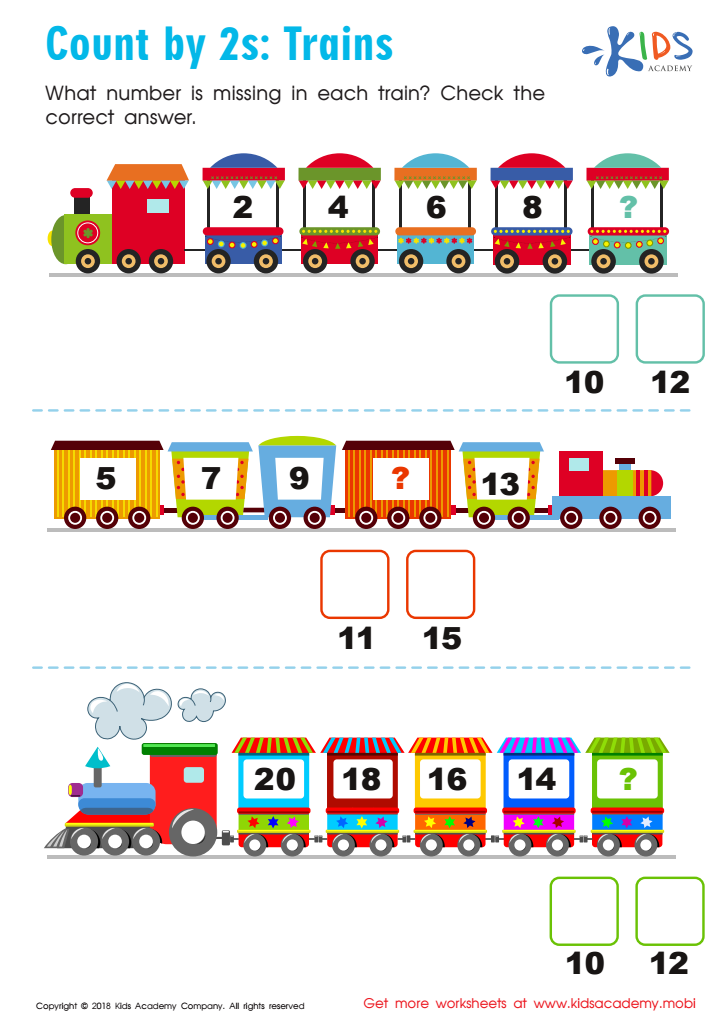
Teaching your kids quick computations? Get them skip-counting by 2s! They'll love filling in the colors of the train while counting, and it will help with 'counting up' or backward on paper or in their heads - essential for quick computations later.
Count by 2's: Trains Worksheet
Worksheet
Magic Numbers Worksheet
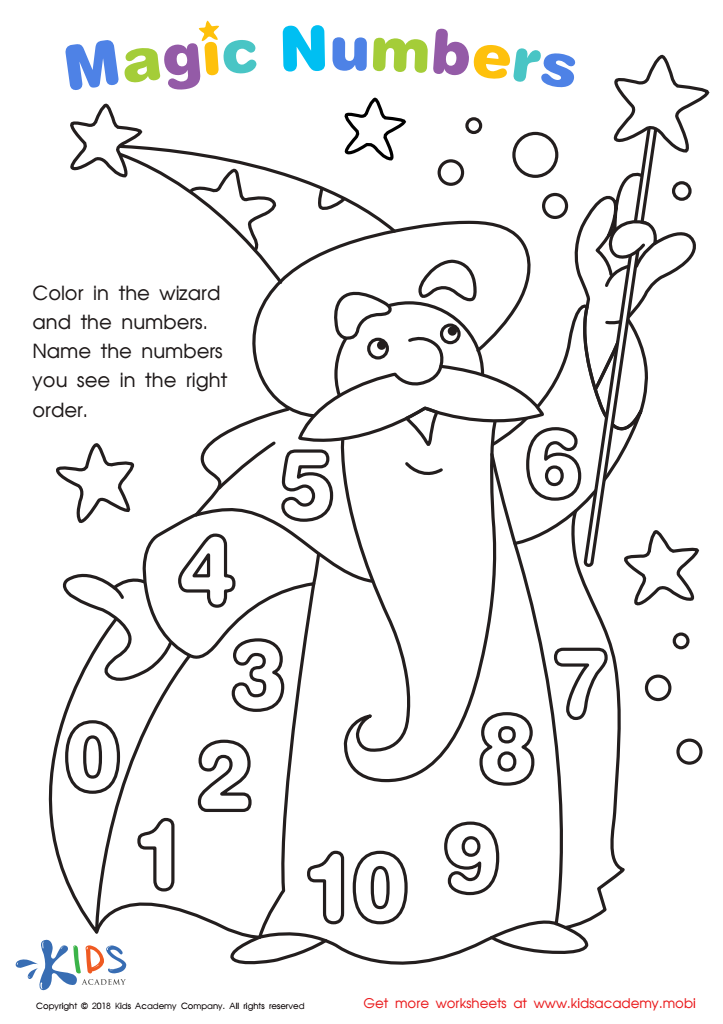
Does your child have an interest in magic? Here's something they'll love - a coloring sheet featuring a wizard! Ask them to name the numbers from smallest to highest, then let them pick colors to color in the wizard and the numbers. It's sure to excite them!
Download (PDF)
 Assign to My Students
Assign to My Students
Magic Numbers Worksheet
Worksheet
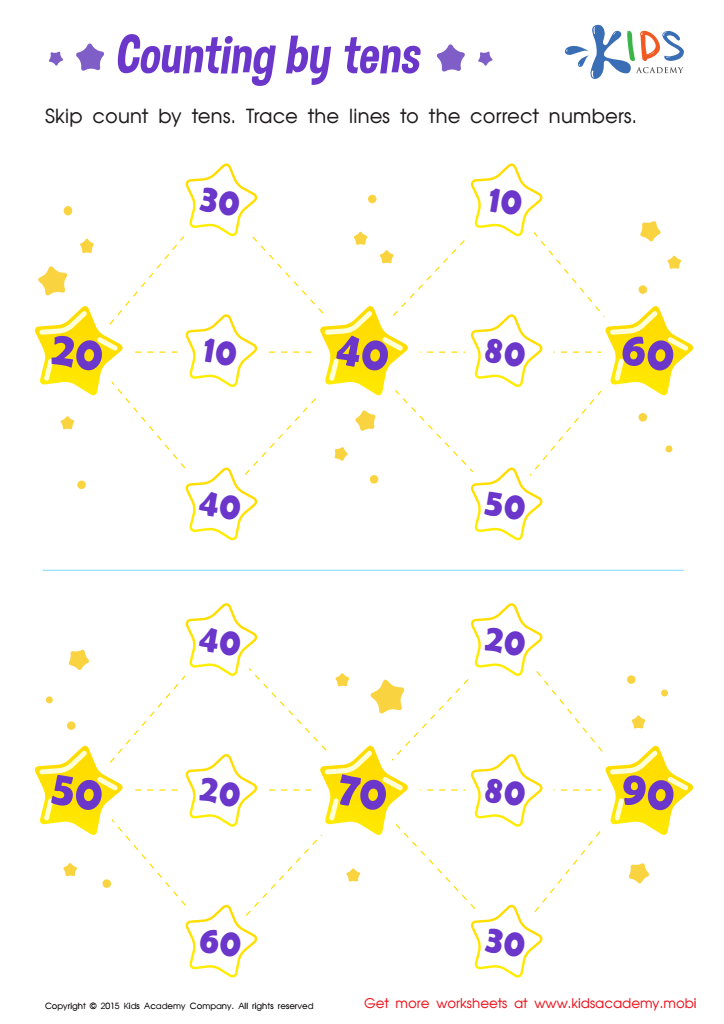
Learn Dozens: Counting by Tens Printable
Kindergartners need to learn skip counting - counting in number groups - to increase number sense and be ready for more advanced math. Our kindergarten worksheet featuring a starry trip to outer space will help your child practice this valuable skill. Your child will choose correct answers to trace the lines to the stars, building fluency in skip counting. They'll also strengthen problem solving and see the pattern it creates. Get your little learner to the next level with this skip counting worksheet!
Learn Dozens: Counting by Tens Printable
Worksheet
Join Kids Academy for Free
Who is primarily going to use this learning content?








Number recognition and counting for children aged 7-8 are essential foundations for their mathematical development and overall cognitive growth. As children transition from basic counting to more complex arithmetic, strong number recognition ensures they can efficiently process numbers in various forms, such as written digits, words, and quantities. This skill is crucial as it permeates nearly every aspect of daily life and education.
Effective number recognition aids children in understanding place value, which is fundamental to performing addition, subtraction, and even early multiplication and division. When children can identify and distinguish numerals easily, they are more likely to develop confidence in their mathematical abilities. This confidence can enhance their enthusiasm for learning and contribute positively to their overall academic performance.
Moreover, a solid grasp of counting and number recognition is linked to the development of logical thinking and problem-solving skills. These abilities not only support future learning in math and science but also promote critical thinking skills essential in everyday decision-making.
For parents and teachers, fostering these skills early provides a supportive learning environment. Utilizing engaging educational games, interactive number puzzles, and hands-on activities can make learning enjoyable and effective, setting the stage for a lifelong appreciation and understanding of mathematics.








