Map reading skills Science Worksheets for Ages 7-9
1 filtered results
-
From - To
Enhance your child's geographic knowledge with our engaging Map Reading Skills Science Worksheets, tailored specifically for ages 7-9. Designed to make learning fun, these worksheets help students grasp essential map-reading concepts, such as understanding symbols, directions, and scales. Perfect for 2nd and 3rd graders, the exercises include interactive activities that encourage critical thinking and problem-solving. Let your young explorers embark on educational adventures, boosting their confidence and skills. Ideal for classroom use or at-home learning, our worksheets equip children with the tools they need to navigate the world confidently. Start your journey in map reading today!
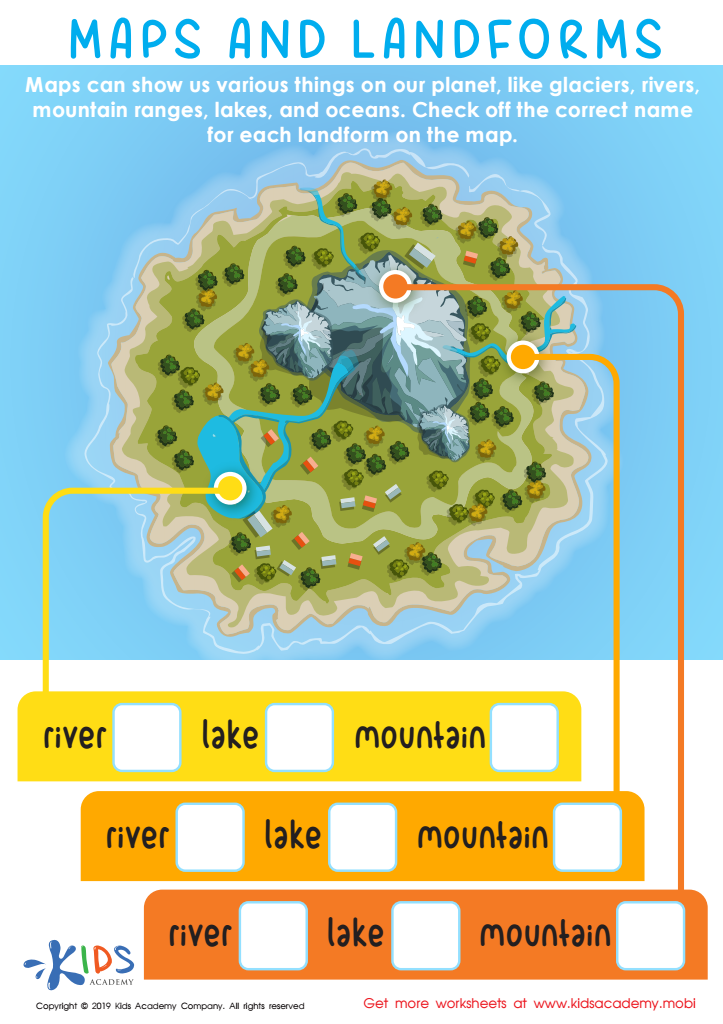
Maps and Landforms Worksheet
 Assign to My Students




Map reading skills are essential for children ages 7-9 as they lay the foundation for critical thinking, spatial awareness, and problem-solving abilities. At this young age, children are naturally curious and eager to explore their surroundings. Learning to read maps encourages them to make sense of the world around them, enhancing their cognitive development. This crucial skill enables them to understand and visualize spatial relationships, which are fundamental in subjects like mathematics and science.
Moreover, map reading promotes practical life skills such as directionality—understanding left, right, north, south—which are invaluable for everyday navigation and later academic pursuits. It also cultivates global awareness and cultural knowledge. When children learn about different places and landmarks, they develop a broader perspective of the world, fostering a sense of curiosity and empathy for diverse cultures and environments.
For teachers and parents, encouraging map reading differentiates the learning experience by integrating geography with storytelling, adventure, and real-life context. It empowers children to become independent learners and confident explorers. This holistic development is invaluable, helping to build a strong educational foundation that benefits all areas of learning and personal growth. Prioritizing map reading is an investment in a child's future, equipping them with the skills to be thoughtful, informed, and resourceful individuals.







