Recognizing Patterns Math Worksheets for Ages 8-9
22 filtered results
-
From - To
Our "Recognizing Patterns Math Worksheets for Ages 8-9" offer engaging activities designed to enhance pattern recognition skills among young learners. These printable resources help children identify, analyze, and extend patterns through a variety of exercises that include numbers, shapes, and colors. Tailored specifically for 8 to 9-year-olds, these worksheets develop critical thinking and problem-solving abilities while making learning fun and interactive. Ideal for classroom and home use, they prepare kids for advanced math concepts by solidifying their foundational understanding of patterns. Unlock your child's mathematical potential with our expertly crafted pattern recognition worksheets. Explore more today!
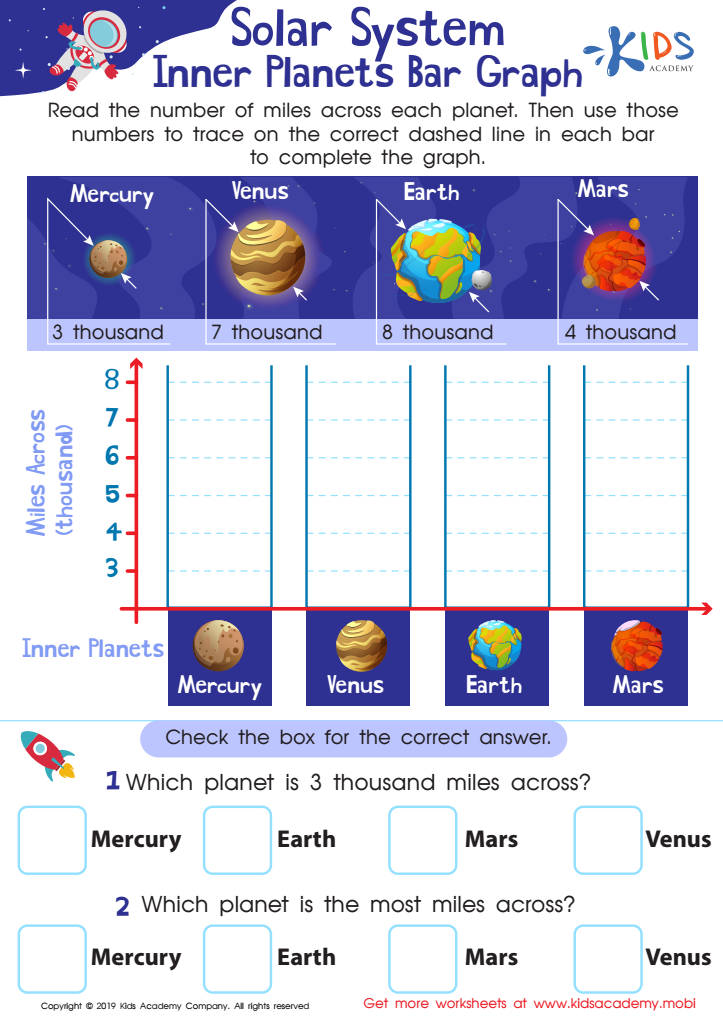
Planets Bar Graph Worksheet
 Assign to My Students



.jpg)




Recognizing patterns in math is crucial for children aged 8-9 because it forms the foundation for more advanced mathematical thinking and problem-solving skills. At this age, children are transitioning from basic arithmetic to more complex concepts. Understanding patterns helps them grasp ideas such as skip counting, multiplication, and problem-solving strategies by honing their observation and critical thinking skills.
When parents and teachers emphasize pattern recognition, they help kids see the underlying structure of mathematics, making complex problems seem approachable and manageable. Patterns also appear in multiple subject areas, so recognizing them can boost overall academic performance. For example, understanding geometric patterns can aid in understanding beginning concepts of geometry and algebraic thinking, making future coursework less daunting.
Moreover, recognizing patterns enhances cognitive development. The practice teaches children to make predictions, observe relationships and sequences, and understand the logic behind mathematical operations. These skills are invaluable not only for doing well in math but in everyday life as well, where pattern recognition can help with decision-making and analytical thinking. Thus, fostering this ability through engaging activities and games makes learning enjoyable and beneficial, setting children up for future success in academics and beyond.








