Comparing quantities Worksheets for 8-Year-Olds
9 filtered results
-
From - To
Explore our engaging "Comparing Quantities Worksheets for 8-Year-Olds," designed to enhance mathematical understanding in young learners! These worksheets offer a variety of fun activities that focus on comparing numbers, enabling students to develop their critical thinking and problem-solving skills. With colorful illustrations and age-appropriate exercises, children will enjoy mastering concepts such as greater than, less than, and equal to. Our resources support the development of foundational math skills in a playful manner, making learning enjoyable. Perfect for classroom use or home study, these worksheets provide an excellent way for 8-year-olds to build confidence in their mathematical abilities. Start comparing today!
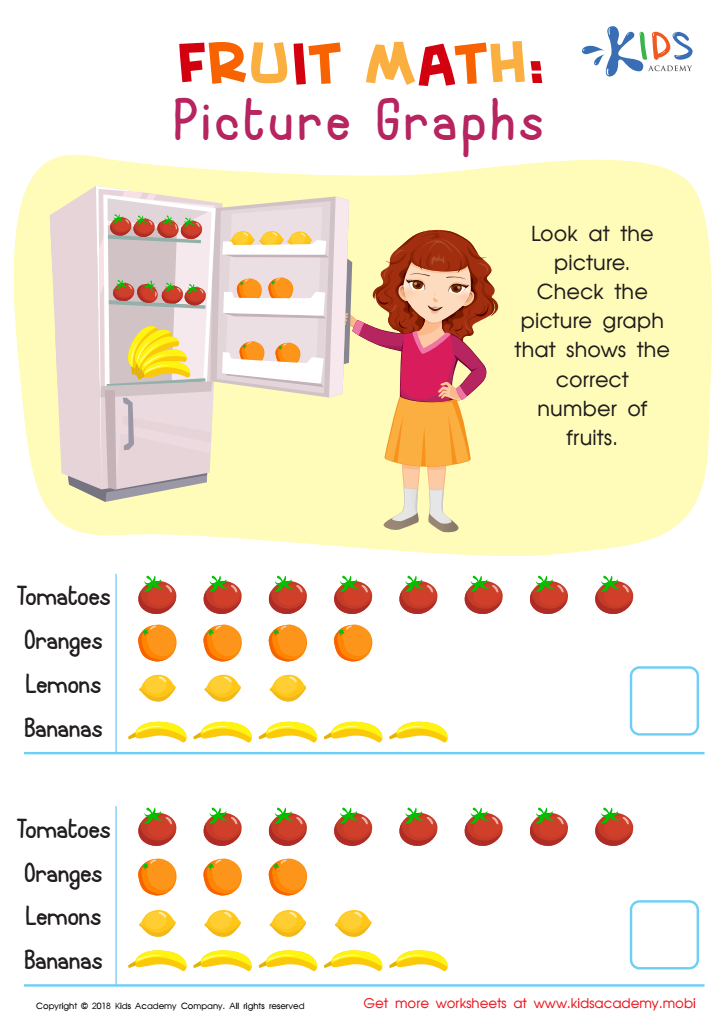
Fruit Math: Picture Graphs Worksheet
 Assign to My Students
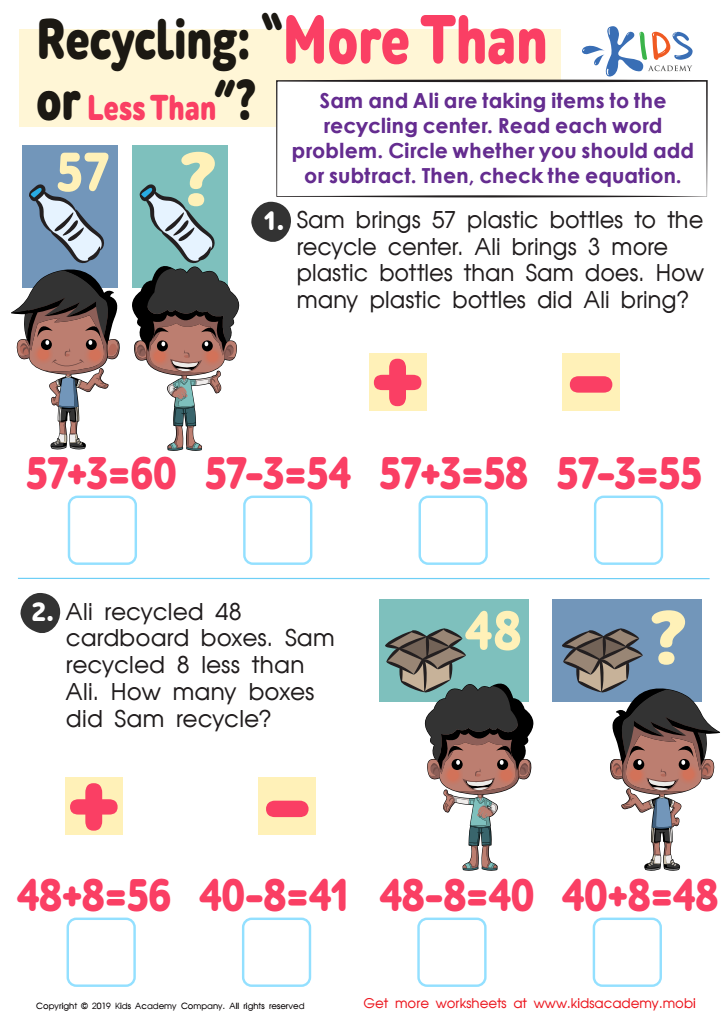
Recycling - More or Less Worksheet




Comparing quantities is a fundamental math skill that plays a crucial role in a child's overall development, particularly at around 8 years old. At this age, children are beginning to grasp abstract concepts and develop critical thinking abilities. Understanding how to compare quantities lays the groundwork for more complex mathematical ideas, such as addition, subtraction, fractions, and problem-solving.
By engaging in activities that inspire comparison, children start to comprehend relationships between numbers and values; for example, distinguishing between bigger and smaller, more and less, and equal and unequal. This skill enhances their logical reasoning abilities and encourages them to think scientifically about the world around them, engaging them in everyday situations, such as shopping or cooking, where they can apply math practically.
Moreover, understanding how to compare quantities fosters confidence in children’s abilities as they become more comfortable dealing with numbers. This can be pivotal in reducing math anxiety, helping them to perceive math as a fun and engaging activity rather than a daunting subject. Thus, by emphasizing the importance of comparing quantities, parents and teachers nurture not only mathematical proficiency but critical thinking, problem-solving skills, and a positive attitude towards learning.








