Understand fractions Addition Worksheets for 8-Year-Olds
20 filtered results
-
From - To
Welcome to our "Understand Fractions Addition Worksheets" designed specifically for 8-year-olds! These engaging worksheets help children grasp the concept of adding fractions with ease. Our activities feature colorful visuals and real-life scenarios, making learning fun and interactive. Kids will practice adding like and unlike fractions, enhancing their comprehension through step-by-step guidance and illustrative examples. Perfect for classroom use or at-home learning, these worksheets encourage critical thinking and boost confidence in math skills. Whether you're a parent, teacher, or tutor, our resources are tailored to support young learners on their journey to mastering fraction addition. Get started today!
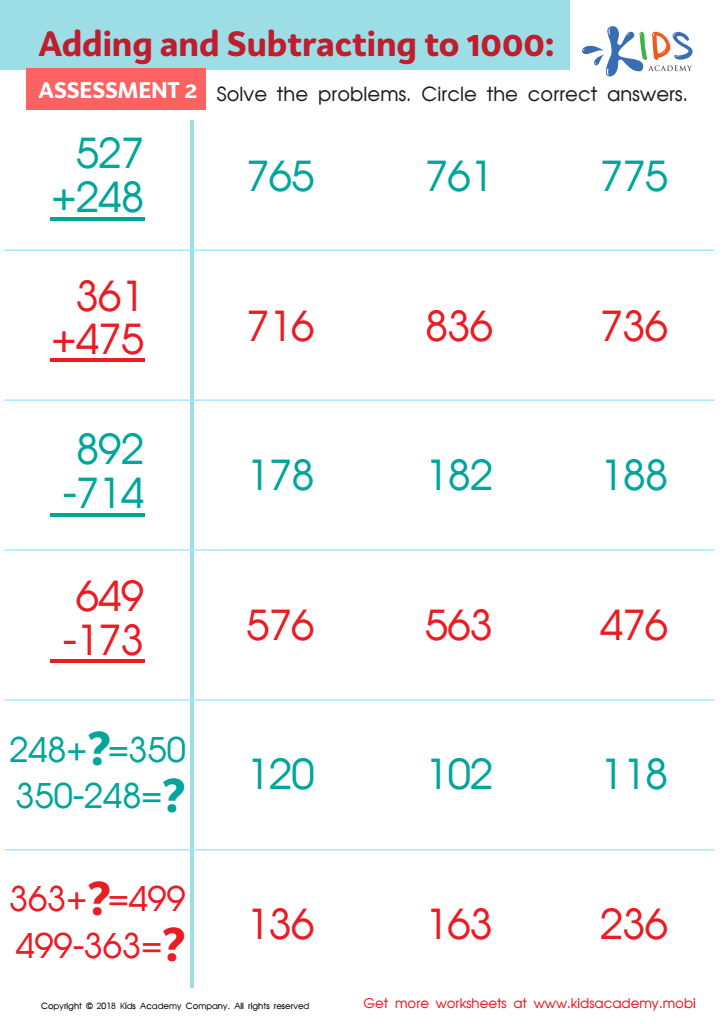
Adding and Subtracting to 1 Worksheet: Assessment 2
 Assign to My Students








Understanding fractions addition is vital for 8-year-olds as it lays the foundation for their mathematical development. At this age, children begin to encounter more complex mathematical concepts, and a strong grasp of fractions is essential for success in future math topics such as ratios, percentages, and algebra.
Parents and teachers should care about this subject because it enhances critical thinking and problem-solving skills. When children learn to add fractions, they engage in reasoning and make connections between numbers and real-life contexts, such as cooking or measuring. These experiences promote a deeper understanding of mathematics and improve overall academic performance.
Moreover, mastering fraction addition boosts children's confidence in their mathematical abilities. Children who struggle with these concepts may develop a negative attitude toward math, which can hinder their learning. Encouraging a positive learning environment where mistakes are viewed as opportunities for growth fosters resilience and a love for learning.
Additionally, fluency in adding fractions contributes to better performance in standardized tests, which are important for educational opportunities. Therefore, supporting 8-year-olds in understanding fractions is crucial for their long-term academic and personal success, making it a priority for both parents and teachers.








