Numbers up to 100 Worksheets for Ages 5-9 - Page 3
50 filtered results
-
From - To
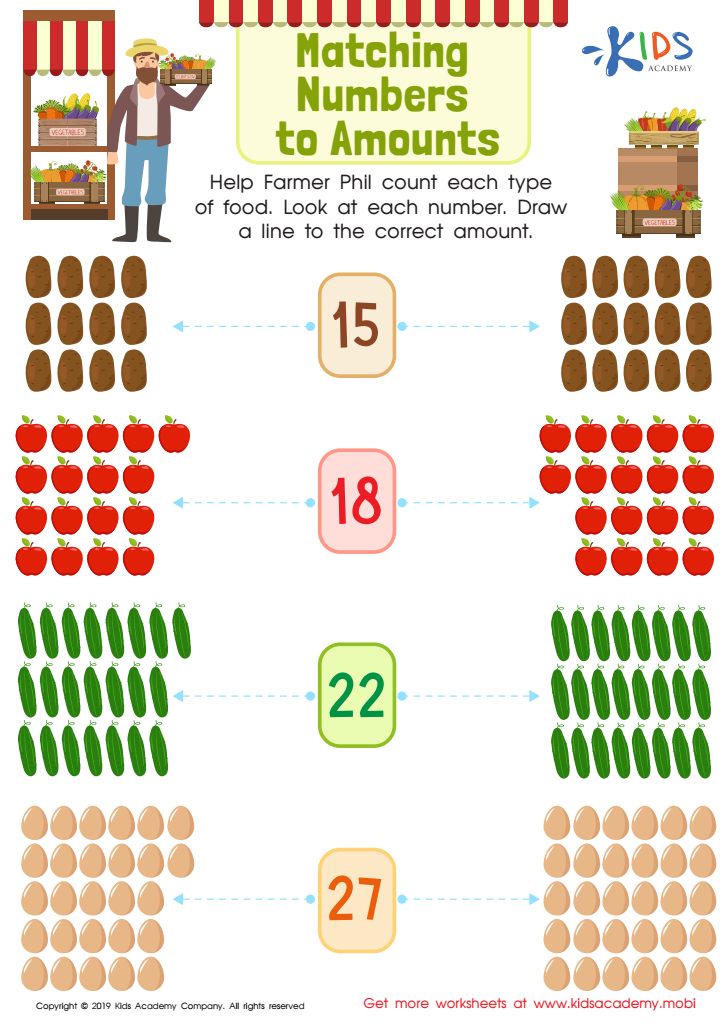
Matching Numbers to Amounts Worksheet
 Assign to My Students

Counting on the City Skyline: Dot-to-Dot Worksheet








Teaching numbers up to 100 to children ages 5-9 lays a crucial foundation for their future mathematical understanding. At this stage, grasping number concepts enhances cognitive development and problem-solving skills. Recognizing and working with numbers up to 100 allows children to develop essential arithmetic skills such as addition, subtraction, and basic place value understanding. These skills are fundamental not only in daily life activities like counting money or measuring ingredients but also in more advanced math topics they will encounter later.
Parents and teachers should care because early numeracy skills have long-term educational benefits. Studies show that children who master early mathematical concepts tend to perform better in other academic areas, including literacy, as math understanding supports logical thinking. Additionally, children who are confident in their math abilities are more likely to have a positive attitude toward the subject, reducing math anxiety.
Furthermore, learning numbers up to 100 helps children understand the sequence of numbers, which is critical for developing a sense of order and predictability. This process of learning can be fun and engaging, using games and hands-on activities to make the experience enjoyable. By prioritizing this knowledge, parents and teachers are helping build a strong mathematical foundation, setting children up for long-term academic success and everyday competence.








