
Normal Skip Counting Worksheets for Ages 4-8
11 filtered results
Difficulty Level
Grade
Age
-
From - To
Subject
Activity
Standards
Discover our engaging Normal Skip Counting Worksheets designed for children aged 4-8! These worksheets are perfect for helping young learners develop essential math skills through fun and interactive activities. With colorful illustrations and clear instructions, children will practice counting by twos, fives, and tens, enhancing their number recognition and sequence understanding. Our resources cater to different learning styles, making abstract concepts more accessible. Parents and educators can use these worksheets to track progress and reinforce classroom learning at home. Join the fun and watch your child’s confidence grow while mastering skip counting concepts essential for their math journey!
Favorites
With answer key
Interactive
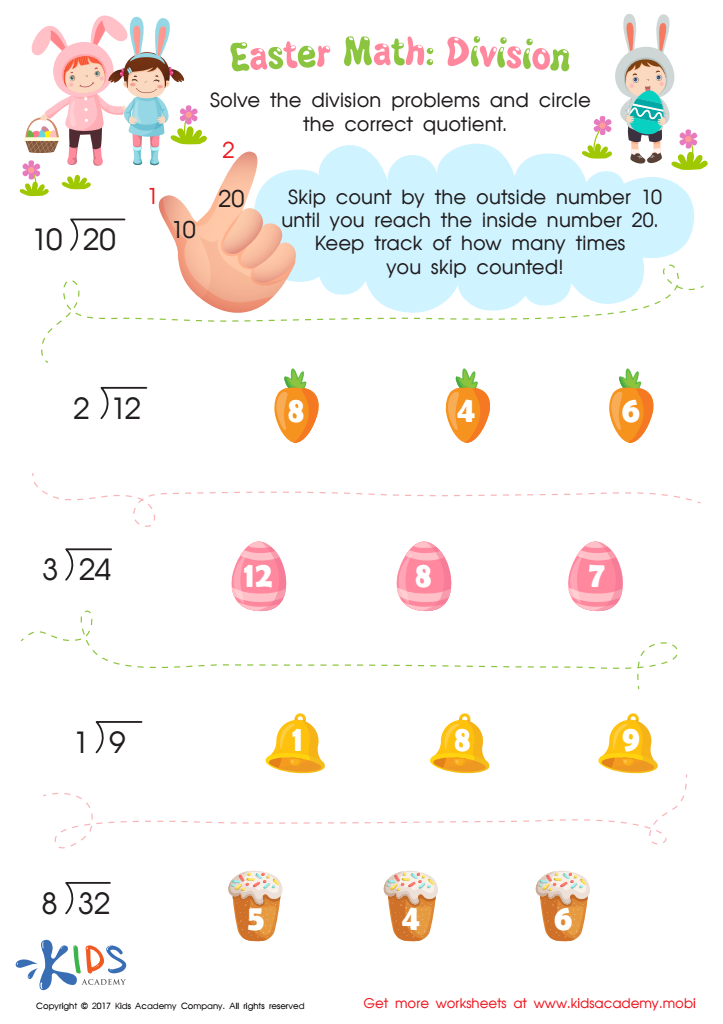
Division Worksheet
Try this Easter-themed PDF worksheet for grade 3: perfect for teaching division with a fun, new trick! It's full of bright, colorful pictures your child will love, and it's as easy as skip counting to solve the problems.
 Assign to My Students
Division Worksheet
Worksheet
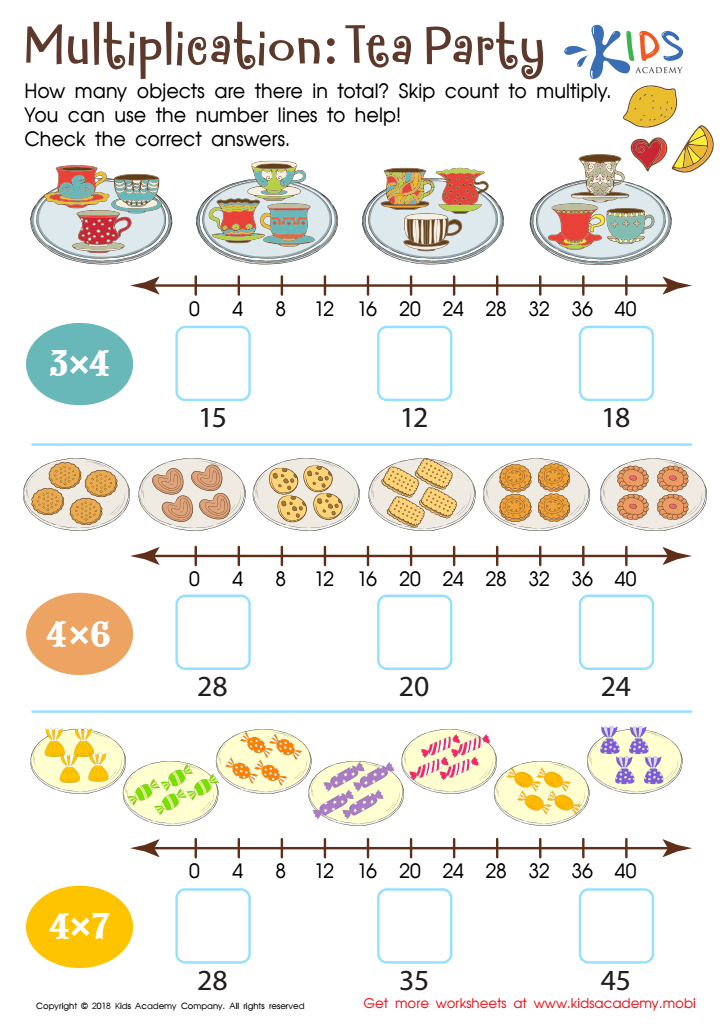
3rd Grade Math Worksheet Multiplication
Our 3rd-grade multiplication math worksheets are great fun! Kids practice using a number line and skip counting, and will feel like throwing a tea party after completing these! Perfect for honing in on multiplication skills.
3rd Grade Math Worksheet Multiplication
Worksheet
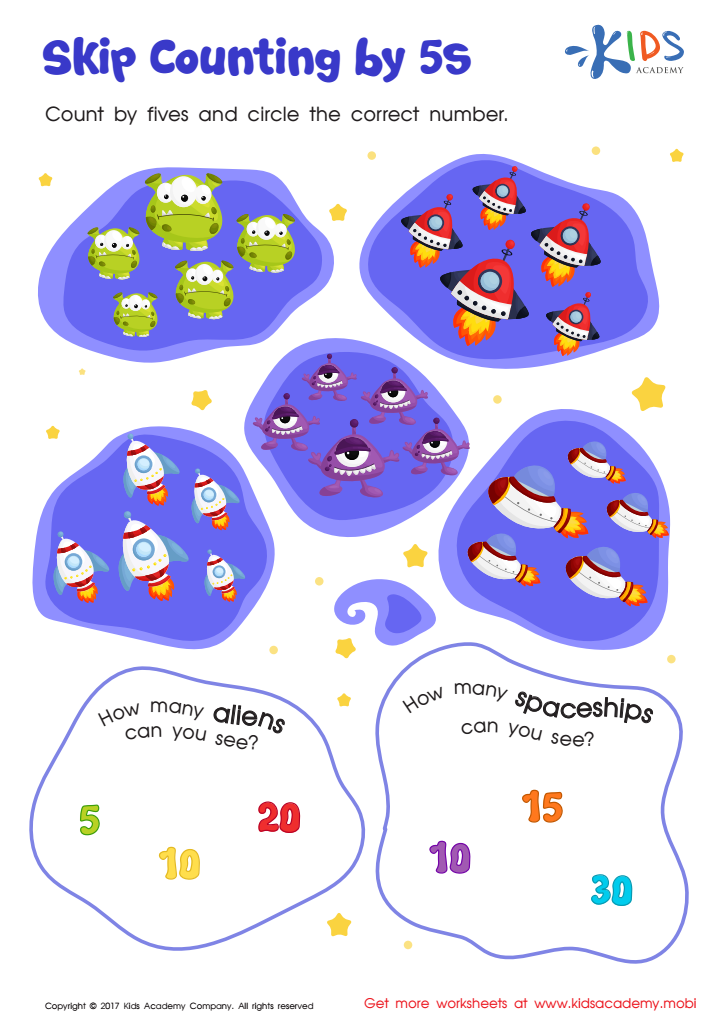
Skip Counting by 5s: Aliens and Spaceships Printable
Your child will love taking an intergalactic adventure as they practice skip counting by 5's with this worksheet! It'll help them identify and recognize large groups of numbers, categorize objects to count them, and prepare them for math concepts like multiplication. And with silly space graphics, they'll be motivated for more practice!
Skip Counting by 5s: Aliens and Spaceships Printable
Worksheet
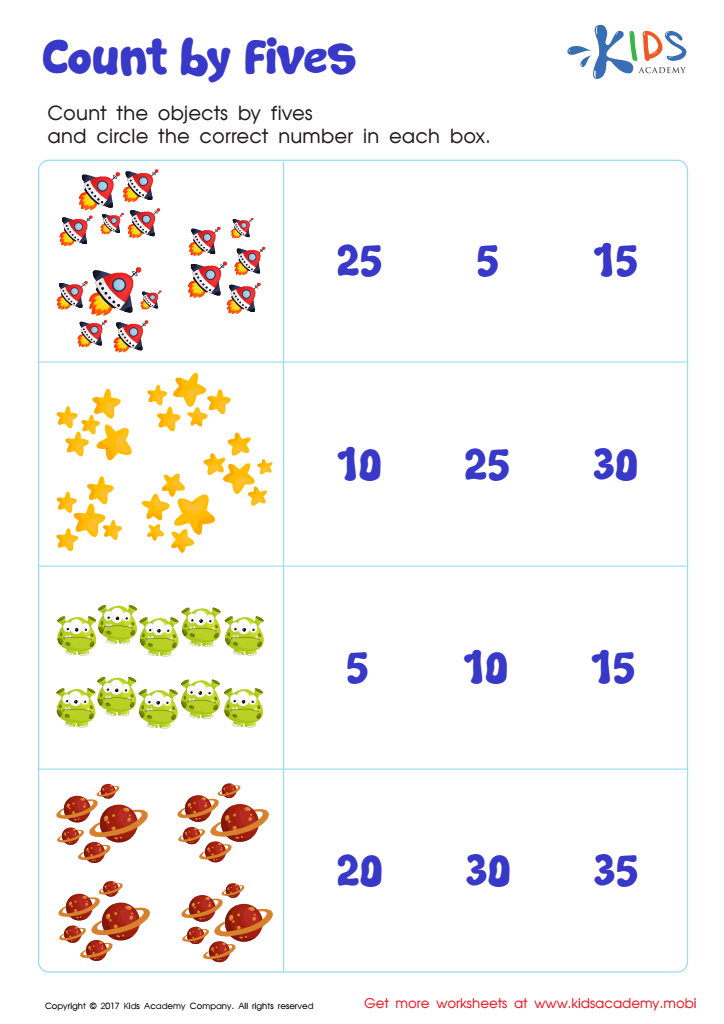
Skip Counting by 5s: Space Math Printable
This worksheet will provide your child with fun and practice counting by 5's. It'll help them visually count numbers, use problem solving skills and make connections between individual and groups of numbers. Counting money and various math concepts will become easier with this invaluable skill. Blast off with this fun and educational worksheet featuring space graphics.
Skip Counting by 5s: Space Math Printable
Worksheet
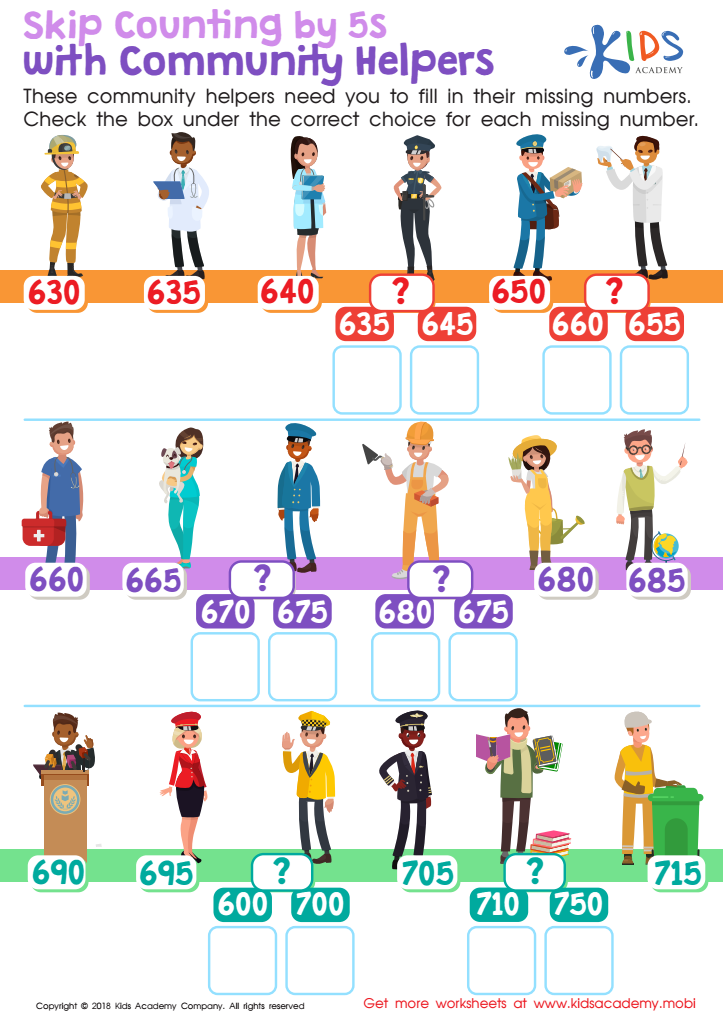
Skip Counting by 5s With Community Helpers Worksheet
This free worksheet combines social studies with math! Kids will practice counting by 5s, rounding numbers and honing their computation skills while also familiarizing themselves with community helpers. Develop your child's number sense and strengthen their math skills - all through a fun and interactive activity.
Skip Counting by 5s With Community Helpers Worksheet
Worksheet
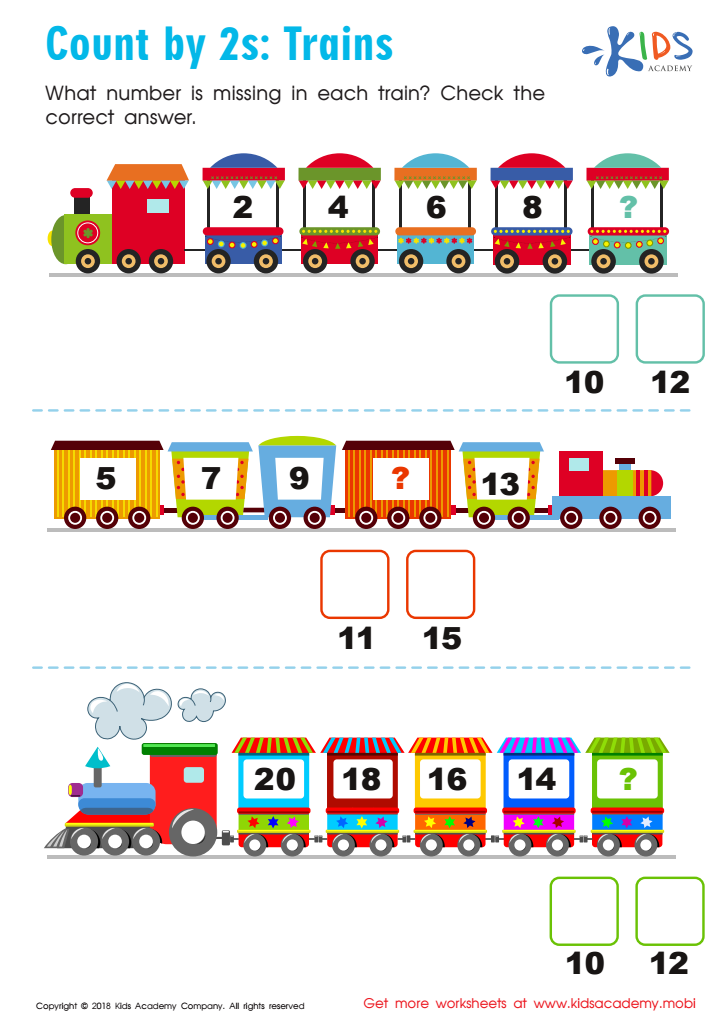
Count by 2's: Trains Worksheet
Teaching your kids quick computations? Get them skip-counting by 2s! They'll love filling in the colors of the train while counting, and it will help with 'counting up' or backward on paper or in their heads - essential for quick computations later.
Count by 2's: Trains Worksheet
Worksheet
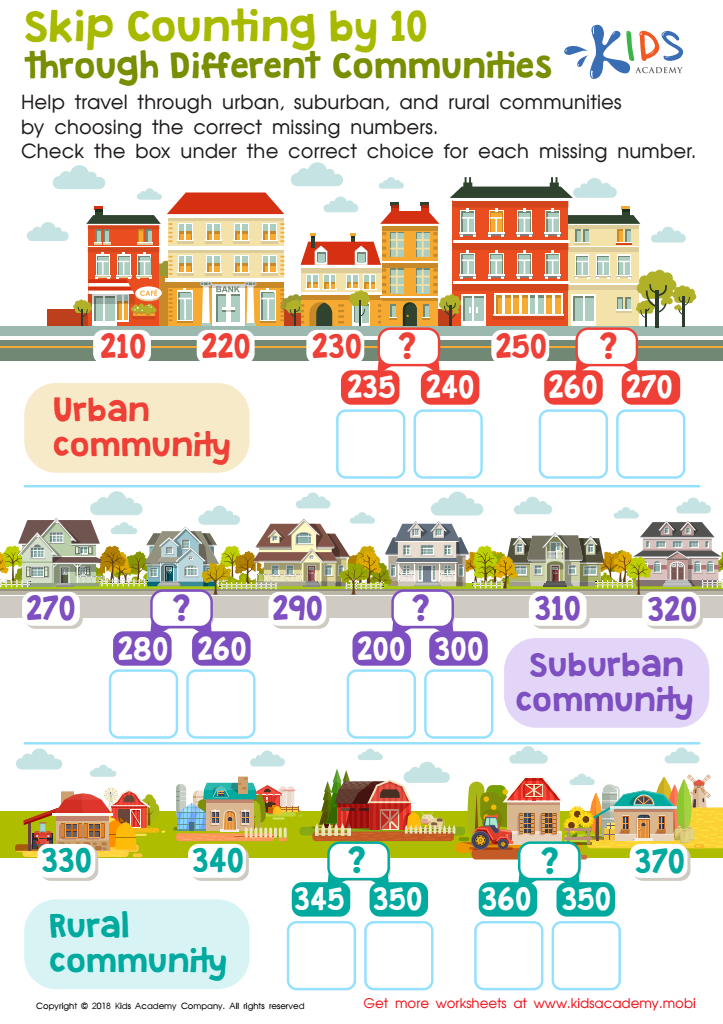
Skip Counting by 10 through Different Communities Worksheet
This free PDF worksheet helps students practice skip counting and 'making a ten', essential for math efficiency and accuracy. Students explore different types of communities (urban, suburban and rural) whilst honing their skills. A great combo of social studies and math!
Skip Counting by 10 through Different Communities Worksheet
Worksheet
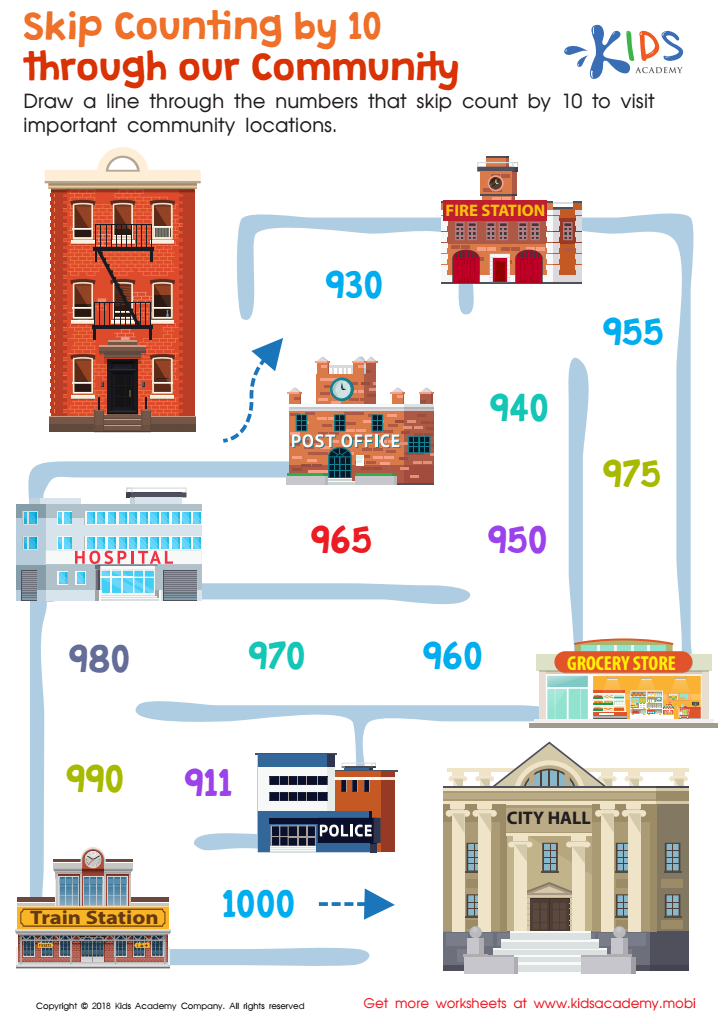
Skip Counting by 10 Through Our Community Worksheet
Our kids need to 'make a ten' and skip count by tens to boost their speed and accuracy in math. This cool, free worksheet takes them on a journey through their local community to practice counting by tens. They'll work on social studies and fine motor skills while having fun with the maze they get to count by tens in!
Skip Counting by 10 Through Our Community Worksheet
Worksheet
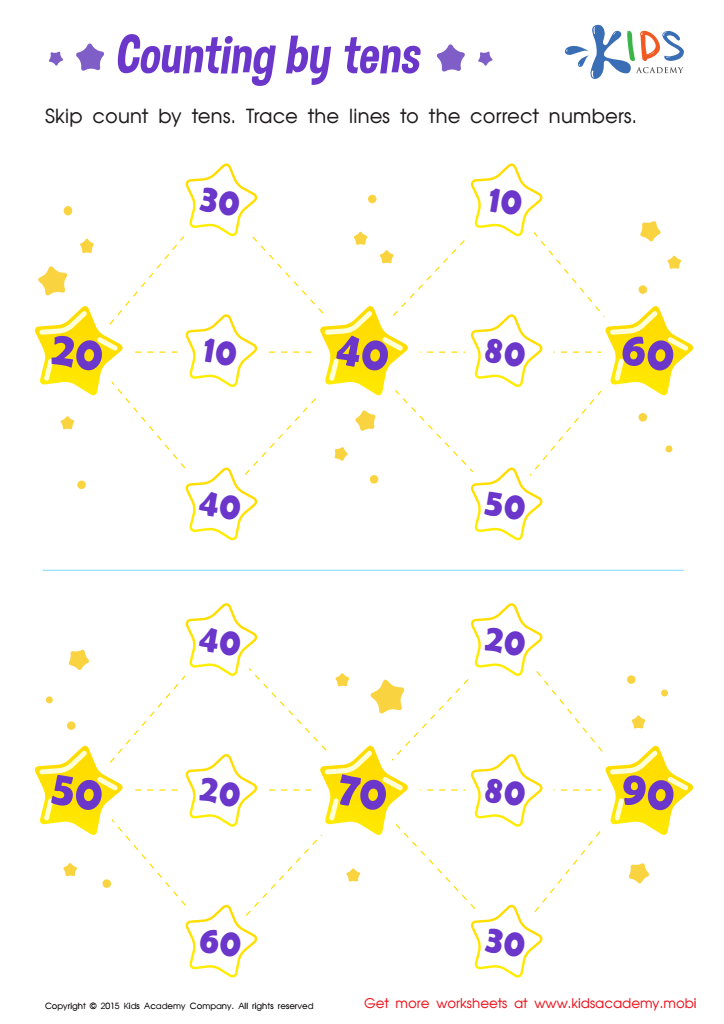
Learn Dozens: Counting by Tens Printable
Kindergartners need to learn skip counting - counting in number groups - to increase number sense and be ready for more advanced math. Our kindergarten worksheet featuring a starry trip to outer space will help your child practice this valuable skill. Your child will choose correct answers to trace the lines to the stars, building fluency in skip counting. They'll also strengthen problem solving and see the pattern it creates. Get your little learner to the next level with this skip counting worksheet!
Learn Dozens: Counting by Tens Printable
Worksheet
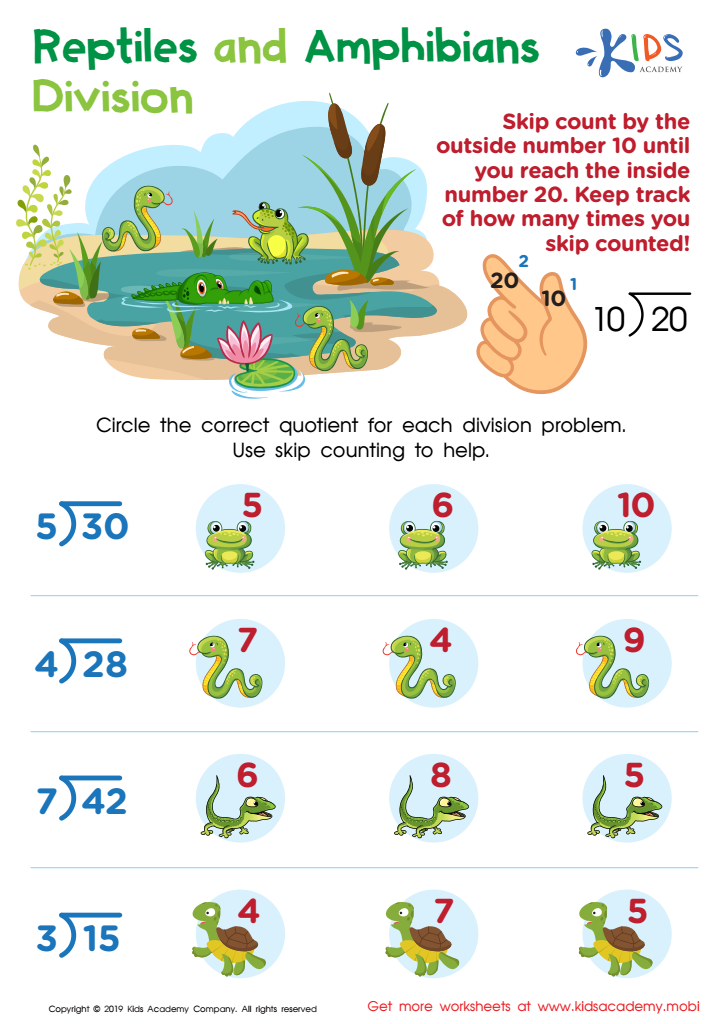
Reptile and Amphibians Division Worksheet
Skip counting is key in division. This PDF worksheet helps children practice this skill with fun reptile and amphibian friends. They must circle the right quotient among the choices given to reinforce their pattern recognition. Perfect for mastering division!
Reptile and Amphibians Division Worksheet
Worksheet
Join Kids Academy for Free
Who is primarily going to use this learning content?







.jpg)
Normal skip counting, which involves counting in patterns such as twos, fives, or tens, is a fundamental mathematical skill for children ages 4 to 8. Parents and teachers should care about this skill for several reasons. First, skip counting builds a strong foundation for understanding more complex mathematical concepts, such as addition, subtraction, multiplication, and division. By recognizing and constructing patterns, children engage in critical thinking and problem-solving, essential skills in mathematics and beyond.
Moreover, skip counting aids in developing number sense, enhancing children's ability to understand and manipulate numbers in different contexts. It also reinforces concepts of even and odd numbers, promoting overall numerical fluency. Additionally, employing skip counting can make math fun and interactive, facilitating a positive attitude toward learning.
Furthermore, this skill has real-life applications, such as grouping items, counting money, and telling time, making it relevant to everyday situations. Lastly, skip counting is often foundational in preparing for concepts like multiplication, so early mastery can lead to greater confidence and success in future math studies. By prioritizing skip counting, parents and teachers help children build essential skills that will benefit them academically and in their everyday lives.








