
Visual discrimination Extra Challenge Geometry Worksheets for Ages 4-8
3 filtered results
Difficulty Level
Grade
Age
-
From - To
Subject
Activity
Standards
Boost your child's visual discrimination skills with our Extra Challenge Geometry Worksheets designed for kids aged 4-8. Perfect for young learners ready to expand their spatial reasoning and pattern recognition, these engaging worksheets offer a fun and interactive way to enhance attention to detail. Through practice, children will learn to distinguish between different shapes, sizes, and patterns while honing their problem-solving abilities. Our carefully crafted activities make learning enjoyable, promoting confidence and academic growth. Ideal for home or classroom use, these worksheets are an excellent resource to support early geometry education. Visit our site to accelerate your child's learning journey!
Favorites
With answer key
Interactive
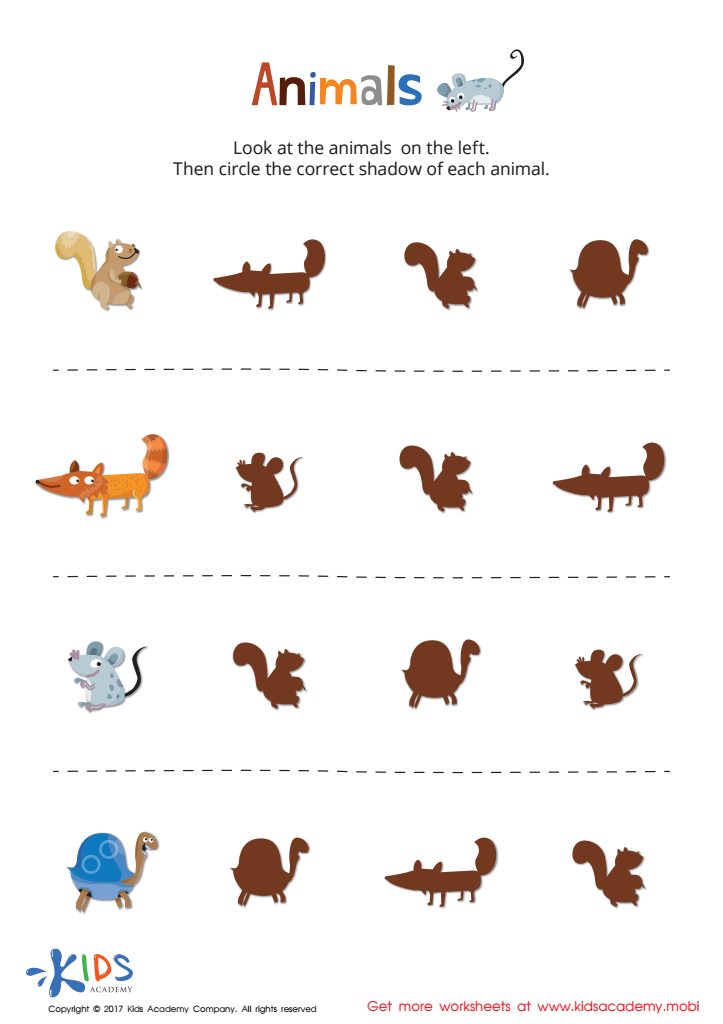
Animal Shadows Sorting Worksheet
This fun worksheet helps your child sharpen many skills. It features animals to match shapes and practice relative directions. Your child will sort animal features, practice spatial recognition, and recognize right/left. Plus, you can use it to start conversations about the animals. And try it also with fruits and veggies to boost sorting skills.
 Assign to My Students
Animal Shadows Sorting Worksheet
Worksheet











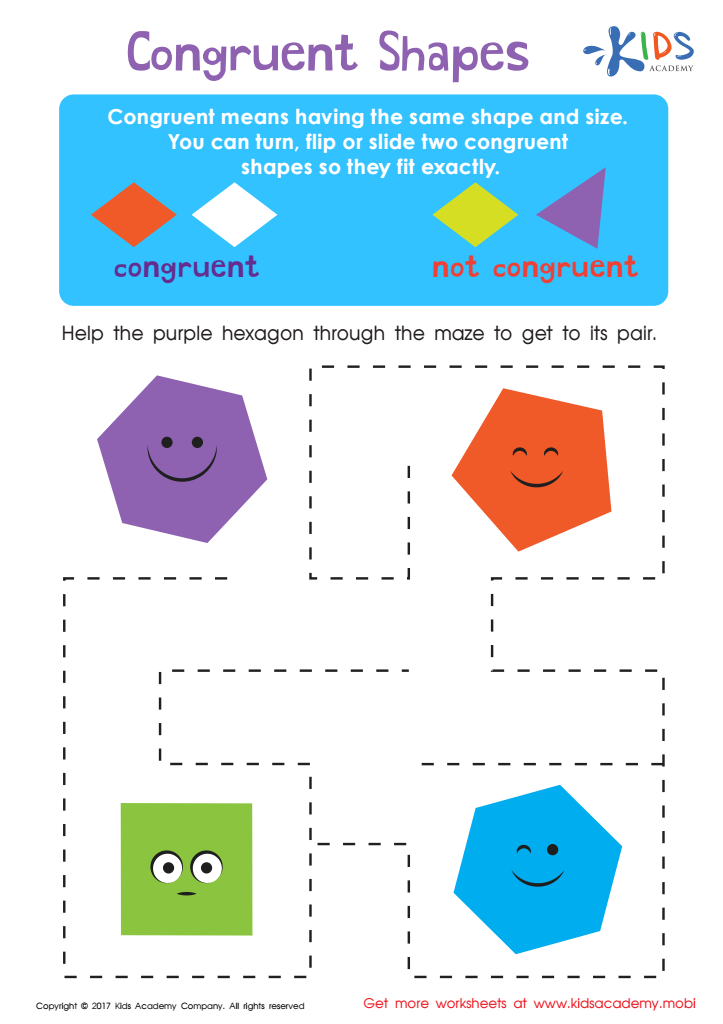
Congruent Shapes Worksheet
Help your child find the twin of the purple hexagon! This congruent shapes worksheet is great for increasing vocabulary while challenging mental rotation skills.
Congruent Shapes Worksheet
Worksheet
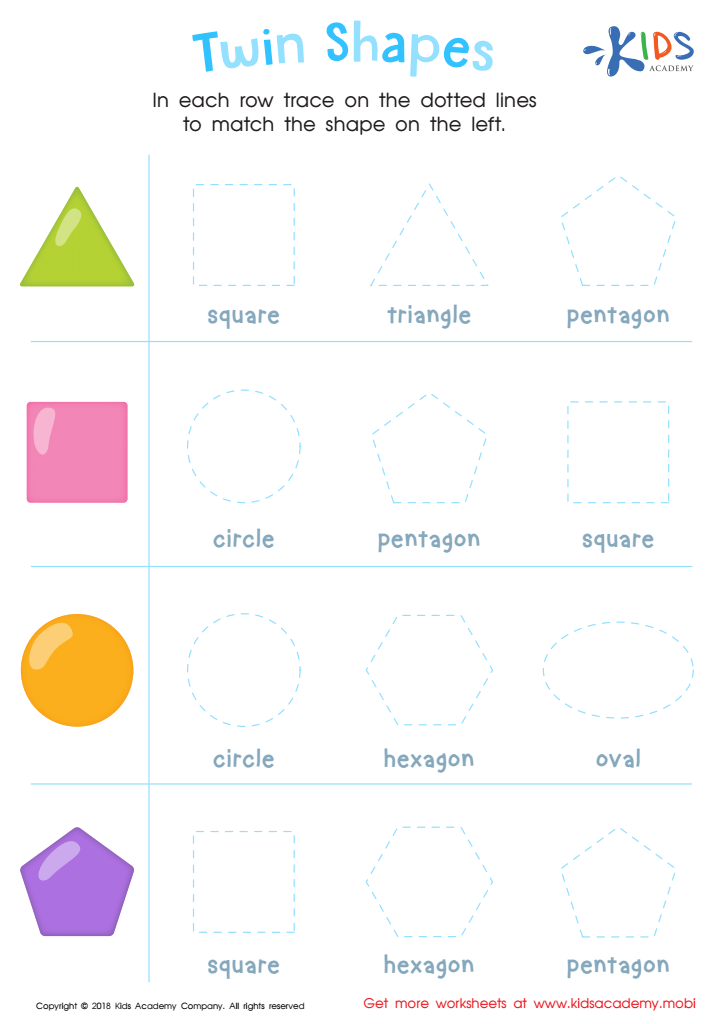
Twin Shapes Dot-to-Dot Worksheet
Test your child's ability to copy with this worksheet. Ask them to find and name the four shapes on the left. Then, they must match each with the dotted lines on the right. Help your child with all four shapes in this fun exercise.
Twin Shapes Dot-to-Dot Worksheet
Worksheet
Join Kids Academy for Free
Who is primarily going to use this learning content?








Visual discrimination is a crucial skill for young children, forming the foundation for both academic success and everyday functioning. Engaging children aged 4-8 in visual discrimination exercises, particularly through extra challenge geometry tasks, has multiple benefits that parents and teachers should eagerly support.
First, enhancing visual discrimination helps children distinguish between different shapes, letters, and numbers, which is vital for early literacy and numeracy. By honing these abilities through geometry challenges, children improve their recognition skills, making it easier to learn to read and perform simple calculations.
Second, geometry helps children understand spatial relationships and properties of shapes, foundational concepts in mathematics that translate to more advanced topics as they grow. Through playful activities that involve sorting, comparing, and manipulating geometric shapes, children develop logical thinking, problem-solving skills, and fine motor coordination.
Moreover, visual discrimination and geometry activities stimulate creativity and imagination. When children engage with varied shapes and patterns, they advance their visual and creative processing abilities, which are key aspects in arts and sciences.
Therefore, by incorporating visual discrimination and geometry tasks into children’s routines, parents and teachers foster not just academic proficiency, but overall cognitive development, aiding their growth into well-rounded individuals.








