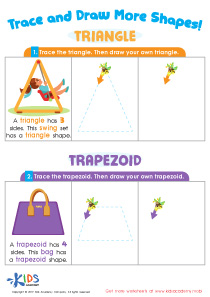
Cognitive Development Kindergarten Tracing Shapes Worksheets
4 filtered results
Difficulty Level
Grade
Age
-
From - To
Subject
Activity
Standards
Boost your child's cognitive development with our expertly designed Kindergarten Tracing Shapes Worksheets. These engaging activities are perfect for young learners, enhancing their problem-solving skills, hand-eye coordination, and fine motor skills while introducing them to fundamental geometric shapes. Each worksheet is thoughtfully crafted to provide a balanced mix of fun and educational content, encouraging kids to trace various shapes ranging from circles to complex polygons. Ideal for classroom use or at-home practice, these worksheets help lay a solid foundation for future mathematical learning. Explore our selection today and watch your child's cognitive abilities flourish!
Favorites
With answer key
Interactive
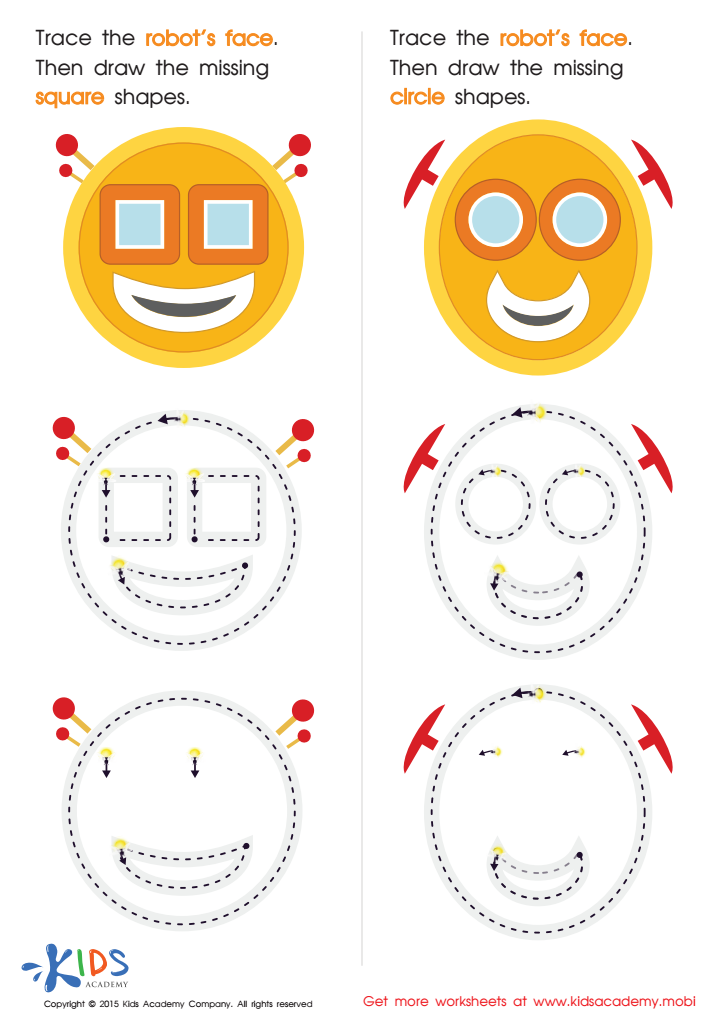
Practicing to Draw Circles And Squares Printable
Download our free printable geometry worksheets to learn shapes with your preschoolers. Trace Robot's face, draw the square parts and round shapes, remember the names for each one. Get more materials for kids at Kids Academy and make learning fun with our free printable geometry worksheets.
 Assign to My Students
Practicing to Draw Circles And Squares Printable
Worksheet
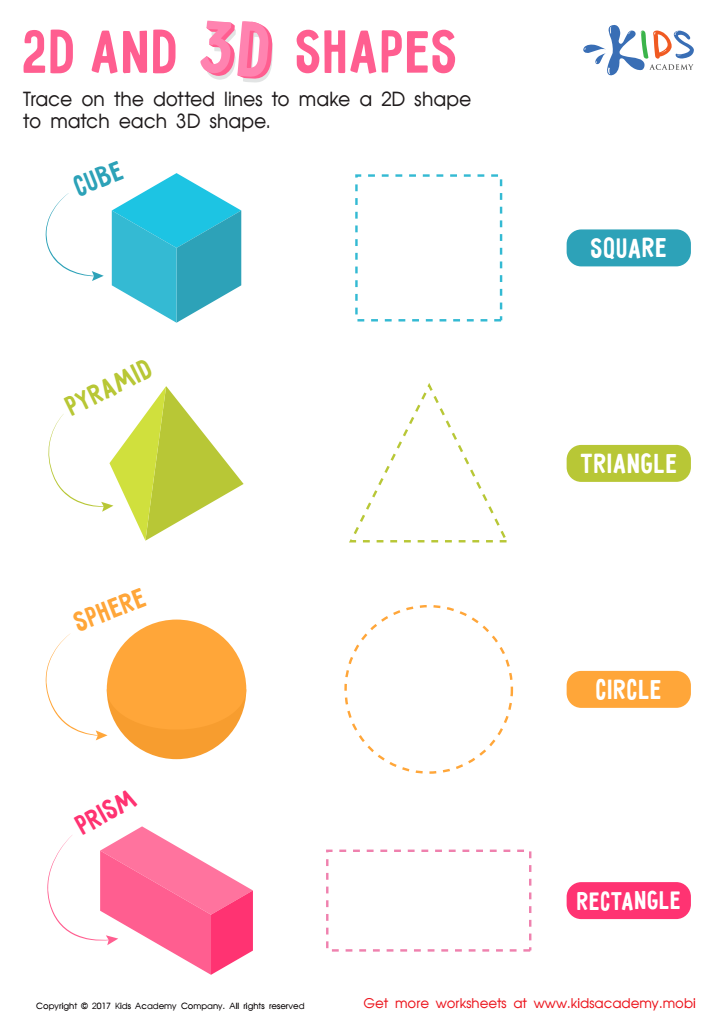
2D and 3D Shapes Worksheet
Introduce your child to 3D and 2D with this traceable worksheet. With dotted lines, help them trace and make a 2D shape for each 3D shape: square, triangle, rectangle, and circle. Show them there's more than one way to draw! You may have taken them to a 3D movie, or they've seen some fantastic 3D art. Now they can wonder no more.
2D and 3D Shapes Worksheet
Worksheet
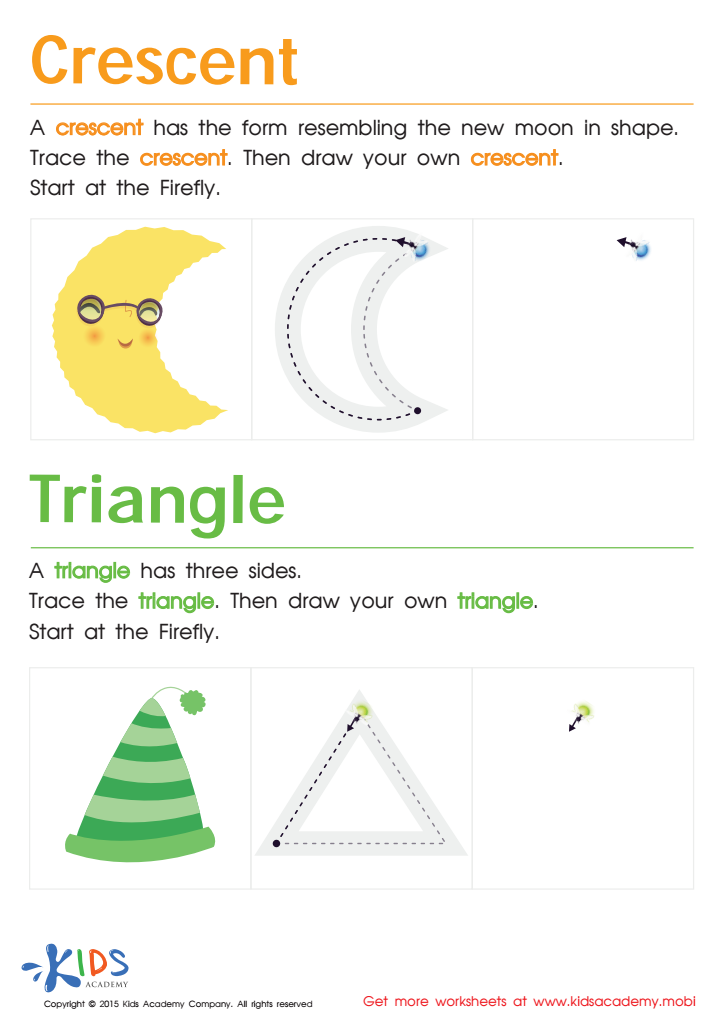
Learning to Draw Crescents And Triangles Worksheet
Help your kids draw a crescent and triangle with this free printable worksheet! Start by tracing a crescent in the form of the new moon, and then teach them that a triangle has three sides and looks like a hat. Find more geometry practice worksheets at Kids Academy!
Learning to Draw Crescents And Triangles Worksheet
Worksheet
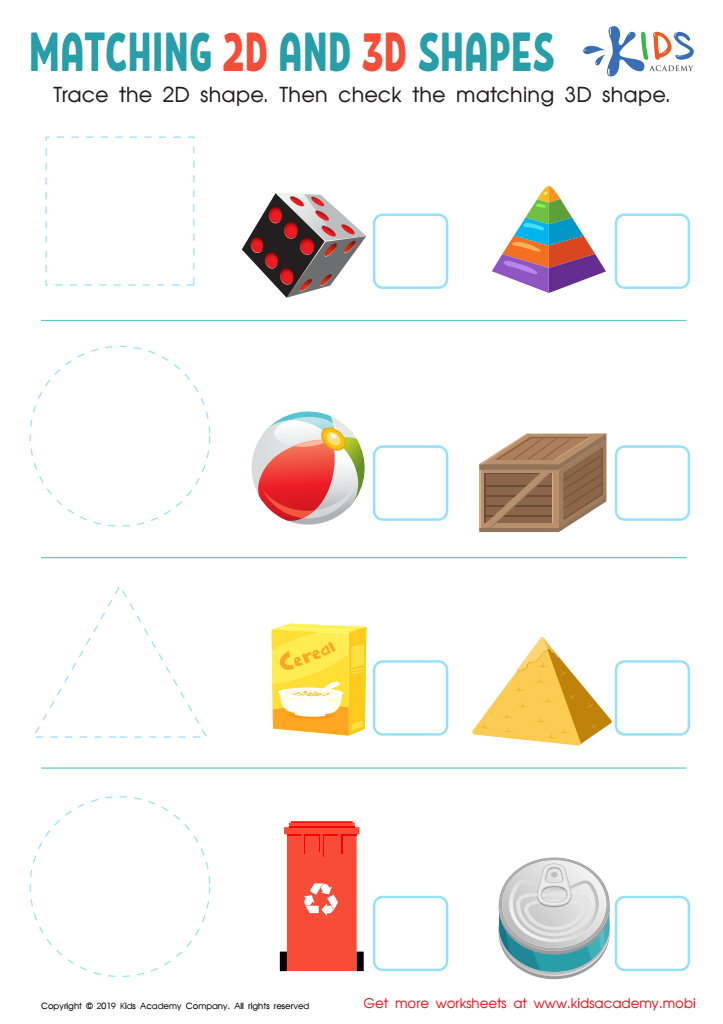
Matching 2D and 3D Shapes Worksheet
Before starting this worksheet, ask your kids what shapes they know and point out the 2D and 3D shapes on it. Help your kids trace the 2D shapes and then match them to the 3D versions. It'll be a fun new world for your kids to explore!
Matching 2D and 3D Shapes Worksheet
Worksheet
Join Kids Academy for Free
Who is primarily going to use this learning content?








Cognitive development in early childhood, particularly during the kindergarten years, is crucial for shaping young minds and setting the groundwork for future learning. One key activity that supports this development is tracing shapes. Parents and teachers should prioritize this activity because it enhances fine motor skills, which are vital for writing and other tasks requiring hand-eye coordination. When children trace shapes, they exercise their hands and fingers, strengthening the muscles necessary for controlling a pencil or pen.
Moreover, tracing shapes promotes cognitive skills such as visual-spatial recognition and memory. By identifying and tracing various shapes, children learn to recognize patterns, understand the concepts of symmetry and geometry, and improve their ability to process and recall visual information. These skills are fundamental in mathematics, reading, and everyday problem-solving.
Additionally, such activities encourage concentration and perseverance. As kids focus on tracing within the lines and completing the task, they develop patience and attention to detail. Practicing tracing also helps build confidence as children observe their progress and accomplishments.
In essence, incorporating shape tracing into a child’s learning routine lays a foundation for various essential life skills. Supporting cognitive development in this way foster's a child's curiosity and love for learning, which serves as a cornerstone for future educational success.