
Color Identification Normal Addition & Subtraction Worksheets for Ages 4-8
4 filtered results
Difficulty Level
Grade
Age
-
From - To
Subject
Activity
Standards
Discover our Color Identification Normal Addition & Subtraction Worksheets tailored for children aged 4-8 at Kids Academy. These engaging, educational worksheets seamlessly blend basic math skills with color identification exercises, making learning fun and interactive. As youngsters practice adding and subtracting, they’ll simultaneously reinforce their understanding of colors, promoting cognitive development and fine motor skills. Perfect for both classroom and home use, our diverse collection aligns with educational standards to support consecutive learning stages. Boost your child's confidence in math while enhancing their color awareness through these thoughtfully designed activities. Explore today to jump-start their academic success!
Favorites
With answer key
Interactive
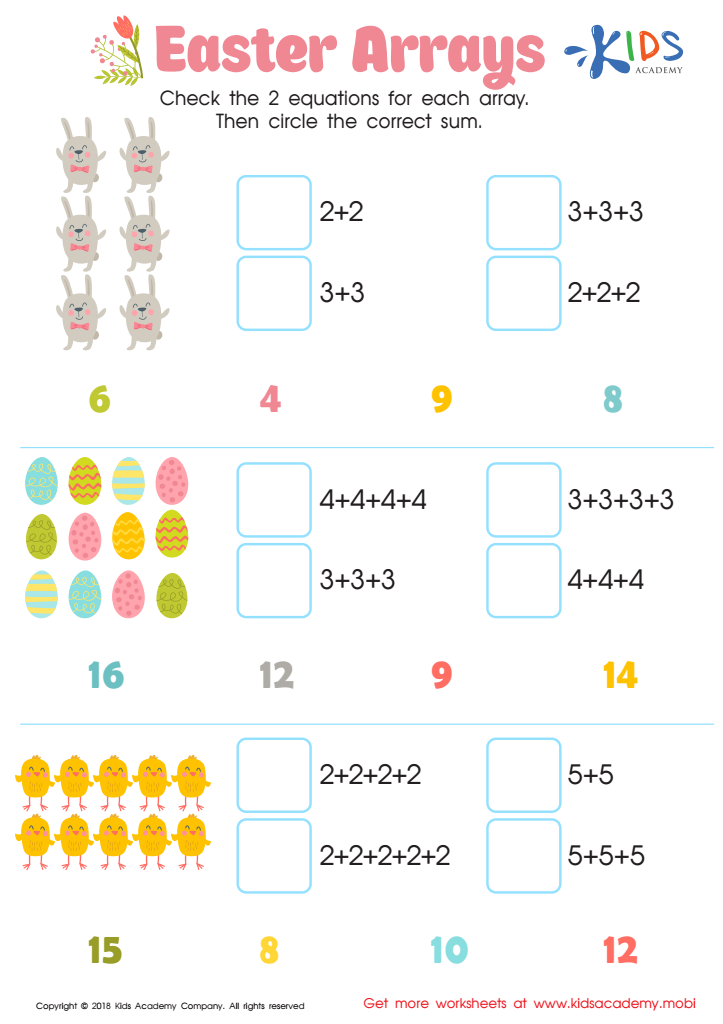
Easter Arrays Worksheet
Does your child love Easter? Do they adore the Easter bunny and egg hunts? Help them have fun with this worksheet! Go through it with them and check the equations for each array. Then, have them circle the correct sum. It's a great way to make the holiday extra exciting!
 Assign to My Students
Easter Arrays Worksheet
Worksheet
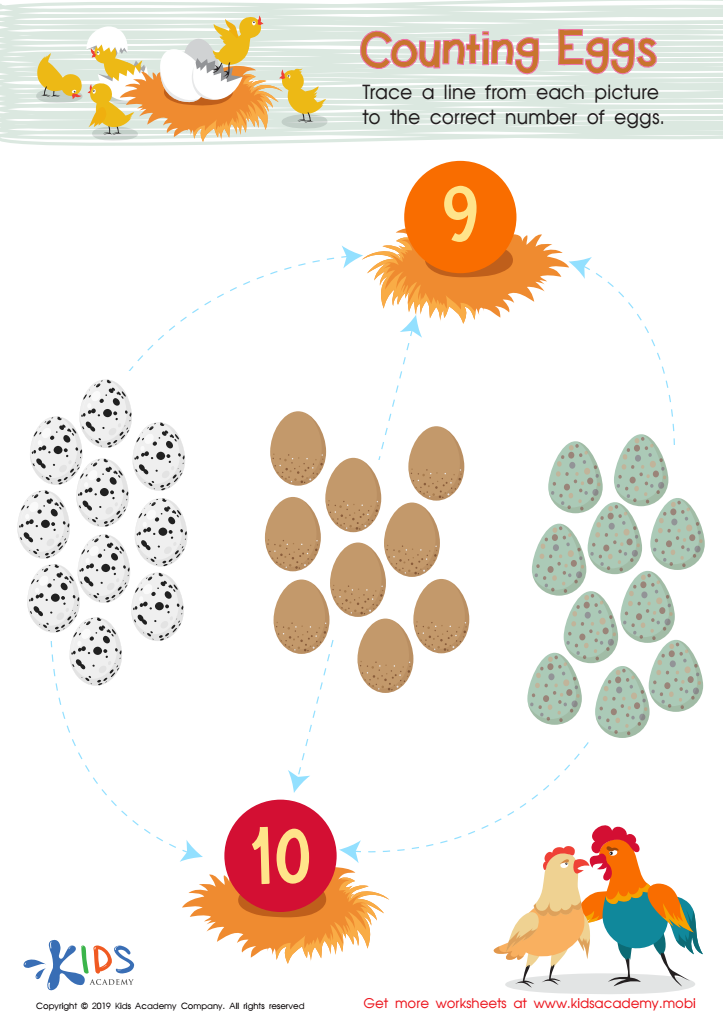
Counting Eggs Worksheet
This worksheet is great for teaching kindergarteners to count and add numbers. It includes colorful pictures of eggs with numbers to trace. Help students count the eggs and draw a line to the right number. This will make learning fun and easy!
Counting Eggs Worksheet
Worksheet
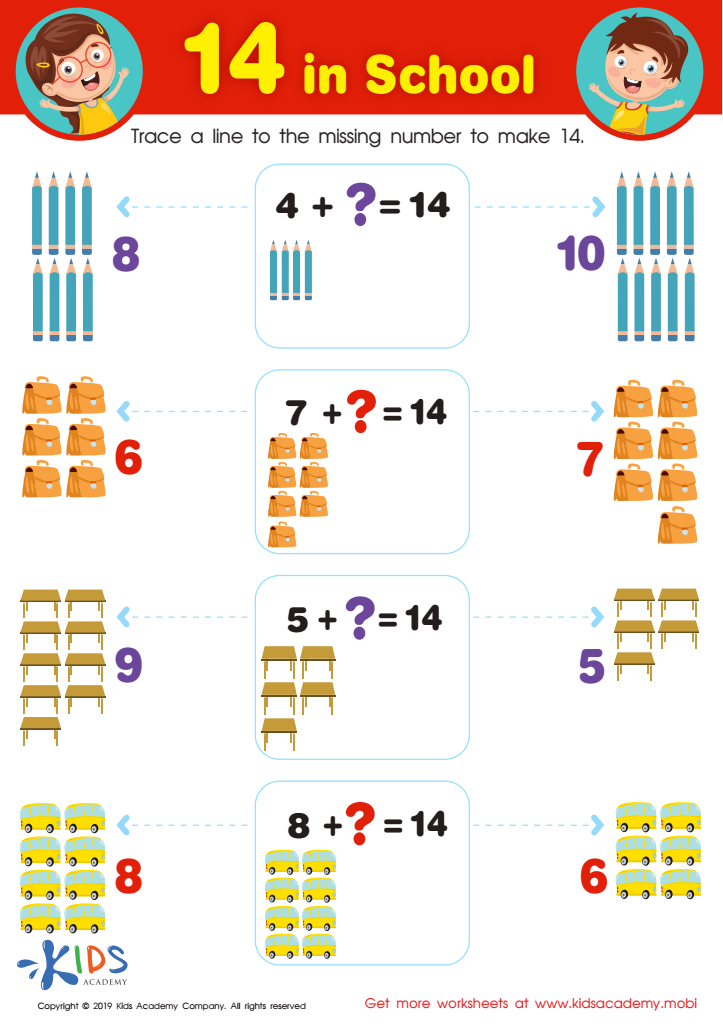
14 in School Worksheet
Remind your kids that adding different sets of numbers can give the same total (e.g. 2+3=5, 4+1=5). Ask them for more examples. Afterwards, work through the exercise. Help them count the objects and trace a line to the missing number that makes the total 14.
14 in School Worksheet
Worksheet
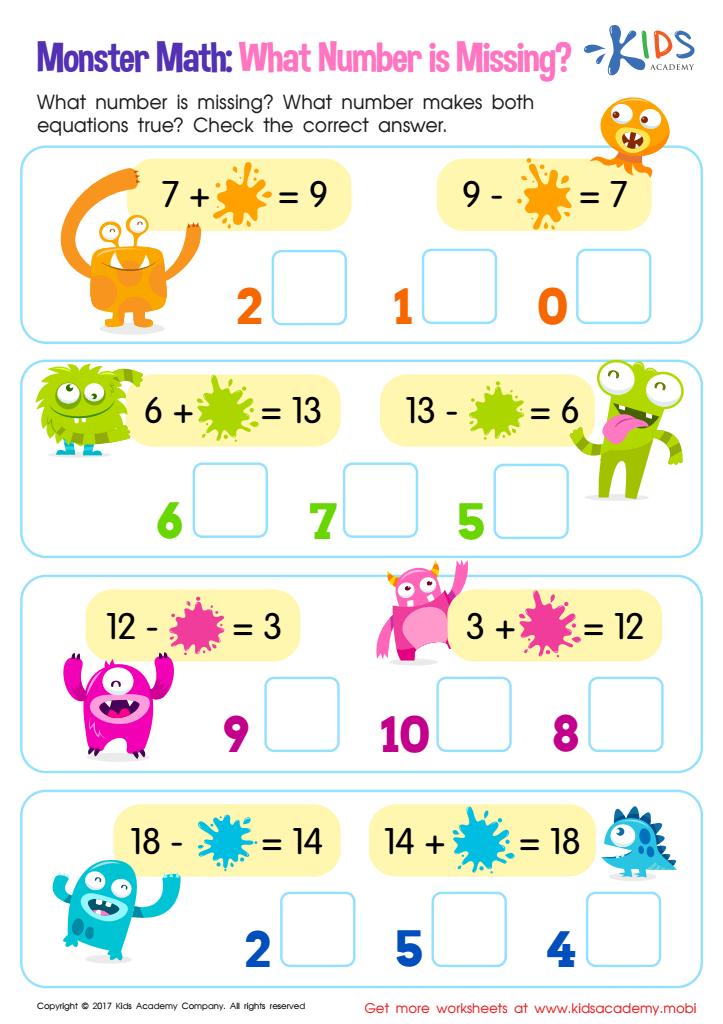
Missing Number: Monster Math Worksheet
Engage your child in monster math fun with a worksheet! They'll need to use their counting, addition and subtraction skills to solve equations on both sides. On the left side, they must complete an addition problem and on the right, the equation is in subtraction form. Assist them in selecting the right number out of the given options to make both equations true.
Missing Number: Monster Math Worksheet
Worksheet
Join Kids Academy for Free
Who is primarily going to use this learning content?








Parents and teachers should care about color identification, normal addition, and subtraction for children aged 4-8 because these skills form the foundation for future academic success and everyday functioning. Color identification is a fundamental skill that enhances cognitive development, visual discrimination, and communication. Recognizing and naming colors helps children describe objects, follow instructions, and engage more fully in classroom activities.
In parallel, mastering basic addition and subtraction is crucial for developing mathematical literacy. These skills underpin more advanced concepts that will be introduced in later grades, such as multiplication and division, time and money calculations, and even complex problem-solving tasks. Early competence in mathematics promotes confidence and reduces math anxiety, creating a positive attitude towards learning.
Moreover, incorporating these skills into a child's daily routine fosters a well-rounded developmental experience. Activities that involve color identification and basic arithmetic encourage critical thinking, pattern recognition, and logical reasoning. For instance, sorting colored objects while counting or solving simple math problems using colored tokens can make learning interactive and fun.
Nurturing these abilities from a young age equips children with the tools they need to succeed academically and lays the groundwork for a lifetime of curiosity and learning. Therefore, parents and teachers play an essential role in ensuring that children are building these foundational skills early on.








