
Matching skills Normal Geometry Worksheets for Ages 4-8
3 filtered results
Difficulty Level
Grade
Age
-
From - To
Subject
Activity
Standards
Our Matching Skills Normal Geometry Worksheets for Ages 4-8 offer an engaging way for children to enhance their geometry skills. Perfect for young learners, these worksheets provide a fun and interactive experience with various activities designed to teach matching shapes, patterns, and spatial relationships. From differentiating circles from squares to understanding complex shapes, kids build a strong foundational understanding of geometry. Additionally, these worksheets promote critical thinking, attention to detail, and problem-solving skills. Ideal for use in classrooms or at home, our worksheets are an excellent resource for helping children excel in math while enjoying the learning process.
Favorites
With answer key
Interactive
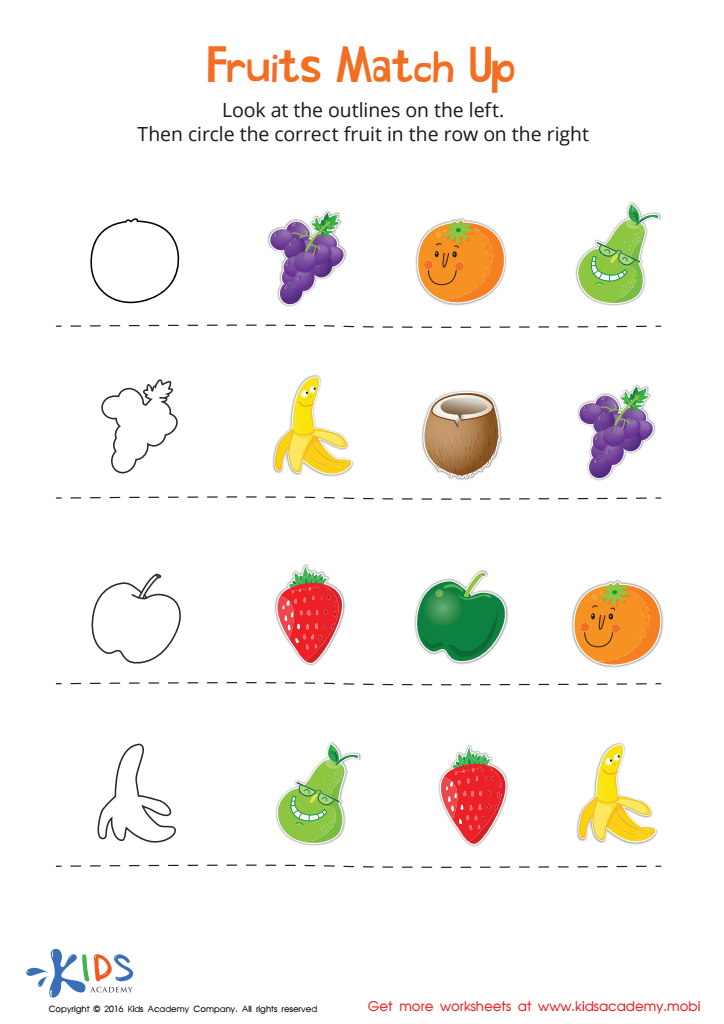
Fruits Match Up Worksheet
Motivate your child to count and sharpen their spatial reasoning skills with this vivid fruit worksheet.
 Assign to My Students
Fruits Match Up Worksheet
Worksheet











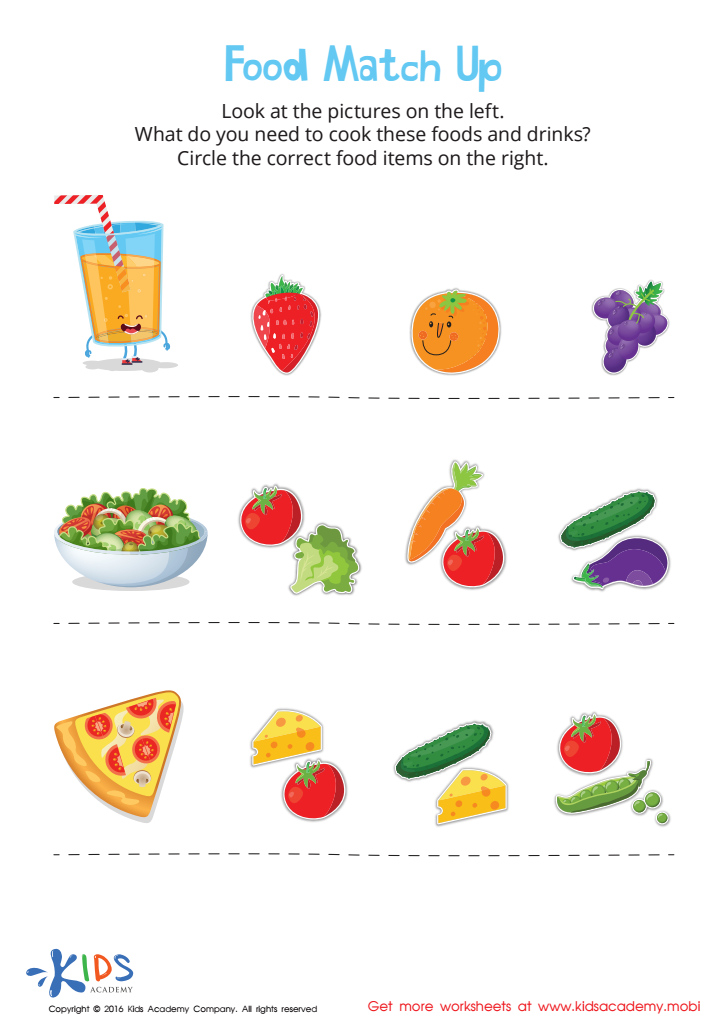
Food Match Up Worksheet
This worksheet will help your preschooler develop early math and cognitive skills. It challenges them to pay attention to details, understand how smaller parts make a whole, and increase important matching skills. Use it to give them a hands-on learning experience in the kitchen, and watch them understand how ingredients come together to make something delicious!
Food Match Up Worksheet
Worksheet
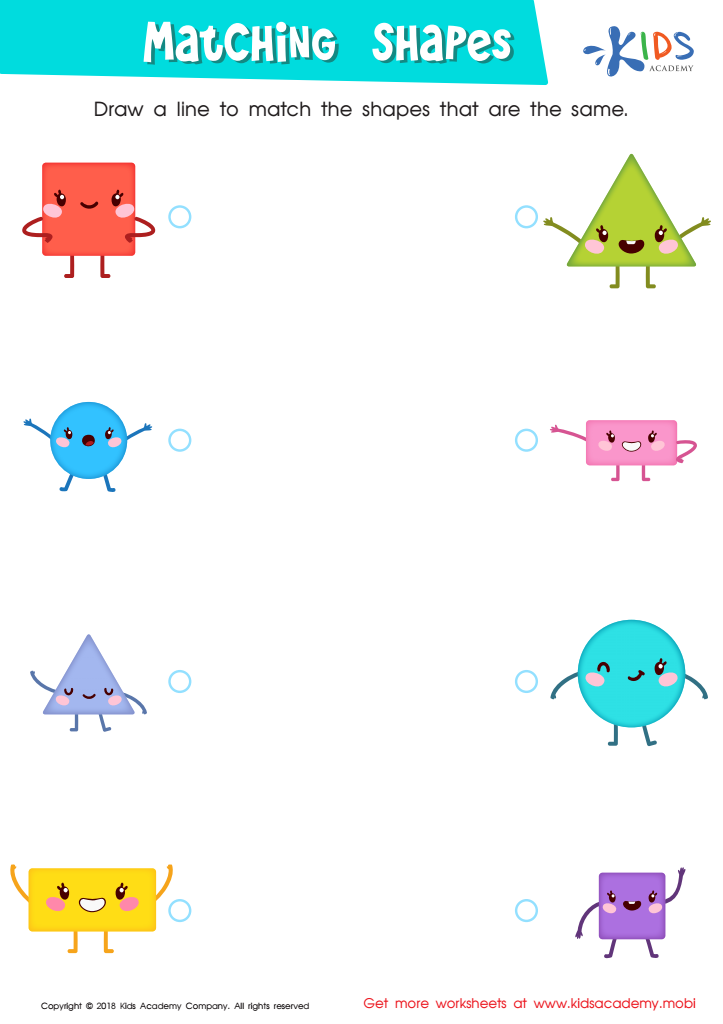
Matching Shapes Worksheet
Introduce your students to the 4 most common shapes: squares, triangles, rectangles and circles. When they progress, show them other shapes like rhombuses and parallelograms. Use this matching shapes worksheet to help them match two identical shapes. Print out the worksheet and instruct them to draw lines connecting them.
Matching Shapes Worksheet
Worksheet
Join Kids Academy for Free
Who is primarily going to use this learning content?








Matching skills in normal geometry are foundational for children aged 4-8, as they significantly contribute to cognitive development and academic success. At this formative stage, children’s brains are rapidly developing and they absorb new information like sponges. Engaging them in activities that foster matching skills in geometry involves recognizing patterns, shapes, sizes, and spatial relationships. This not only sharpens their visual discrimination but also enhances their attention to detail.
Developing geometry matching skills is essential for mathematical understanding. It lays the groundwork for grasping more complex concepts such as measurement, symmetry, and eventually algebra and calculus. For example, recognizing and replicating patterns or differentiating between shapes like squares and triangles helps children understand mathematical principles and relationships implicitly.
Moreover, geometry matching activities bolster problem-solving abilities and logical thinking. Children learn to sort, categorize, and classify objects, which are critical skills in both academic and everyday contexts. Matching skills also aid in physical development, improving fine motor control which is crucial for writing and other detailed tasks.
Lastly, these activities support social and emotional growth. Successfully completing matching tasks can boost a child’s confidence and encourage a growth mindset. Engaging parents and teachers emphasizing these skills fosters a collaborative learning environment, setting the stage for lifelong educational and personal success.








