
Understanding measurements Normal Measurement Worksheets for Ages 4-8
8 filtered results
Difficulty Level
Grade
Age
-
From - To
Subject
Activity
Standards
Discover the joy of learning with our 'Understanding Measurements' worksheets tailored for kids aged 4-8. These engaging, age-appropriate resources help young learners grasp key measurement concepts through fun activities and exercises. Perfect for both classroom and home use, our worksheets cover essential skills such as comparing lengths, estimating sizes, and understanding units of measurement. By integrating illustrations and interactive tasks, children can easily visualize and comprehend spatial relationships. Foster confident, curious minds with Kids Academy's measurement worksheets, designed to build a solid foundation in math while making learning enjoyable and effective. Download now and inspire a love for learning!
Favorites
With answer key
Interactive
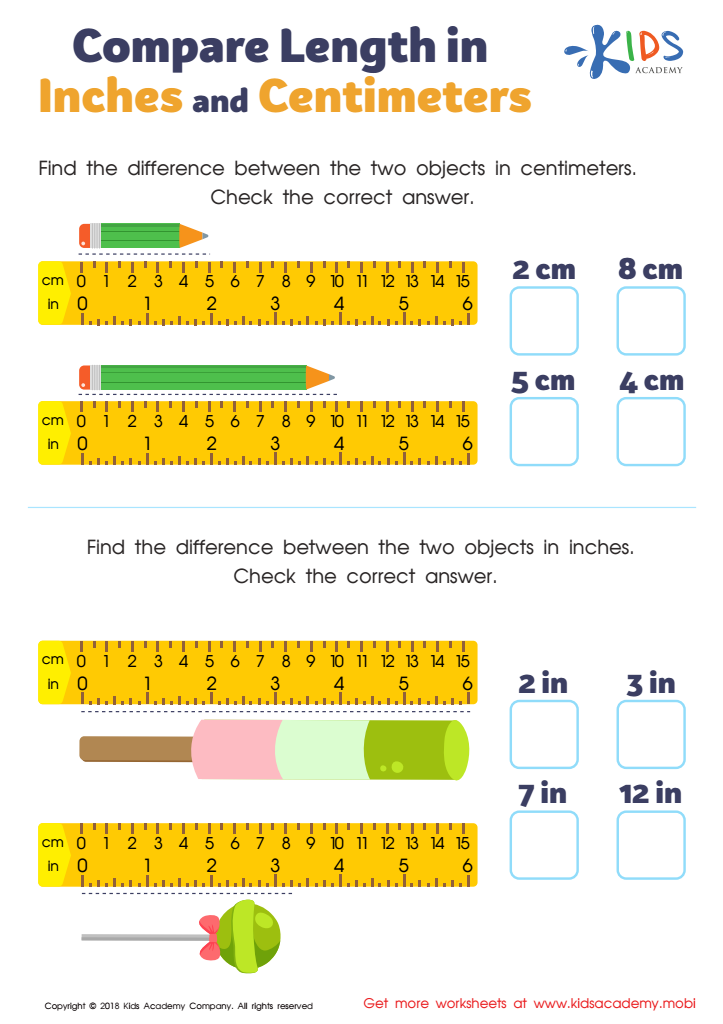
Compare Length in Inches and Centimeters Worksheet
This worksheet has your child measuring objects in both centimeters and inches. The first task requires measuring both objects in centimeters, then finding their difference. The second task is the same but in inches.
 Assign to My Students
Compare Length in Inches and Centimeters Worksheet
Worksheet
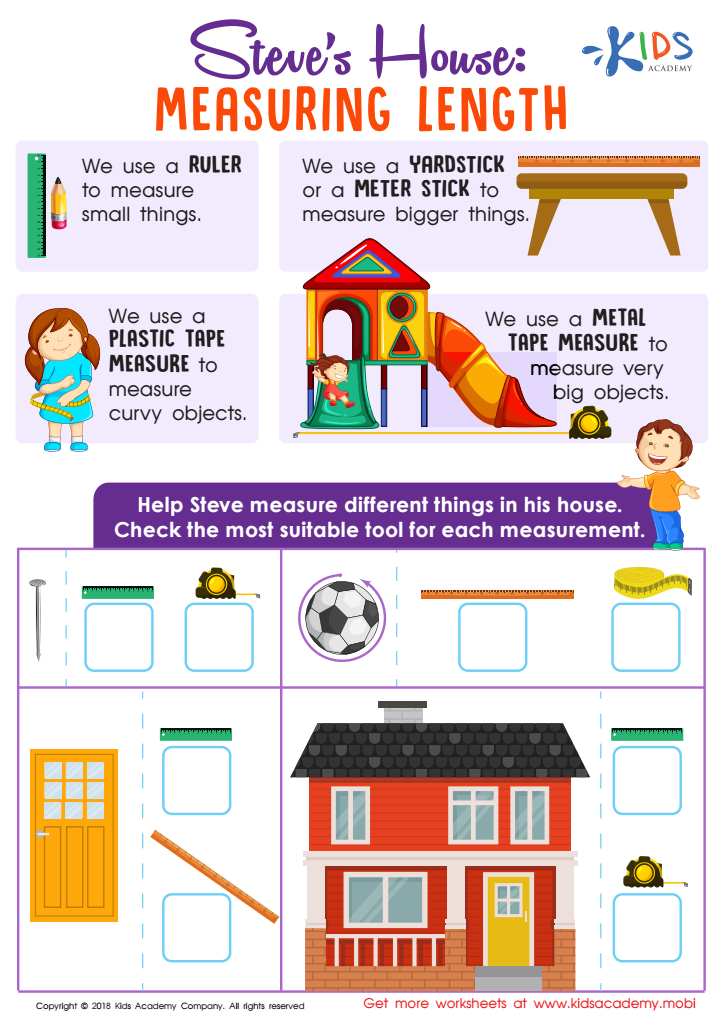
Steve's House: Measuring Length Worksheet
Introduce your kids to the various measuring tools and their uses. Explain how a ruler, plastic tape, yard stick, and metal tape measure are used to measure different objects. Guide them as they help Steve measure things in his home with the correct tool.
Steve's House: Measuring Length Worksheet
Worksheet
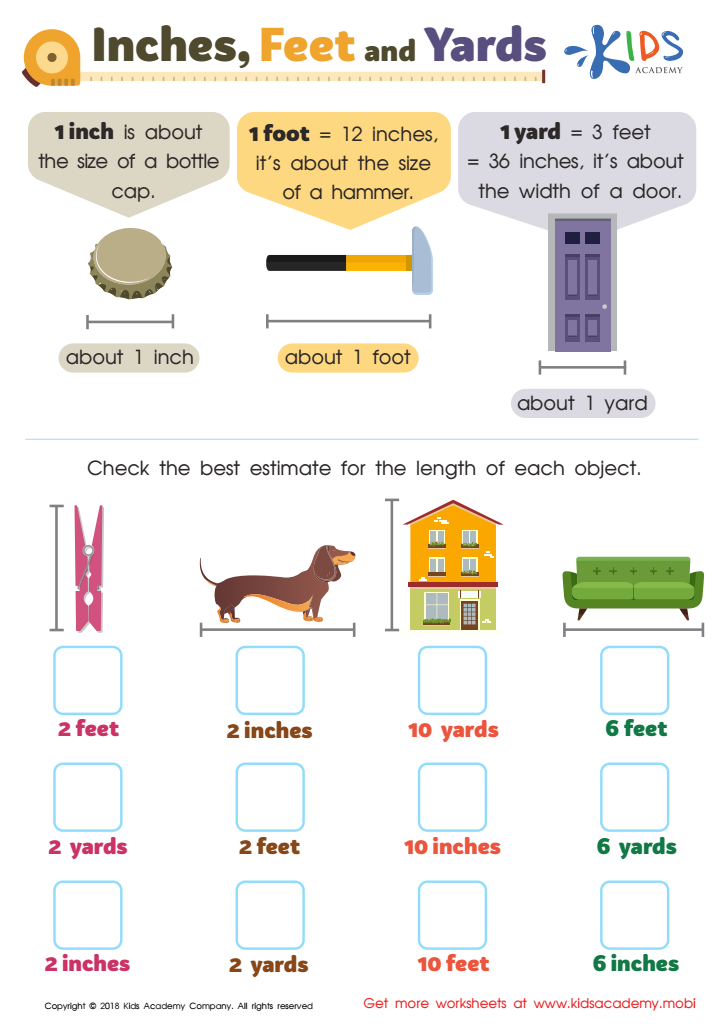
Inches, Feet and Yards Worksheet
Explain the size of measurements to your child by comparing them to objects they can visualize. For example, one inch is a bottle cap and one foot is the size of a hammer. Then, explain that one yard is the width of a door. Then, go through worksheets, circling the best estimates for each object's length.
Inches, Feet and Yards Worksheet
Worksheet
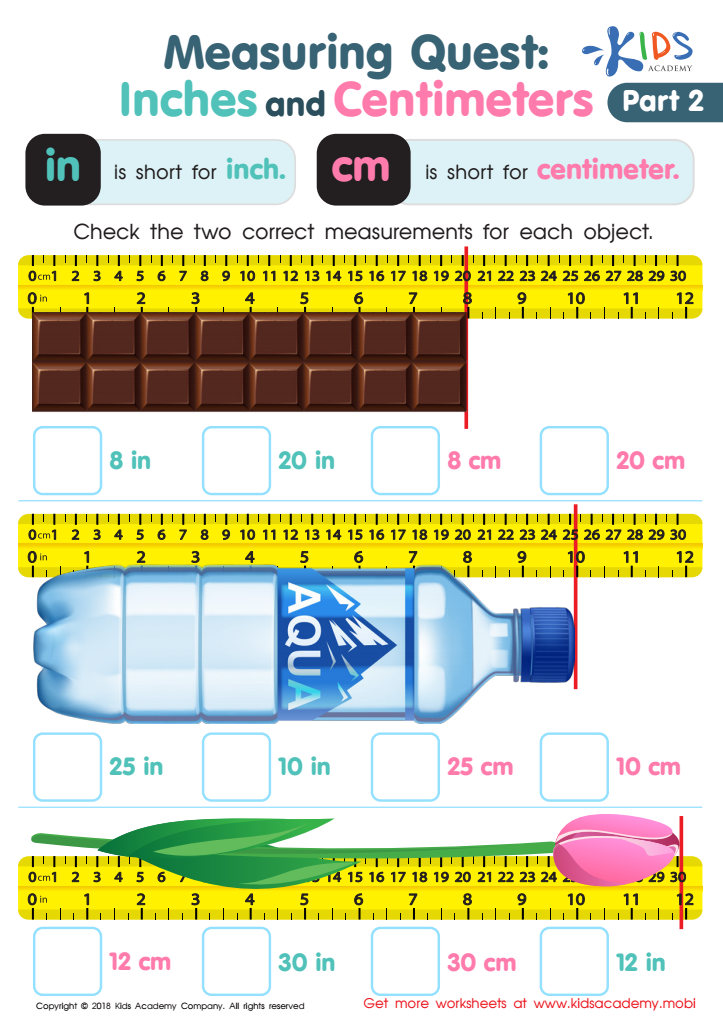
Measuring Quest: Inches and Centimeters - Part 2 Worksheet
This worksheet teaches kids how inches and centimeters measure up. It features rulers with centimeter measurements at the top, and inches at the bottom. Kids must choose the correct measurement for each object among the options provided.
Measuring Quest: Inches and Centimeters - Part 2 Worksheet
Worksheet
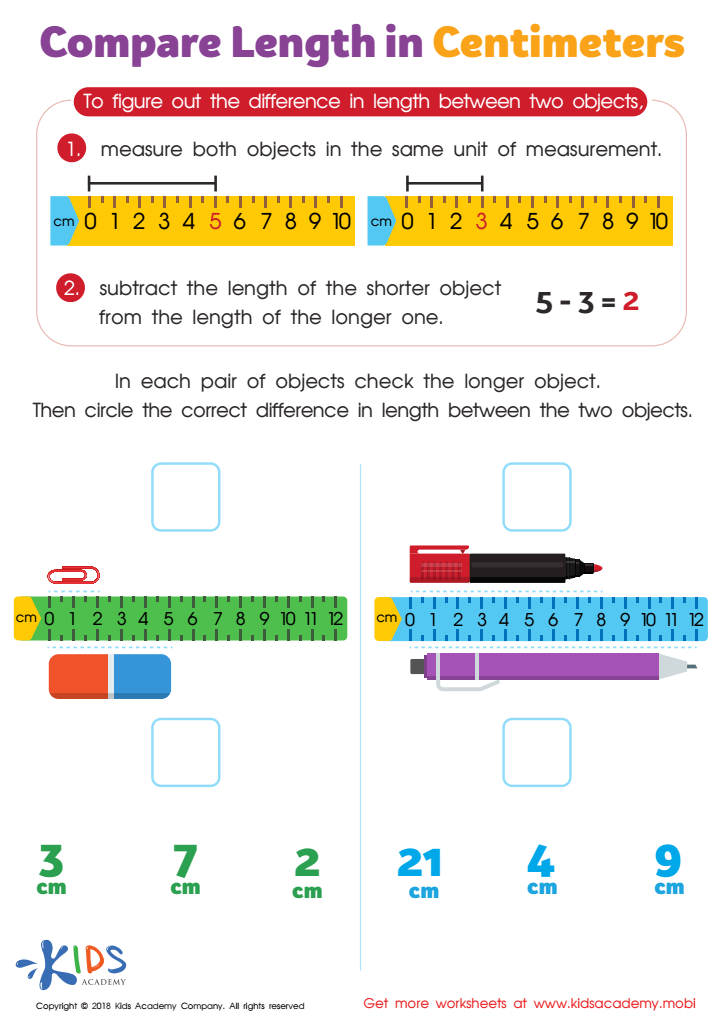
Compare Length in Centimeters Worksheet
To do this worksheet, your child needs to be able to measure accurately, add and subtract. They must measure both items and subtract the shorter from the longer to work out the difference in length.
Compare Length in Centimeters Worksheet
Worksheet
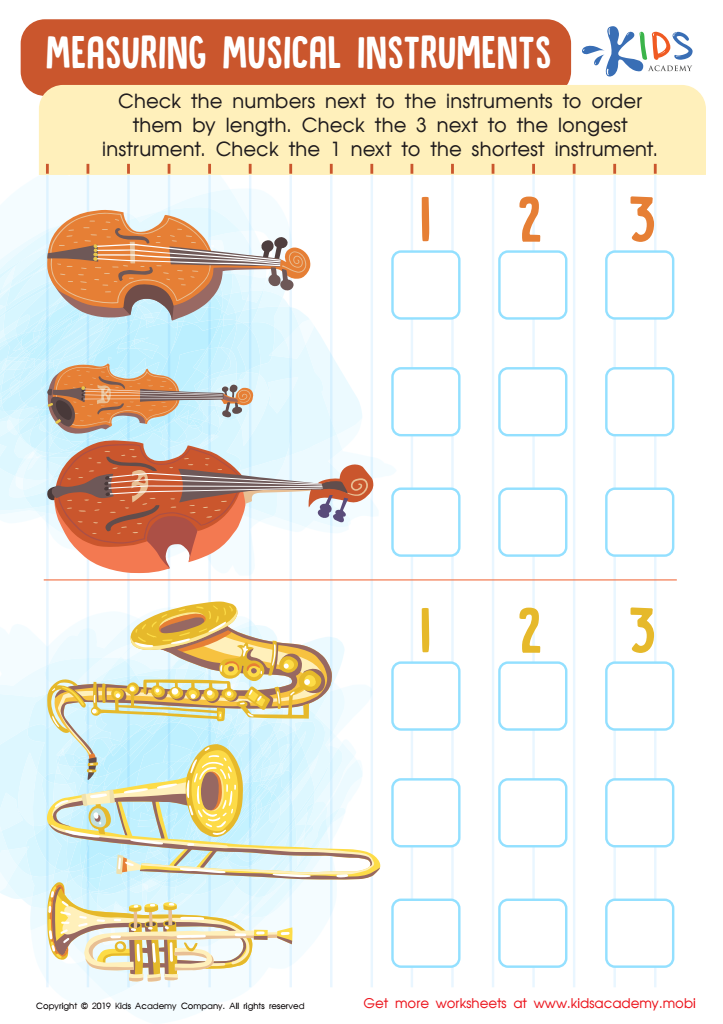
Measuring Musical Instruments Worksheet
Learning measurements can be tricky, but this worksheet makes it easy. Ask your child to identify the instruments in the pictures. Then, order them by length using the numbers. 3 is the longest, 1 is the shortest. Simple exercises like this will help them understand the different metric systems.
Measuring Musical Instruments Worksheet
Worksheet
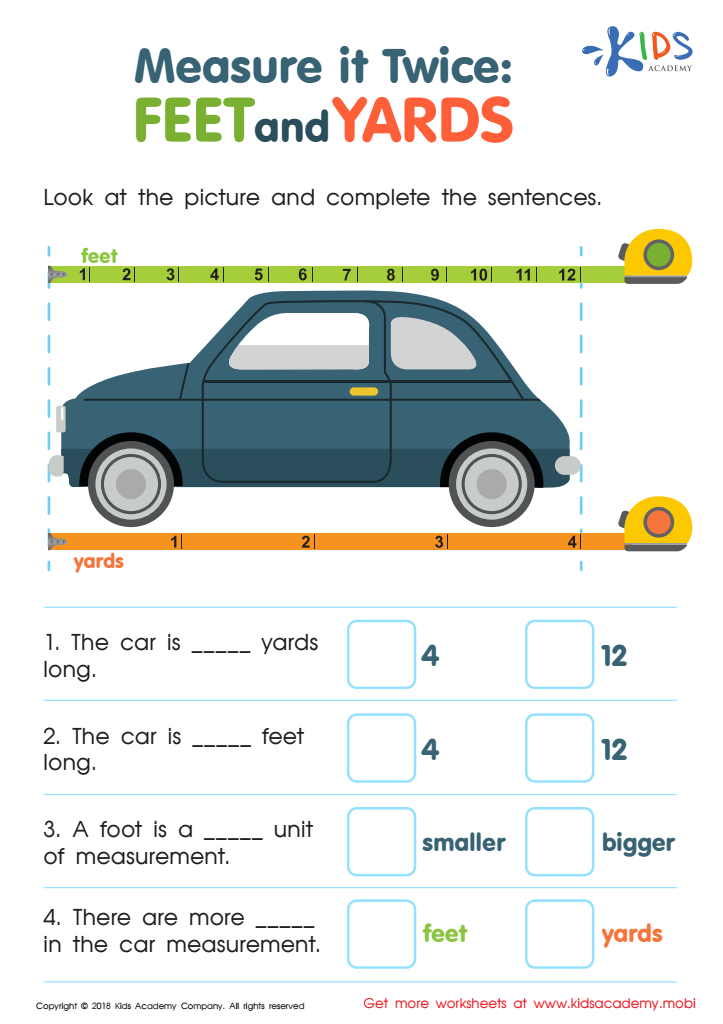
Measure It Twice: Feet and Yards Worksheet
A car is pictured with a metric ruler in feet at the top and a yard ruler at the bottom. Get your child to look at the picture and complete sentences about it; for example, how many yards long is the car? Is a foot a bigger or smaller unit of measurement? It'll teach them that 1 yard is equal to 3 feet.
Measure It Twice: Feet and Yards Worksheet
Worksheet
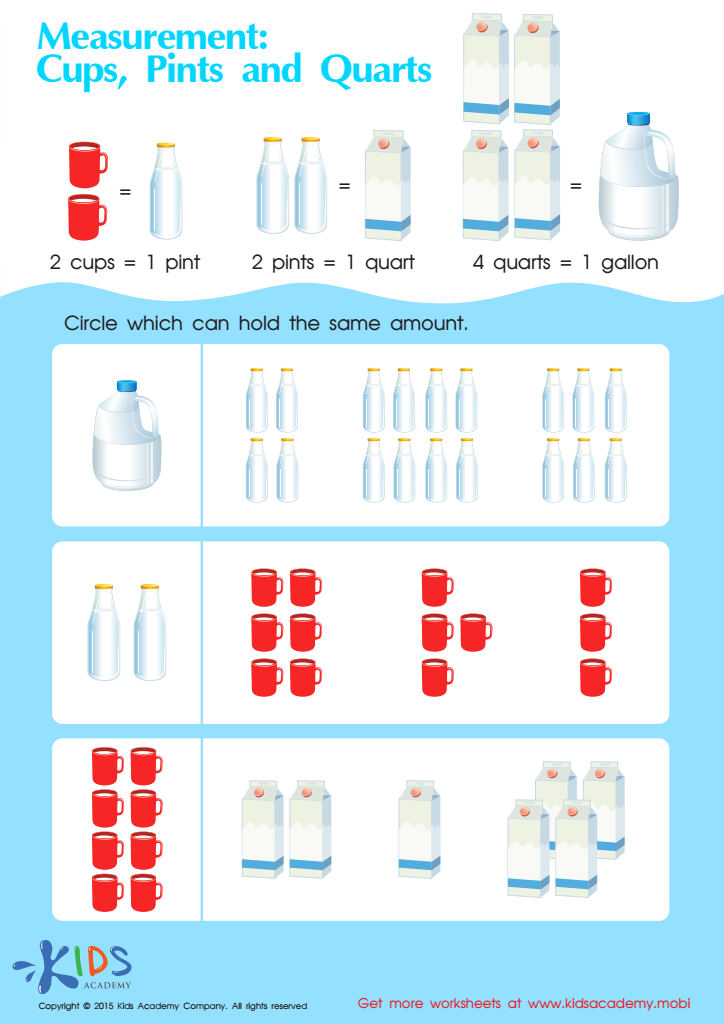
Cups, Pints and Quarts 2 Worksheet
Practice measuring liquids with our free math worksheets. Learn how many cups are in a quart and how many quarts are in a gallon. Accurately calculate the answers and write them in the provided spaces. Visit Kids Academy for a collection of free worksheets and make math fun!
Cups, Pints and Quarts 2 Worksheet
Worksheet
Join Kids Academy for Free
Who is primarily going to use this learning content?








Understanding measurements at an early age is critical for children's development and lays the foundation for future academic success. For parents and teachers, fostering these skills in children ages 4-8 can have a profound impact on multiple areas of learning and everyday life.
Firstly, basic measurement concepts such as length, weight, and volume are integral parts of the math curriculum. Introducing these ideas early helps children develop problem-solving skills and mathematical reasoning, crucial for more complex math learned in later years. For example, activities like measuring the length of a table with a ruler or comparing the weight of different objects enrich a child's tactile and cognitive experiences.
Secondly, understanding measurements enhances scientific inquiry. It's a key component of the scientific process, helping youngsters observe, compare, and analyze the physical world. Think of a child measuring the growth of a plant over weeks; this simple activity cultivates curiosity and critical thinking, preparing them for deeper scientific study.
Moreover, measurement understanding is essential in daily life. It informs a child's ability to follow recipes, understand distances, and manage time effectively. These practical skills build confidence and independence, making children more capable in their everyday environment.
Thus, integrating measurement education in early childhood, both at home and in school, equips children with foundational tools for lifelong learning and social independence.








