
Pattern recognition Normal Math Worksheets for Ages 4-9
9 filtered results
Difficulty Level
Grade
Age
-
From - To
Subject
Activity
Standards
Enhance your child's math skills with our engaging Pattern Recognition worksheets designed for ages 4-9. These printable resources encourage young learners to identify, extend, and create patterns, laying a solid foundation for critical thinking and problem-solving. Perfect for home or classroom activities, each worksheet is tailored to suit various learning levels, ensuring that your child finds the right challenge. The fun and colorful designs capture children's interest while promoting academic growth. With a focus on interactive learning, our worksheets are ideal for introducing essential math concepts in a playful and effective manner. Start your child’s journey to math mastery today!
Favorites
With answer key
Interactive
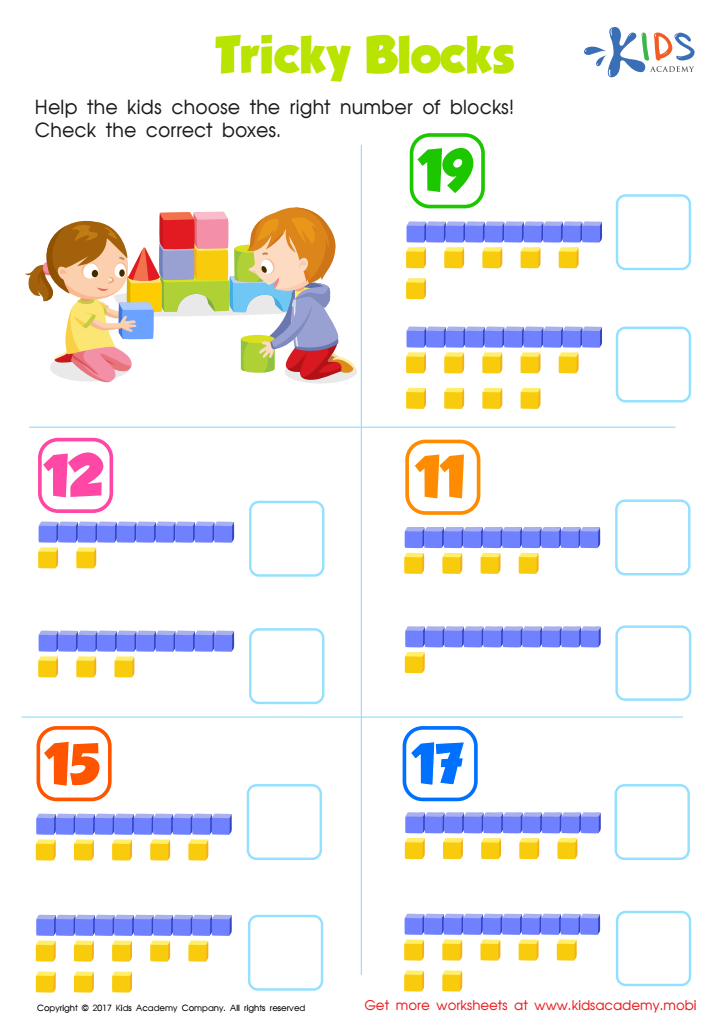
Tricky Blocks Worksheet
Help your child count with this printable worksheet. You'll be able to explain the technicalities of each answer as you work together to count the boxes and choose the correct number in the spaces provided. This will help your child better understand the concept and will go faster than if they do it alone.
 Assign to My Students
Tricky Blocks Worksheet
Worksheet
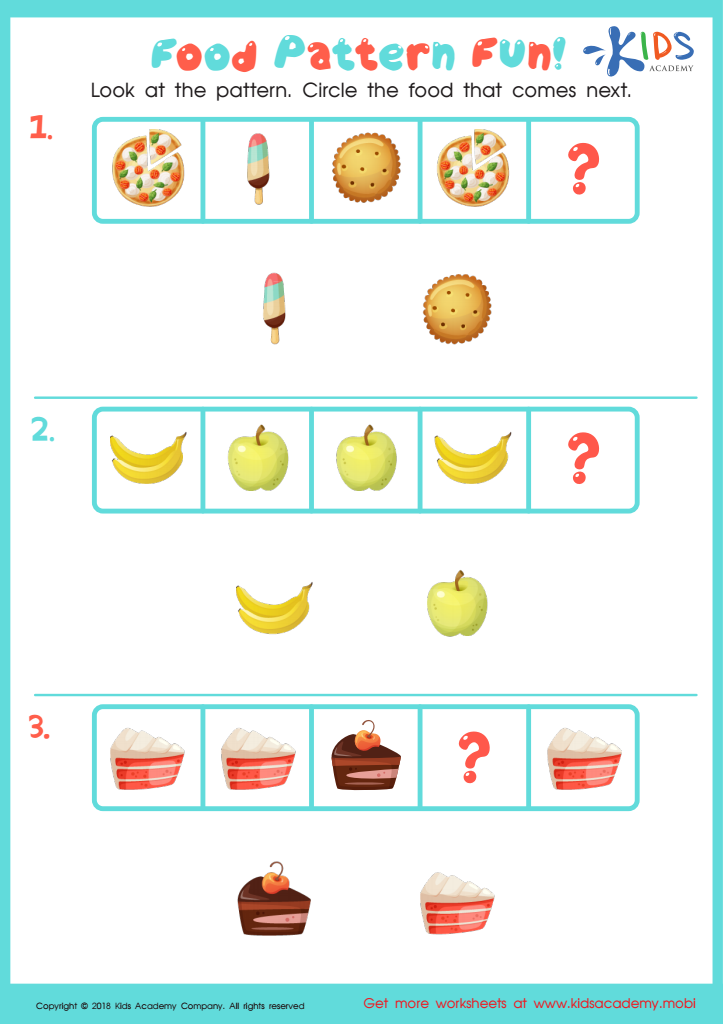
Food Pattern Fun Worksheet
Got kids who love snacks? Get them excited with this fun food pattern worksheet! Ask them to identify the foods in the printout then spot the pattern and circle the next food in each row. It's a great way to get them thinking and have fun at the same time!
Food Pattern Fun Worksheet
Worksheet
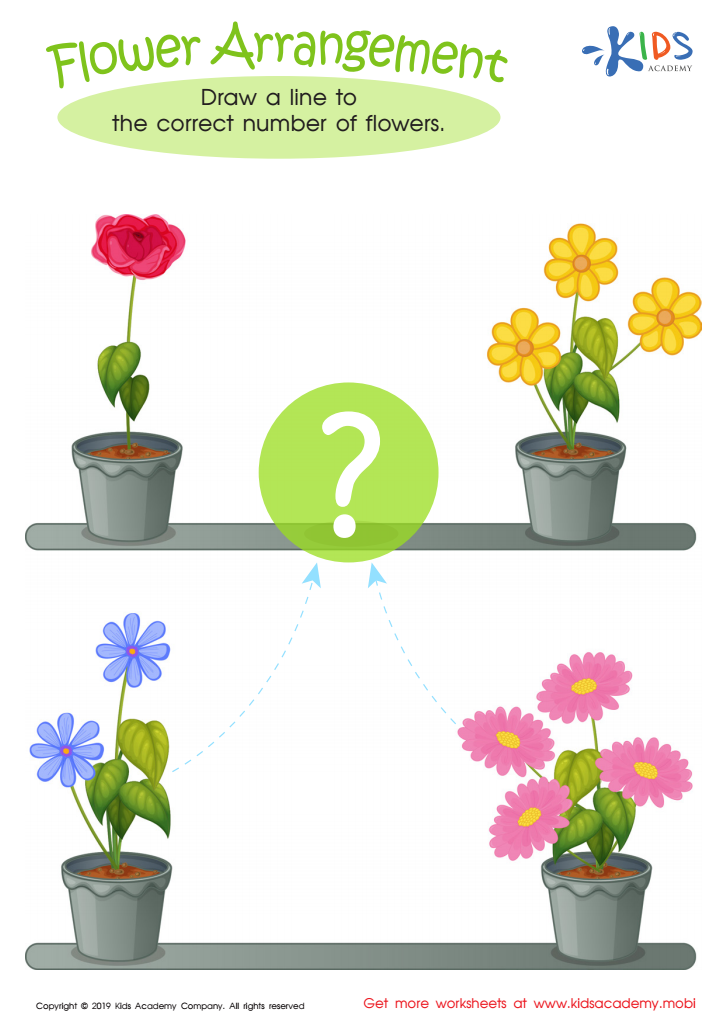
Flower Arrangement Worksheet
Your math whizzes can use flower power to showcase their counting skills with this bright PDF! One-to-one representation in pictures helps children build number sense, which leads to better math and computation efficiencies. This PDF features traceable lines for kids to draw to the correct number of flowers, all while practicing their counting with pretty pictures.
Flower Arrangement Worksheet
Worksheet
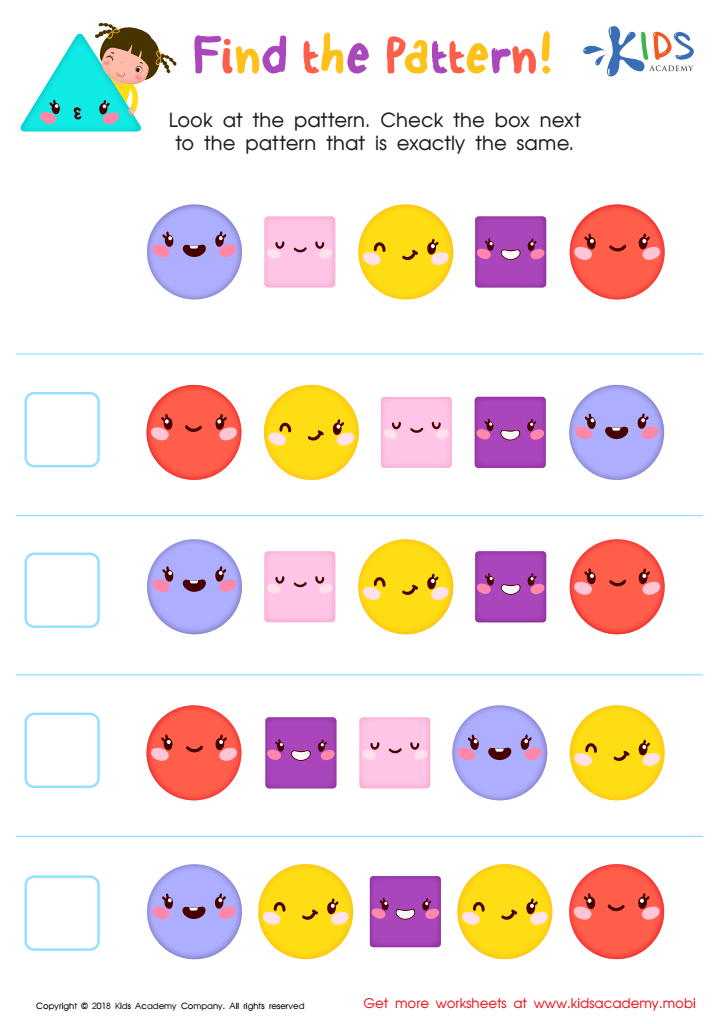
Find the Pattern Worksheet
This colorful pattern worksheet is perfect for testing your kids' pattern recognition. The bright colors will keep them engaged, while they check the box next to the pattern that is the same. Ask your kids to identify the colors used and see how well they can spot similarities!
Find the Pattern Worksheet
Worksheet
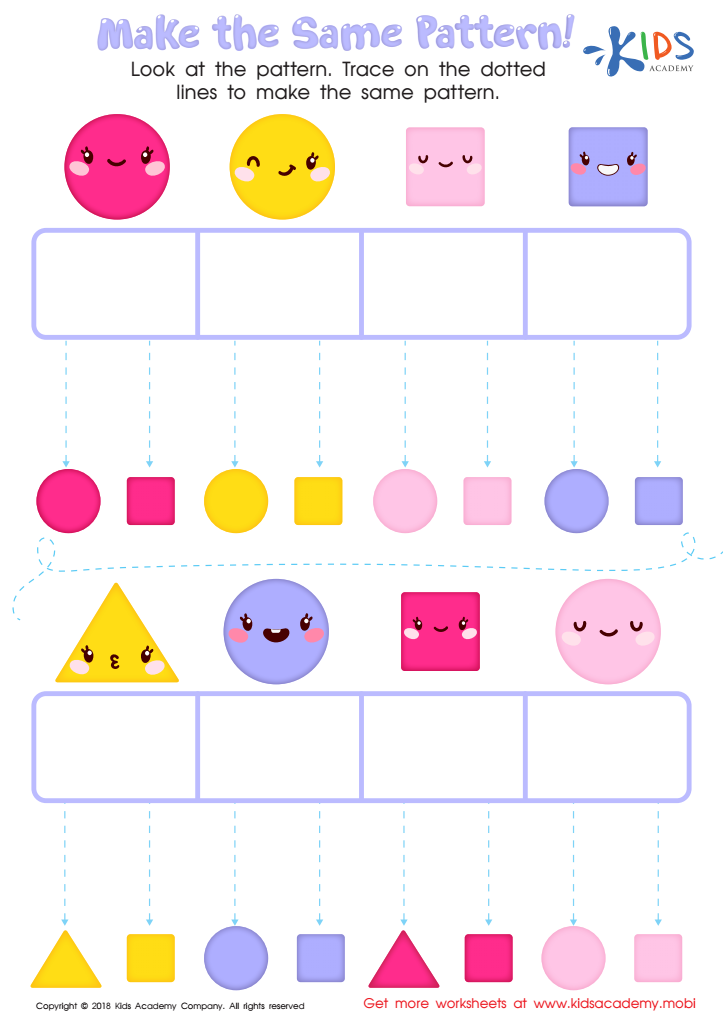
Make the Same Pattern Worksheet
Help your child look at the patterns in the tracing sheet and guide them to trace the dotted lines to match the shapes. This exercise tests their ability to copy pictures correctly, so emphasize the importance of paying attention to the instructions and details.
Make the Same Pattern Worksheet
Worksheet
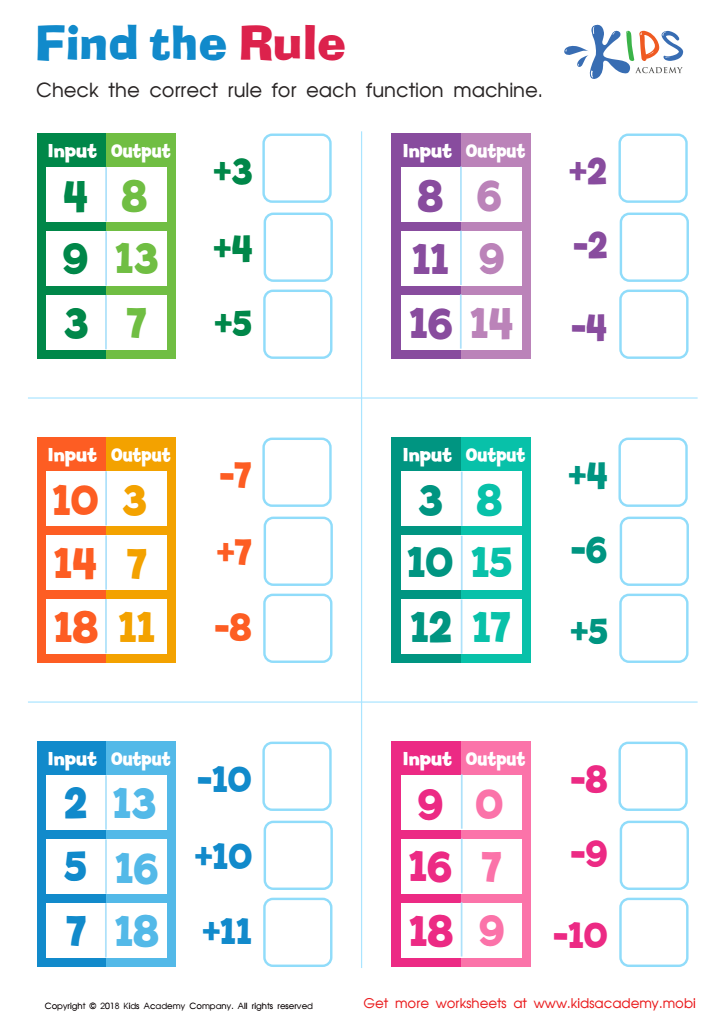
Find the Rule Worksheet
A function machine is an elementary math tool used to find an output by applying a rule, like addition or subtraction, to an input. Children use the diagram to understand the relationship between each input and output, with this worksheet helping them to analyze the machine and find the rule being used.
Find the Rule Worksheet
Worksheet
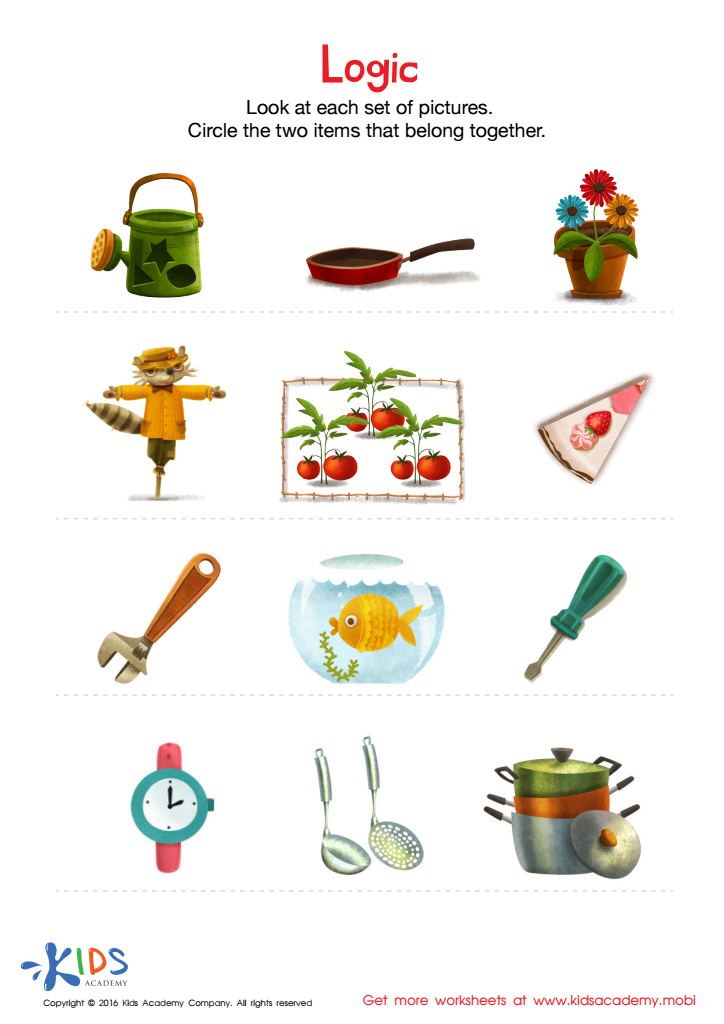
Logic Game Sorting Worksheet
Start your child's logic and reasoning development early with this fun matching worksheet! Through cute images and simple conversations, your little one can learn problem-solving, categorization, and matching skills. Plus, it's a great way for children to explore how items are used in real life. Try it and watch them boost skills with ease and fun!
Logic Game Sorting Worksheet
Worksheet
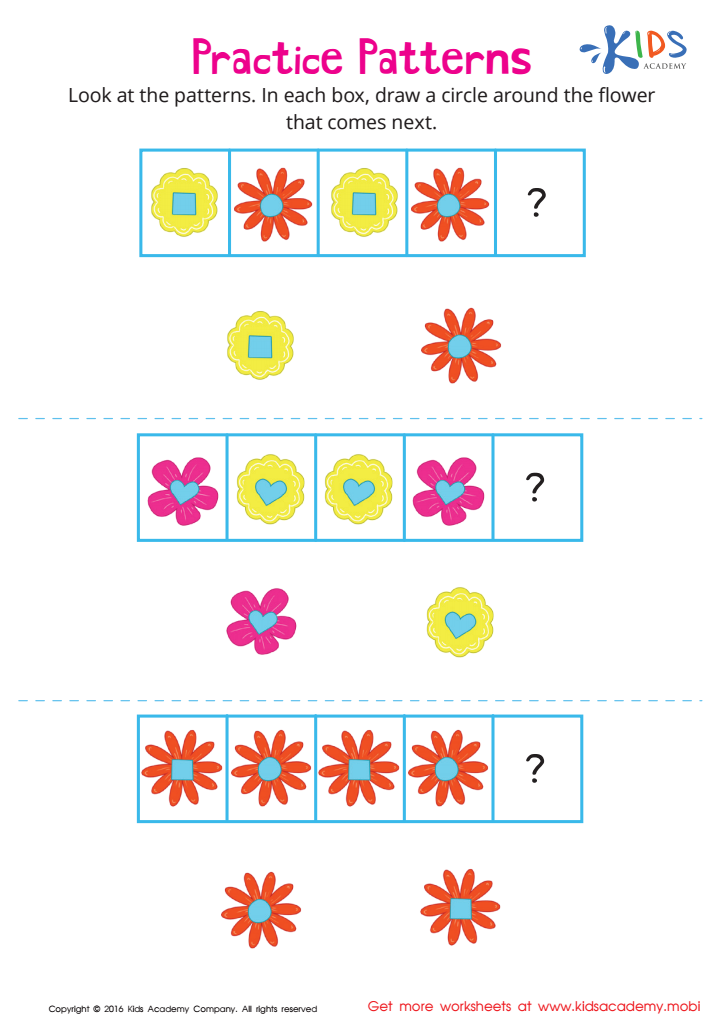
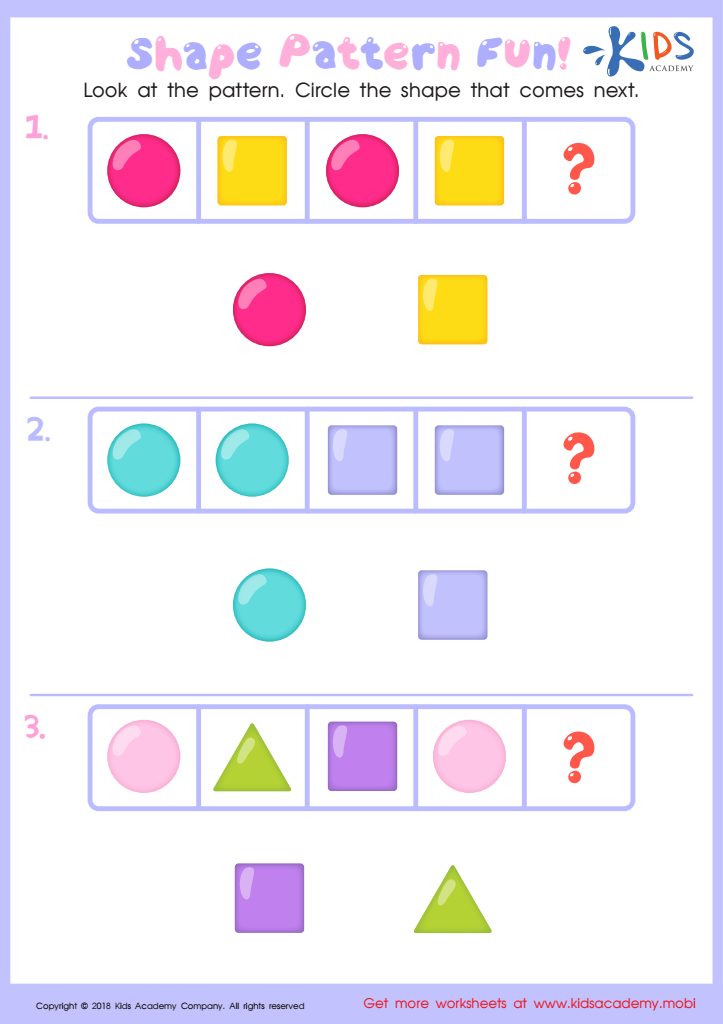
Shape Pattern Fun Worksheet
Challenge your kids to look at the pictures and identify colors, shapes and patterns. Ask them to circle the shapes that follow the sequence. See if they can spot the pattern and stick to it!
Shape Pattern Fun Worksheet
Worksheet
Join Kids Academy for Free
Who is primarily going to use this learning content?




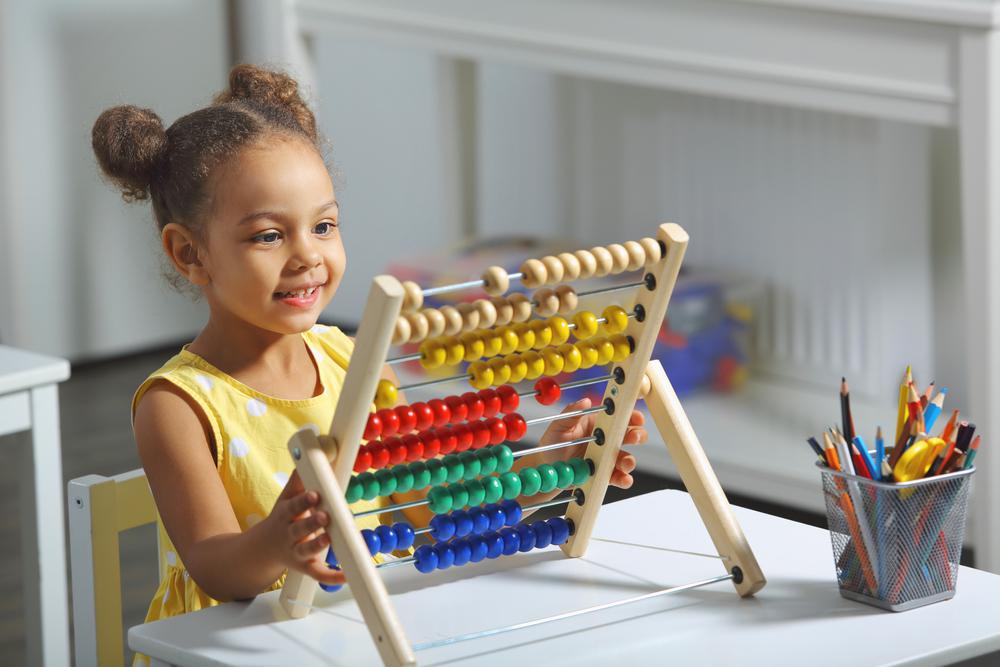



Pattern recognition is a fundamental skill that plays a pivotal role in mathematics, particularly for children aged 4-9. As young learners encounter various shapes, numbers, and arrangements, engaging with patterns enables them to categorize and make sense of the world around them. Parents and teachers should prioritize pattern recognition because it serves as a building block for critical thinking, problem-solving, and advanced mathematical concepts.
Through pattern recognition, children develop observational skills and attention to detail, which are essential for successful learning across all subjects. This skill lays the groundwork for understanding relationships, sequences, and mathematical operations, helping them grasp addition, subtraction, and even early algebraic concepts as they progress. Additionally, engaging with patterns enhances creativity as children begin to see connections and possibilities in different contexts.
Moreover, early mastery of pattern recognition fosters confidence and perseverance in young learners, encouraging a positive attitude towards math and learning in general. Parents and teachers can use everyday experiences—like nature, art, and music—to highlight patterns, making math more relatable and fun. By nurturing these skills early on, we empower children to think critically and enjoy learning, ultimately leading to greater academic success and a lifelong love of mathematics.








