
Understanding opposites Normal Worksheets for Ages 5-8
3 filtered results
Difficulty Level
Grade
Age
-
From - To
Subject
Activity
Standards
Explore the fun and engaging "Understanding Opposites" worksheets designed for children ages 5-8! These printable resources from Kids Academy help young learners grasp the concept of opposites through colorful activities and relatable examples. Perfect for maintaining their interest and enhancing their vocabulary, these worksheets encourage critical thinking and creativity. Children will enjoy identifying pairs of opposites, such as hot and cold or big and small, while improving their reading and comprehension skills. Whether used at home or in the classroom, these worksheets serve as an excellent educational tool to support early childhood learning and development. Start fostering curiosity and knowledge today!
Favorites
With answer key
Interactive
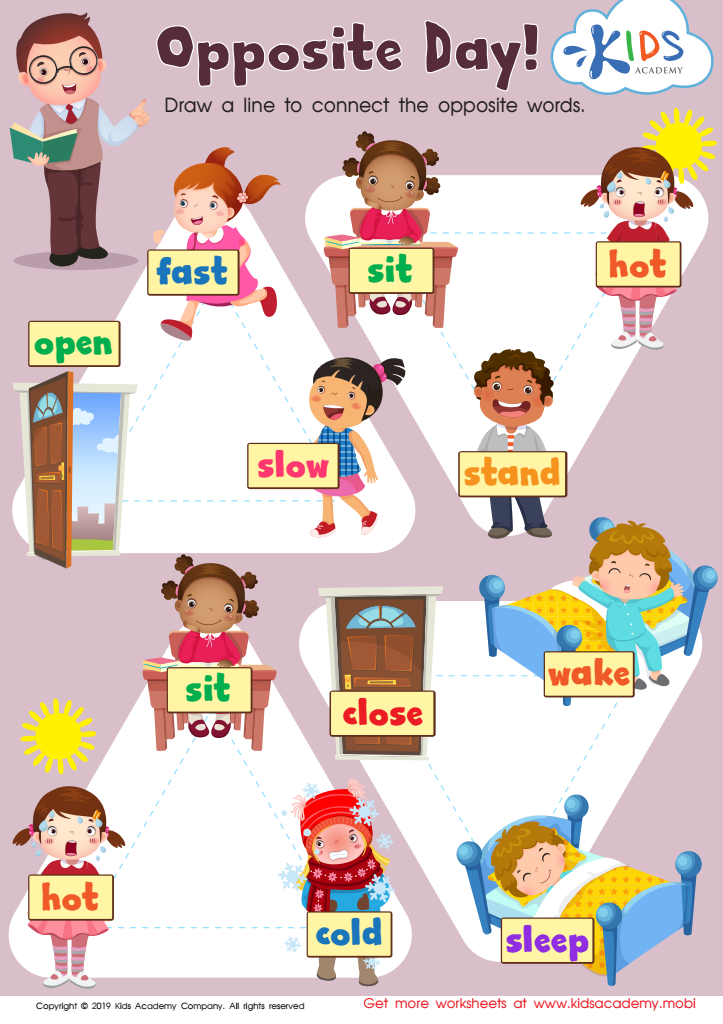
Opposite Day Worksheet
Early learners need to know about opposites to improve their higher-order thinking and critical thinking. This fun worksheet helps them understand the concept, practice opposite words, read high-frequency words and work on fine motor skills. Download the traceable PDF to get started.
 Assign to My Students
Opposite Day Worksheet
Worksheet
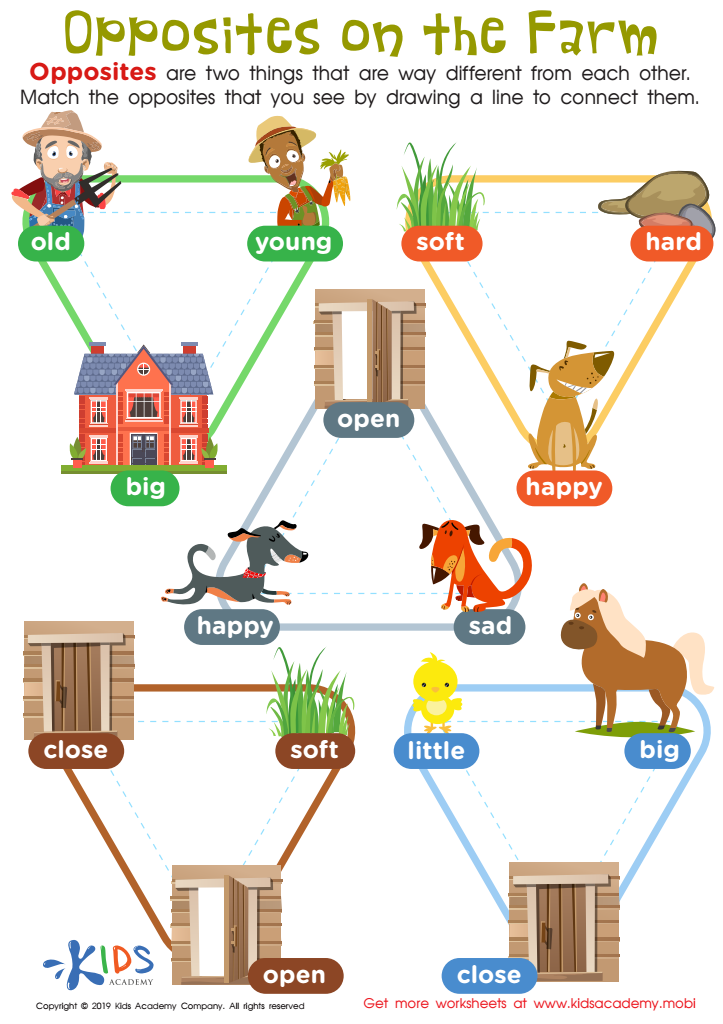
Opposites on the Farm Worksheet
Teaching children the concept of opposites is important for their development. This worksheet offers a fun way to practice. Kids can use traceable lines to match farm imagery with pairs of opposites. It's a great way to help them compare and contrast, a key skill for reading, math, writing and more.
Opposites on the Farm Worksheet
Worksheet
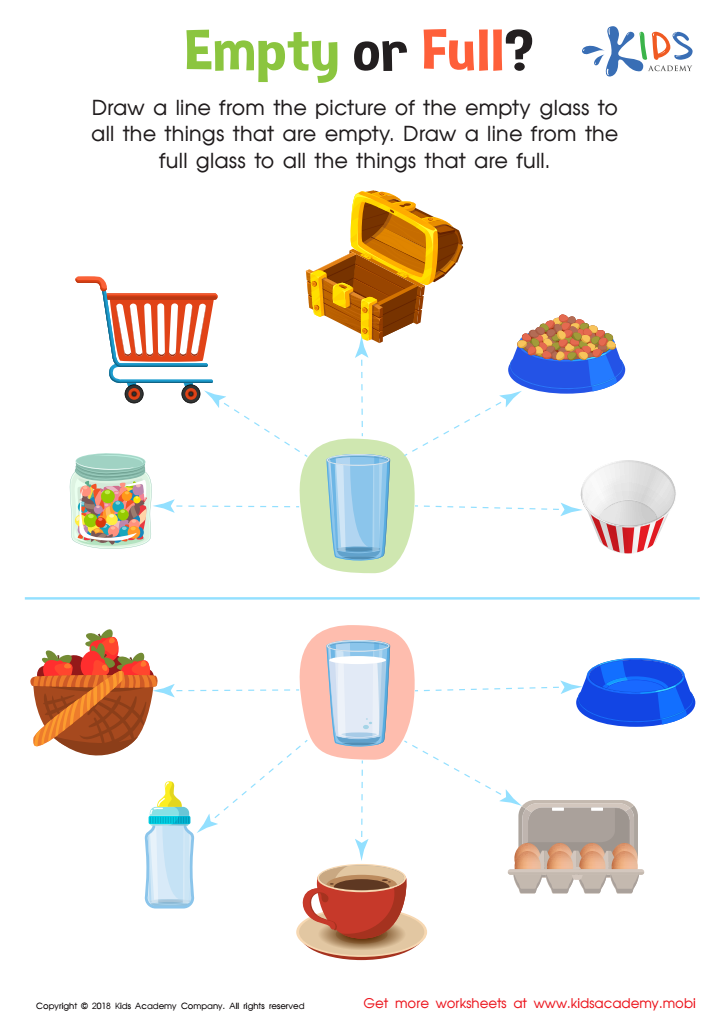
Empty or Full? Worksheet
Let students get to grips with the concepts of empty and full with this PDF worksheet. It uses fun, bright pictures to help them comprehend the difference and also helps develop fine-motor skills with tracing lines. Kids will be proud of themselves as they get answers right!
Empty or Full? Worksheet
Worksheet
Join Kids Academy for Free
Who is primarily going to use this learning content?






Understanding opposites is crucial for children aged 5-8 as it lays the foundation for essential cognitive and language development. At this age, children engage in active exploration of their environments, and recognizing opposites helps them make sense of the world around them. Concepts like hot/cold, big/small, and happy/sad are fundamental to their understanding of directions, emotions, and physical attributes.
For parents and teachers, fostering this understanding aids in developing critical thinking and problem-solving skills. Children learn to categorize and differentiate, enhancing their ability to classify objects and experiences. Advertisements, storytelling, and everyday conversations often include oppositional terms, making comprehension of these concepts vital for effective communication.
Moreover, understanding opposites positively impacts emotional intelligence, as children begin to recognize and express contrasting feelings. This awareness promotes empathy, as they understand others' emotions in relation to their own experiences.
Incorporating playful activities, such as games, songs, and imaginative play focused on this concept, can reinforce learning in an engaging manner. Overall, emphasizing opposites contributes to well-rounded development in language, mathematics (comparing sizes), social interactions, and emotional health, making it essential for parents and teachers to prioritize this knowledge in early learning environments.








