
Basic geometry understanding Normal Geometry Worksheets for Ages 5-8
3 filtered results
Difficulty Level
Grade
Age
-
From - To
Subject
Activity
Standards
Boost your child's math skills with our Normal Geometry Worksheets, perfect for ages 5-8. These engaging activities introduce basic geometric concepts, enhancing their understanding of shapes, spatial awareness, and problem-solving abilities. Each worksheet is designed to align with early learning standards, making it an excellent educational tool for both parents and teachers. Through fun and interactive lessons, kids will learn to identify, compare, and create various shapes, laying a strong foundation for future mathematical success. Download our free worksheets today and watch your young learner's confidence and competence in geometry grow!
Favorites
With answer key
Interactive
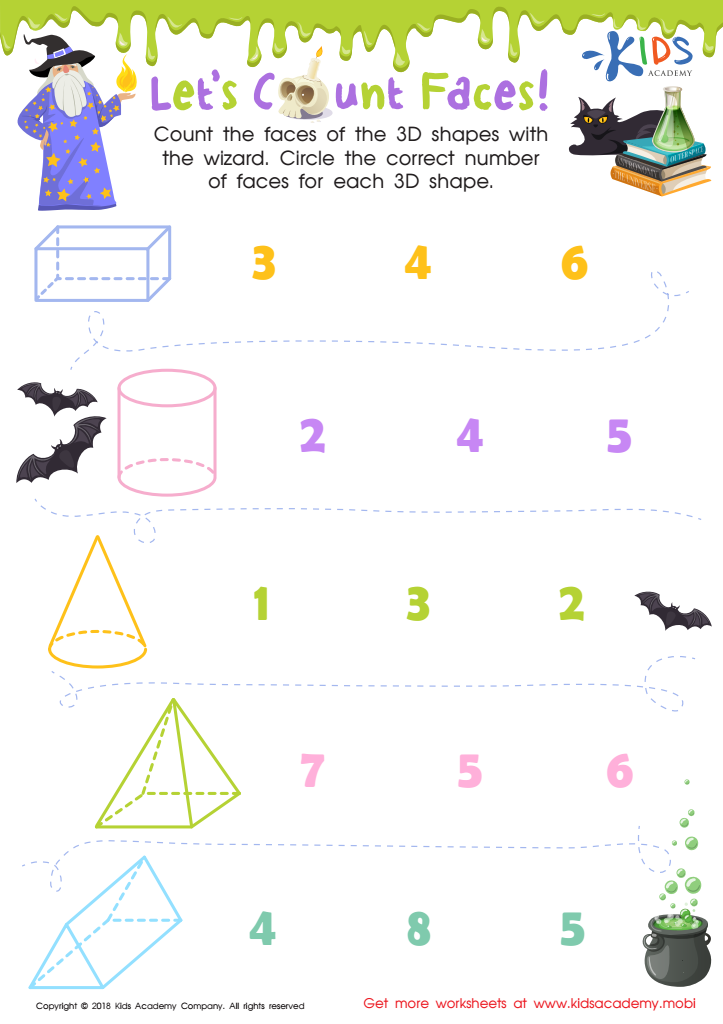
Let's Count Faces! Worksheet
Help the wizard count the faces of 3D shapes! Ask your kids to identify the shapes before beginning, then have them circle the correct number of faces. Enjoy this fun wizard-themed worksheet with your kids!
 Assign to My Students
Let's Count Faces! Worksheet
Worksheet











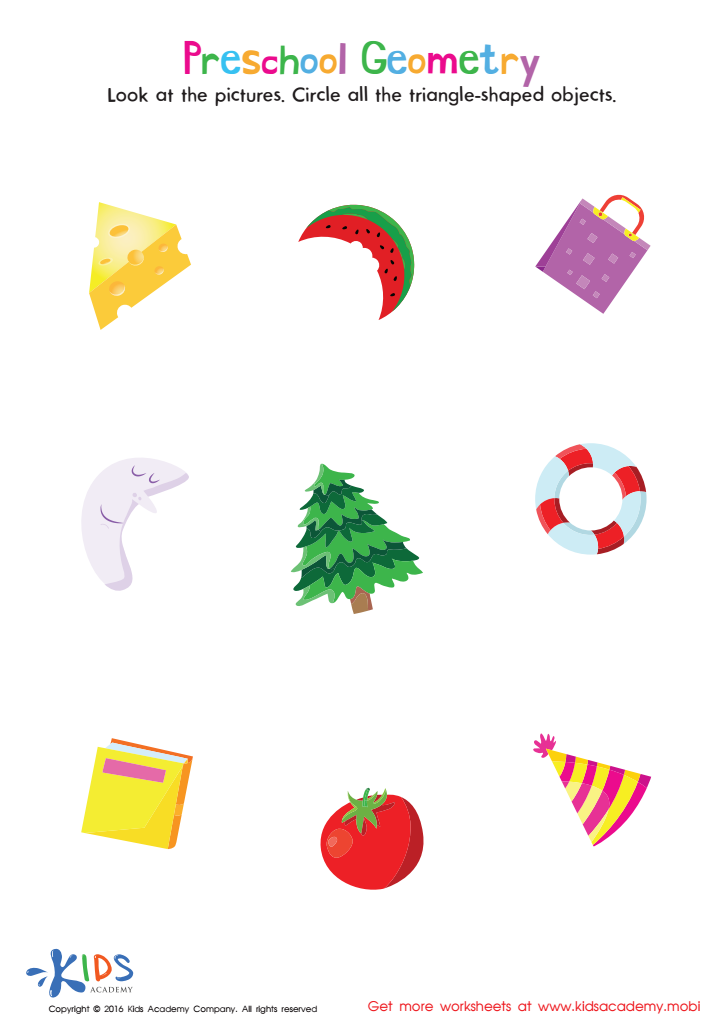
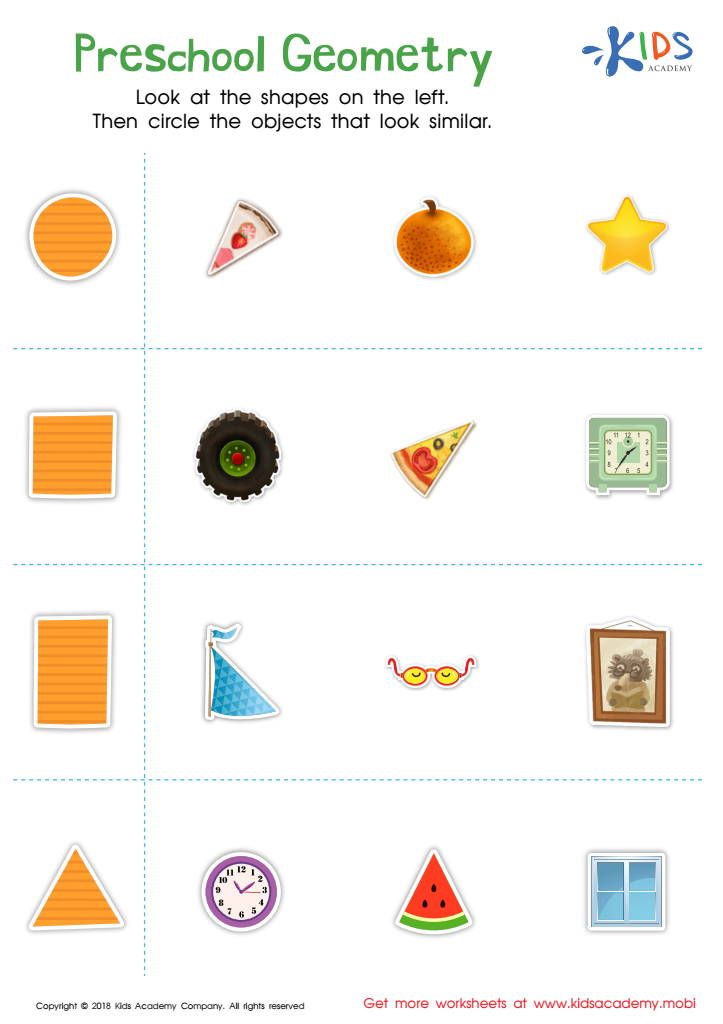
Preschool Geometry Worksheet
This worksheet gives 3rd graders the basics of geometry. Kids match everyday objects to shapes they know, e.g. an orange to a circle, a square to a slice of watermelon and a rectangle to a picture frame. It's a fun way to give them confidence to tackle more complex geometry in the future.
Preschool Geometry Worksheet
Worksheet
Join Kids Academy for Free
Who is primarily going to use this learning content?








Basic geometry is fundamental for children aged 5-8 as it lays the groundwork for spatial awareness, critical thinking, and problem-solving skills. Understanding shapes, sizes, and the properties of space helps young minds make sense of the world around them. Geometry is not just about math; it’s a language that helps children describe and interact with their surroundings. For instance, identifying and sorting shapes enhances visual and tactile learning, while concepts like symmetry and patterns foster early algebraic thinking.
From a developmental perspective, engaging with geometry strengthens fine motor skills through activities like drawing shapes and building structures. These hands-on experiences translate to better coordination and precision in daily tasks. Furthermore, early exposure to geometry can boost cognitive skills by promoting logic and reasoning.
In the context of education, a solid grasp of basic geometric concepts paves the way for future success in more advanced mathematics and science. It ties into other subjects, such as art and engineering, showing the interdisciplinary nature of learning.
For parents and teachers, nurturing an interest in geometry adds another layer to a child’s educational foundation, making learning more comprehensive and enjoyable. Encouraging curiosity and exploration in geometry ensures children are well-prepared for academic challenges ahead. In essence, geometry shapes thinking and fosters a well-rounded approach to learning.








