Filters

29 filtered results

Clear all filters
Favorites
With answer key
Interactive

29 filtered results

Difficulty Level

Grade


Subject

    Check out this FREE Trial Lesson on Addition and Subtraction Word Problems for age 6-8!

    1 Step Subtraction Word Problems - Using Drawings to Write Equations

    Favorites
    With answer key
    Interactive
    • 6-8
    • Addition and Subtraction Word Problems
    • Normal
    Party Problems Worksheet
    Party Problems Worksheet

    Party Problems Worksheet

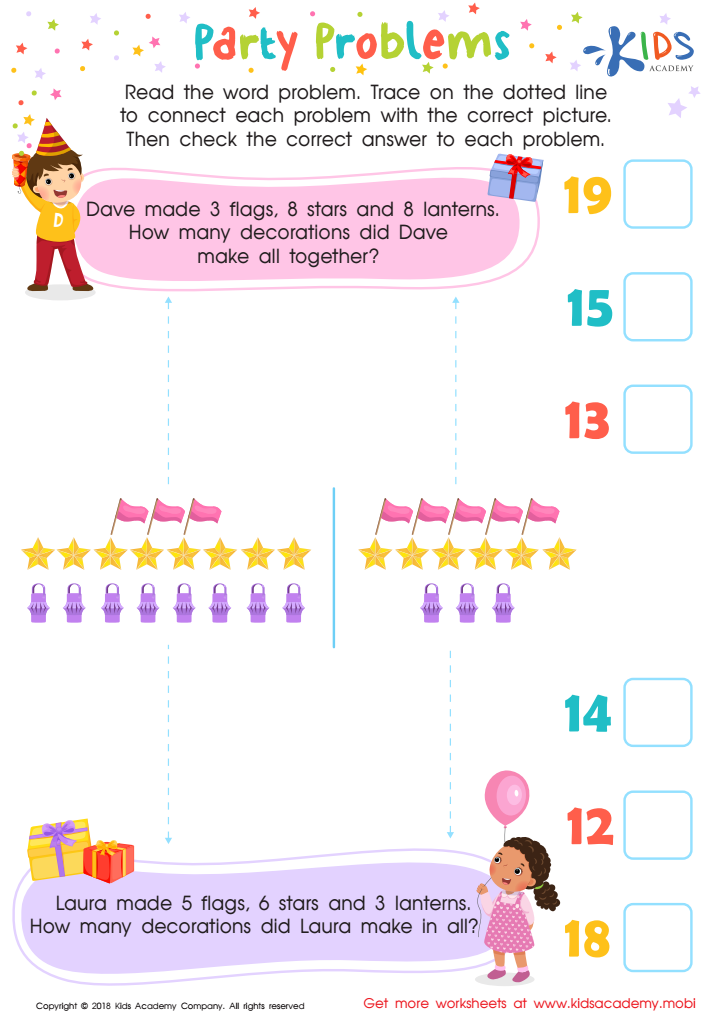
    Problems at parties? No problem! With this engaging PDF worksheet, your student can connect word problems to pictures, check correct answers, and find the sum of 3 addend problems. They'll be a party-saving hero in no time!
    Party Problems Worksheet
    Worksheet
    Reggie's Reuse Word Problems: Subtraction Worksheet
    Reggie's Reuse Word Problems: Subtraction Worksheet

    Reggie's Reuse Word Problems: Subtraction Worksheet

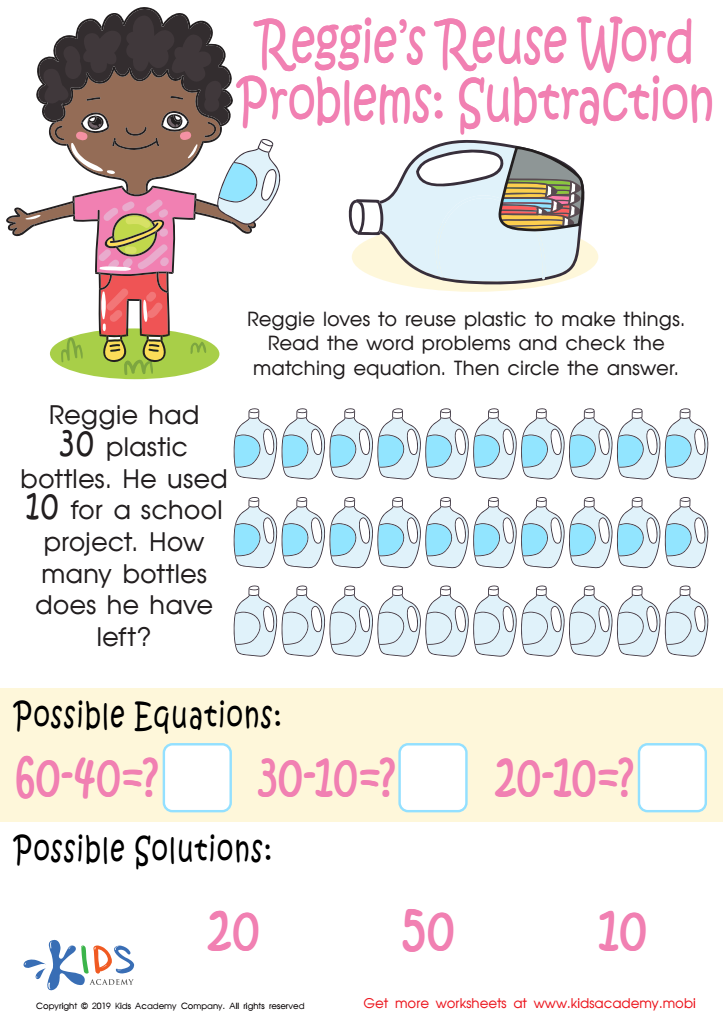
    Kids can help pal Reggie become an eco-friendly friend! This PDF teaches kids subtraction and one-to-one number representation. They'll use pictures to solve word problems and find out how many plastic bottles Reggie can reuse. They'll also match number equations and solutions to get the right answer.
    Reggie's Reuse Word Problems: Subtraction Worksheet
    Worksheet
    Counting with Drawings:Fruits & Flowers Worksheet
    Counting with Drawings:Fruits & Flowers Worksheet

    Counting with Drawings:Fruits & Flowers Worksheet

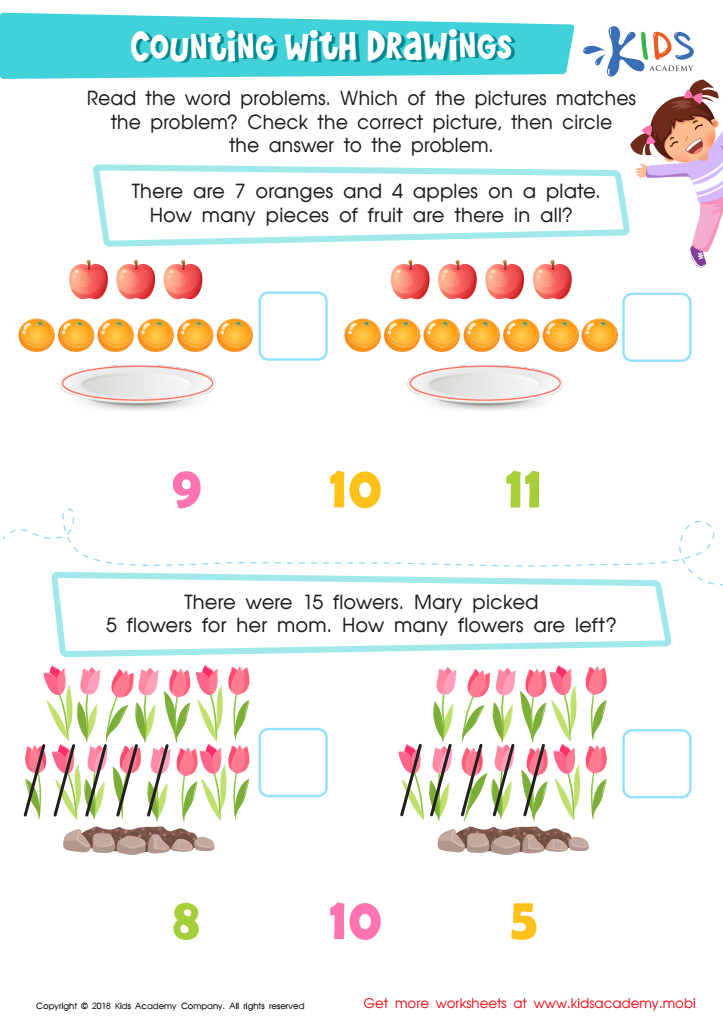
    At Kids Academy, we know pictures make math come alive and make sense. This worksheet is perfect for early learners to practice word problems. Kids read each problem and count the images that represent the numbers, then solve the problem with addition or subtraction to get the right answer.
    Counting with Drawings:Fruits & Flowers Worksheet
    Worksheet
    Supermarket Math Worksheet
    Supermarket Math Worksheet

    Supermarket Math Worksheet

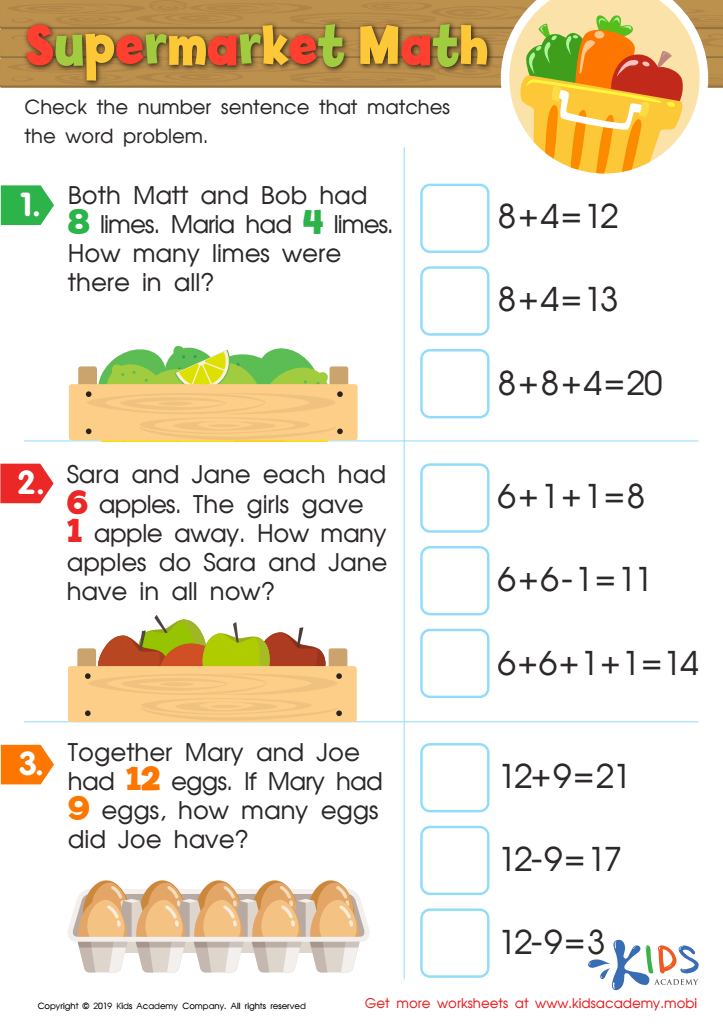
    Take your kids to the supermarket and ask what they're looking forward to buying. Help them solve the three questions in the worksheet by interpreting each one into an equation, then choose the right answer.
    Supermarket Math Worksheet
    Worksheet
    Recycling - More or Less Worksheet

    Recycling - More or Less Worksheet

    Recycling - More or Less Worksheet

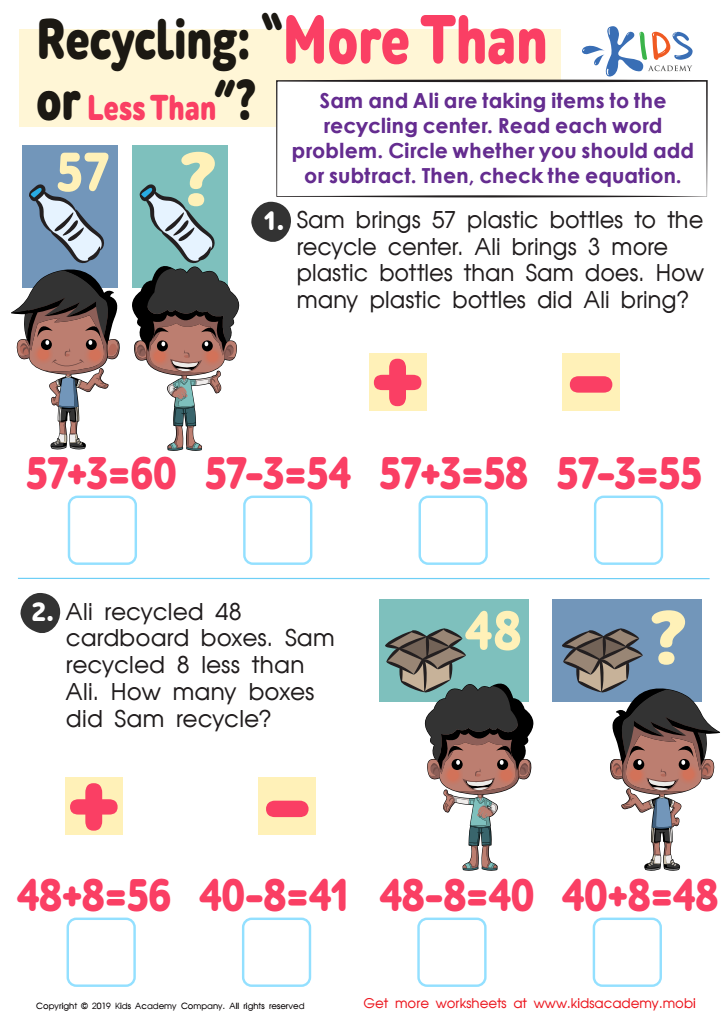
    Your child can compare numbers and solve word problems with this free worksheet. Help them understand what's being asked as Sam and Ali take items to the recycling center. They can choose the correct equation to match the word problem and apply their skills in reading and pulling out the appropriate information.
    Recycling - More or Less Worksheet

    Worksheet


    Parents and teachers should prioritize Normal Addition and Subtraction Word Problems for children aged 6-8 because these tasks are fundamental in developing critical mathematical skills and reasoning. At this age, children are transitioning from simple arithmetic to applying their knowledge in real-world contexts. Word problems encourage them to interpret situations, identify relevant information, and choose the appropriate operation—skills that are crucial for problem-solving in everyday life.

    Moreover, these problems promote mathematical language acquisition, helping children articulate their understanding and approaches to solving challenges. This strengthens their communication skills, allowing them to share their reasoning clearly with others, fostering collaboration and discussion.

    Practicing word problems also highlights the significance of critical thinking; students learn to analyze what a question is asking rather than merely performing rote calculations. Successfully solving these problems builds confidence and resilience, as children experience the satisfaction of overcoming challenges.

    In summary, by focusing on Normal Addition and Subtraction Word Problems, parents and teachers can effectively nurture a child's mathematical foundation, enhance their reasoning and communication abilities, and prepare them for more complex mathematical concepts in the future. Engaging with these problems supports both academic growth and real-life application, laying the groundwork for lifelong learning.