
Pattern recognition Normal Math Worksheets for Ages 7-9
3 filtered results
Difficulty Level
Grade
Age
-
From - To
Subject
Activity
Standards
Unlock your child's potential with our engaging Pattern Recognition Math Worksheets designed specifically for ages 7-9! These printable resources offer a fun and interactive way for young learners to develop essential pattern recognition skills critical for mastering mathematical concepts. With a variety of worksheets that challenge kids to identify, analyze, and extend patterns, they will enhance their problem-solving abilities and boost their confidence in math. Our user-friendly format ensures easy printing and at-home use, making learning convenient for parents and enjoyable for children. Foster a love for math and watch your child thrive as they explore the world of patterns!
Favorites
With answer key
Interactive
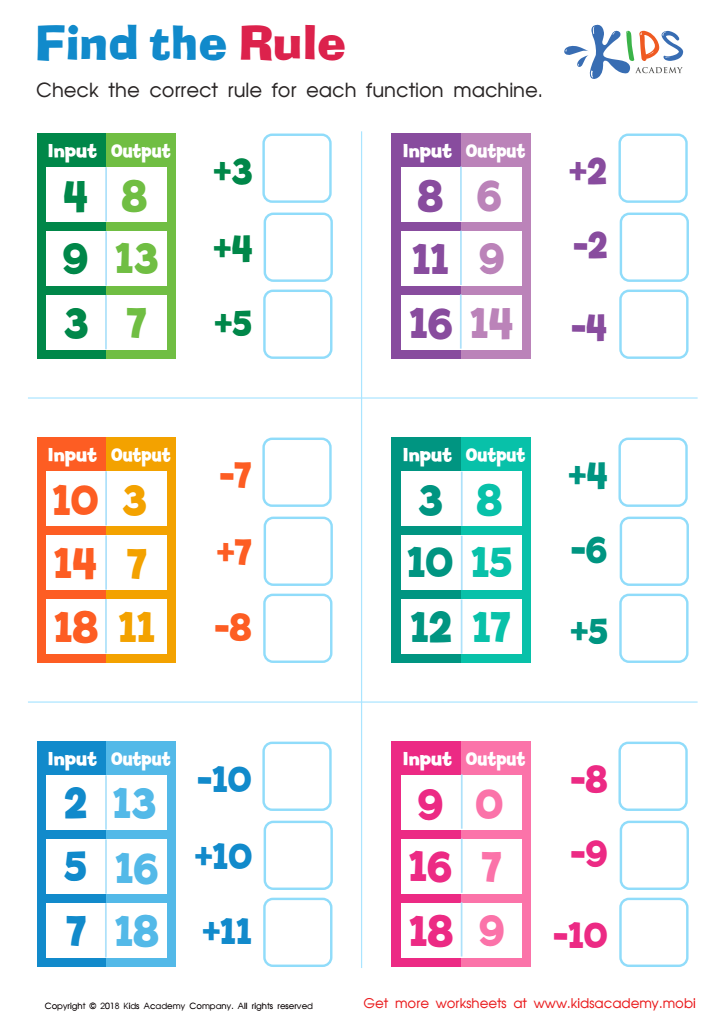
Find the Rule Worksheet
A function machine is an elementary math tool used to find an output by applying a rule, like addition or subtraction, to an input. Children use the diagram to understand the relationship between each input and output, with this worksheet helping them to analyze the machine and find the rule being used.
 Assign to My Students
Find the Rule Worksheet
Worksheet
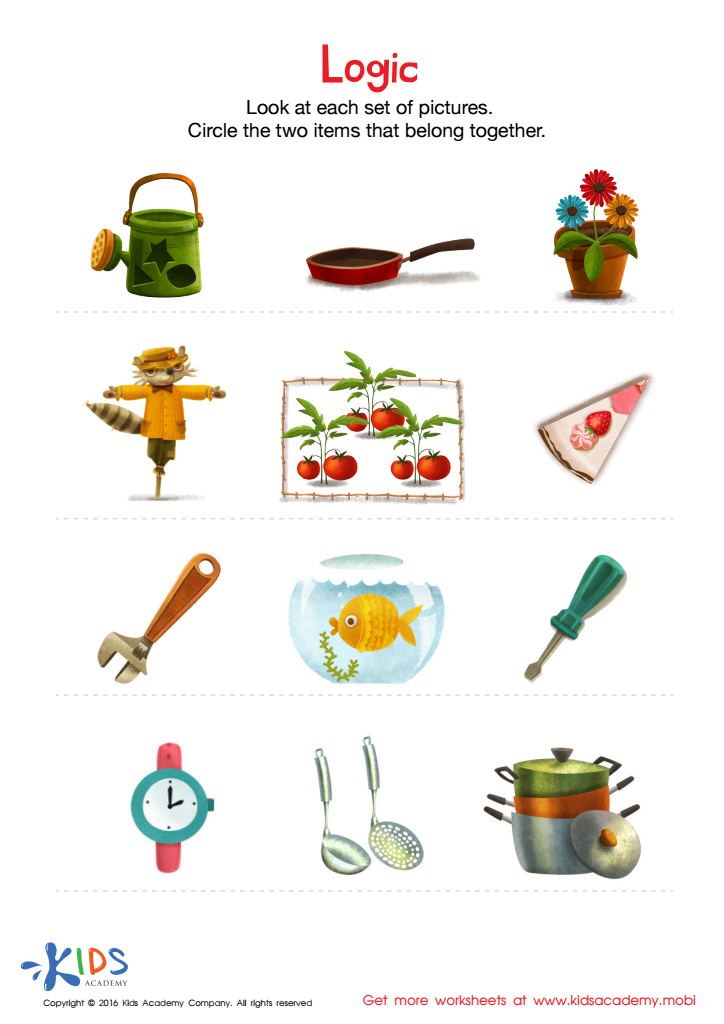
Logic Game Sorting Worksheet
Start your child's logic and reasoning development early with this fun matching worksheet! Through cute images and simple conversations, your little one can learn problem-solving, categorization, and matching skills. Plus, it's a great way for children to explore how items are used in real life. Try it and watch them boost skills with ease and fun!
Logic Game Sorting Worksheet
Worksheet
Join Kids Academy for Free
Who is primarily going to use this learning content?





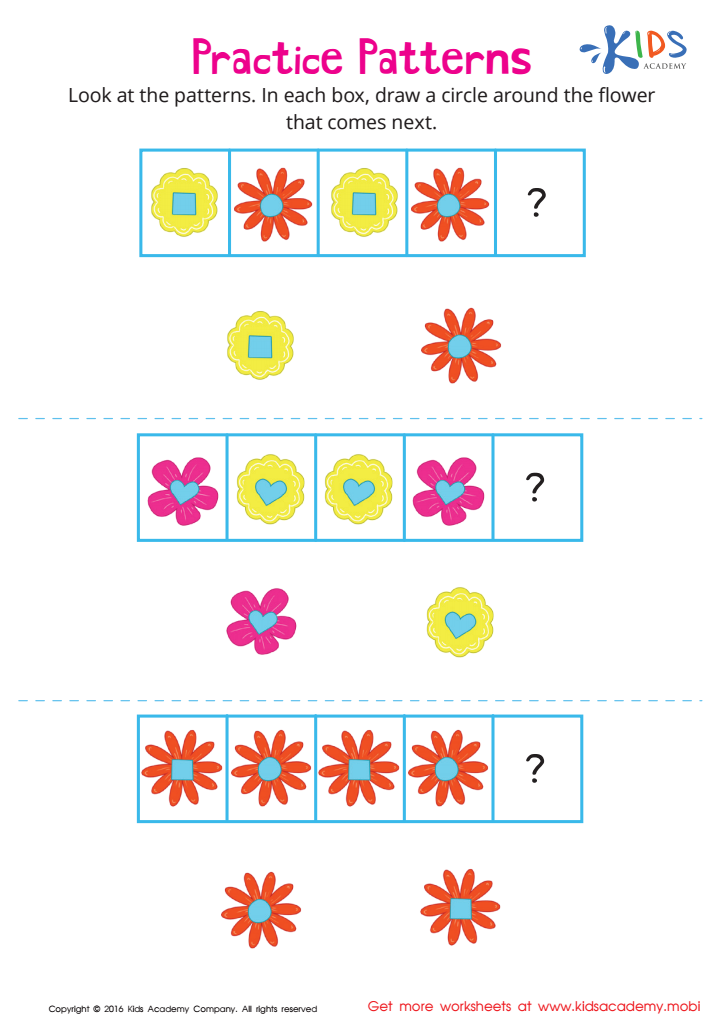
Pattern recognition is a crucial aspect of mathematical understanding for children ages 7-9, and teachers and parents should care deeply about fostering this skill. At this age, children are transitioning from concrete mathematical concepts to more abstract thinking. Pattern recognition helps them identify relationships and rules within numbers, shapes, and processes, laying a foundation for more complex mathematical concepts in the future.
By recognizing patterns, children can develop critical thinking and problem-solving skills. It encourages them to explore relationships and sequences, enhancing their ability to make predictions and draw conclusions. This skill not only applies in math but is also transferable to other subjects and real-life scenarios.
Moreover, engaging students in pattern recognition can spark their curiosity and interest in mathematics, making learning more enjoyable. Teachers and parents can incorporate fun activities such as games, puzzles, or visual arts that highlight patterns in everyday life. These experiences promote a sense of achievement and boost confidence in children's mathematical abilities. Ultimately, prioritizing pattern recognition in early math education equips children with the tools they need for success in academia and enriches their cognitive development. By emphasizing this skill, adults can support children's learning journeys both in and out of the classroom.








