Filters

32 filtered results

Clear all filters
Favorites
With answer key
Interactive

32 filtered results

Difficulty Level

Grade


Check out this FREE Math Trial Lesson for age 3-5!

Z

Favorites
With answer key
Interactive
  • Math
  • 3-5
  • Interactive
Shapes: Assessment 3 Worksheet

Shapes: Assessment 3 Worksheet

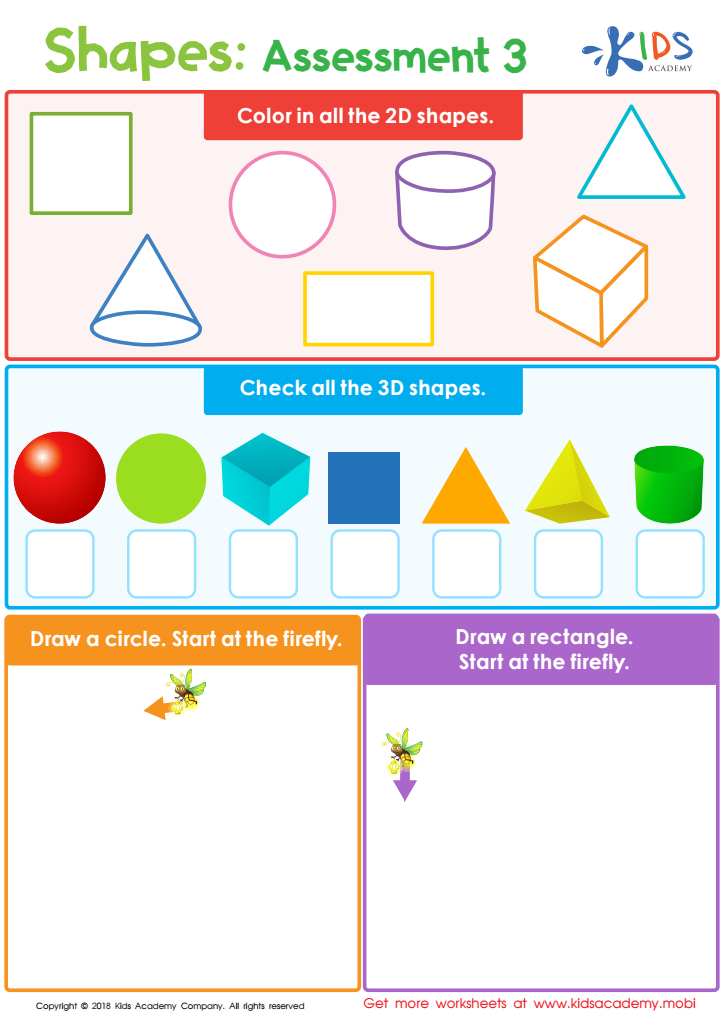
Shapes are everywhere! Help your students differentiate between 2D and 3D shapes. Ask them the difference between a triangle and pyramid, or a circle and a sphere. This worksheet tests their understanding of both types and is a useful assessment tool.
Shapes: Assessment 3 Worksheet
Worksheet
Shapes: Assessment 2 Worksheet

Shapes: Assessment 2 Worksheet

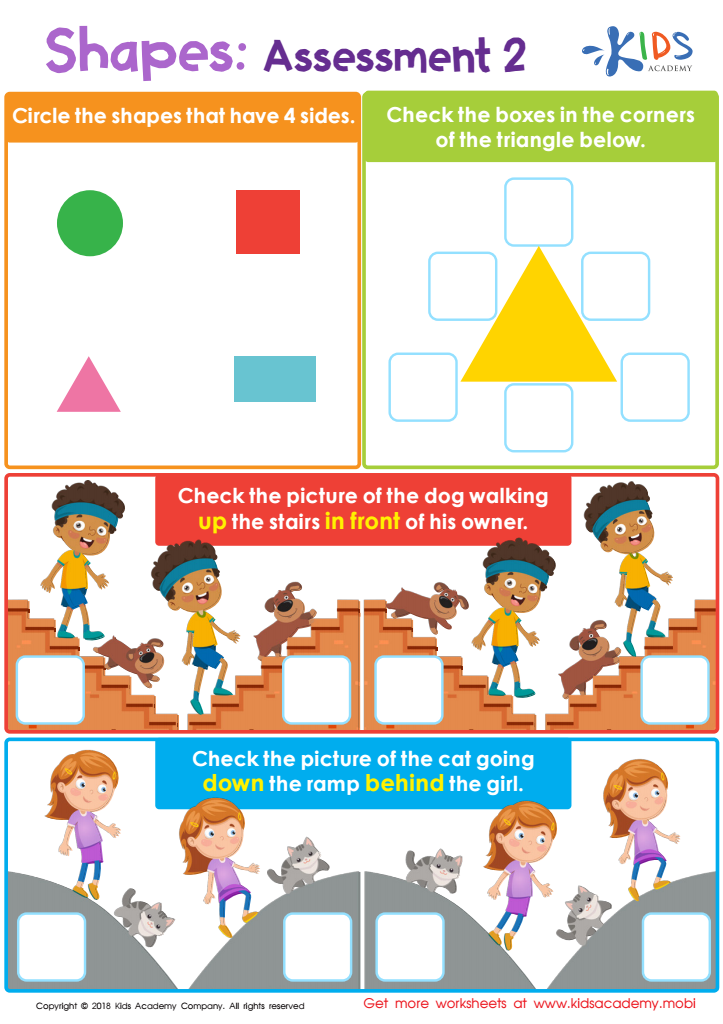
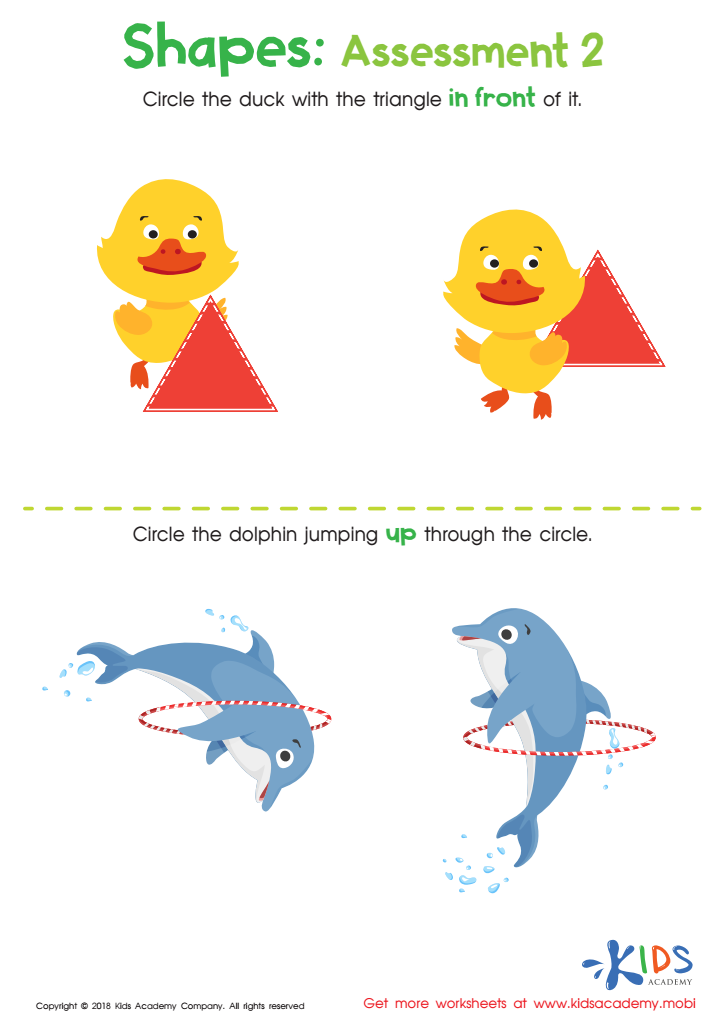
This geometry worksheet assesses a student's knowledge of shapes and positional words. They must identify shapes with 4 sides and corners on a triangle. The worksheet also tests understanding of words like "up", "front", "down" and "behind". Easily determine what your student knows about these concepts with this downloadable worksheet!
Shapes: Assessment 2 Worksheet
Worksheet
Shapes: Assessment 1 Worksheet

Shapes: Assessment 1 Worksheet

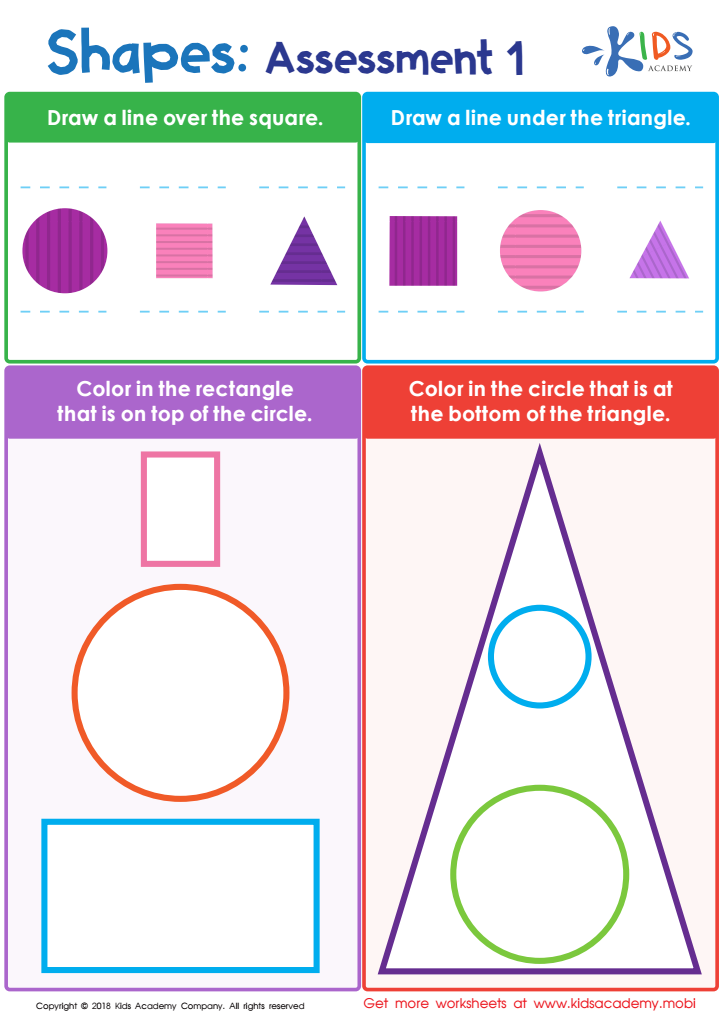
Test your students' understanding of the four basic shapes - circle, square, triangle and rectangle - with this assessment worksheet. Get them to draw a line over or under the shape indicated in the directions to show they can identify it correctly.
Shapes: Assessment 1 Worksheet
Worksheet
Geometry - Assessment 2 Worksheet Preview

Geometry – Assessment 2 Worksheet

Preschoolers will learn to identify circles and triangles and practice using terms like "in front of" to place objects. This skill is key to further learning and is an important part of development.
Geometry – Assessment 2 Worksheet
Worksheet
Geometry - Assessment 1 Worksheet Preview

Geometry – Assessment 1 Worksheet

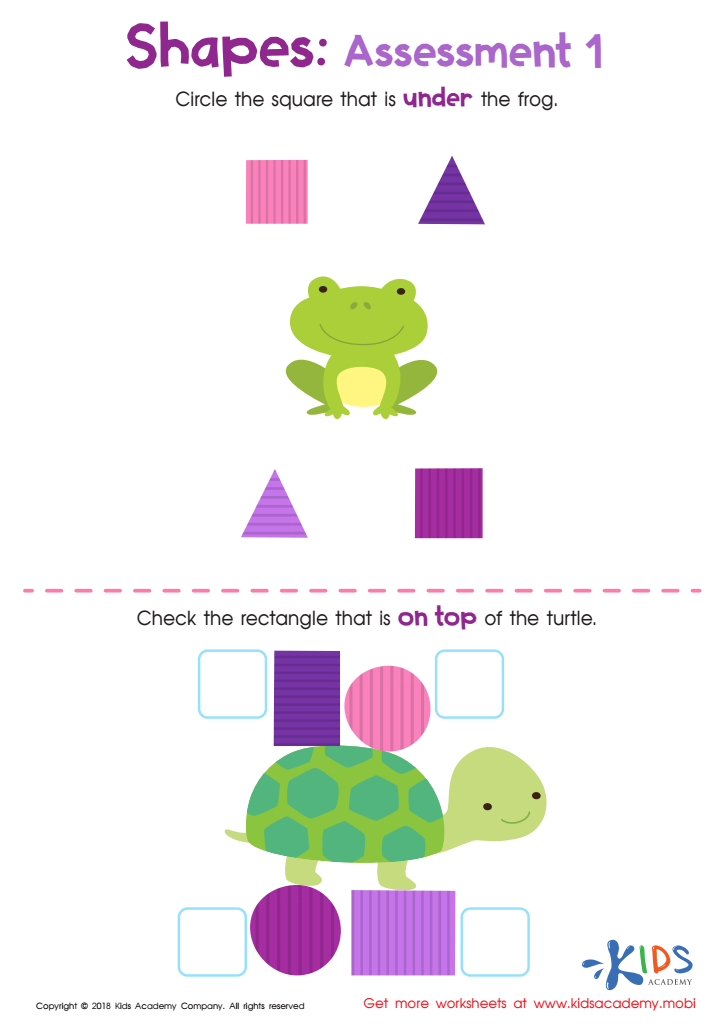
This activity helps preschoolers find shapes "on top of" and "under" animals. They must identify the correct shapes assigned to them. It's a great way to learn geometry and placements of objects.
Geometry – Assessment 1 Worksheet
Worksheet
Counting: Assessment 5 Worksheet

Counting: Assessment 5 Worksheet

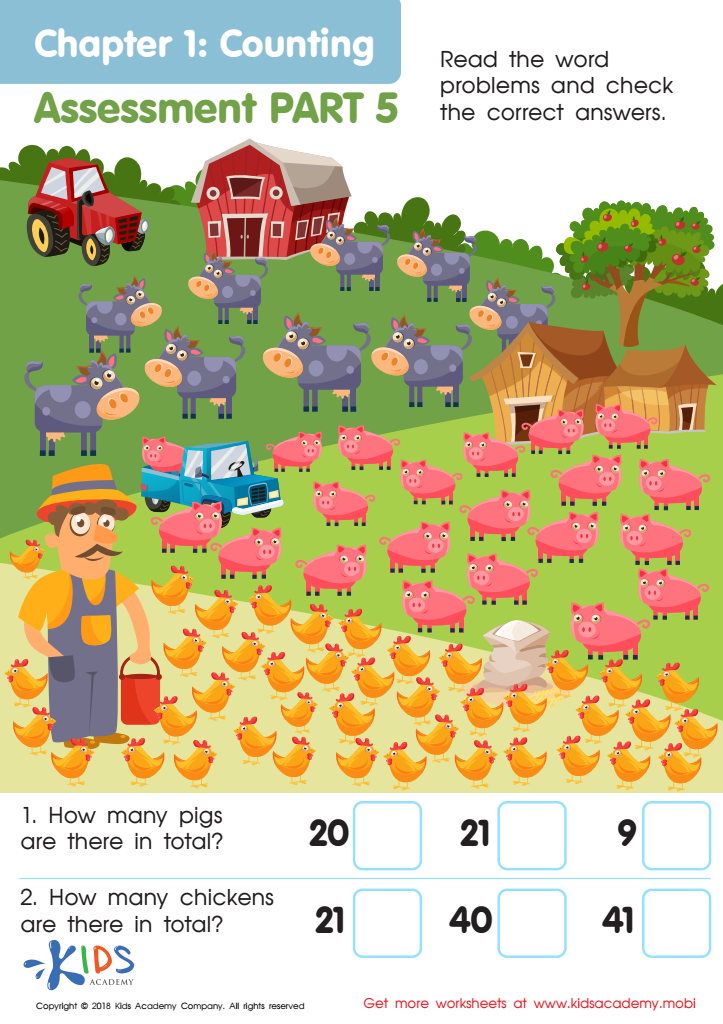
Let your kids have fun counting farm animals on this worksheet! Help the farmer count the animals and have your child check the answers to assess their counting skills. Read the word problem at the bottom of the page and count the animals together. It's an entertaining way to practice counting and have a great time!
Counting: Assessment 5 Worksheet
Worksheet
Counting: Assessment 4 Worksheet

Counting: Assessment 4 Worksheet

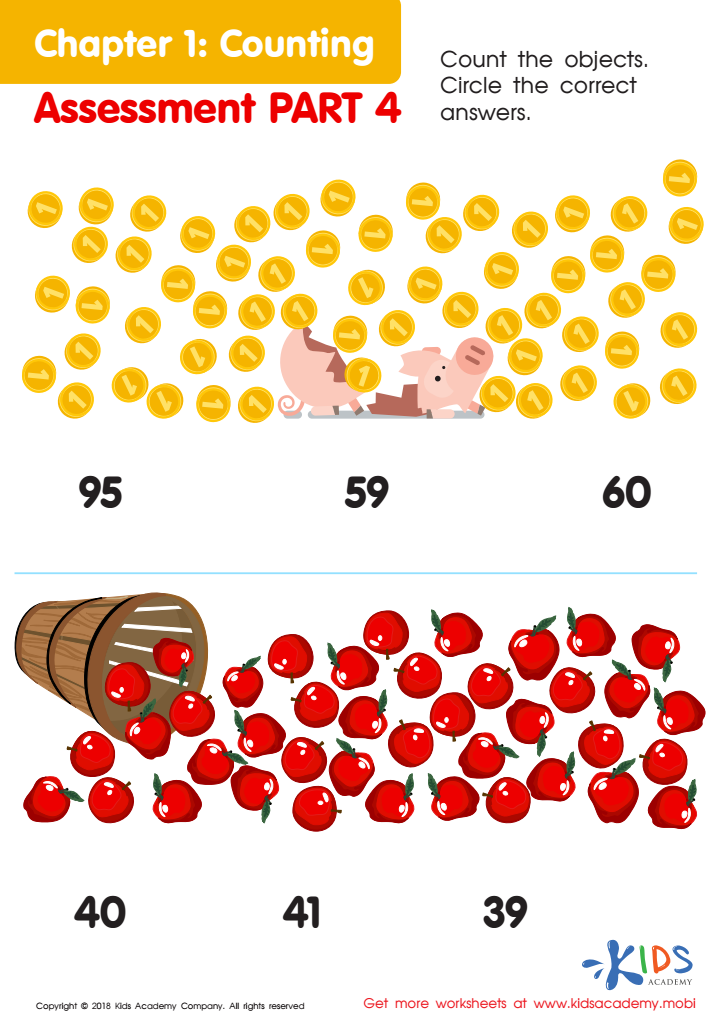
Encourage your students to count objects in this colorful worksheet. Ask them to circle the correct answers from the options given. See how much their counting skills have improved with your guidance. Have fun!
Counting: Assessment 4 Worksheet
Worksheet
Counting: Assessment 3 Worksheet


Counting: Assessment 3 Worksheet

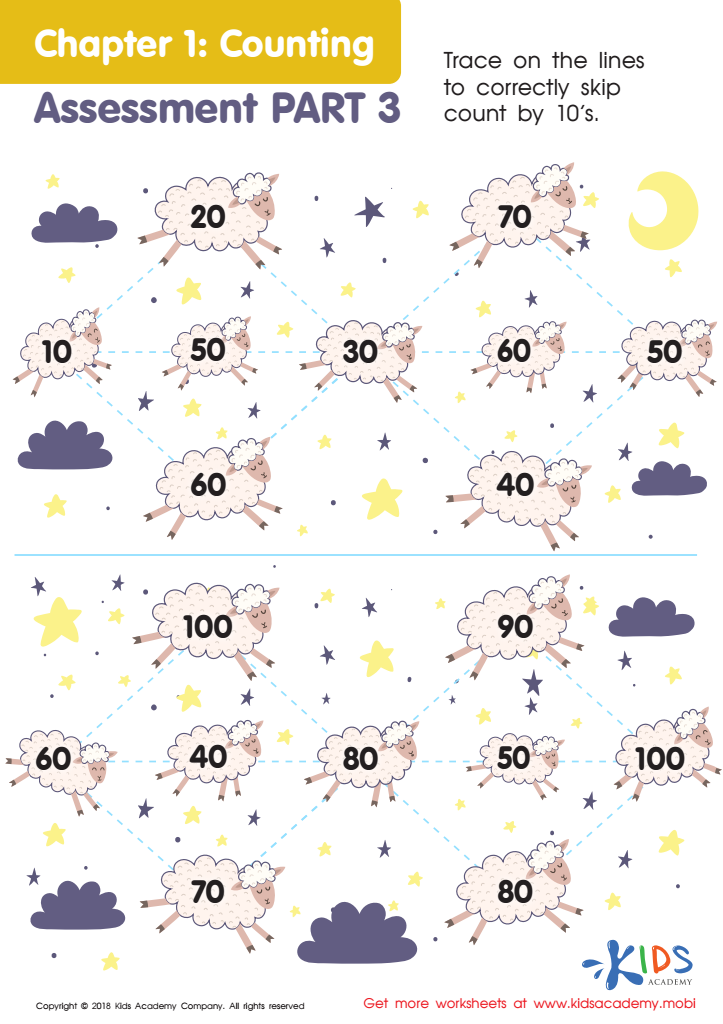
This worksheet is great for assessing your child's counting skills. It's a bit more challenging than the usual 'count to fifty' exercises. Have them trace the lines and skip count by 10's to help them learn counting in tens.
Counting: Assessment 3 Worksheet

Worksheet


Math worksheets activities are a fundamental tool in the journey of learning mathematics. They offer a structured approach that can significantly enhance a student's understanding and proficiency in the subject. These activities are not only beneficial for practicing new concepts but also for reinforcing previously learned ones. Here’s why math worksheets activities are so useful:

Firstly, math worksheets activities provide the much-needed practice that is essential for mastering mathematical concepts. Mathematics is a subject that requires repetition to understand and retain complex ideas. Through these activities, students can practice problems of varying difficulty levels, gradually building their confidence and skills.

Secondly, these activities cater to individual learning paces. Every student has their own speed of learning, and math worksheets activities allow them to work at their own pace. Whether they need more time to grasp a concept or they're ready to accelerate their learning, math worksheets give them that flexibility.

Moreover, math worksheets activities are incredibly versatile. They can be used to introduce new topics, provide extra practice, or review concepts before a test. This versatility makes them an invaluable resource for teachers and students alike, ensuring that learning is never monotonous but always engaging and effective.

Furthermore, error analysis becomes manageable with math worksheets activities. When students make mistakes, these worksheets provide a clear record of their work, making it easier for both teachers and students to identify and understand where and why the error occurred. This immediate feedback is crucial for learning from mistakes and avoiding them in the future.

Lastly, math worksheets activities foster independent learning. They encourage students to take initiative, work through problems on their own, and seek solutions, which is a critical skill not just in mathematics but in life.

In conclusion, math worksheets activities are an indispensable part of mathematics education. They reinforce learning, accommodate individual learning speeds, offer versatility, facilitate error analysis, and promote independence, making them a powerful tool in developing a strong mathematical foundation.