
Measurement worksheets activities for Ages 5-6
2 filtered results
Difficulty Level
Grade
Age
-
From - To
Subject
Activity
Standards
Dive into our comprehensive collection of Measurement Worksheets Activities, designed to make learning about measurements both fun and educational for students of all ages. Our meticulously curated activities cover a wide range of measurement topics, from basic length, weight, and volume concepts to more complex units of measurement. These engaging worksheets are perfect for classroom lessons, homework assignments, or even at-home practice, providing a hands-on approach to understanding measurements in real-life contexts. With our Measurement Worksheets Activities, students will enhance their measuring skills, develop critical thinking, and build confidence in their ability to tackle measurement challenges. Start exploring our collection today and make measurement learning an exciting adventure!
Favorites
With answer key
Interactive
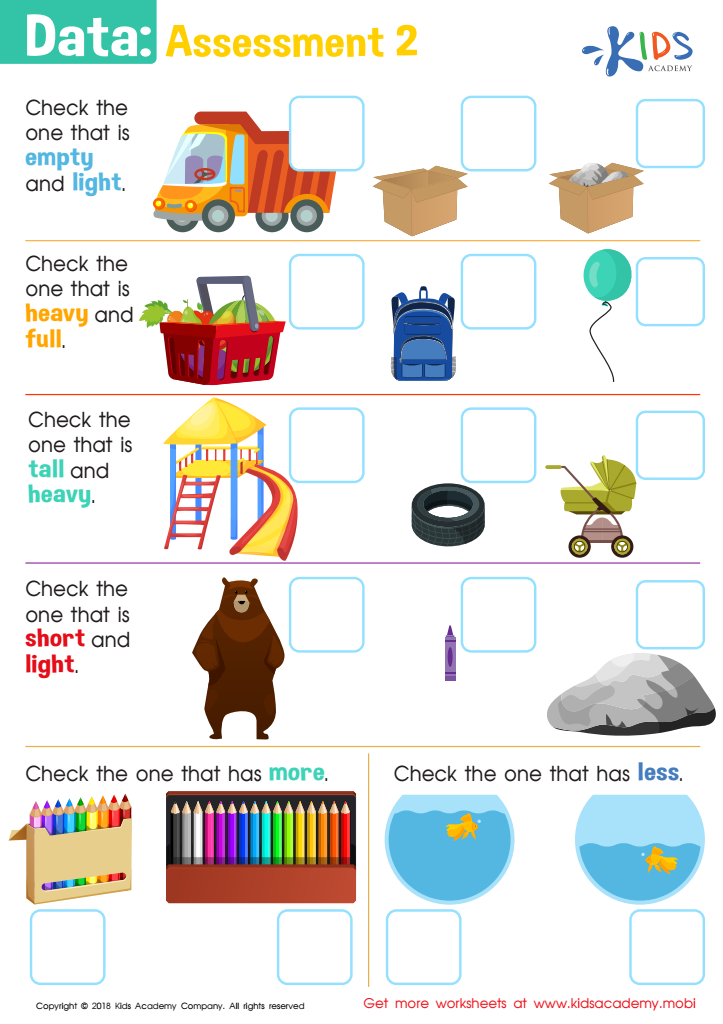
Data: Assessment 2 Worksheet
This PDF helps you assess your students' understanding of concepts like empty/light, full/heavy, tall/short, and more/less. With this worksheet, students use pictures to answer questions and check off the appropriate box. It's a fast, easy way to determine what concepts they have learned and which need more work.
 Assign to My Students
Data: Assessment 2 Worksheet
Worksheet
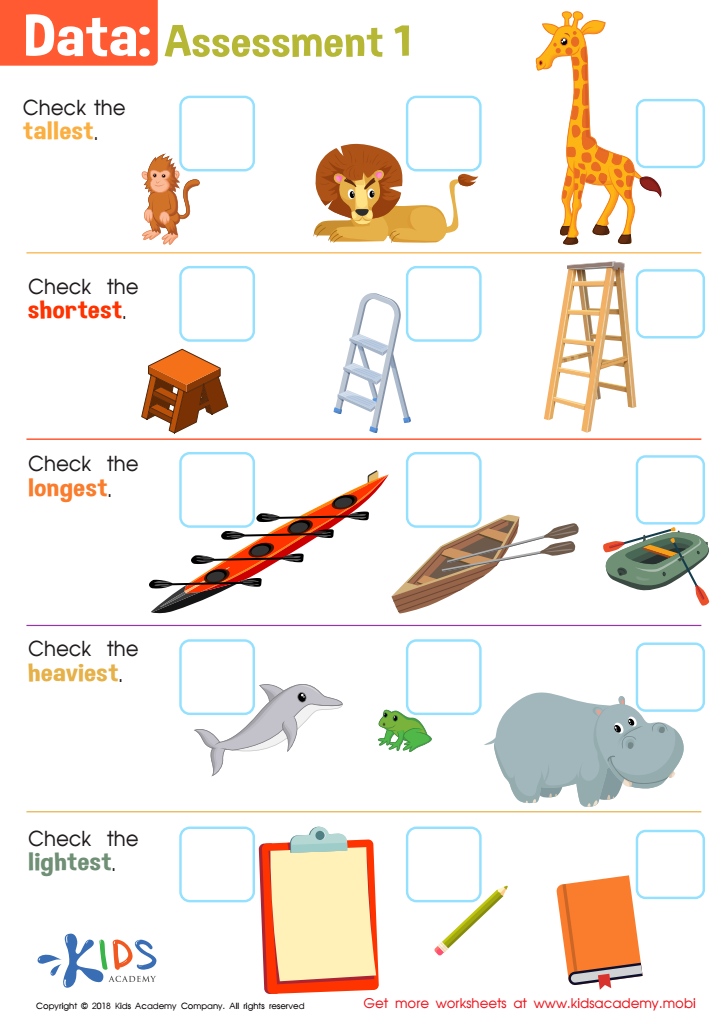
Data: Assessment 1 Worksheet
This free worksheet helps you assess where your young students are with measurement superlatives like tallest, shortest, heaviest, longest and lightest. It features cute, colorful pics of familiar objects so your kids have a reference, and helps you identify areas to work on.
Data: Assessment 1 Worksheet
Worksheet
Join Kids Academy for Free
Who is primarily going to use this learning content?







Measurement worksheets activities stand as an indispensable educational tool, fostering a range of skills that are essential both in academic environments and daily life. Through engaging with these practical exercises, students not only grasp fundamental concepts of measurement, including length, volume, weight, and temperature, but also develop critical thinking, problem-solving abilities, and mathematical literacy.
Firstly, measurement worksheets activities introduce young learners to the concept of quantifying objects, which is a foundational skill in mathematics. By estimating and comparing sizes, weights, and volumes, students begin to understand the relative nature of measurement. This hands-on approach aids in cementing abstract concepts into tangible understanding, making mathematics more approachable and less intimidating for students.
Moreover, these activities promote an analytical mindset. As students engage with various problems, they learn to apply logical reasoning to deduce answers. This not only enhances their mathematical skills but also prepares them for real-life situations where problem-solving and analytical skills are invaluable. For instance, understanding measurements is crucial when following recipes, planning travel distances, or evaluating quantities for purchases.
Additionally, measurement worksheets activities are designed to be interactive and often collaborative, offering a dynamic learning environment. This encourages students to work together, share strategies, and discuss solutions, fostering a sense of community and cooperation in the classroom. Such interactions are vital for developing social skills and learning to appreciate different perspectives.
Furthermore, these worksheets are adaptable to different learning styles and levels, making them an excellent resource for personalized learning. Teachers can tailor activities to challenge advanced students or provide foundational practice for those needing reinforcement, ensuring that every student finds the activities engaging and beneficial.
In summary, measurement worksheets activities are more than just educational exercises; they are a multi-faceted learning tool that prepares students for mathematical challenges and daily life. By integrating these activities into the curriculum, educators can provide a solid foundation in measurement while also nurturing critical life skills.








