Filters

7 filtered results

Clear all filters
Favorites
With answer key
Interactive

7 filtered results

Difficulty Level

Grade


Unlock the world of shapes, angles, and dimensions with our captivating Geometry Worksheets Activities! Designed to engage and challenge students, these activities offer a rich blend of problems that cover a wide range of geometry topics. From understanding the basics of lines and angles to exploring the complexities of three-dimensional shapes, our meticulously crafted worksheets serve as an excellent resource for both classroom learning and home practice. Whether you're looking to reinforce geometry concepts, enhance spatial reasoning skills, or just explore the fascinating world of geometry, our Geometry Worksheets Activities are your go-to solution for making learning both fun and effective. Dive into geometry like never before!

Check out this FREE Geometry Trial Lesson for age 5!

Match Exactly the Same

Favorites
With answer key
Interactive
  • Geometry
  • 5
  • Interactive
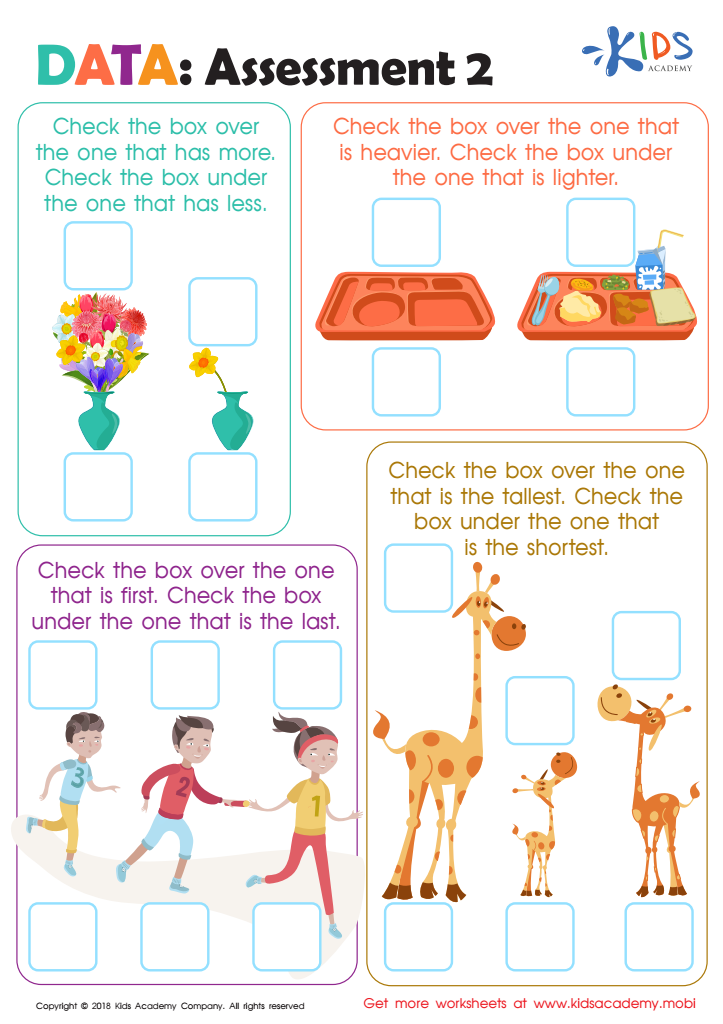
Data: Assessment 2 Worksheet

Data: Assessment 2 Worksheet

This printable worksheet tests students' understanding of words related to quantity and measurement, such as "more", "less", "heavy", "light", "first", "last", "tall", and "short". It helps children compare and contrast when solving measurement problems. Ideal for math classes, it encourages students to gain the essential skills needed in subjects like math, science, and reading.
Data: Assessment 2 Worksheet
Worksheet
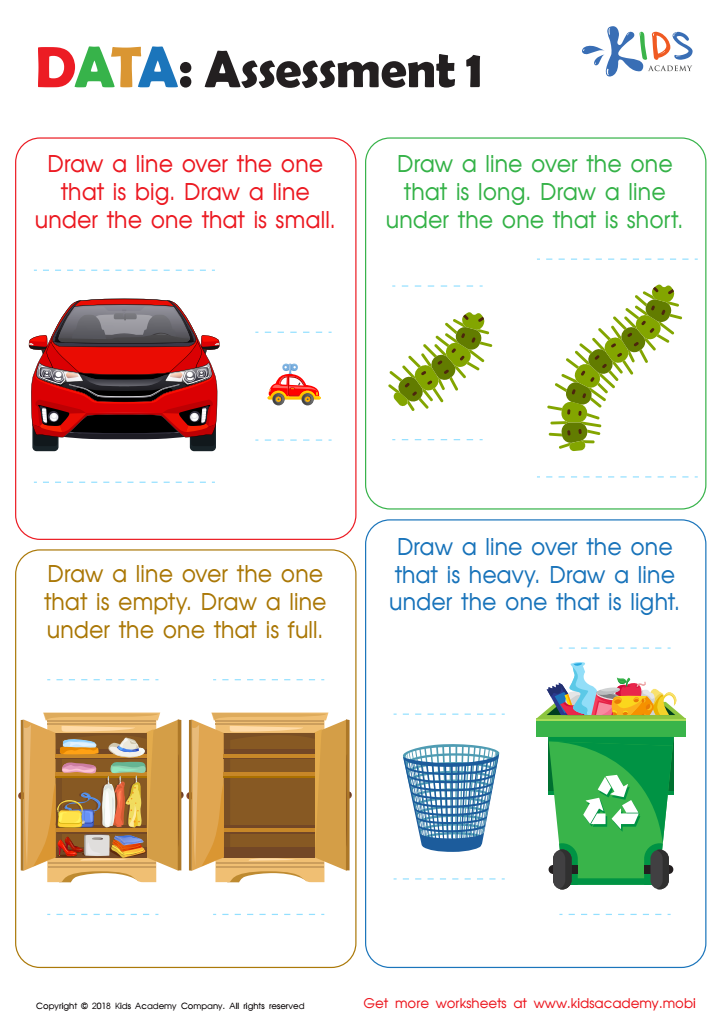
Data: Assessment 1 Worksheet

Data: Assessment 1 Worksheet

Assess your students' knowledge of measurement words with this worksheet. Have them compare and describe objects/quantities using words like "big", "small", "long", "short", "empty", "full", "heavy" and "light". Encourage further learning by asking students to provide examples of each word meaning.
Data: Assessment 1 Worksheet
Worksheet
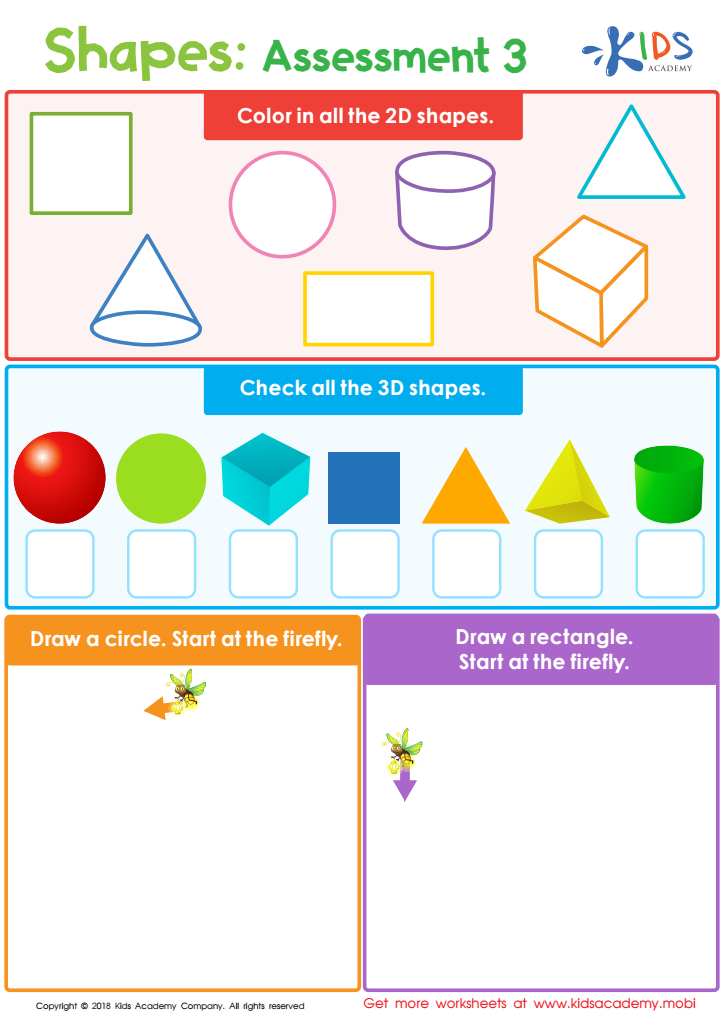
Shapes: Assessment 3 Worksheet

Shapes: Assessment 3 Worksheet

Shapes are everywhere! Help your students differentiate between 2D and 3D shapes. Ask them the difference between a triangle and pyramid, or a circle and a sphere. This worksheet tests their understanding of both types and is a useful assessment tool.
Shapes: Assessment 3 Worksheet
Worksheet
Shapes: Assessment 2 Worksheet

Shapes: Assessment 2 Worksheet

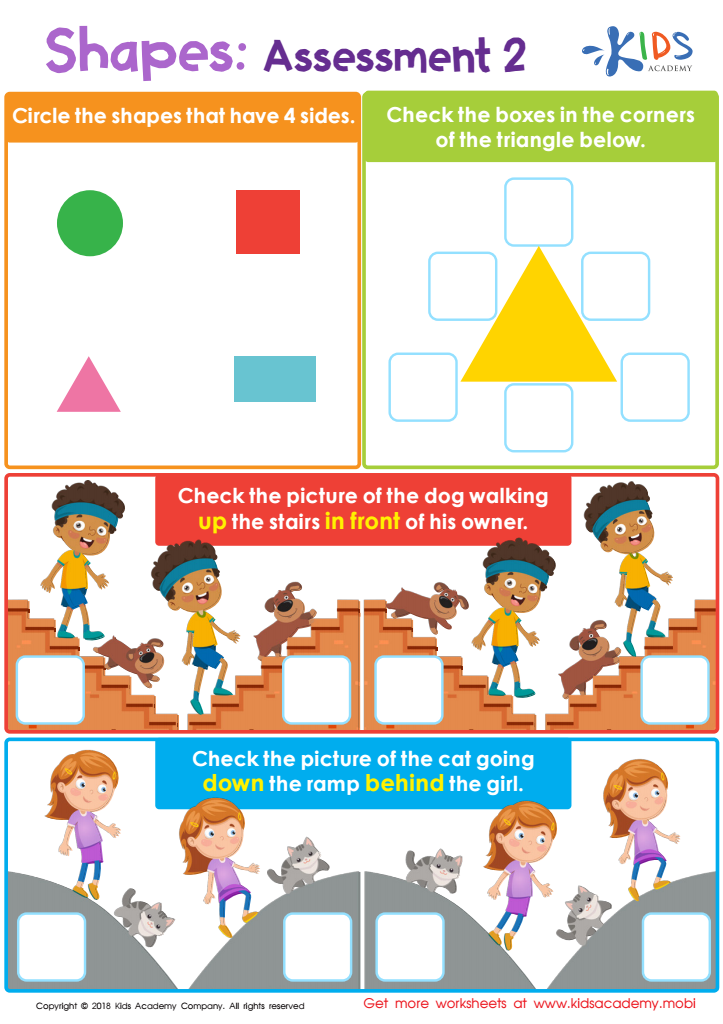
This geometry worksheet assesses a student's knowledge of shapes and positional words. They must identify shapes with 4 sides and corners on a triangle. The worksheet also tests understanding of words like "up", "front", "down" and "behind". Easily determine what your student knows about these concepts with this downloadable worksheet!
Shapes: Assessment 2 Worksheet
Worksheet
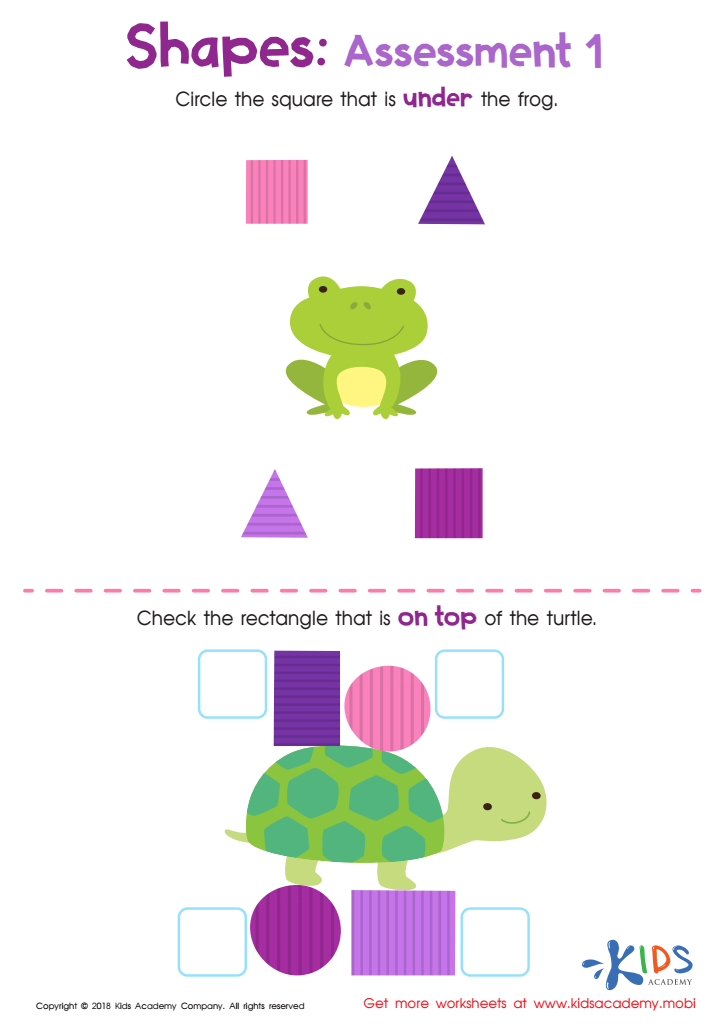
Shapes: Assessment 1 Worksheet

Shapes: Assessment 1 Worksheet

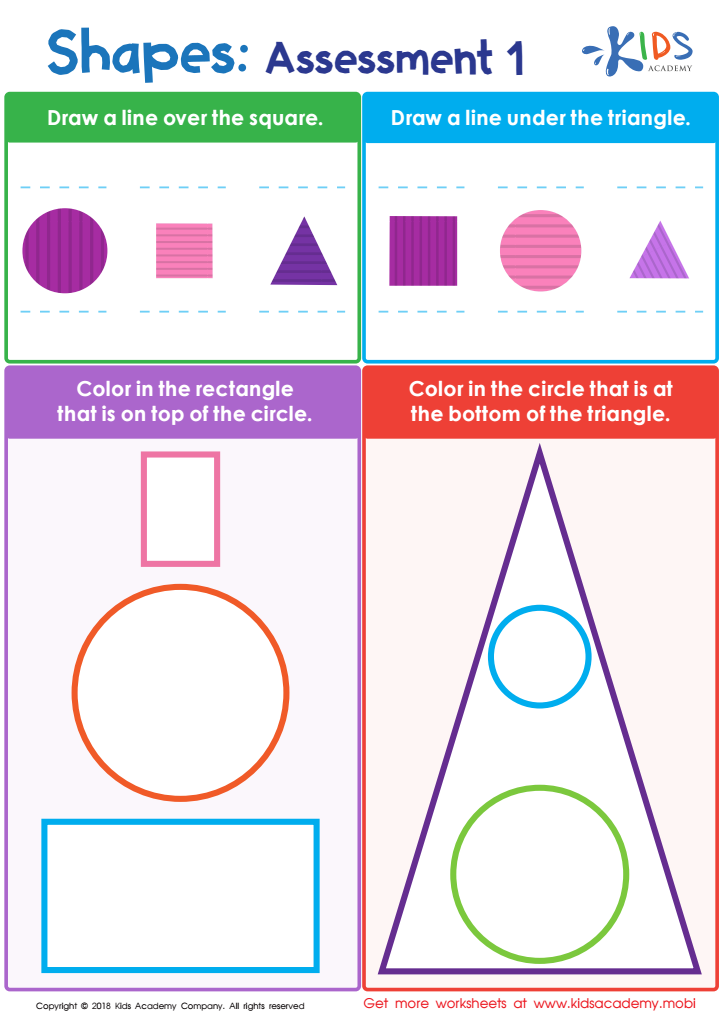
Test your students' understanding of the four basic shapes - circle, square, triangle and rectangle - with this assessment worksheet. Get them to draw a line over or under the shape indicated in the directions to show they can identify it correctly.
Shapes: Assessment 1 Worksheet
Worksheet
Geometry - Assessment 2 Worksheet Preview

Geometry – Assessment 2 Worksheet

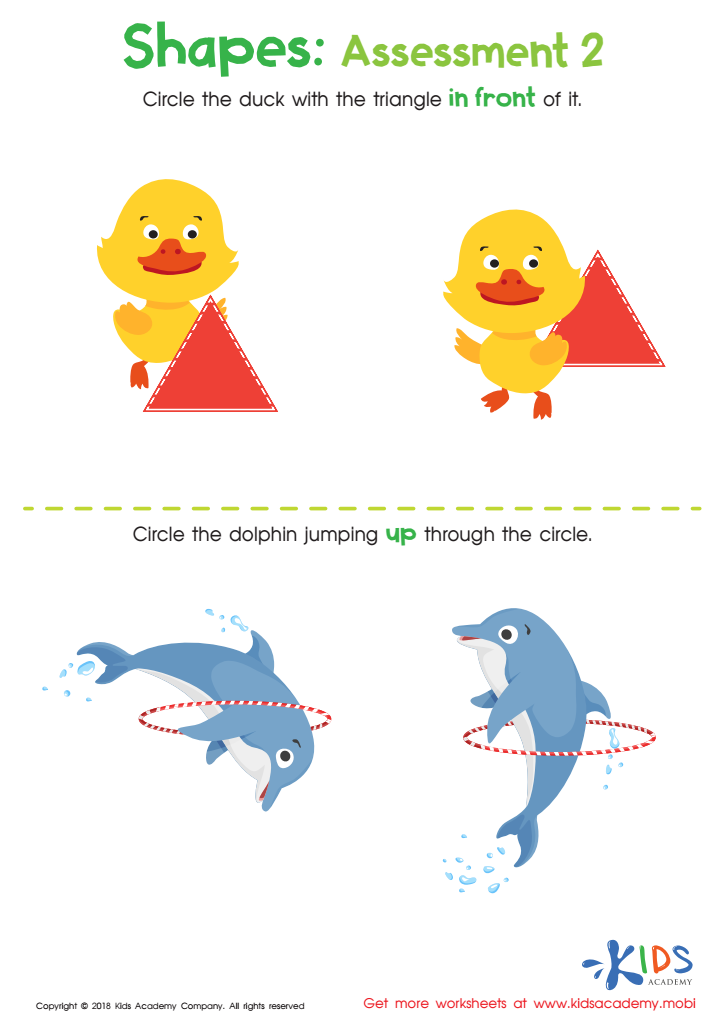
Preschoolers will learn to identify circles and triangles and practice using terms like "in front of" to place objects. This skill is key to further learning and is an important part of development.
Geometry – Assessment 2 Worksheet
Worksheet
Geometry - Assessment 1 Worksheet Preview

Geometry – Assessment 1 Worksheet

This activity helps preschoolers find shapes "on top of" and "under" animals. They must identify the correct shapes assigned to them. It's a great way to learn geometry and placements of objects.
Geometry – Assessment 1 Worksheet

Worksheet


Geometry worksheets activities play a pivotal role in the educational development of students, particularly in the field of mathematics and spatial understanding. These activities are not only useful but essential for a variety of reasons.

Firstly, Geometry worksheets activities provide a structured way for students to engage with complex geometrical concepts and theorems. By working through problems and exercises, students can internalize the principles of geometry more effectively. This hands-on approach allows learners to see geometry as not just theoretical, but as a practical and applicable part of mathematics.

Moreover, these activities offer a diverse range of problems that cater to different learning styles. Whether a student is a visual learner, who benefits from seeing the shapes and patterns on paper, or a kinesthetic learner, who understands concepts better through doing, Geometry worksheets activities have something for everyone. This inclusivity enhances the learning experience and ensures that all students have the opportunity to grasp geometric concepts thoroughly.

Another key benefit of Geometry worksheets activities is the immediate feedback they provide. As students work through the problems, they can quickly ascertain whether they understand a concept or if they need further clarification. This instant feedback loop is critical in the learning process, as it allows students to identify and rectify their mistakes in real-time, leading to a deeper understanding of the subject matter.

Furthermore, Geometry worksheets activities are immensely beneficial for reinforcing and consolidating learning. Regular practice of these worksheets helps students to retain information and improve their problem-solving skills. This consistent practice is crucial for mastery of geometry, as it builds confidence and competence in the subject.

In conclusion, Geometry worksheets activities are an invaluable tool in the education of geometry. They provide a practical, inclusive, and effective method for learning that caters to a wide range of learning preferences. Through these activities, students can develop a comprehensive understanding of geometric concepts, enhancing their mathematical abilities and preparing them for more advanced studies in the field.