
Normal Rhyming worksheets activities for 6-Year-Olds
1 filtered results
Difficulty Level
Grade
Age
-
From - To
Subject
Activity
Standards
Explore the world of words with our captivating Normal Rhyming Worksheets Activities! Crafted with care, these activities are designed to engage learners of all levels in the delightful rhythm and patterns of language. Through a series of fun, interactive exercises, participants will develop a keen ear for rhymes, enhance their vocabulary, and boost their reading skills. Perfect for educators seeking to add a spark to their teaching methods or parents aiming to support their child's linguistic development at home. Dive into our Normal Rhyming Worksheets Activities today and unlock a new dimension of language learning!
Favorites
With answer key
Interactive
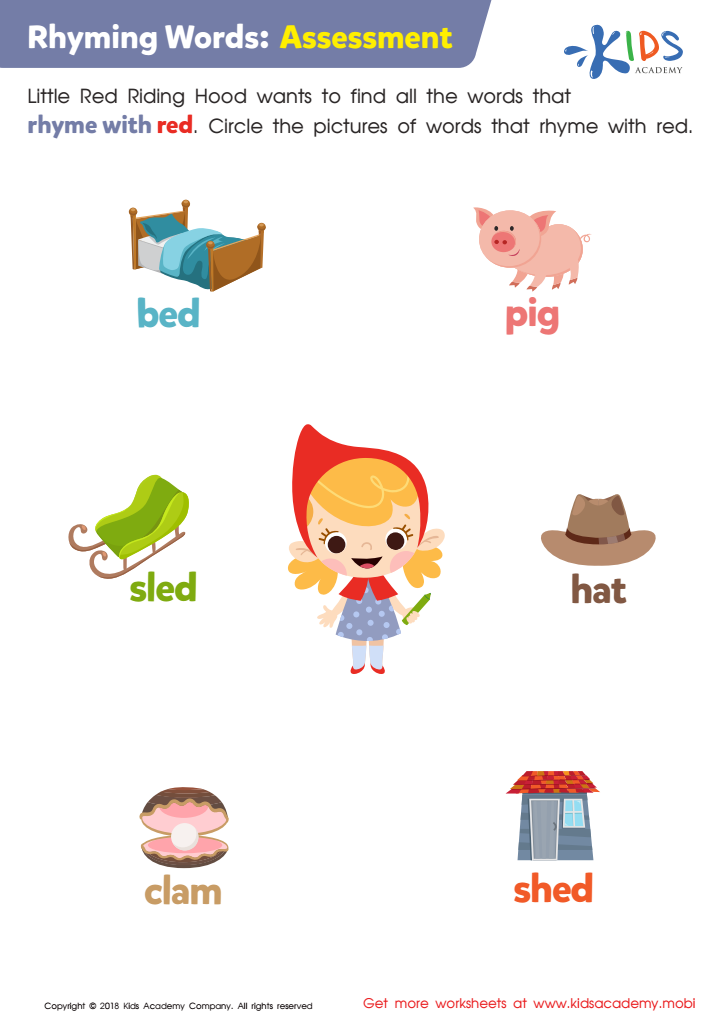
Rhyming Words: Assessment Worksheet
Help Little Red Riding Hood find rhyming words with "red". Download and print this worksheet. Have your child circle the rhyming words and pictures. Get them to say each word out loud and compare it to the word "red". When they're done, review the answers and talk about any words that don't rhyme.
 Assign to My Students
Rhyming Words: Assessment Worksheet
Worksheet
Learning Skills
Join Kids Academy for Free
Who is primarily going to use this learning content?








Normal Rhyming worksheets activities are an essential tool in the educational toolkit for young learners. These activities offer a multitude of benefits that support children’s linguistic development, making them an invaluable resource for parents and teachers alike. Engaging in these activities helps children enhance their phonological awareness, an important precursor to successful reading and writing skills.
Phonological awareness refers to the ability to recognize and manipulate sounds in spoken language. Normal Rhyming worksheets activities are specifically designed to hone this skill by encouraging children to identify words that sound similar. This not only aids in their auditory discrimination but also enriches their vocabulary as they are exposed to a wide range of words. Furthermore, rhyming teaches children about word patterns and structures, making it easier for them to predict and learn new words, thereby fostering their reading fluency.
Moreover, Normal Rhyming worksheets activities make learning fun and engaging. Rhymes are inherently playful and musical, which captures children's attention and sustains their interest in learning. This playful approach to education ensures that children associate learning with positive emotions, promoting a lifelong love for reading and language arts.
Additionally, these activities enhance children’s memory and concentration. Remembering rhymes involves repetition, a critical strategy in memory retention. As children engage in rhyming activities, they also develop their concentration skills, focusing on the sounds and patterns within words, which is crucial for both academic success and daily interactions.
In conclusion, Normal Rhyming worksheets activities are more than just a fun pastime. They are a strategic approach to developing foundational language skills that children will rely on throughout their academic journey and beyond. By incorporating these activities into the learning process, educators and parents can provide children with a strong foundation in phonological awareness, enrich their vocabulary, and instill a positive attitude towards learning.








