
Normal Arrays Worksheets for Ages 3-8
11 filtered results
Difficulty Level
Grade
Age
-
From - To
Subject
Activity
Standards
Explore our captivating "Normal Arrays Worksheets for Ages 3-8" designed to make early math learning engaging and fun! These worksheets help children understand the concept of arrays using colorful and interactive exercises, ideal for developing counting, addition, and multiplication skills. Each worksheet combines visual aids with age-appropriate challenges to enhance kids' grasp of math fundamentals. Perfect for both classroom and home learning, these resources provide a foundation for mathematical confidence. Visit Kids Academy now to unlock your child's potential with our expert-designed array worksheets suitable for young learners aged 3-8!
Favorites
With answer key
Interactive
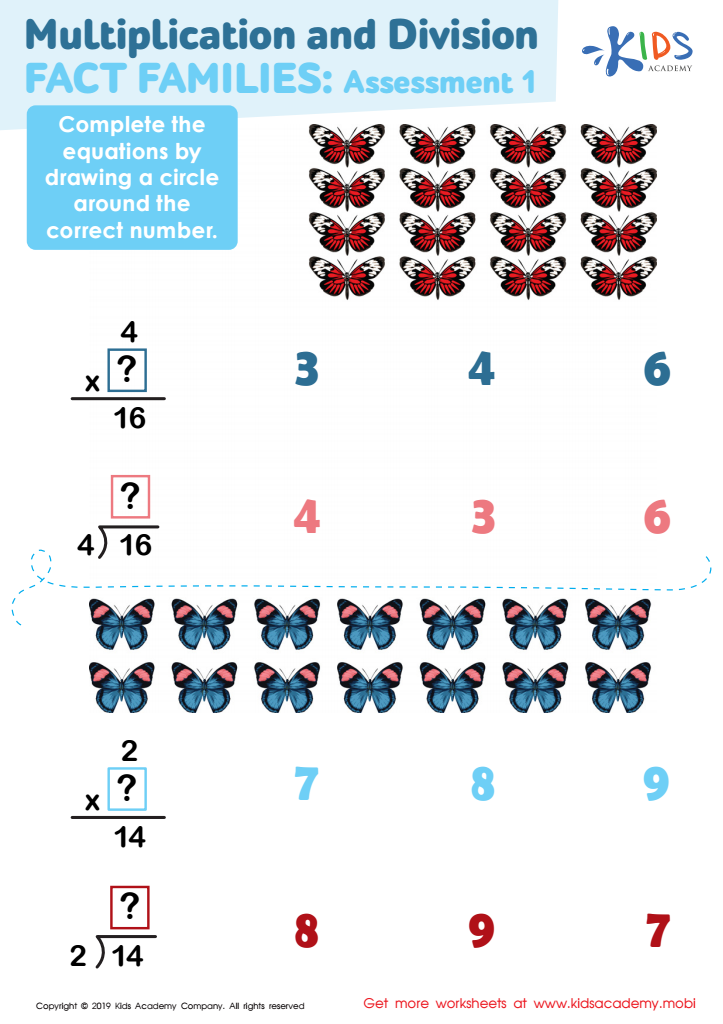
Multiplication and Division Fact Families Assessment 1 Worksheet
When it comes to multiplication and division, automaticity and efficiency are key. Test your child's understanding of fact families with this free butterfly worksheet. They'll practice equations, picture concepts and fact families to arrive at the correct number. Repetition will help them develop strong skills and confidence.
 Assign to My Students
Multiplication and Division Fact Families Assessment 1 Worksheet
Worksheet
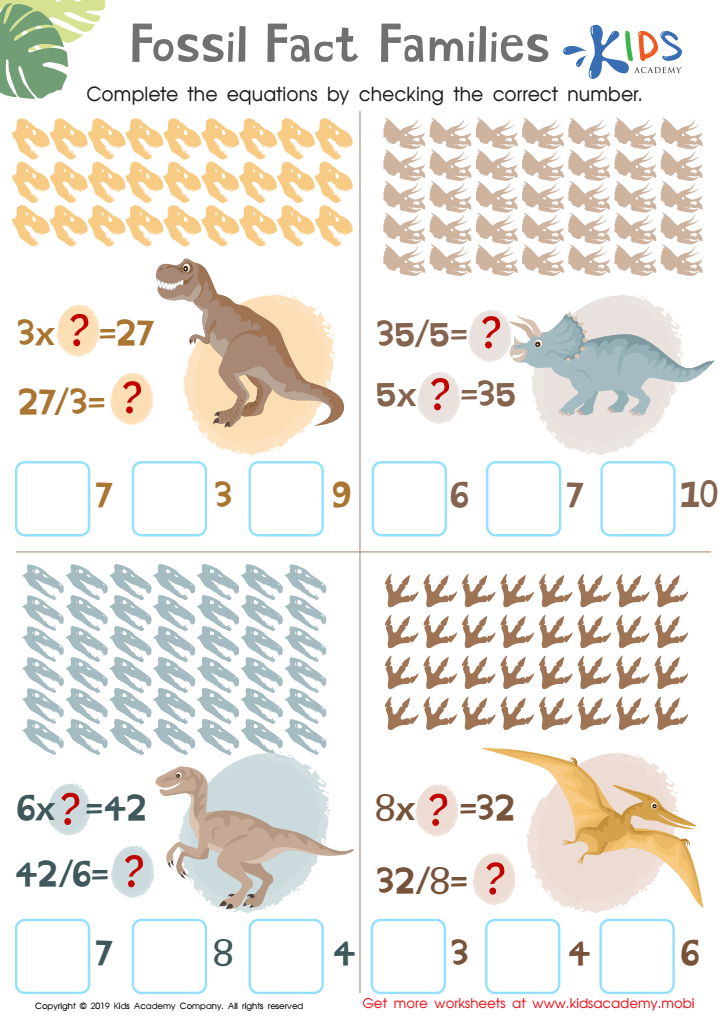
Fossil Fact Families Worksheet
Kids love dinosaurs, so why not learn about fact families with some fun prehistoric friends? This PDF worksheet uses picture arrays to help kids understand the relationships between multipliers and dividends. It helps them build automaticity with multiplication facts so they can quickly solve division problems and see the relationships between the two fact families.
Fossil Fact Families Worksheet
Worksheet
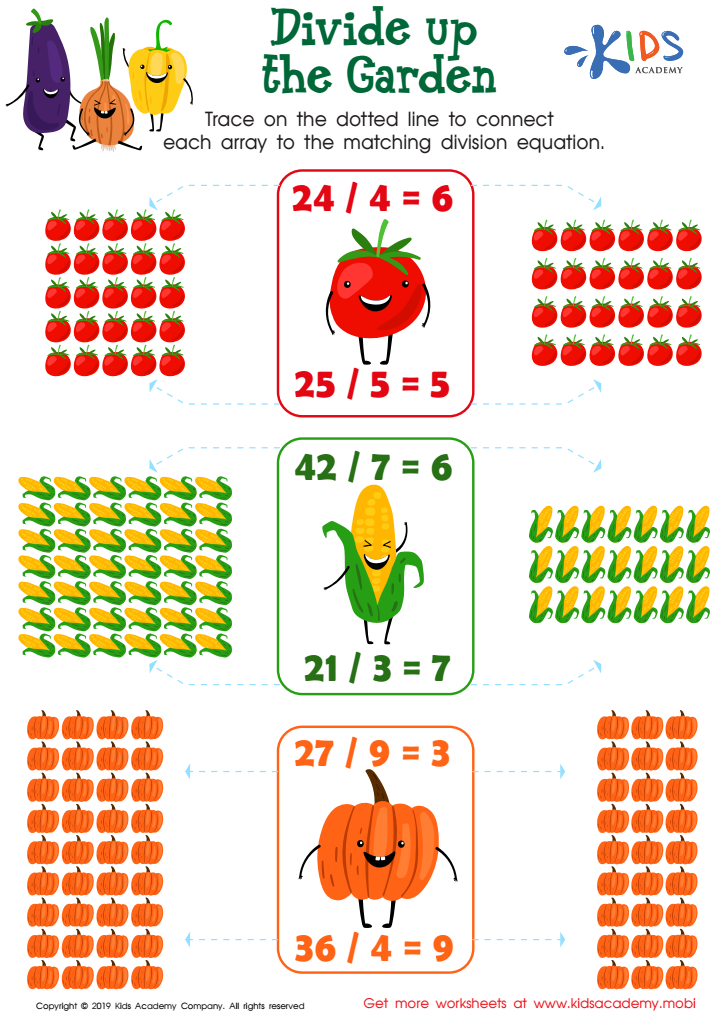
Divide up the Garden Worksheet
Dividing is simply grouping items into equal sets. This worksheet helps kids see division problems in array form. They'll match each equation with a picture group, using the lines provided. It's a great way for beginners to understand division more concretely.
Divide up the Garden Worksheet
Worksheet
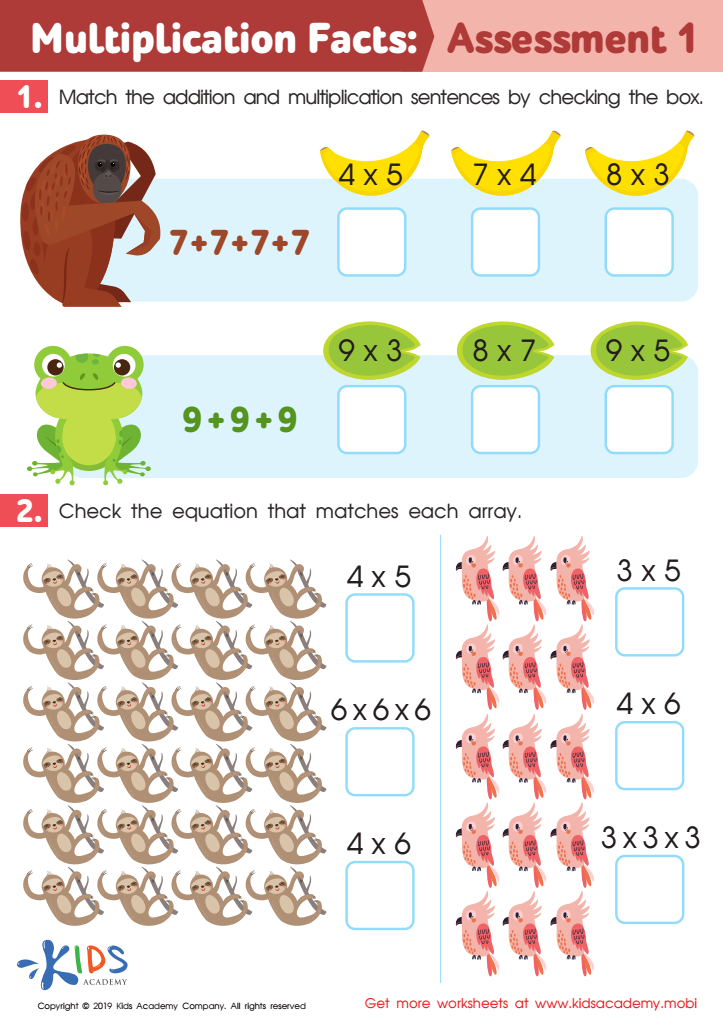
Multiplication Facts: Assessment 1 Worksheet
Teach your kids math with diligence, patience and practice. This colorful worksheet helps by matching addition and multiplication sentences, then checking the equation that matches each array. Perfect for kids having difficulty or to give extra practice. Help your little ones master mathematics with this printout.
Multiplication Facts: Assessment 1 Worksheet
Worksheet
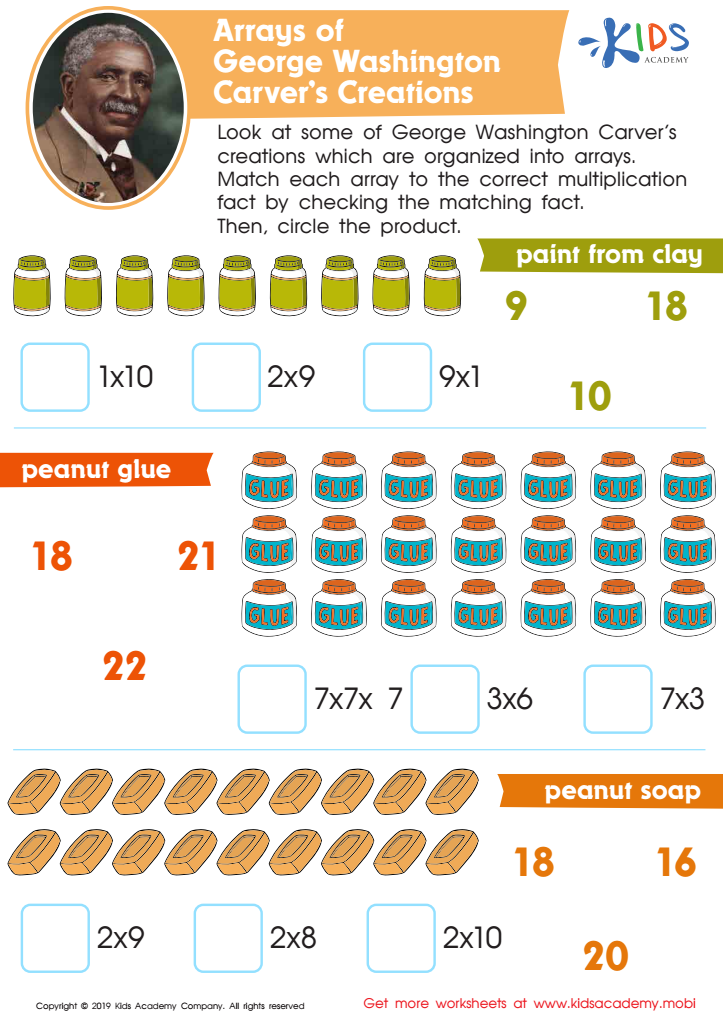
Arrays of George Washington Carver’s Creations Worksheet
Remind your child of what George Washington Carver created. Can they tell you? This worksheet has arrays with his creations. Match the array to the multiplication fact and help your child to circle the product.
Arrays of George Washington Carver’s Creations Worksheet
Worksheet
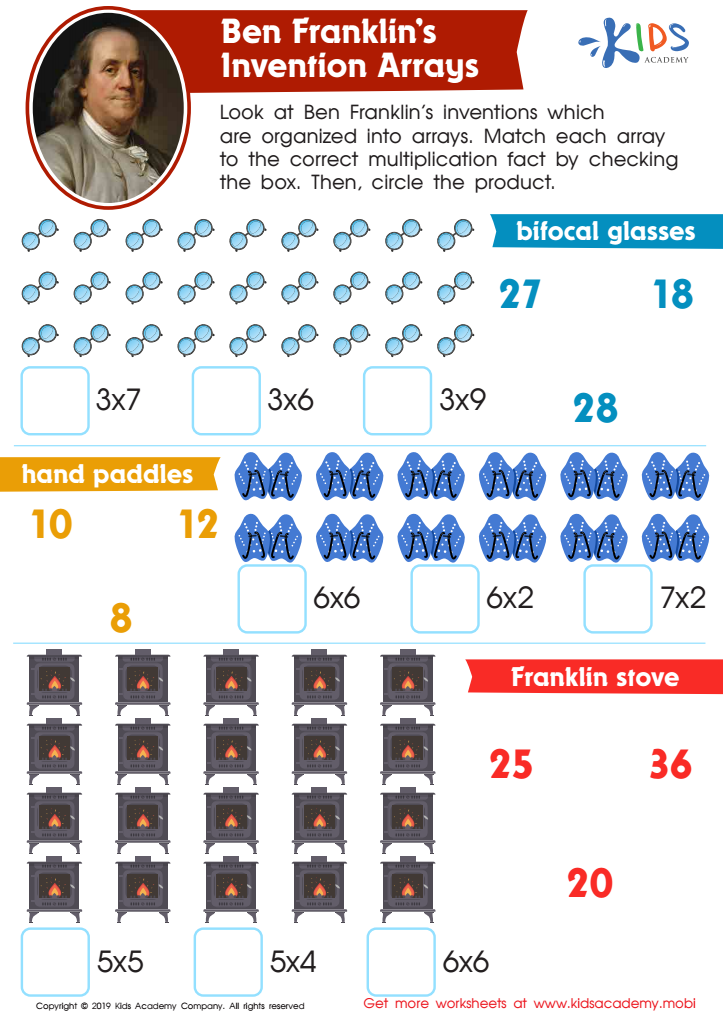
Ben Franklin’s Invention Arrays Worksheet
Have your child guess some of the inventors of the popular items we use today. For instance, the light bulb was invented by Thomas Edison. Look at Ben Franklin's inventions and help your kids match the arrays to the correct multiplication fact. Check the box and circle the product.
Ben Franklin’s Invention Arrays Worksheet
Worksheet
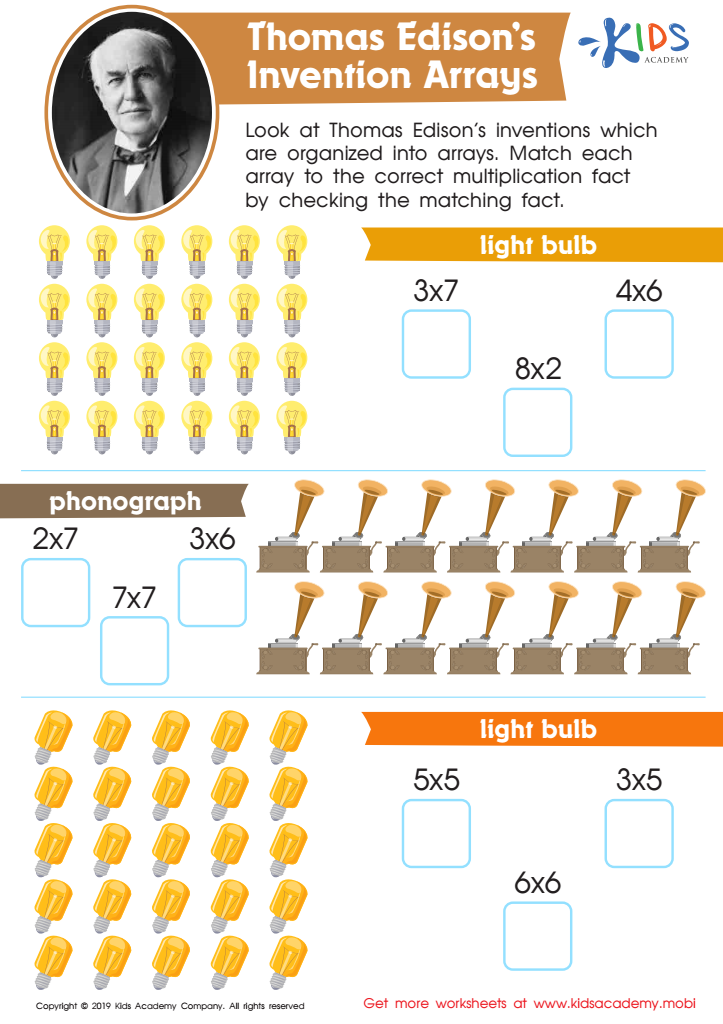
Thomas Edison’s Invention Arrays Worksheet
Test your students' knowledge on history by asking them what Thomas Edison invented. If they get the right answer, provide more information on other inventors. Check out this printout of Edison's light bulb inventions laid out in arrays. Get them to match each array to the correct multiplication fact.
Thomas Edison’s Invention Arrays Worksheet
Worksheet
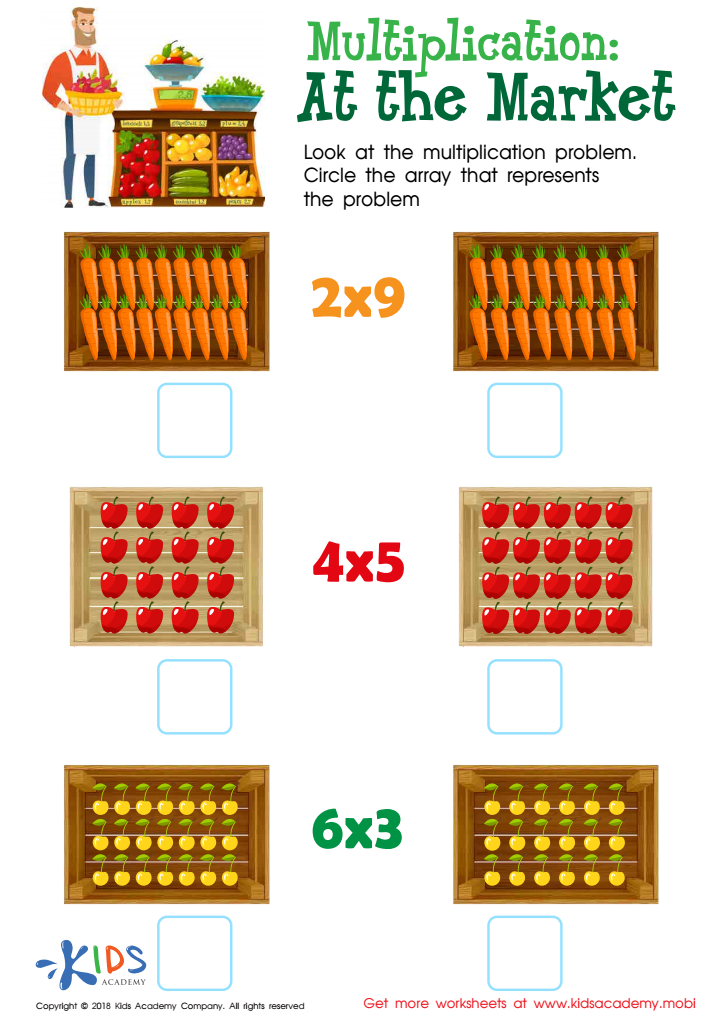
At the Market Worksheet
Head to At the Market! This attractive worksheet features arrays of delicious fruits and veggies that'll have 3rd graders working on their multiplication. Solve the problems, choose the correct answer, and learn while having fun!
At the Market Worksheet
Worksheet
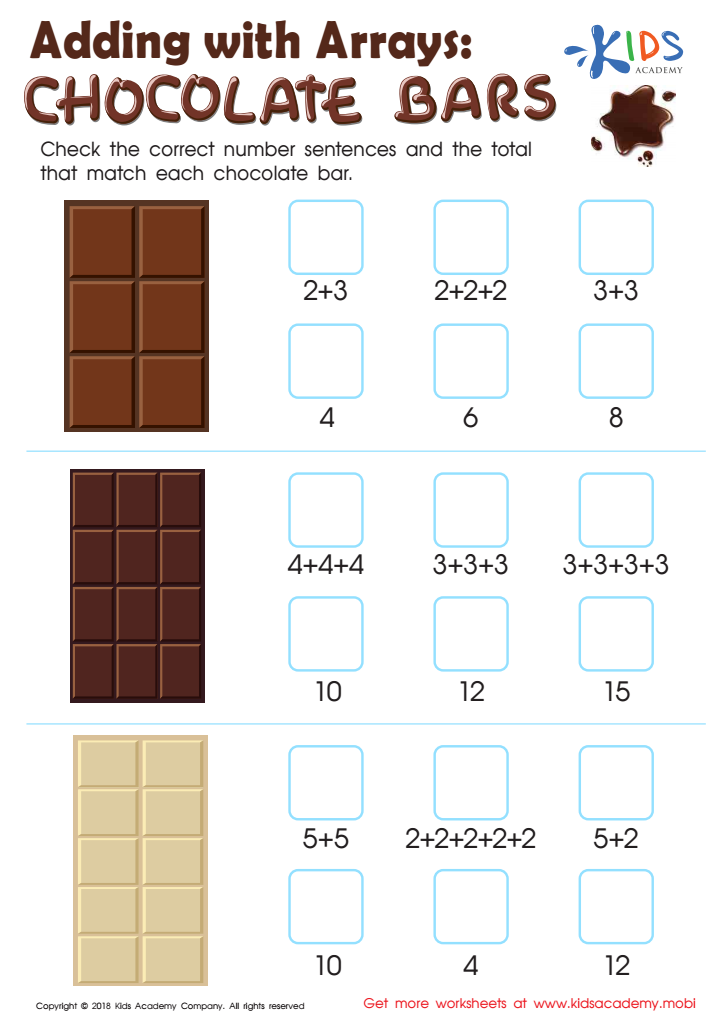
Adding with Arrays: Chocolate Bars Worksheet
Kids love chocolates! Gauge how enthused your kids get when you mention them. This worksheet is a fun exercise about chocolates - get your kids to check the correct number sentences and totals for each chocolate bar. Reward their hard work with some chocolates - extra incentive for a job well done!
Adding with Arrays: Chocolate Bars Worksheet
Worksheet
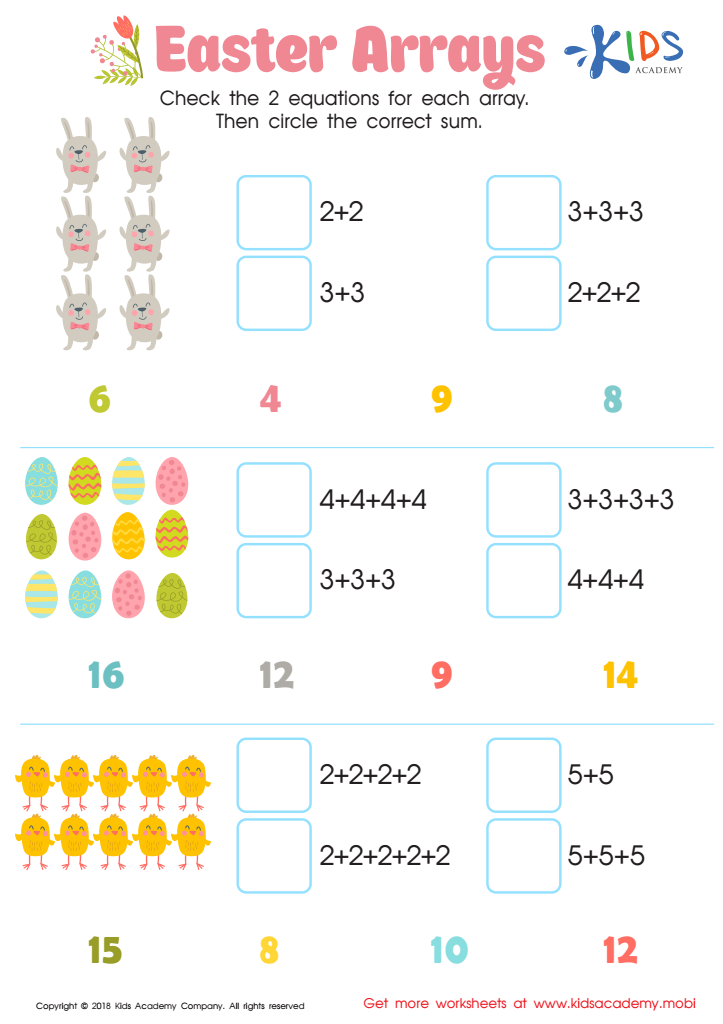
Easter Arrays Worksheet
Does your child love Easter? Do they adore the Easter bunny and egg hunts? Help them have fun with this worksheet! Go through it with them and check the equations for each array. Then, have them circle the correct sum. It's a great way to make the holiday extra exciting!
Easter Arrays Worksheet
Worksheet
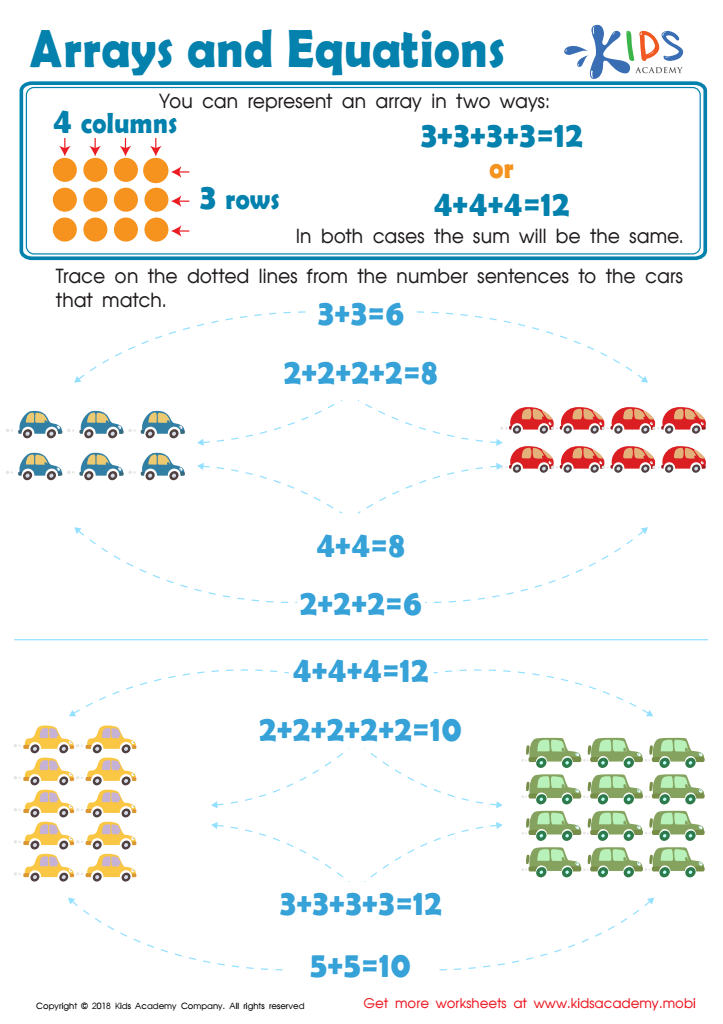
Arrays and Equations Worksheet
An array is objects, pix, or numbers organized in rows and columns. Show kids two ways to interpret this: 3 rows in 4 places = 12 and 4 columns in 3 places = 12. Help your child trace the number sentences to the matching cars. All equations always add up to the same amount.
Arrays and Equations Worksheet
Worksheet
Join Kids Academy for Free
Who is primarily going to use this learning content?








Normal Arrays, or the concept of organizing objects in rows and columns, play a crucial role in early childhood education, especially between the ages of 3 to 8. Parents and teachers should recognize the importance of using arrays to bolster cognitive development, mathematical reasoning, and problem-solving skills in young children.
First, Normal Arrays introduce foundational skills necessary for understanding more complex mathematical concepts. By arranging objects in rows and columns, children learn about numbers, counting, addition, and multiplication in an intuitive way. Visualizing numbers spatially helps them grasp these concepts more effectively than abstract representations do.
Second, working with arrays enhances pattern recognition and the ability to categorize, both critical cognitive abilities. By identifying repeated groupings, children start to understand the nature of patterns and sequences, which form the basis for advanced math and reasoning skills.
Additionally, using arrays nurtures fine motor coordination and spatial awareness. Handling and placing objects in precise positions in an array format helps develop hand-eye coordination, an essential skill for writing and other daily activities.
Lastly, the structured and organized nature of arrays instills a sense of order and systematic thinking in children. Early exposure to these concepts lays the groundwork not only for future mathematical learning but also for skills applicable to various life scenarios, such as planning and organizing tasks systematically. Hence, integrating Normal Arrays in early education offers multifaceted benefits that support a child's overall developmental growth.








