Filters

739 filtered results

Clear all filters
Favorites
With answer key
Interactive

739 filtered results

Difficulty Level

Grade


Check out this FREE Trial Lesson for age 8-9!

Initial Positions on the Board

Favorites
With answer key
Interactive
  • 8-9
  • Interactive
  • Normal
Chessboard Puzzle Worksheet
Chessboard Puzzle Worksheet

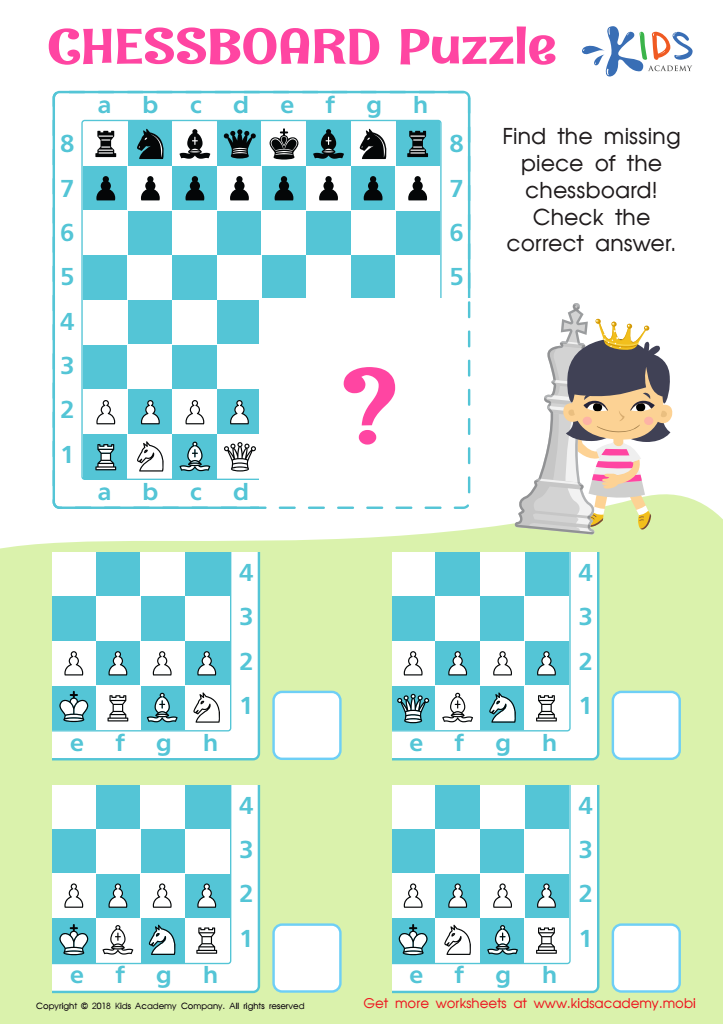
Test your child's chess prowess with this simple worksheet. They must find the missing pieces to complete the white side of an empty chessboard. The black pieces are already arranged properly on the board. Correct answers are provided so you can see how they did!
Chessboard Puzzle Worksheet
Worksheet
Setting up the Chessboard: Part 2 Worksheet

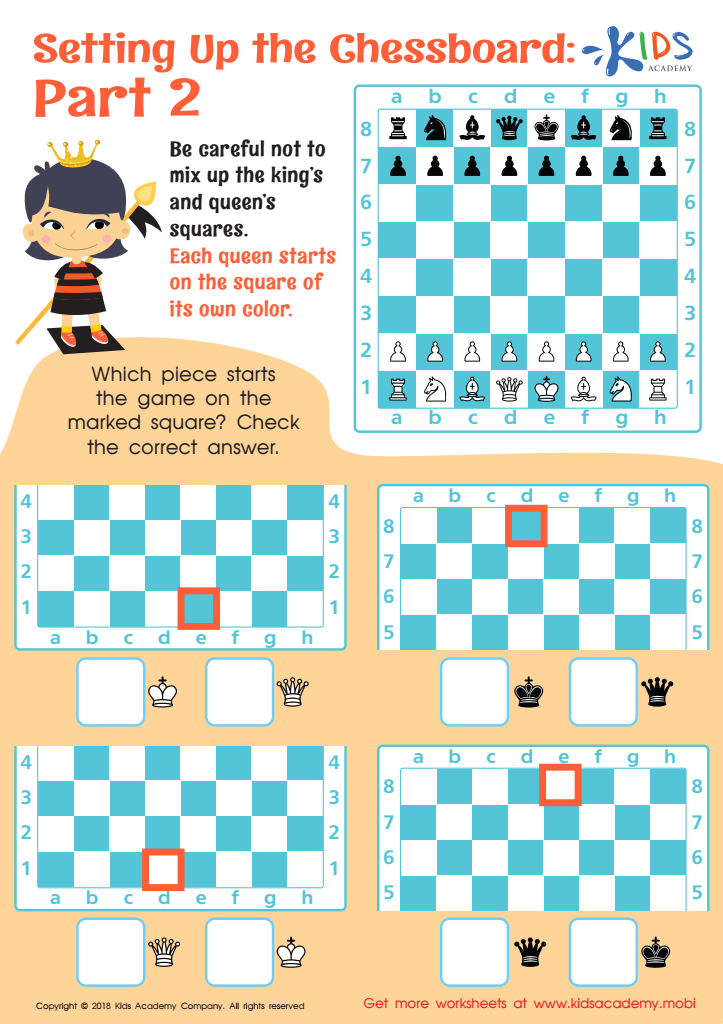
Setting up the Chessboard: Part 2 Worksheet

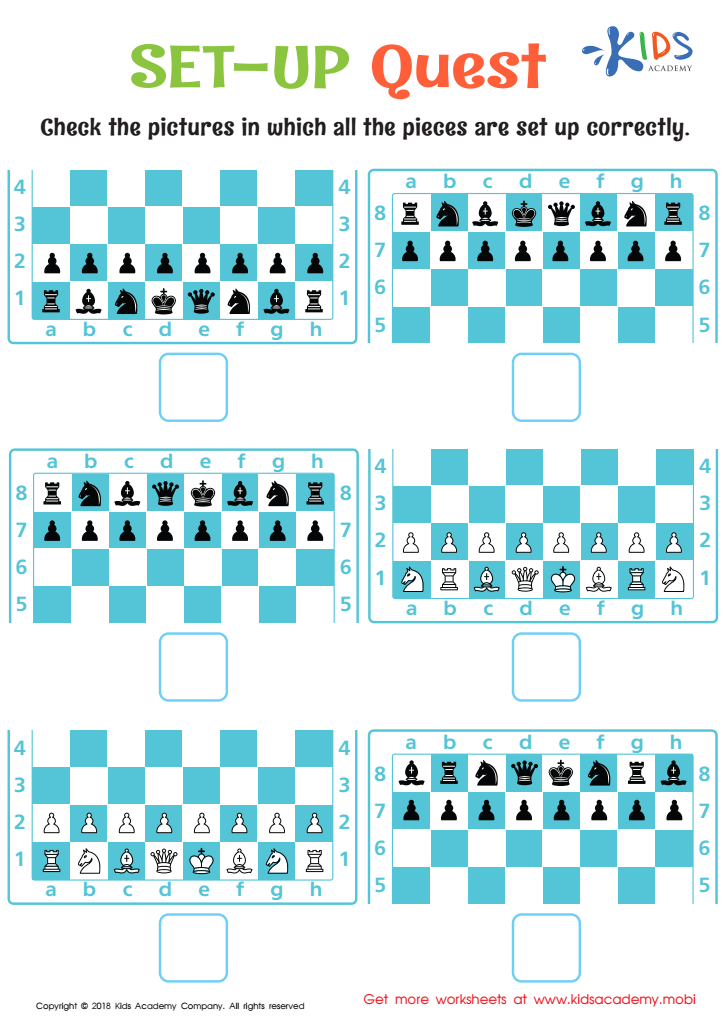
Before starting the game, make sure your child knows how to correctly set up the chessboard. Point to each square and ask them to name the piece that should be there. If they don't know, the printout can help. Remind them the queens should be on their own colour's square, then have them check the correct answers for the other pieces.
Setting up the Chessboard: Part 2 Worksheet
Worksheet
Setting up the Chessboard: Part 1 Worksheet

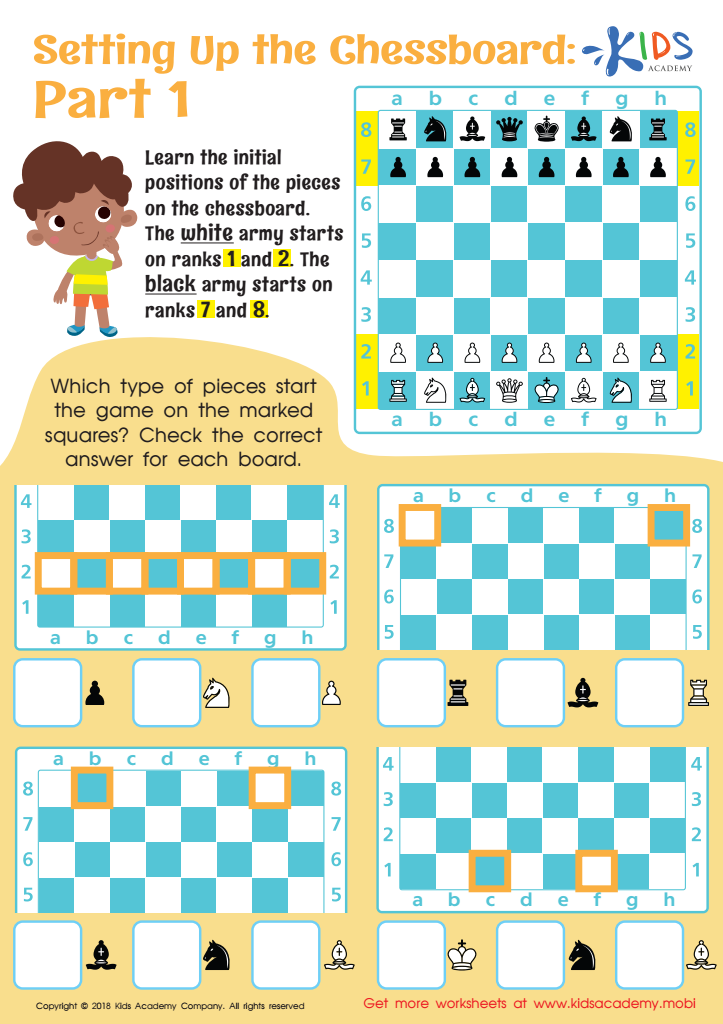
Setting up the Chessboard: Part 1 Worksheet

Teach your child the starting positions of the black and white armies on the chessboard. Black pieces are placed on ranks 7 and 8, and white pieces on ranks 1 and 2. Have them check the highlighted boxes on the chessboard to make sure they know the correct pieces to start with.
Setting up the Chessboard: Part 1 Worksheet
Worksheet
Find Diagonals Worksheet

Find Diagonals Worksheet

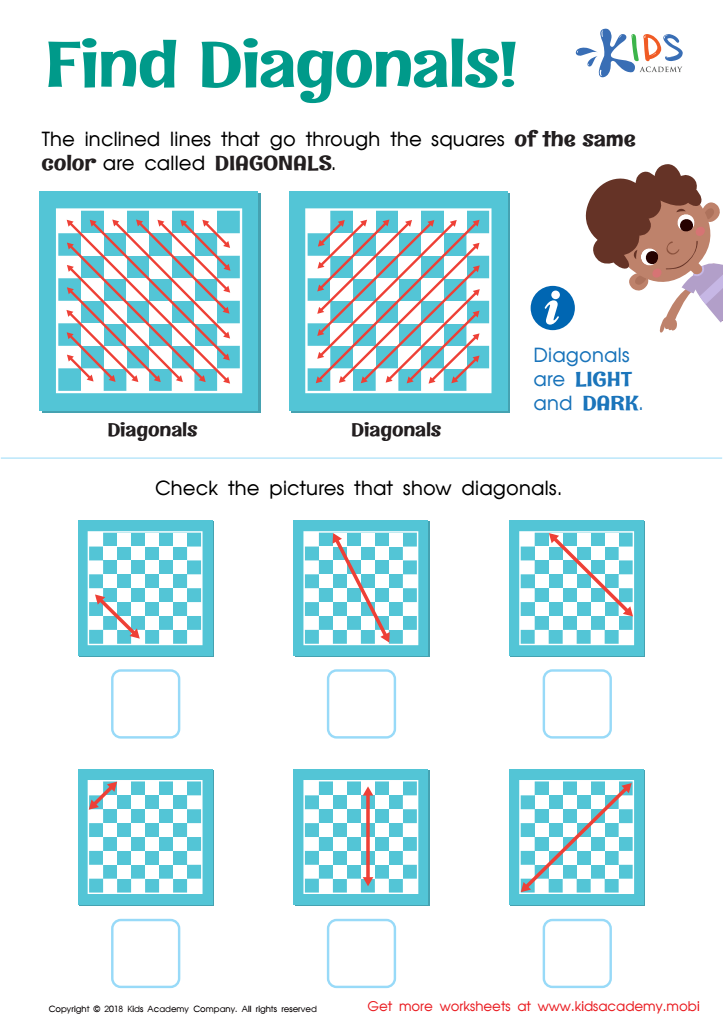
Help your child learn the name of the lines that go through squares with this fun worksheet. Diagonals slant in left or right directions and create the same shape. Ask your child to identify the pictures with correctly drawn diagonals.
Find Diagonals Worksheet
Worksheet
Ranks and Files Worksheet

Ranks and Files Worksheet

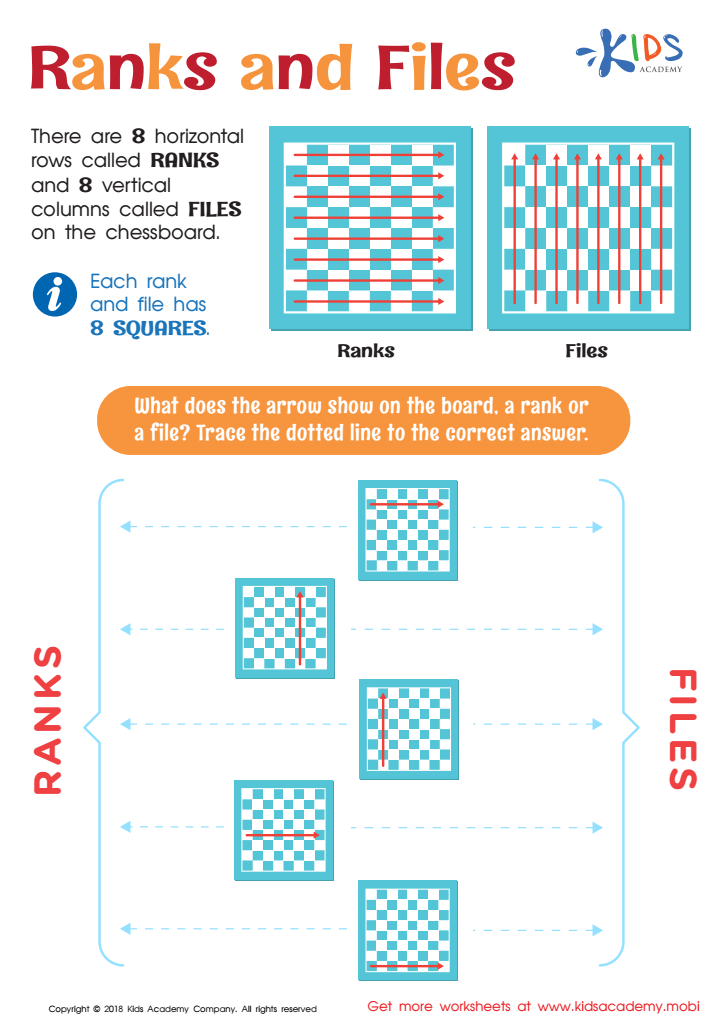
A chessboard has 8 horizontal ranks and 8 vertical files, each with 8 squares. Test your child's understanding of these directions with this fun worksheet!
Ranks and Files Worksheet
Worksheet
Position of the Chessboard: White on the Right Worksheet

Position of the Chessboard: White on the Right Worksheet

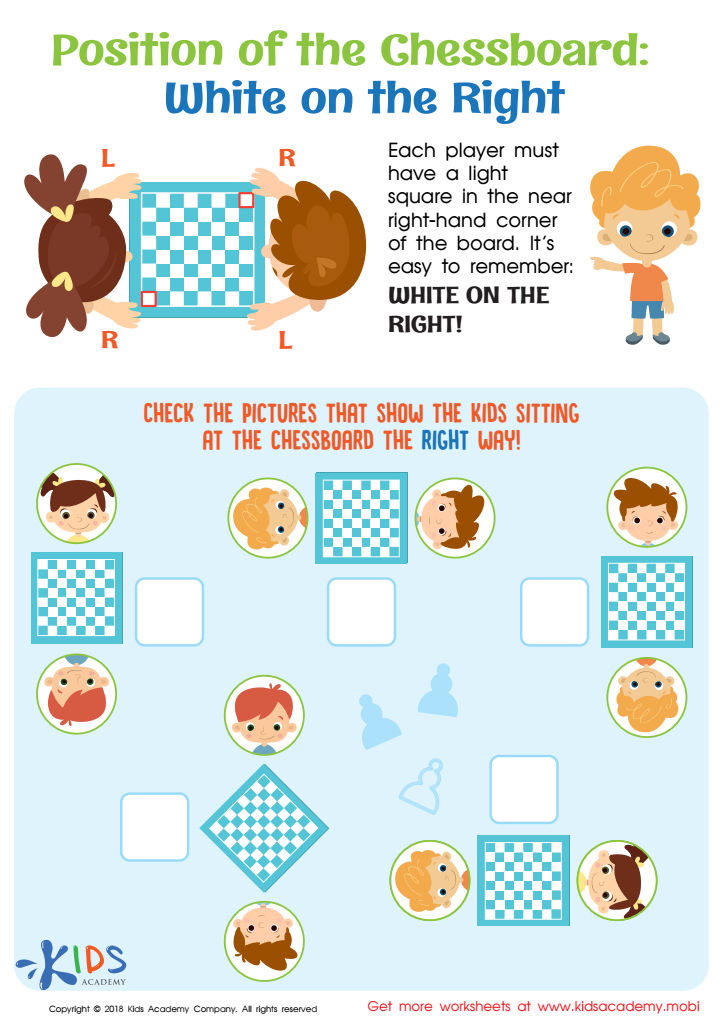
Proper positioning of the chessboard and players is key. Before the game, make sure the white square is in the right-hand corner. A simple rhyme can help: "White on the right". Check pictures of kids at the chessboard to ensure correct positioning.
Position of the Chessboard: White on the Right Worksheet
Worksheet
How Pawns Move: Part I Worksheet

How Pawns Move: Part I Worksheet

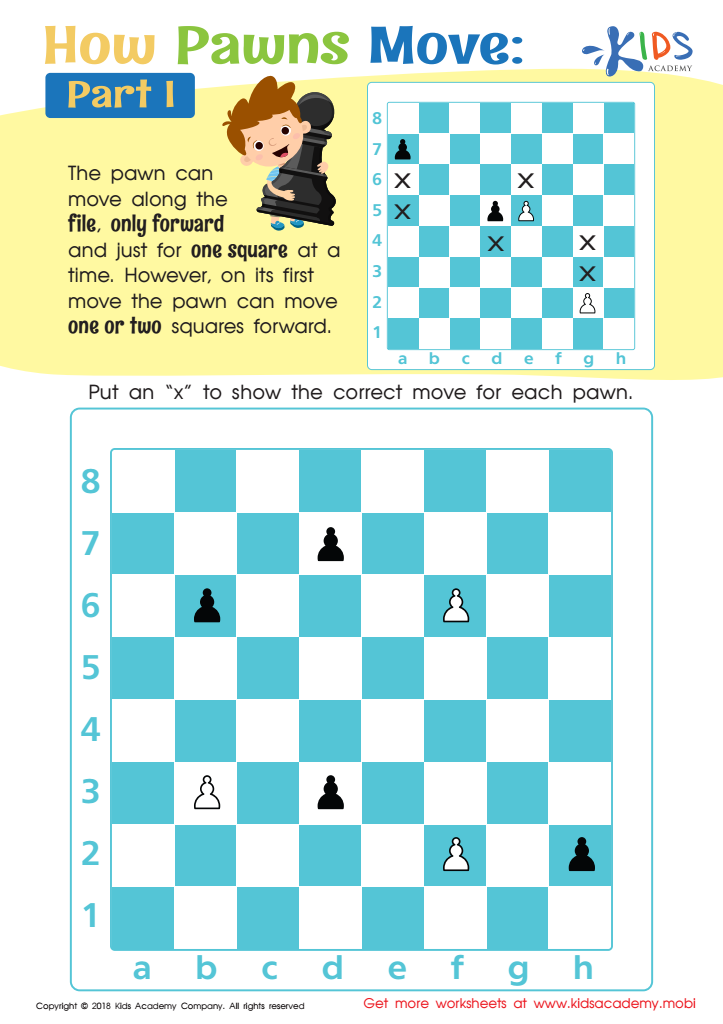
Pawns can only move forward along the file one square at a time. For its first move, a pawn can move one or two squares. Show your child how to move pawns by asking them to put an X for the correct move on this worksheet. This exercise will help them gain confidence in using pawns.
How Pawns Move: Part I Worksheet
Worksheet
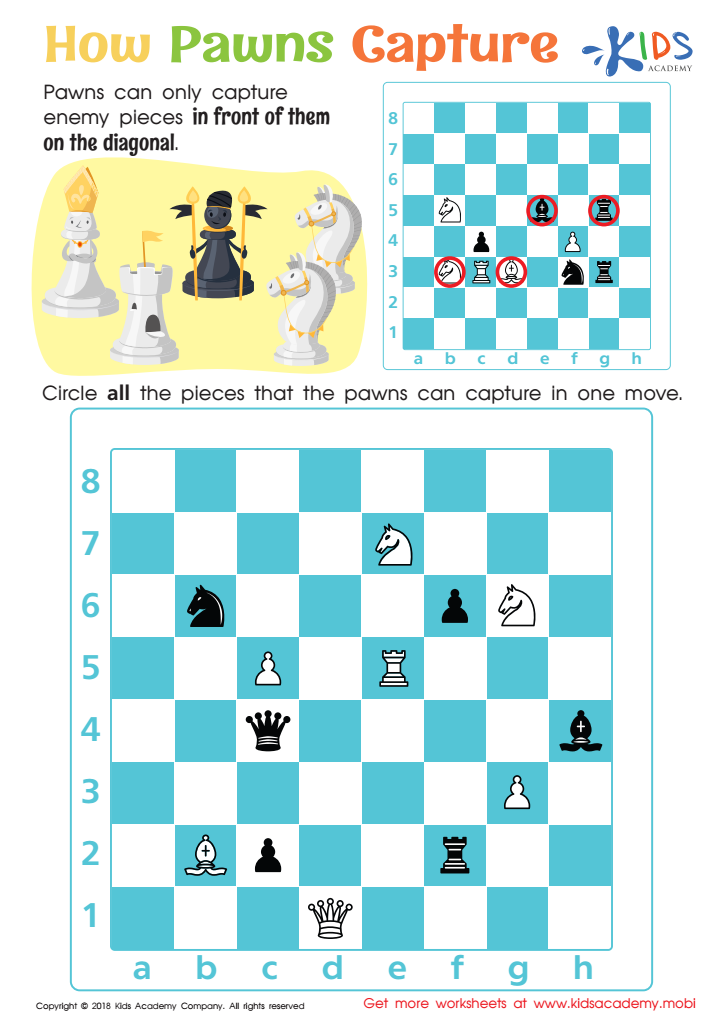
How Pawns Capture Worksheet

How Pawns Capture Worksheet

Ask your child to circle all the places a pawn can capture in one move on the diagonal. Pawns are limited in the moves they can make, but can still capture enemy pieces. This worksheet will help brush up on their knowledge of the rules of chess.
How Pawns Capture Worksheet
Worksheet
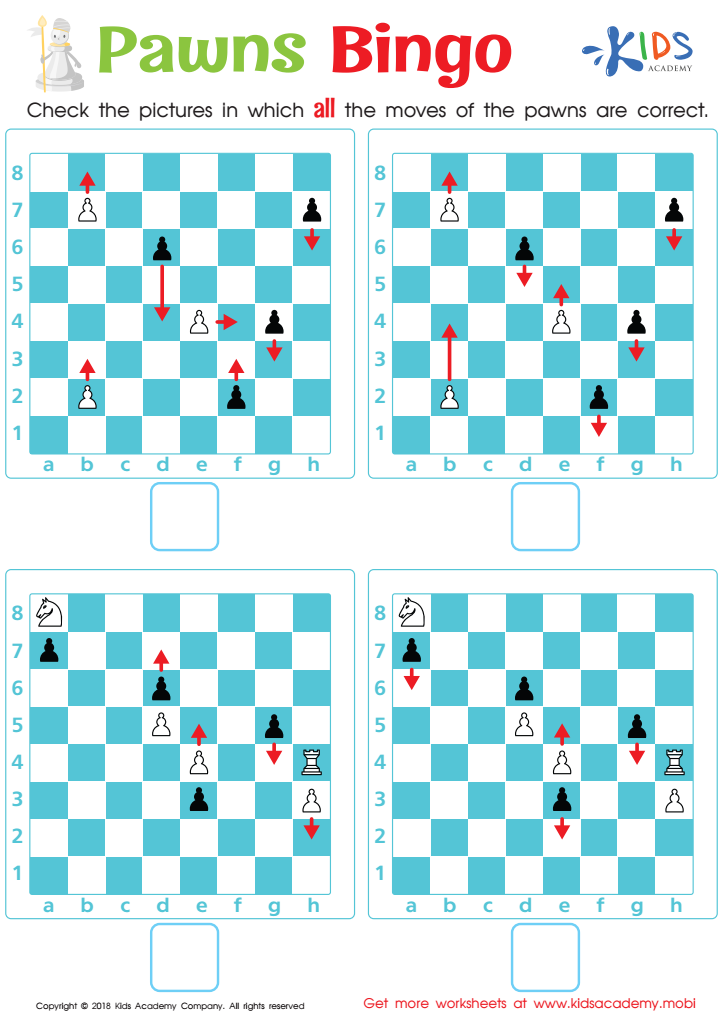
Pawns Bingo Worksheet

Pawns Bingo Worksheet

Test your students' knowledge of chess pawns. Present them with a worksheet featuring a picture, and ask them to identify the correct pawn moves. Afterward, they'll be better equipped to maneuver strategically on the chessboard.
Pawns Bingo Worksheet
Worksheet
How Pawns Move: Part II Worksheet

How Pawns Move: Part II Worksheet

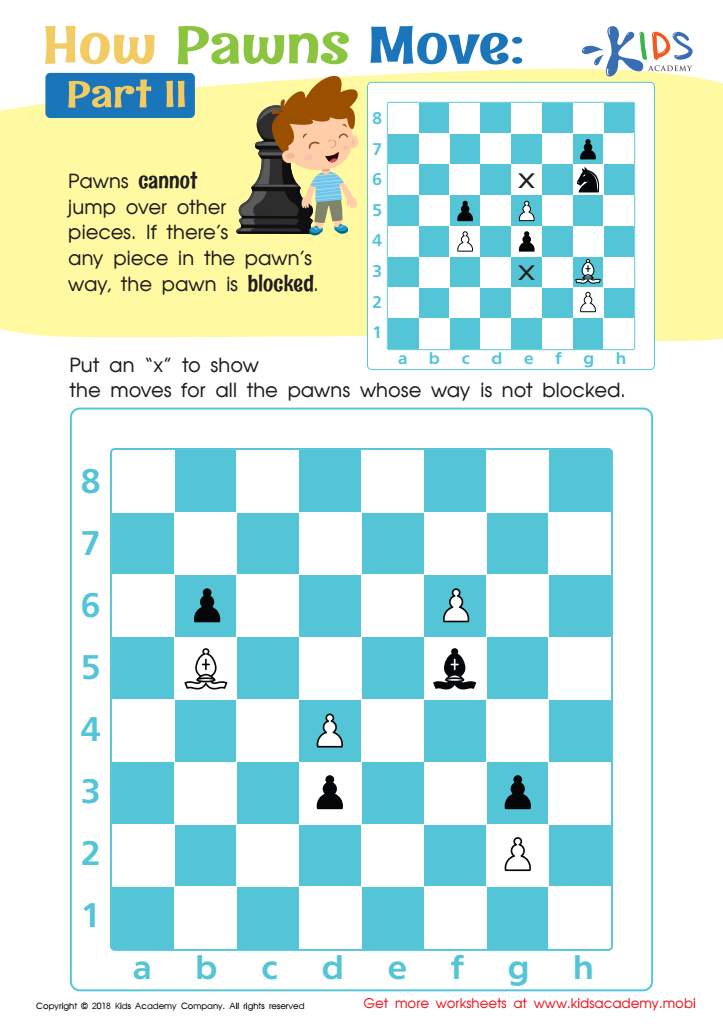
Pawns are the first to attack in chess and each player has the most pieces. They can't jump over other pieces, so if there's an obstacle, the pawn can't move. Ask your child to put an X to show all possible moves for the pawns not blocked by other pieces. (80)
How Pawns Move: Part II Worksheet
Worksheet
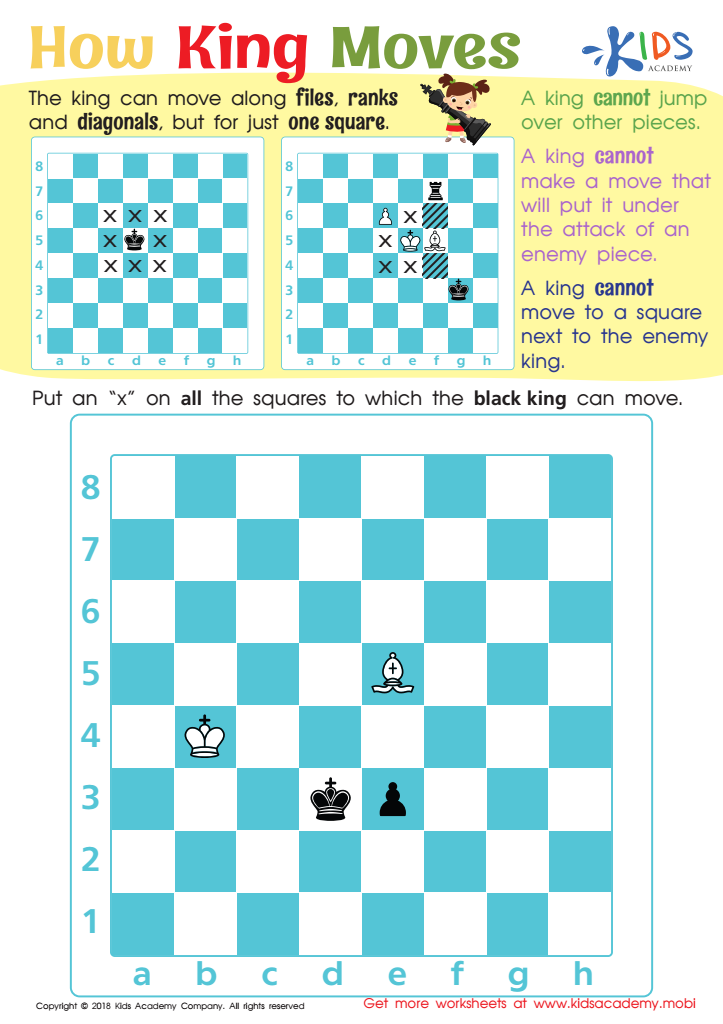
How King Moves Worksheet

How King Moves Worksheet

Teach your kids the fundamentals of chess with this worksheet! The goal is to checkmate the opponent's king, so it must be protected at all times. The king moves along files, ranks, and diagonals (except one square at a time), and cannot move to a square next to the enemy king. Your kids will soon master the art of checkmate!
How King Moves Worksheet
Worksheet
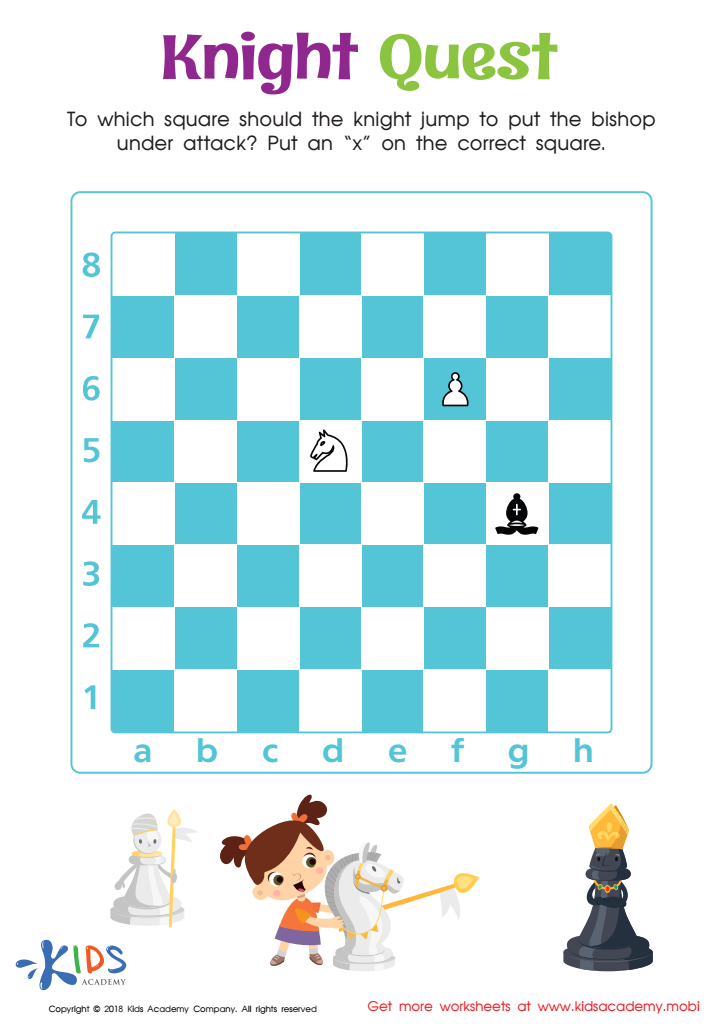
Knight Quest Worksheet

Knight Quest Worksheet

Testing your child's strategic planning and chess skills? Give them this worksheet: Ask them to mark an 'x' on the square where the knight should jump to attack the enemy bishop. See how well they plan for a win! (80 words)
Knight Quest Worksheet
Worksheet
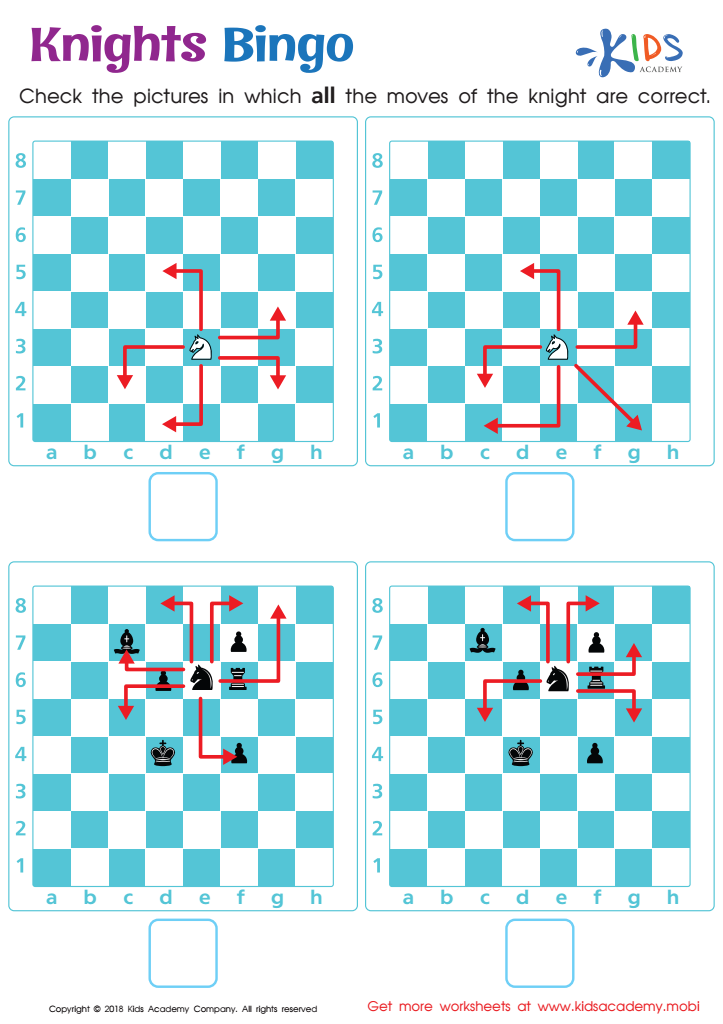
Knights Bingo Worksheet

Knights Bingo Worksheet

Help your child identify legal knight moves in this easy worksheet. Review each picture with them, questioning if the knight moves are correct. Then have them verify pictures with correct moves.
Knights Bingo Worksheet
Worksheet
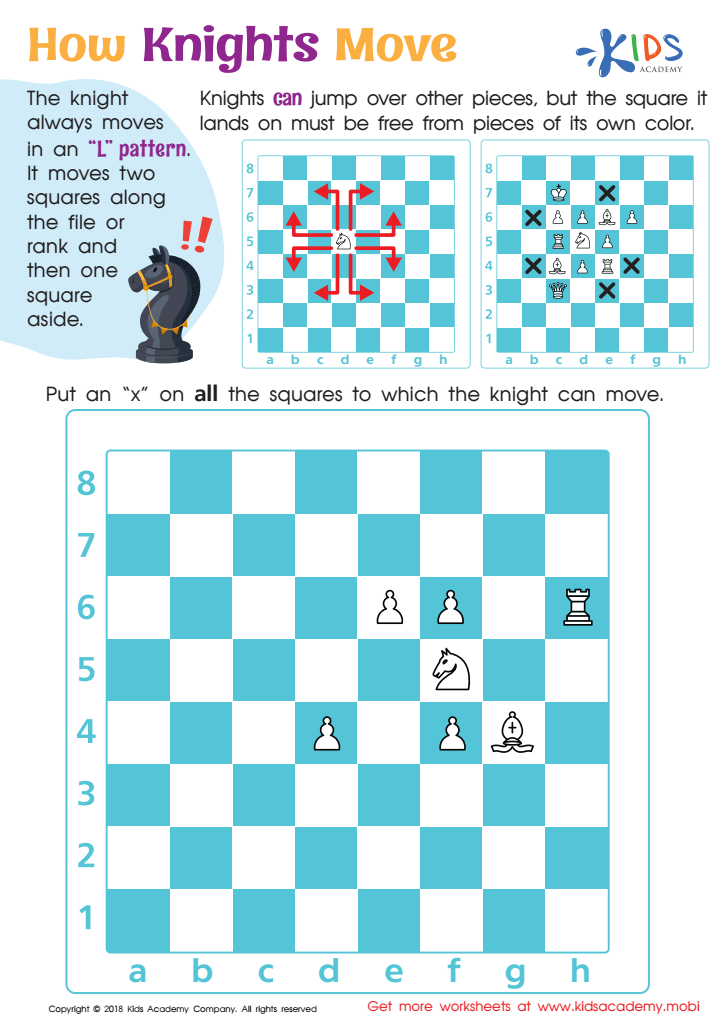
How Knights Move Worksheet

How Knights Move Worksheet

Get your kids to tell you how a knight moves in chess. If they need help, explain that a knight moves in an «L» pattern - two squares on the file/rank, one square aside. It may also jump over other pieces, as long as the landing square is unoccupied. Have them mark the squares where the knight can move in the exercise.
How Knights Move Worksheet
Worksheet
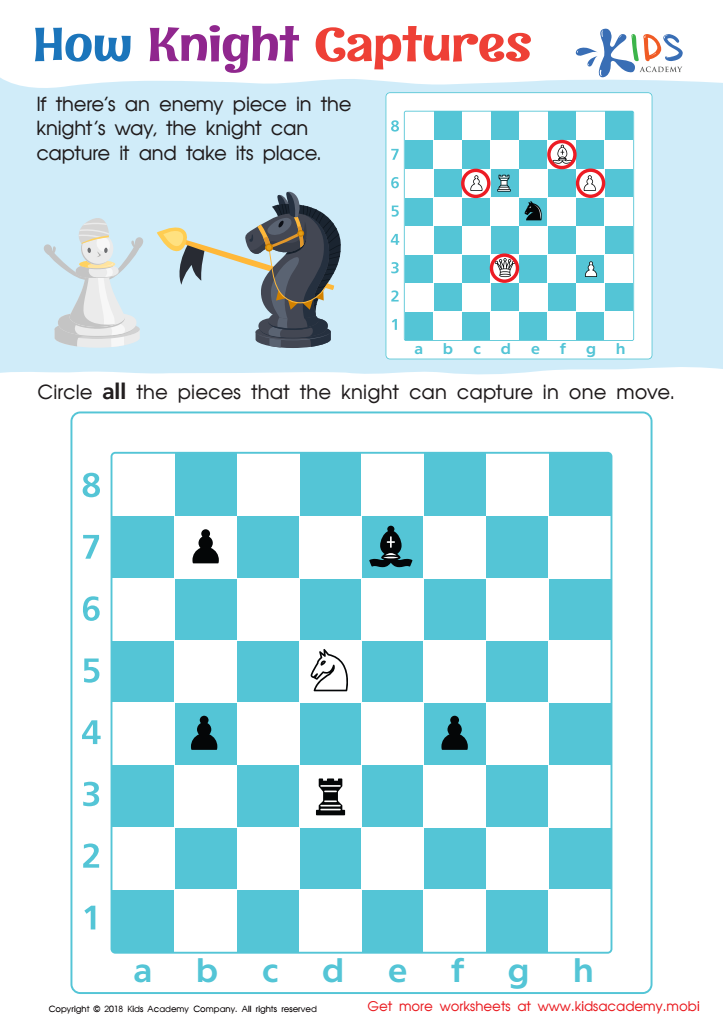
How Knight Captures Worksheet

How Knight Captures Worksheet

Test your child's knowledge of chess pieces by asking them to identify the knight. It is shaped like a horse and its goal is to capture the enemy king in order to win the game. The knight has the advantage of being able to jump over other pieces, taking them out and taking their place. See how many pieces the knight can capture in one move with this worksheet.
How Knight Captures Worksheet
Worksheet
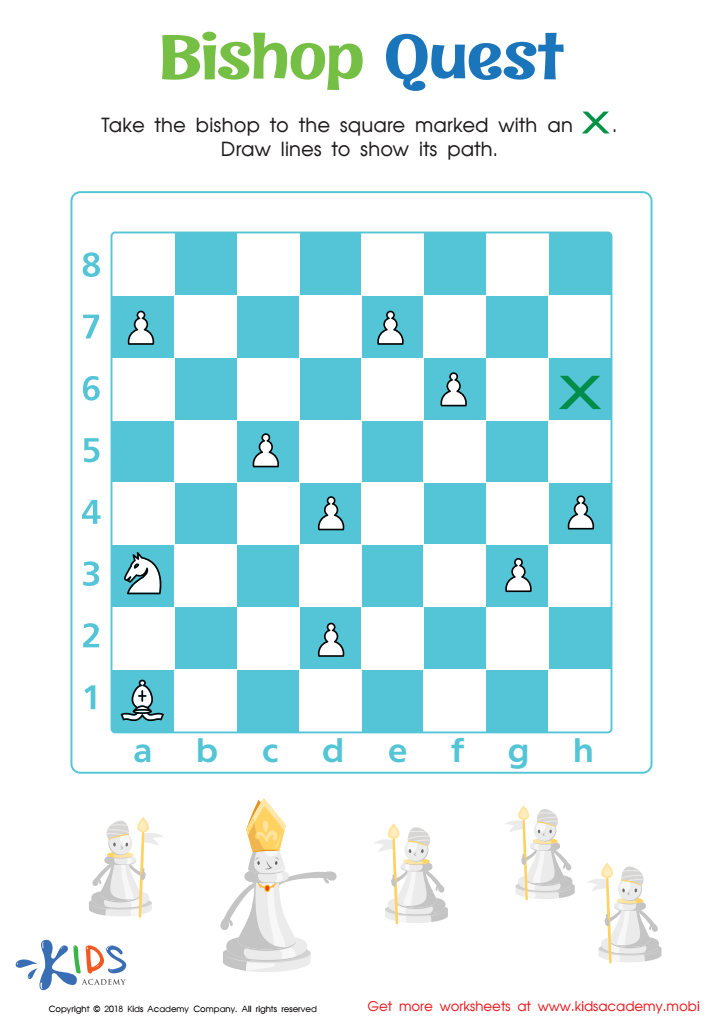
Bishop Quest Worksheet

Bishop Quest Worksheet

Show kids the board and ask them to identify the bishop. Then ask them to move it to the square marked 'x', drawing lines to show its path. This worksheet helps teach kids how to move the bishop on a chessboard.
Bishop Quest Worksheet
Worksheet
How Bishops Move Worksheet

How Bishops Move Worksheet

There is no such thing as too much sharpening of skills. Encourage your child to learn more about chess technicalities with this simple worksheet. It shows them how a bishop moves: along diagonals any number of squares, but it can't jump over other pieces.
How Bishops Move Worksheet
Worksheet
Cutting Rectangles with Alien Worksheet

Cutting Rectangles with Alien Worksheet

If your students are interested in aliens and otherworldly events, they'll love this exercise! It requires them to help a small alien cut rectangles into halves (½). They must trace the dotted lines to accurately cut each rectangle.
Cutting Rectangles with Alien Worksheet
Worksheet
Wholes and Halves Worksheet

Wholes and Halves Worksheet

Students can feel overwhelmed with fractions. Help take the stress off by using a colorful worksheet to explain whole shapes and how to find halves. Ask them to identify the whole and point to the matching word for the half. A free printout can help guide them.
Wholes and Halves Worksheet
Worksheet
Dividing Rectangles Worksheet

Dividing Rectangles Worksheet

Ask your child to draw lines to divide the white rectangles like the colored ones. Then, have them count the parts in each and choose the correct number. This worksheet will help them practice counting and dividing.
Dividing Rectangles Worksheet
Worksheet
Rook Quest Worksheet

Rook Quest Worksheet

Is your child a chess whiz? Check their progress with this rook quest: get the enemy's pawn piece in just two moves. Have them draw the lines for the moves they'll make. See how quickly they master it!
Rook Quest Worksheet
Worksheet
How Rooks Move Worksheet

How Rooks Move Worksheet

Help your kids master chess with this worksheet! Explain how rook pieces move along ranks and files, and have them mark the squares it can move to. Note that it can't jump over other pieces. With your guidance, they'll soon understand the game they love.
How Rooks Move Worksheet
Worksheet
Guess the Time Worksheet

Guess the Time Worksheet

Help students tell the time accurately with this fun exercise. Read the time each person says and find the corresponding clock. Check the options on the left and have students guess the right time. This worksheet is sure to sharpen their time-telling skills.
Guess the Time Worksheet
Worksheet
Setting Time with Watchmaker Worksheet

Setting Time with Watchmaker Worksheet

Can your kids tell the time? If so, this worksheet should be easy. Help them set the time for each clock: look at the time written on the left side and find the clock on the right side that matches.
Setting Time with Watchmaker Worksheet
Worksheet


Normal worksheets for Ages 8-9 are exceptionally beneficial tools in the educational journey of children. At this critical age, kids are not only expanding their academic knowledge but also developing vital learning habits that will support their future endeavors. Normal worksheets are meticulously designed to cater to the unique developmental needs of 8 to 9-year-olds, making learning both enjoyable and effective.

Firstly, these worksheets provide a structured learning environment. They offer clear, manageable tasks that help children understand and apply concepts in subjects like math, language arts, and science. The structure of normal worksheets ensures that students can practice at their own pace, reinforcing their learning without feeling overwhelmed.

Secondly, normal worksheets for Ages 8-9 are crafted to stimulate cognitive development. They challenge children to think critically, solve problems, and develop reasoning skills. These activities encourage kids to engage deeply with the material, promoting long-term retention of knowledge.

Moreover, the interactive nature of these worksheets makes learning engaging. They often include colorful illustrations, puzzles, and games, making education feel more like play. This aspect is crucial for maintaining the attention and interest of children in this age group, fostering a positive attitude towards learning.

Lastly, normal worksheets provide a tangible way for parents and educators to gauge a child's understanding and progress. By observing how children tackle these worksheets, adults can identify areas of strength and areas needing improvement, allowing for targeted support.

In summary, normal worksheets for Ages 8-9 are invaluable tools that blend education with engagement, nurturing the intellectual and developmental growth of children. They are a cornerstone in building a solid foundation for lifelong learning.