Subtraction Worksheets for Ages 3-9 - Page 5
97 filtered results
-
From - To
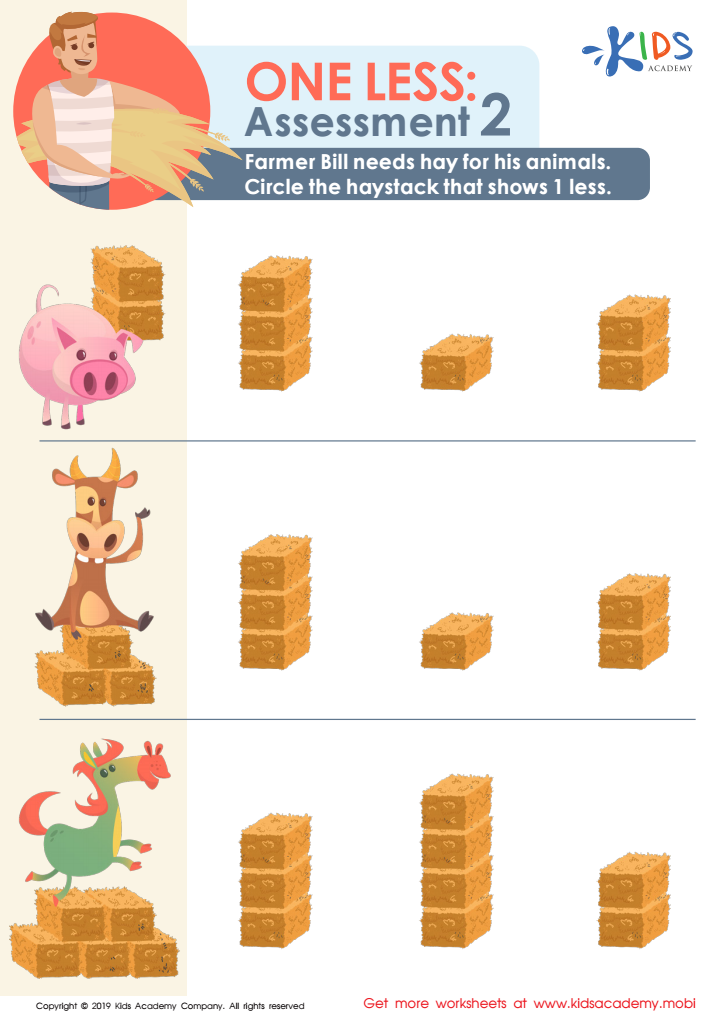
One Less: Assessment 2 Worksheet
 Assign to My Students








Subtraction is a fundamental mathematical skill that lays the groundwork for a child’s future in mathematics and critical thinking. For children ages 3-9, mastering subtraction helps them understand the concept of taking away, which is essential for grasping more complex math concepts later on, such as addition and even basic algebra.
Parents and teachers should care about teaching subtraction because it enhances cognitive development. Engaging children in subtraction through games or real-life scenarios promotes problem-solving skills and logical thinking. This is vital for their overall intellectual growth and prepares them for everyday situations, like estimating what remains after making a purchase or sharing snacks.
Moreover, early mastery of subtraction can boost a child’s confidence in their math abilities. Struggling with this skill can lead to anxiety, diminishing their interest in mathematics as they progress. By nurturing their understanding at an early age, parents and teachers can help foster a positive attitude towards math.
Furthermore, subtraction is not just an abstract concept; it can have practical applications in life skills, such as budgeting and measuring. Thus, emphasizing subtraction enables children not only to succeed academically but also to apply their knowledge in practical, real-world situations.








