Time Worksheets for Ages 4-7 - Page 2
25 filtered results
-
From - To
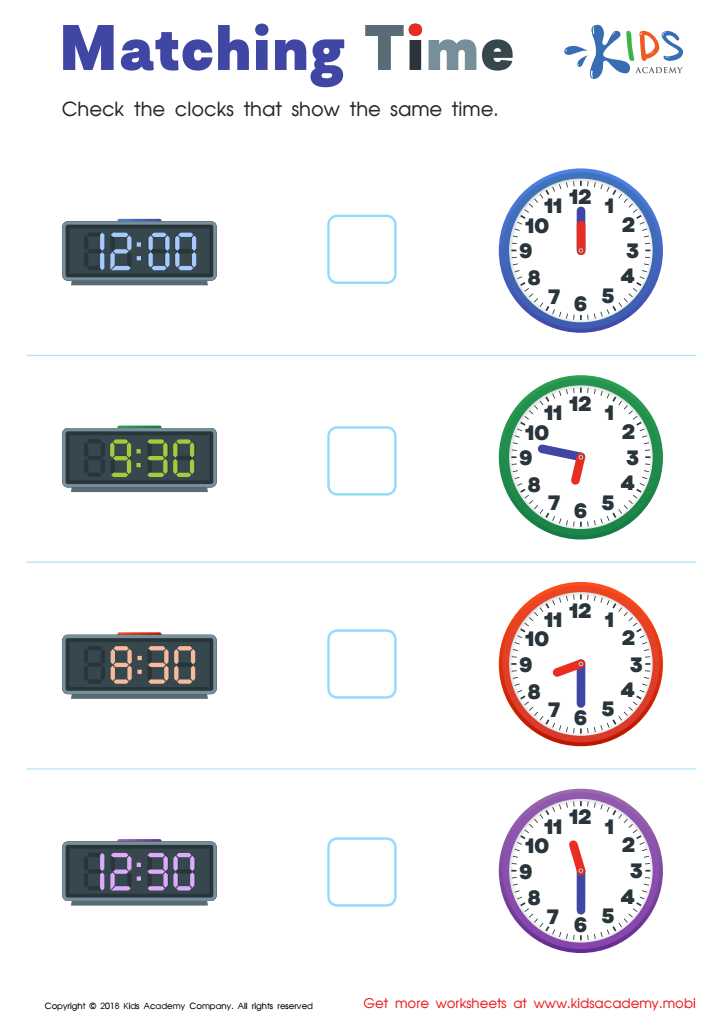
Matching Time Worksheet
 Assign to My Students








Time is a fundamental concept that significantly shapes a child's understanding of the world. For children ages 4-7, grasping the concept of time helps them develop essential skills such as planning, prioritization, and self-regulation. Understanding time allows children to synchronize their activities, leading to improved routines, such as recognizing when it’s time to play, study, or take a break.
Moreover, teaching children about time fosters critical cognitive skills, including logical reasoning and problem-solving abilities. For example, learning how to tell time using clocks enhances spatial intelligence and encourages mathematical skills, such as counting and measuring. This understanding also builds language skills, as children learn to use time-related vocabulary in daily conversations.
Additionally, recognizing the broader significance of time fosters emotional maturity. As children begin to comprehend the concepts of past, present, and future, they can better reflect on their experiences and develop empathy towards others by understanding timing in social interactions. Ultimately, ensuring that parents and teachers prioritize teaching children about time equips them with crucial life skills that benefit their overall development, academic success, and social dynamics. Such foundational skills set the tone for lifelong learning and adaptation in an ever-evolving world.








