Check out this FREE Trial Lesson on Geometry for age 5-7!

Cut Rectangles: Thirds and Fourths

Favorites
With answer key
Interactive
  • 5-7
  • Understanding fractions
  • Geometry
Cutting in Halves Worksheet

Cutting in Halves Worksheet

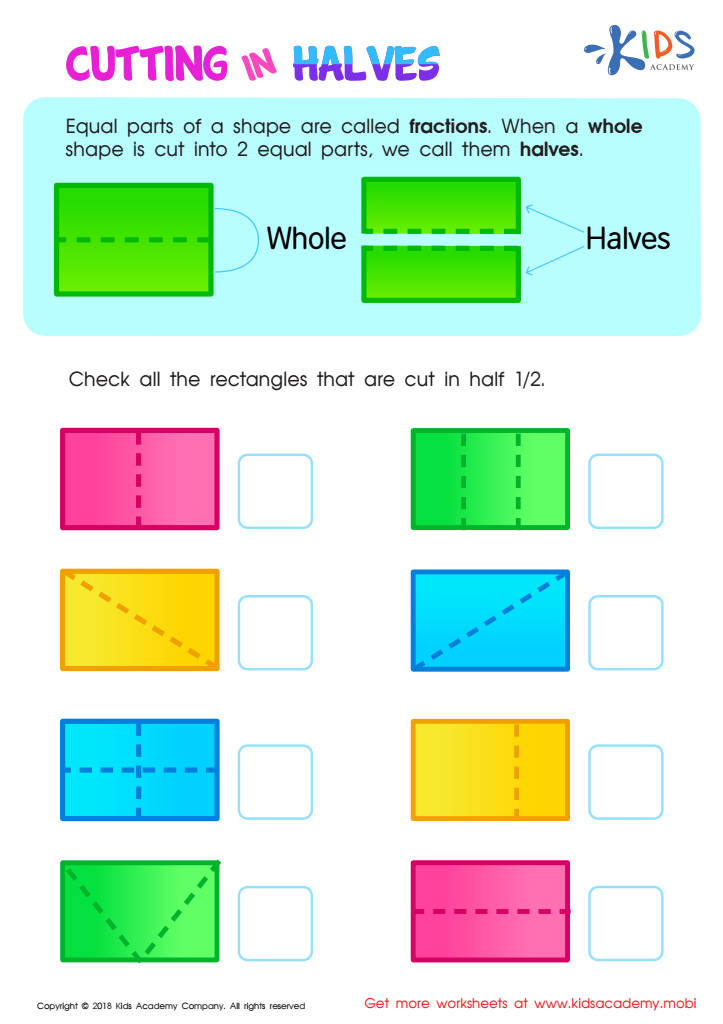
Show your child how to divide a whole shape, like a square, into smaller pieces to become fractions. Point out when a shape is divided into two equal parts, it's called a half. Look at the worksheet together, and identify all rectangles that are cut in half (½).
Cutting in Halves Worksheet
Worksheet
Circle Thirds Worksheet

Circle Thirds Worksheet

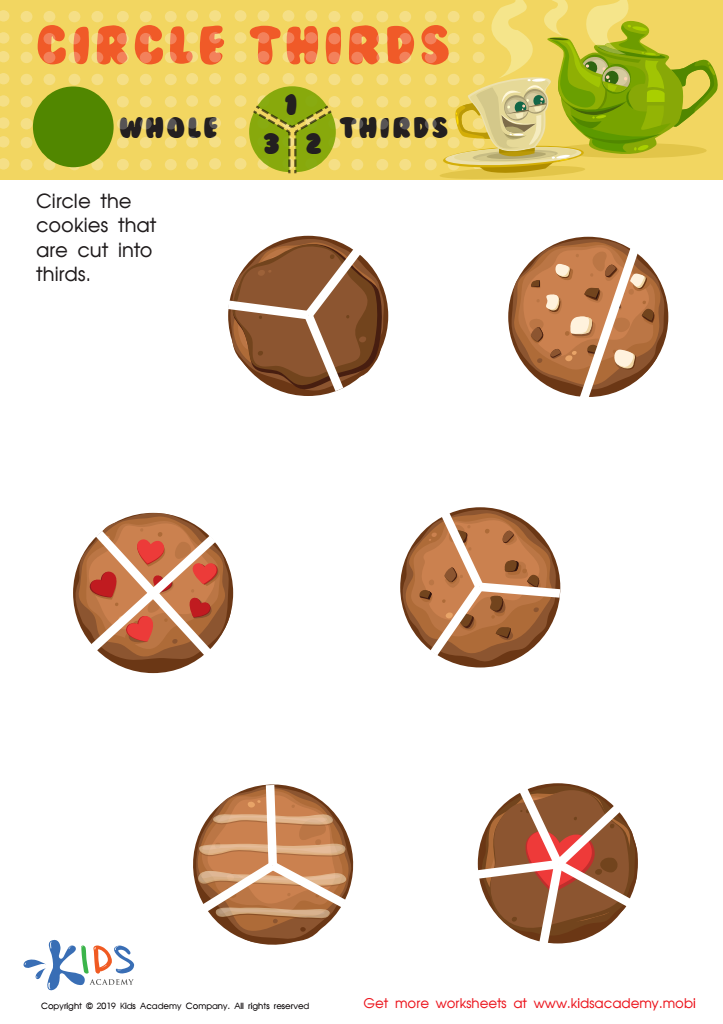
Remind your kids of the different ways shapes can be divided: wholes, halves, thirds, and fourths. Now, look at the shapes in the worksheet and have them circle the cookies cut into thirds.
Circle Thirds Worksheet
Worksheet
Slice It Up Worksheet

Slice It Up Worksheet

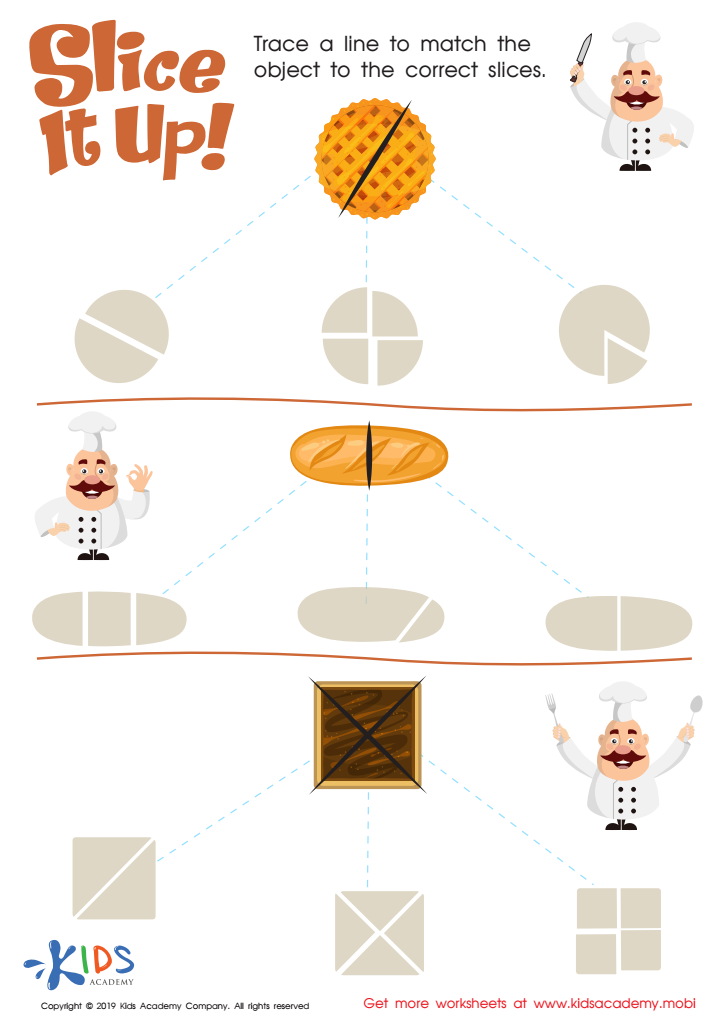
Try this fun math, reading and writing worksheet with your kids! They will love the colorful activities that perfect coordination and tracing. Engaging learning exercises help keep young minds sharp and boost skills. With these worksheets, your kids will be academically ahead of the curve!
Slice It Up Worksheet
Worksheet
Fractions of Shapes Printable Worksheet

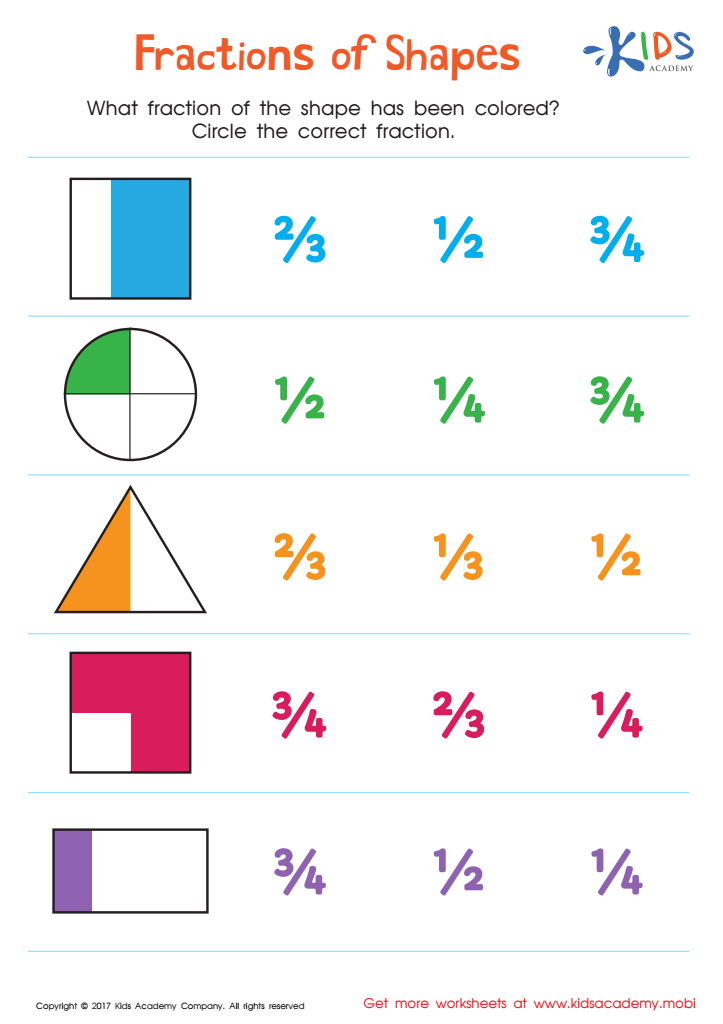
Fractions of Shapes Worksheet
It will also show them how fractions are represented in everyday shapes.
Fractions of Shapes Worksheet
Worksheet
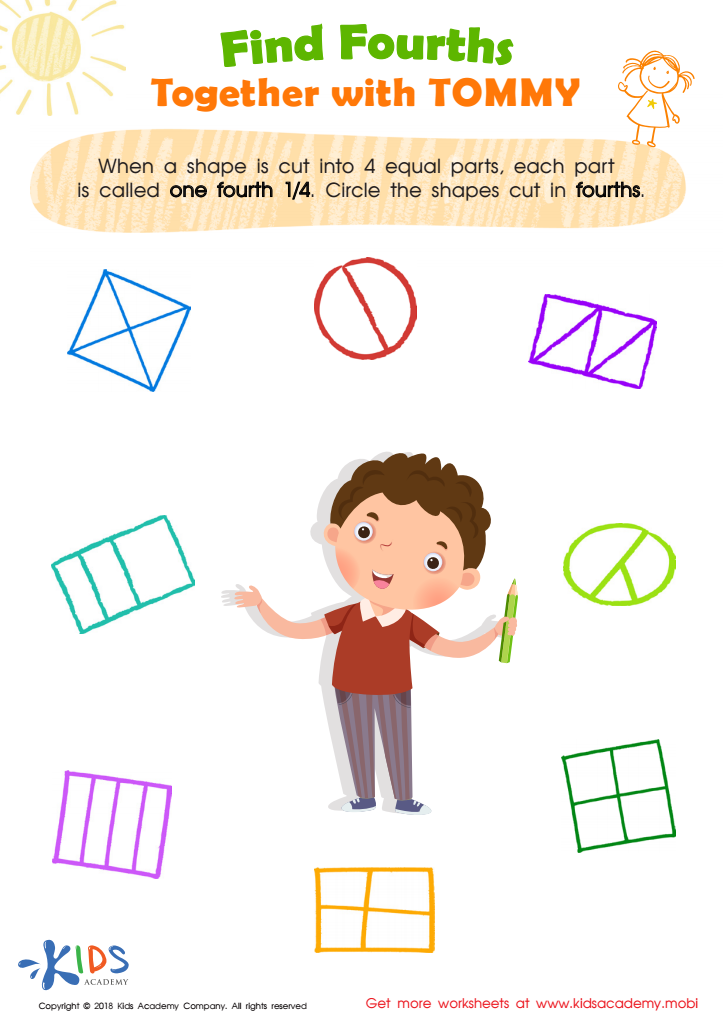
Find Fourths Together with Tommy Worksheet

Find Fourths Together with Tommy Worksheet

Teach your kids fractions with this easy and fun worksheet! They should already know that two equal parts is a half, and three is a third. Now, help them understand one fourth (¼) by asking them to circle shapes that are divided into four parts. Make fractions learning stress-free for you and your children!
Find Fourths Together with Tommy Worksheet
Worksheet
Fractions of shapes worksheet

Fractions of Shapes: Math Concept Worksheet
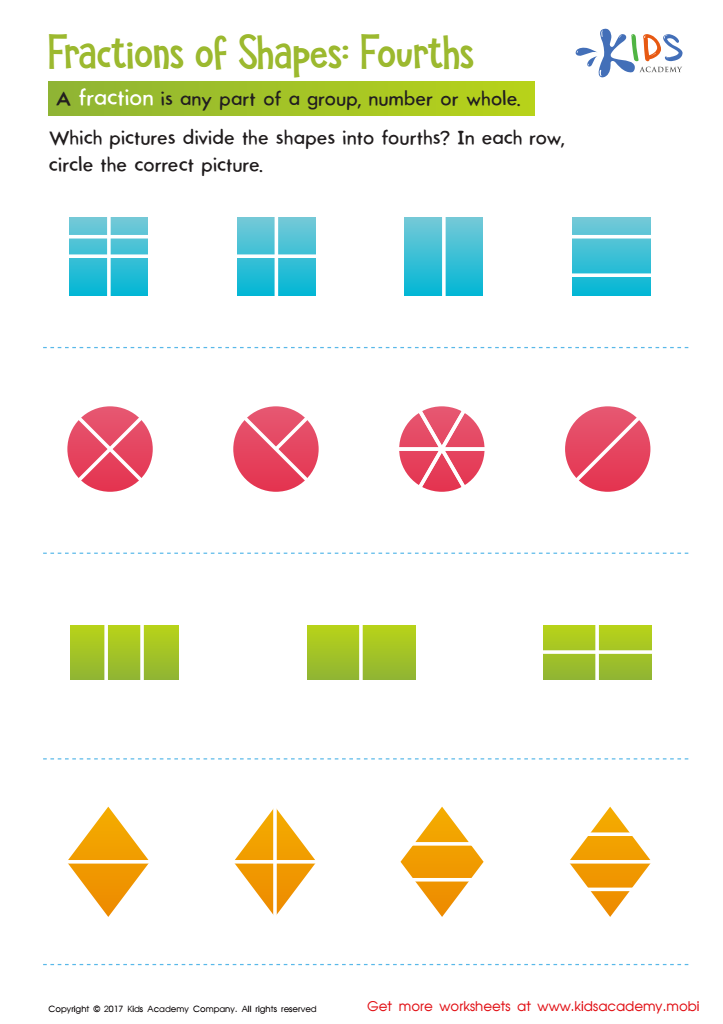
Fractions can be tricky, but with pictures to illustrate them, they become much easier to understand. Our fractions of shapes worksheet is a great way to help children visualize fractions and gain a better understanding of them.
Fractions of Shapes: Math Concept Worksheet
Worksheet
Equal Parts: Food Worksheet


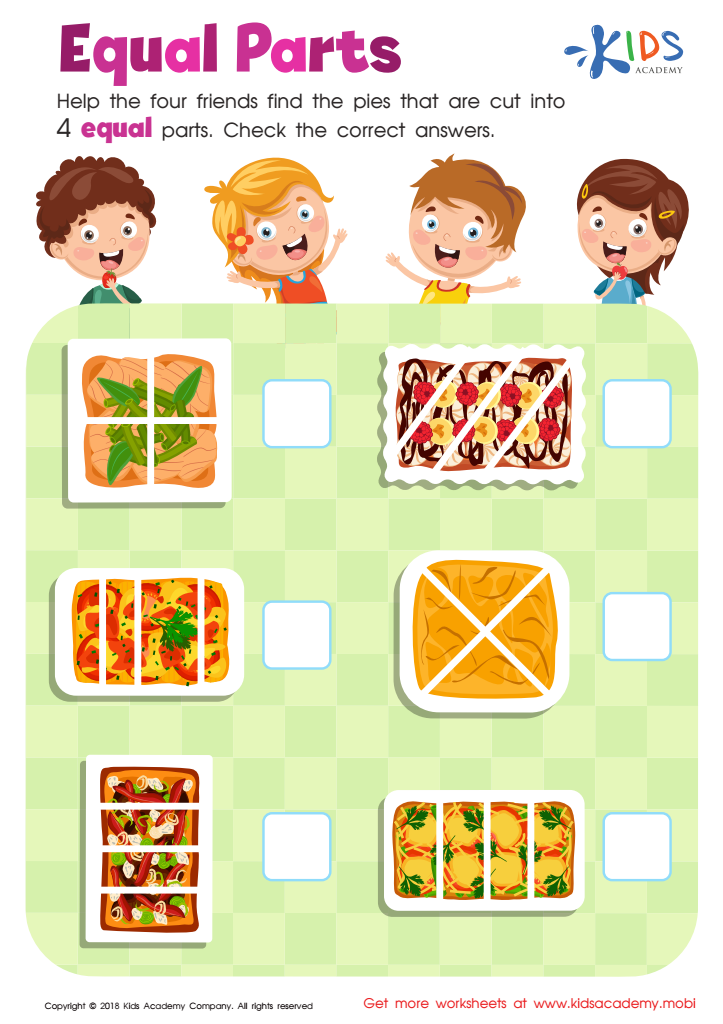
Equal Parts: Food Worksheet

Kids love pies! In this worksheet, they must help four friends share one equally. Six pictures of pies cut in different ways are provided. Your child must choose the one where the pie is divided into four equal parts. That way, each friend gets an equal share.
Equal Parts: Food Worksheet
Worksheet


Understanding fractions and geometry at a young age sets a strong foundation for children's future mathematical learning. For ages 5-7, an introduction to these concepts plays a crucial role in cognitive development.

Early exposure to fractions helps children grasp the idea of parts and wholes. They learn that a whole can be divided into equal parts, which is fundamental for arithmetic and division. This understanding eases their transition to more complex math concepts and reduces anxiety around division and proportionality in later grades.

Geometry fosters spatial reasoning, which is the ability to understand and remember the spatial relations among objects. By recognizing shapes, identifying patterns, and understanding spatial properties, children enhance their problem-solving and critical thinking skills. These skills are not confined to mathematics alone but apply to real-world situations, such as navigation and understanding patterns in nature.

Moreover, integrating fractions with geometry, such as recognizing how a half-circle or quarter-pie relates to whole objects, strengthens both disciplines. This multidisciplinary approach makes abstract concepts concrete, engaging children through visual and hands-on learning.

Parents and teachers who emphasize these foundational skills provide children with essential tools for lifelong learning, nurturing curiosity, and fostering academic success across various subjects. This early investment cultivates a positive attitude toward math and develops a child's confidence and capabilities.