
Simplifying Fractions Math Worksheets for Ages 5-8
22 filtered results
Difficulty Level
Grade
Age
-
From - To
Subject
Activity
Standards
Welcome to our collection of "Simplifying Fractions Math Worksheets" for ages 5-8! These engaging and interactive worksheets are designed to introduce young learners to the concept of simplifying fractions in a fun and approachable way. Within our resource, you'll find a variety of colorful, age-appropriate activities that promote hands-on learning and critical thinking skills. Each worksheet gradually builds confidence in fraction recognition and simplification through clear explanations and captivating exercises. Perfect for classroom use or at-home practice, these worksheets foster a solid mathematical foundation, encouraging children to explore the world of fractions with ease and enjoyment. Enhance your child's math journey today!
Favorites
With answer key
Interactive
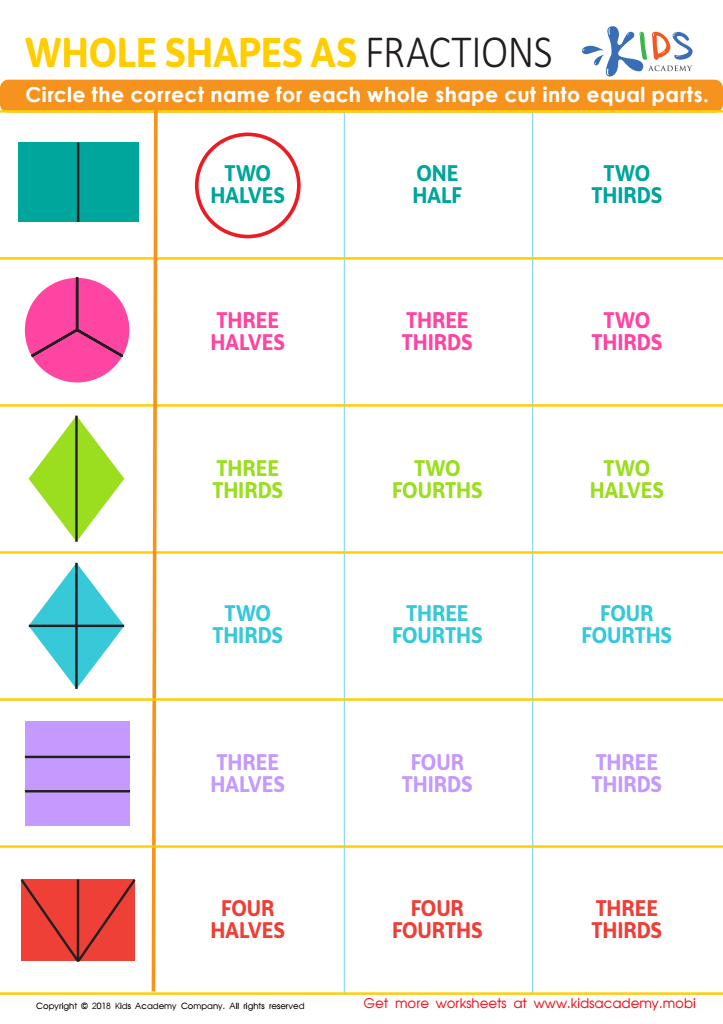
Whole Shapes as Fractions Worksheet
Introduce your child to fractions! After they can draw whole shapes, have them represent them as fractions using a simple worksheet. This will help improve their understanding of naming whole shapes cut into equal parts.
 Assign to My Students
Whole Shapes as Fractions Worksheet
Worksheet
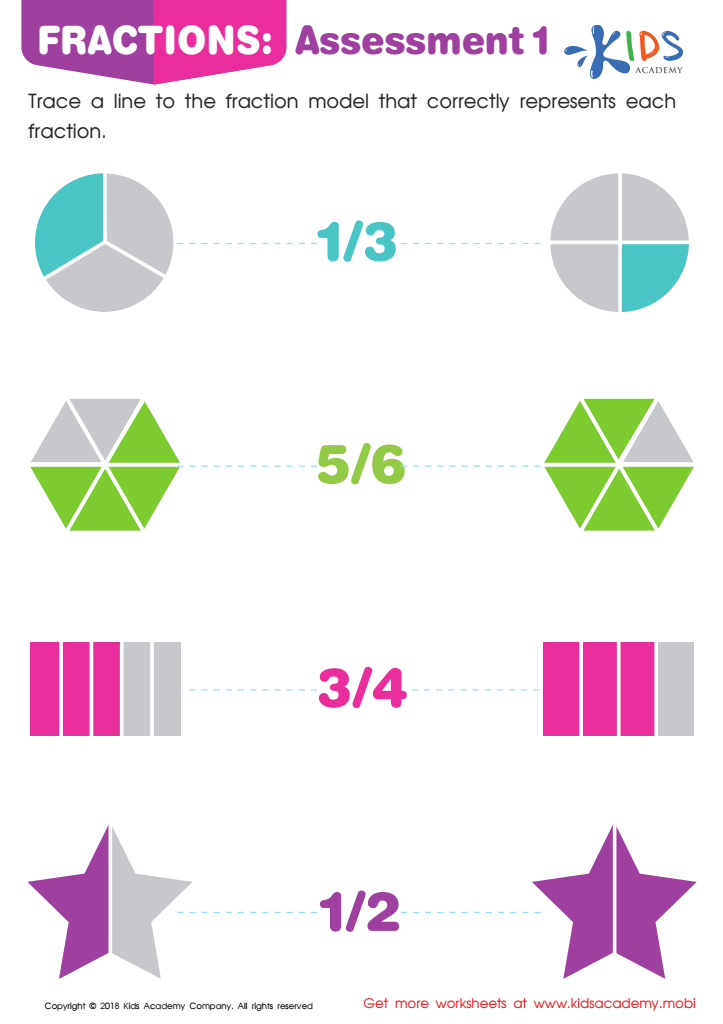
Fractions: Assessment 1 Worksheet
Master fractions easily with this worksheet! It has four sets of fraction models and fraction equations with two models each. Guide your kids to trace a line to the correct fraction model for each equation.
Fractions: Assessment 1 Worksheet
Worksheet
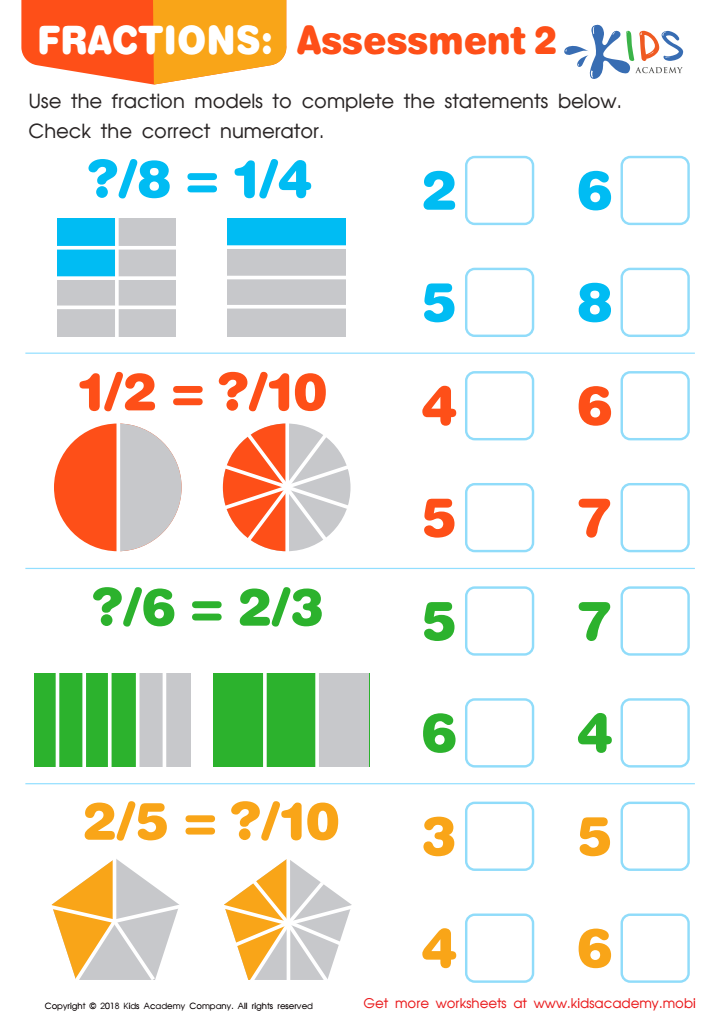
Fractions: Assessment 2 Worksheet
Help your kids understand fractions better with this worksheet. Ask them to complete the fraction statements using the fraction models on the left and then check the correct numerators. This can help clear up any confusion they may have with fractions and fraction models.
Fractions: Assessment 2 Worksheet
Worksheet
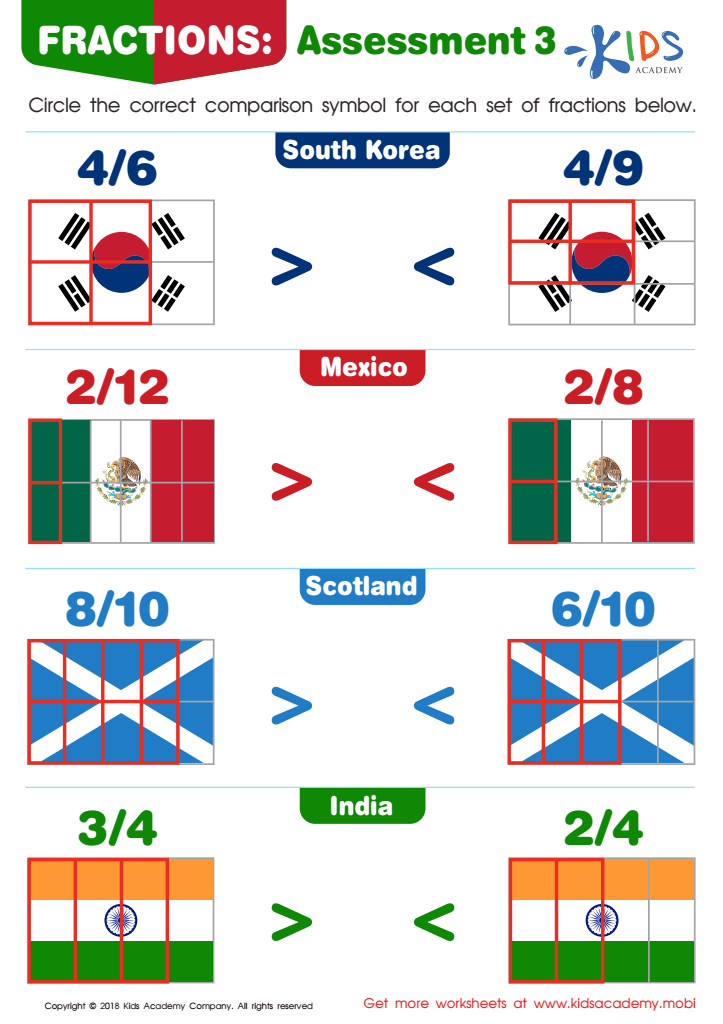
Fractions: Assessment 3 Worksheet
This worksheet helps teach kids about fractions and introduces them to countries and their flags. Have them read the country names and point to the flags. Then help them assess the fractions, and ask them to circle the symbol that shows their values.
Fractions: Assessment 3 Worksheet
Worksheet
Join Kids Academy for Free
Who is primarily going to use this learning content?







Simplifying fractions is a fundamental math skill that helps young learners in ages 5-8 develop a strong mathematical foundation. Teaching children to simplify fractions fosters critical thinking and problem-solving abilities, enabling them to approach more complex concepts with confidence. At this age, children are naturally curious and eager to learn, making it an ideal time to introduce fractional concepts that can enhance their understanding of division and proportional reasoning.
Moreover, simplifying fractions allows children to see relationships between numbers in a more meaningful way. It reinforces the importance of equal parts and helps them visualize how fractions relate to whole numbers. This understanding is not only essential for future calculations but also applies to real-life situations, such as sharing food or measuring ingredients.
For parents and teachers, knowing how to simplify fractions equips them to provide effective guidance. With a hands-ons, engaging approach, they can make learning fun and interactive. Early mastery of this skill also builds a solid groundwork for future math topics, encouraging a positive attitude towards math as students progress in their education. In supporting this learning, adults contribute to developing confident, competent mathematicians while instilling a love for learning that can last a lifetime.








