Subtraction Worksheets for Ages 5-9 - Page 5
97 filtered results
-
From - To
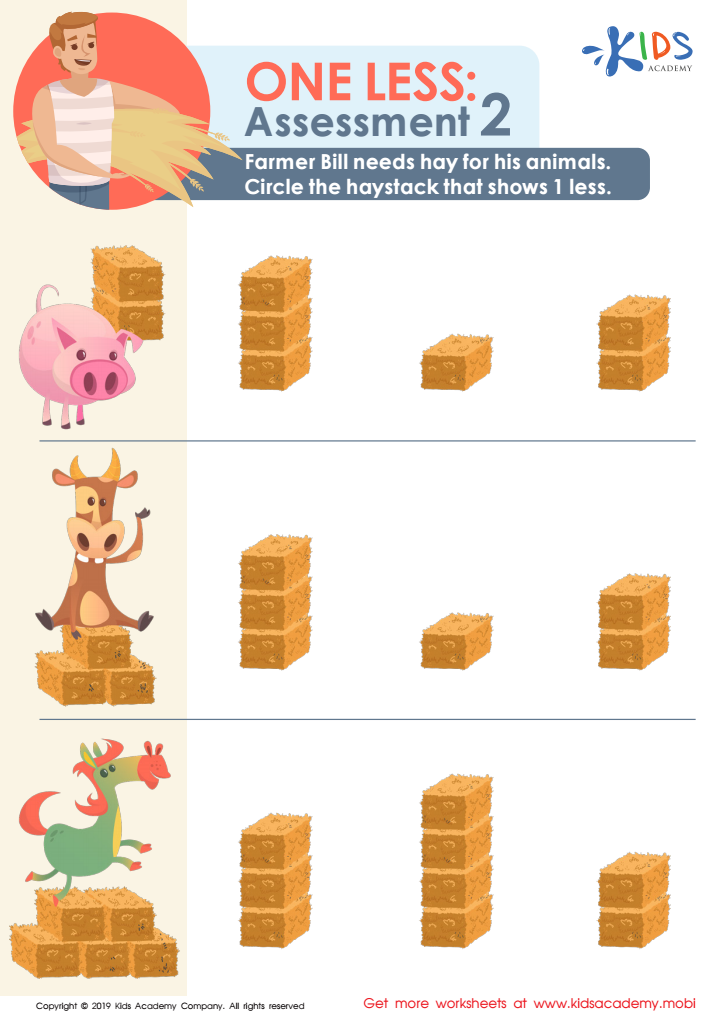
One Less: Assessment 2 Worksheet
 Assign to My Students








Subtraction for children aged 5-9 is a foundational skill crucial for their overall mathematical development, and parents and teachers should prioritize it for several reasons. At this age, children are starting school and encountering formal math education for the first time, making it essential to help them build a strong arithmetic foundation.
Firstly, subtraction is directly tied to their understanding of basic arithmetic, as it complements addition. Mastery of subtraction forms the groundwork for more complex math concepts, such as multiplication and division, which they will encounter in later grades.
Secondly, learning subtraction enhances critical thinking and problem-solving skills. When children practice subtracting numbers, they develop the ability to analyze problems, recognize patterns, and apply logical reasoning, which are essential skills not only for math but for everyday decision-making.
Also, fostering a strong grasp of subtraction improves their confidence. Children who struggle with basic arithmetic can quickly become discouraged, which might lead to a broader academic disinterest. Helping them succeed from the beginning encourages a positive attitude toward learning.
Lastly, as part of fundamental numeracy skills, subtraction is widely applicable in daily life, from counting change to time management. It’s an essential life skill that supports their ability to function independently and responsibly.
In conclusion, by prioritizing subtraction skills, parents and teachers lay the groundwork for a child's academic success and practical life skills, promoting an all-rounded educational experience.








