Time Worksheets for Ages 5-9 - Page 2
25 filtered results
-
From - To
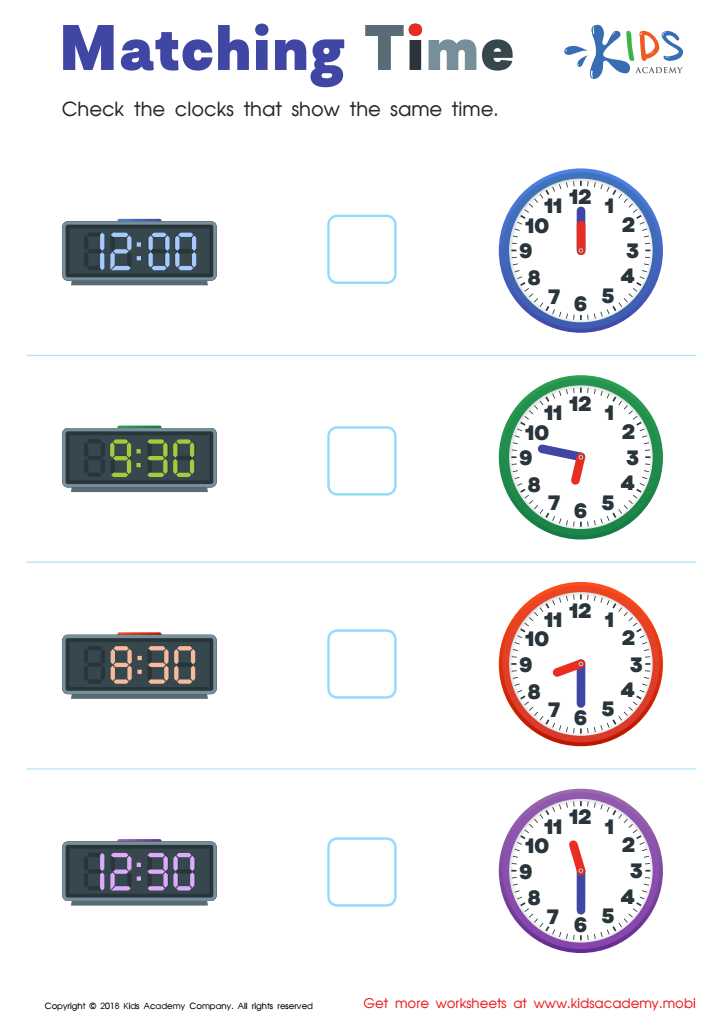
Matching Time Worksheet
 Assign to My Students








Understanding time is crucial for children aged 5-9, as it lays the foundation for many cognitive and social skills. At this age, children are developing their sense of routine and responsibility, which are essential for their growth. Teaching them how to read clocks, comprehend schedules, and understand the concept of past, present, and future enhances their time management skills. This knowledge empowers them to plan their activities, from homework to playtime, fostering a sense of autonomy and self-discipline.
Moreover, grasping the concept of time aids in the understanding of sequencing and cause-and-effect relationships. When children learn to appreciate the flow of time, they can better relate to stories, retain information, and participate in discussions about events. Teachers and parents can use time-oriented activities to build critical thinking and problem-solving skills, as well as enhance mathematical abilities through simple addition and subtraction connected with scheduling.
By prioritizing lessons on time, parents and teachers cultivate not just practical skills but also instill responsibility and independence, which are instrumental in a child’s overall development. Fostering an understanding of time sets the groundwork for future success in both academic and daily life arenas, making it a vital educational focus.








