
Understanding fractions Math Worksheets for Ages 8-9
194 filtered results
Difficulty Level
Grade
Age
-
From - To
Subject
Activity
Standards
Our "Understanding Fractions Math Worksheets for Ages 8-9" provide engaging and educational practice for young learners. Tailored for 3rd graders, these worksheets help students grasp key fraction concepts including numerator, denominator, and equal parts. Each activity uses visual aids and real-world examples, making fractions relatable and easier to understand. These resources align with educational standards, ensuring your child develops a solid foundation in fractions while boosting their confidence in math. Perfect for both classroom use and homeschooling, our worksheets offer a fun and thorough approach to mastering fractions. Start today and watch your child's skills multiply!
Favorites
With answer key
Interactive
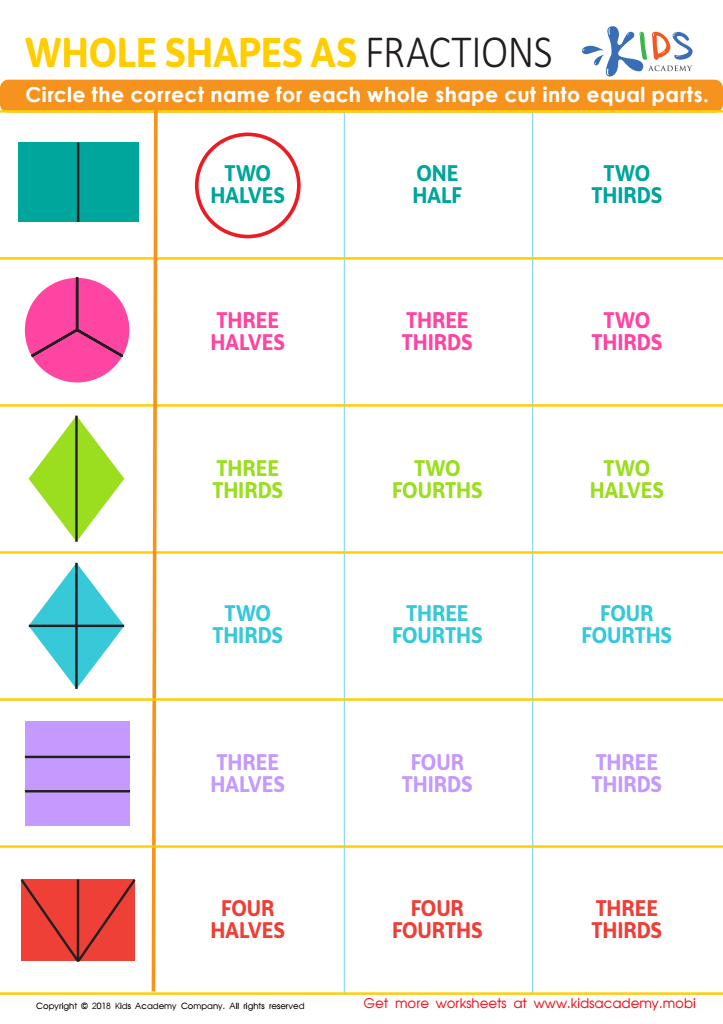
Whole Shapes as Fractions Worksheet
Introduce your child to fractions! After they can draw whole shapes, have them represent them as fractions using a simple worksheet. This will help improve their understanding of naming whole shapes cut into equal parts.
 Assign to My Students
Whole Shapes as Fractions Worksheet
Worksheet
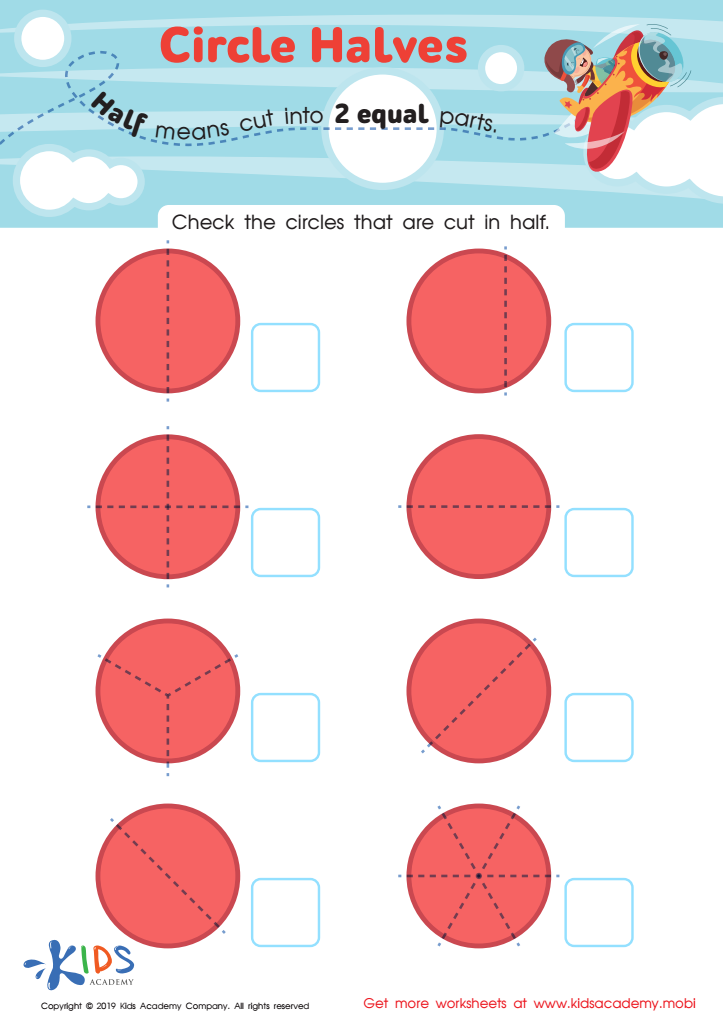
Circle Halves Worksheet
Remind your kindergartners that objects can be divided into halves, thirds and fourths. Now, look at this worksheet with your students and help them check the circles cut in half.
Circle Halves Worksheet
Worksheet
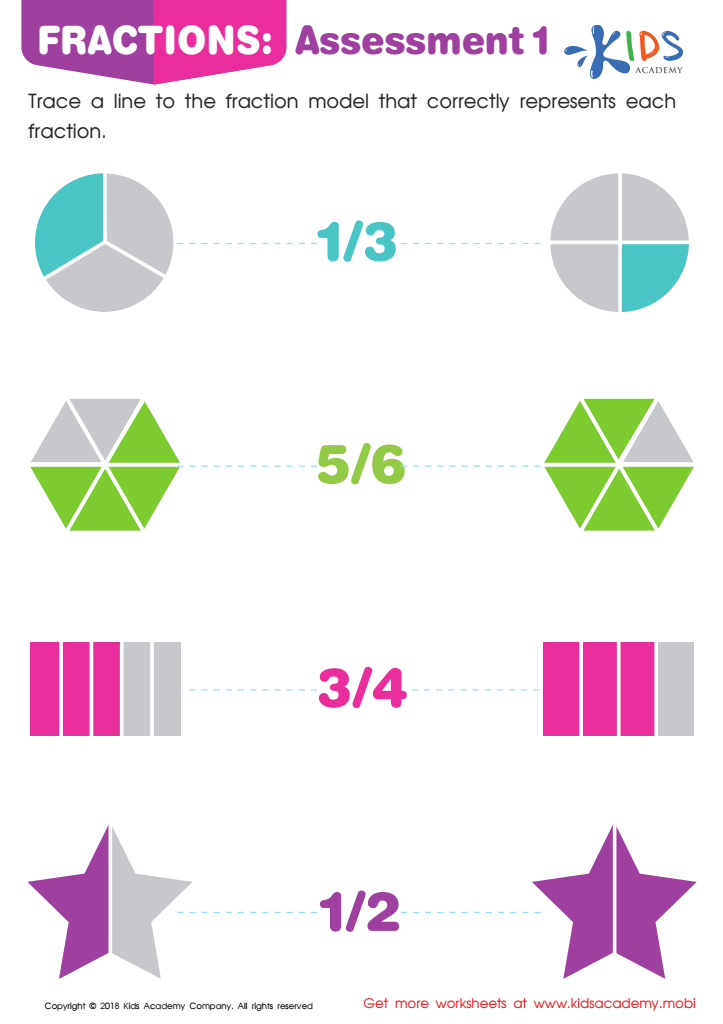
Fractions: Assessment 1 Worksheet
Master fractions easily with this worksheet! It has four sets of fraction models and fraction equations with two models each. Guide your kids to trace a line to the correct fraction model for each equation.
Fractions: Assessment 1 Worksheet
Worksheet
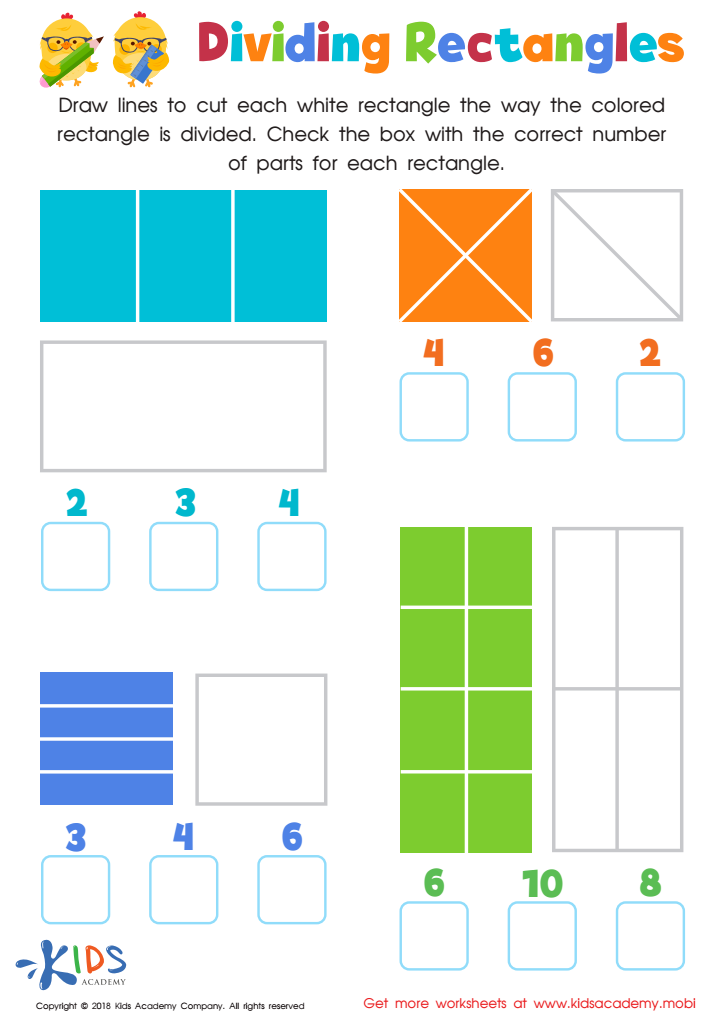
Dividing Rectangles Worksheet
Ask your child to draw lines to divide the white rectangles like the colored ones. Then, have them count the parts in each and choose the correct number. This worksheet will help them practice counting and dividing.
Dividing Rectangles Worksheet
Worksheet
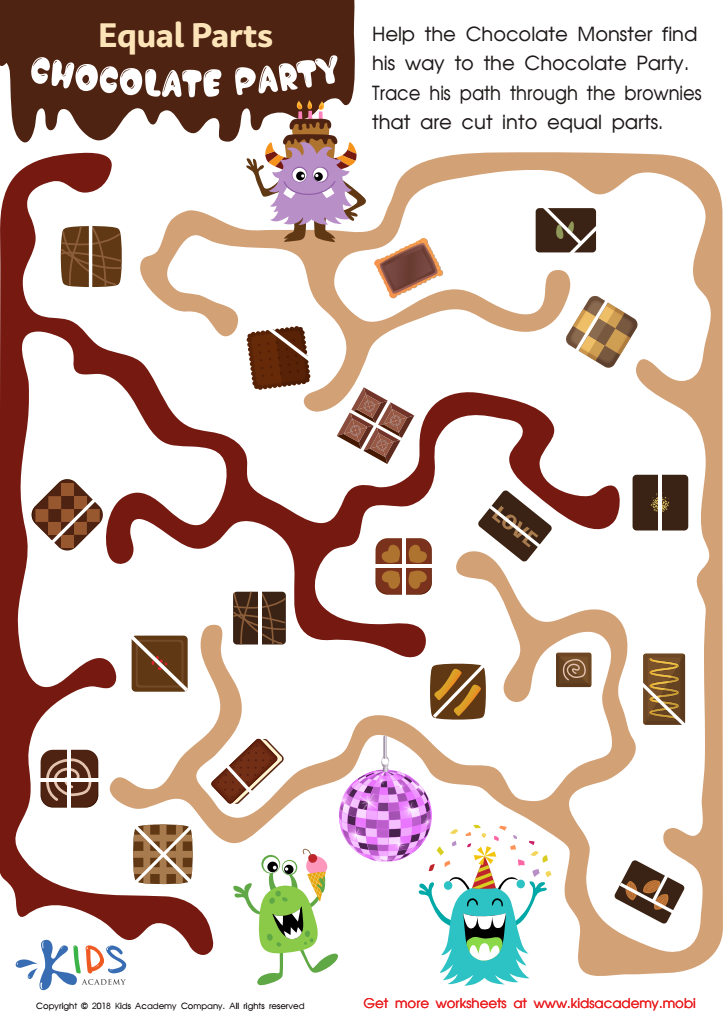
Equal Parts: Chocolate Party Worksheet
Mention "chocolate" and watch your kids' excitement soar! Learning can go hand-in-hand with that sugary treat. This worksheet helps kids guide the Chocolate Monster to the Chocolate Party, following a trail of brownie halves. It's an easy, tasty way to have fun!
Equal Parts: Chocolate Party Worksheet
Worksheet
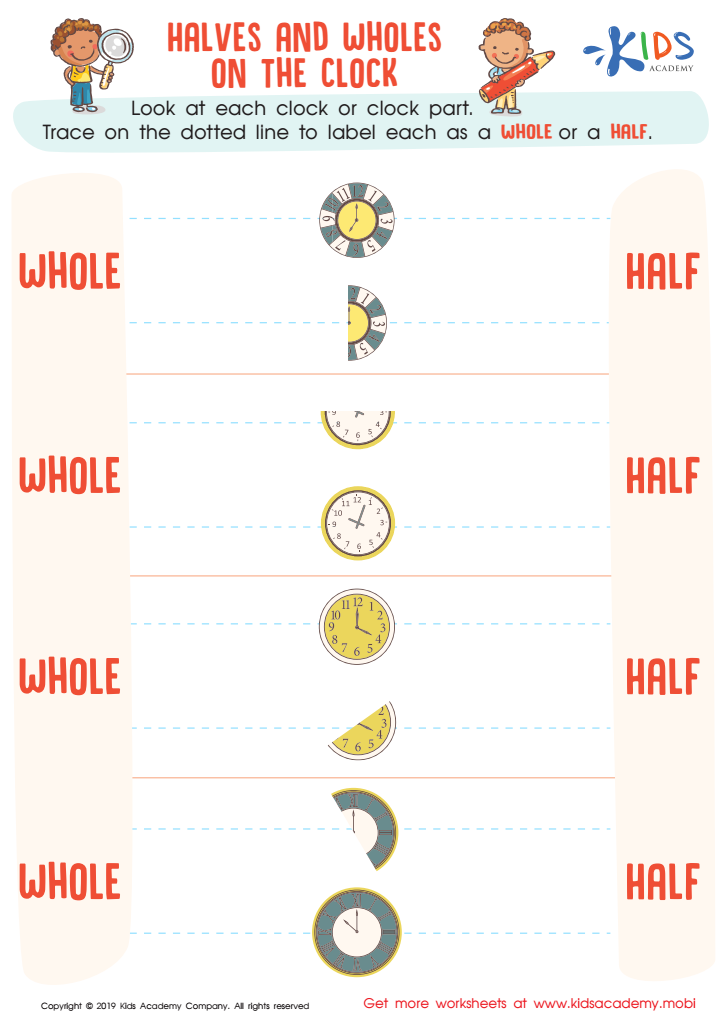
Halves and Wholes on the Clock Worksheet
Ask your kids if they know the difference between a whole and a half. If not, explain it's when a whole is divided into two equal parts. Show them the worksheet with clocks and clock parts, and help them label each shape as a whole or a half by tracing on the dotted line.
Halves and Wholes on the Clock Worksheet
Worksheet
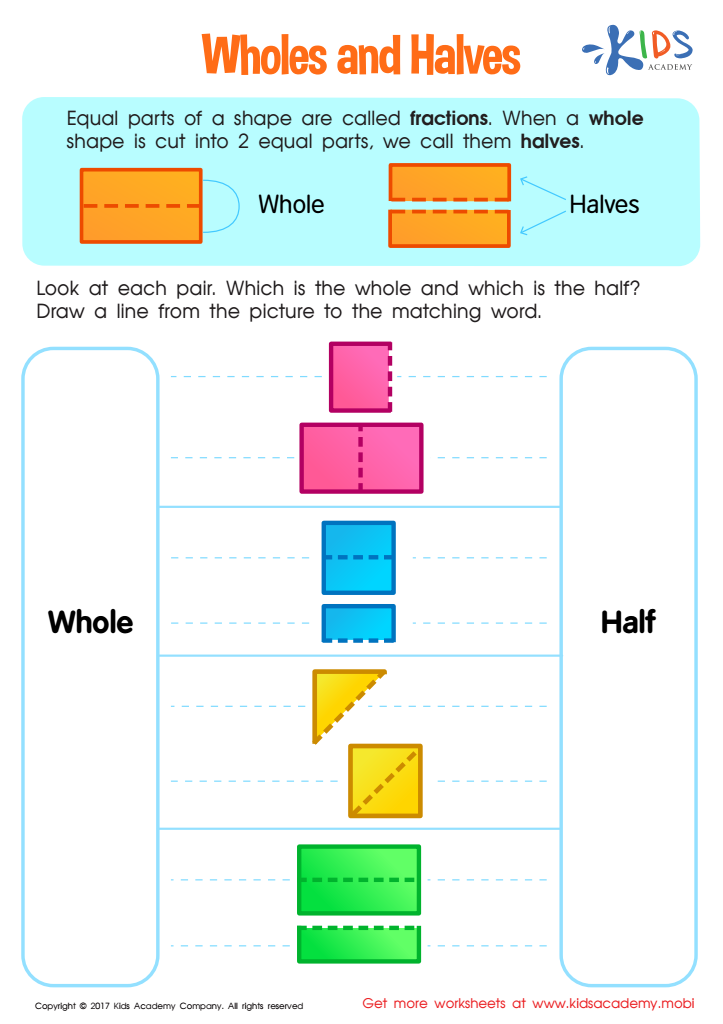
Wholes and Halves Worksheet
Students can feel overwhelmed with fractions. Help take the stress off by using a colorful worksheet to explain whole shapes and how to find halves. Ask them to identify the whole and point to the matching word for the half. A free printout can help guide them.
Wholes and Halves Worksheet
Worksheet
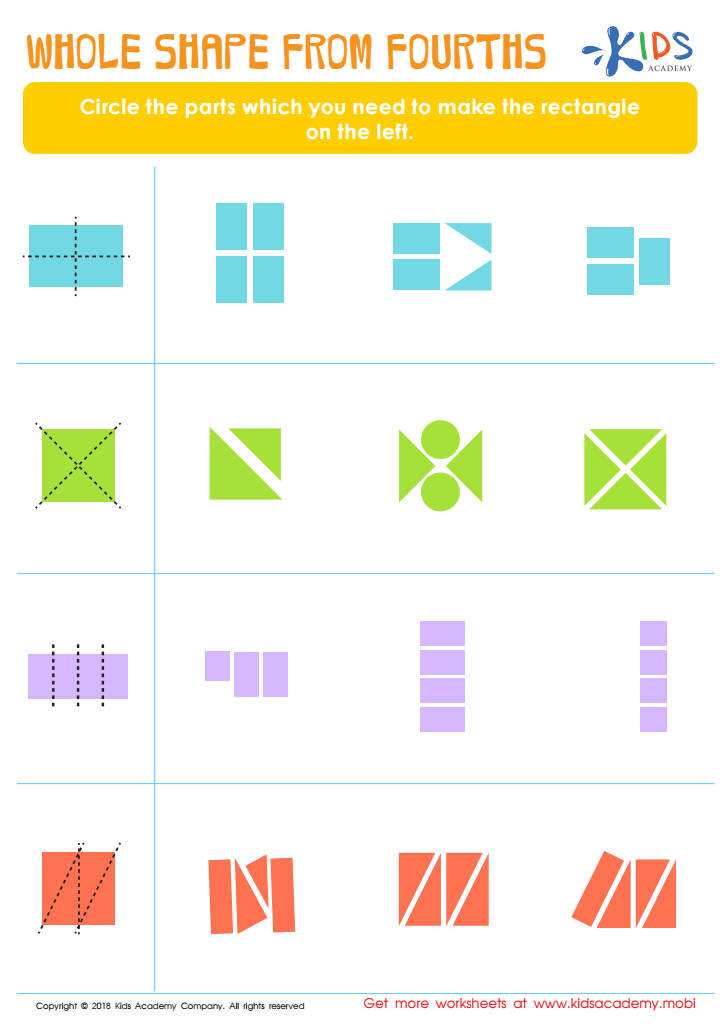
Whole Shape from Fourths Worksheet
Have your kids circle the shapes that'll form the rectangle on the left. It'll test their knowledge of shapes and ability to put them together to make a new one. Ask them to look at the parts on the right and circle the ones that'll form the rectangle.
Whole Shape from Fourths Worksheet
Worksheet
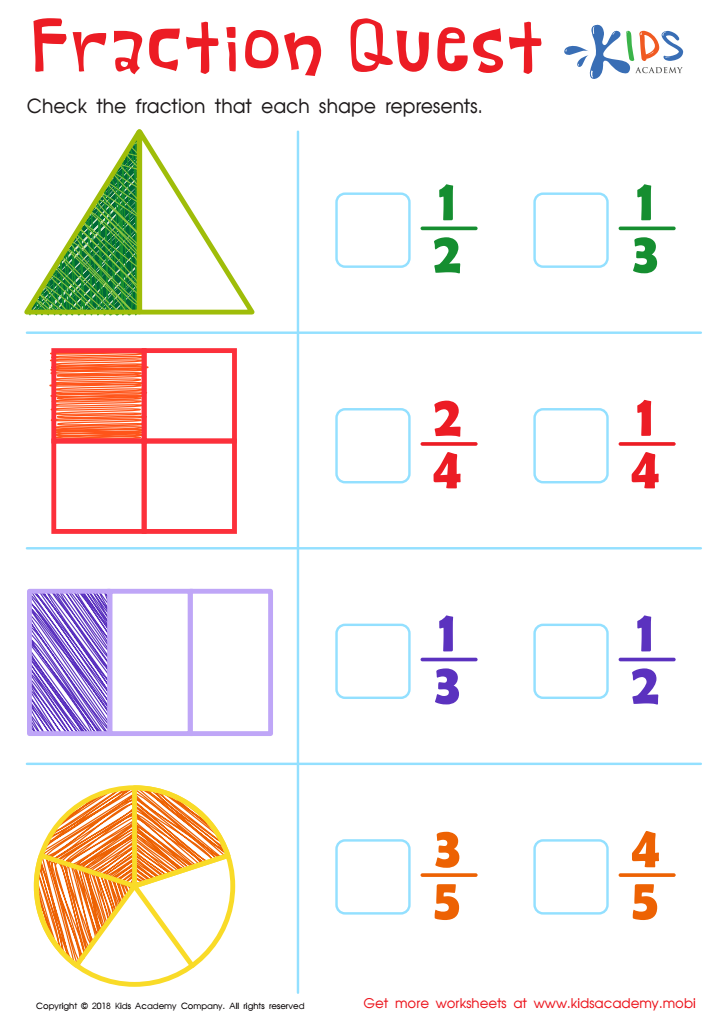
Fraction Quest Worksheet
This colorful and educative worksheet can help kids conquer their fractions struggles. Ask them to identify the four shapes, then the fractions they represent. They can then check the correct answers from the options given.
Fraction Quest Worksheet
Worksheet
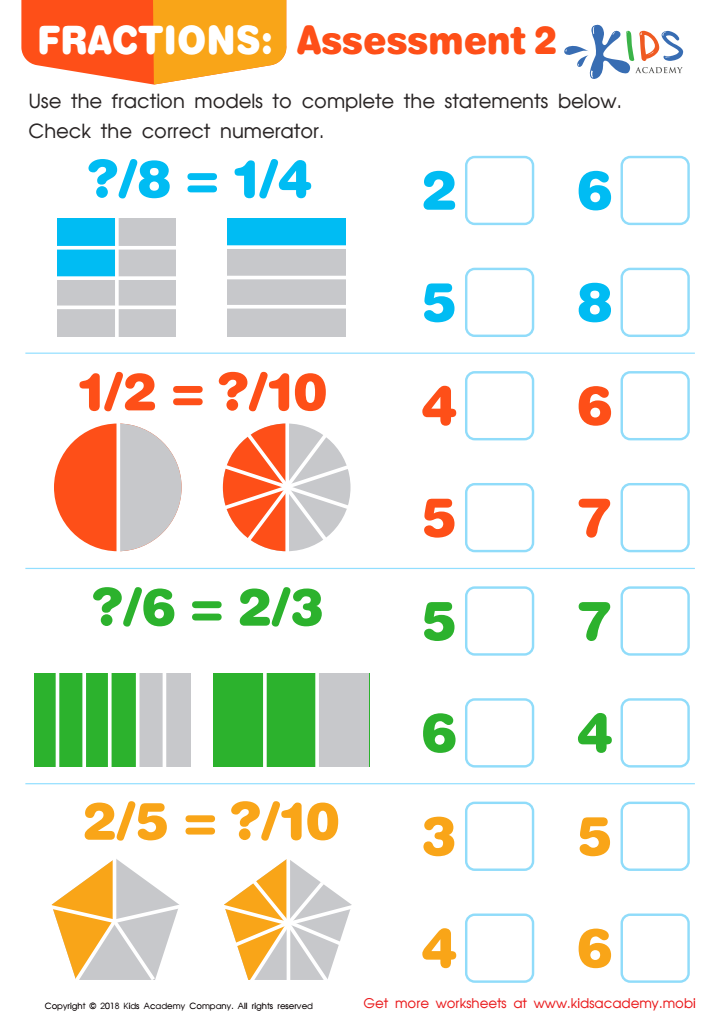
Fractions: Assessment 2 Worksheet
Help your kids understand fractions better with this worksheet. Ask them to complete the fraction statements using the fraction models on the left and then check the correct numerators. This can help clear up any confusion they may have with fractions and fraction models.
Fractions: Assessment 2 Worksheet
Worksheet
Join Kids Academy for Free
Who is primarily going to use this learning content?







Understanding fractions is critical for children ages 8-9 because it lays down a strong mathematical foundation essential for future learning. Fractions are not just another math topic; they are a pivotal concept that aids in developing both analytical and problem-solving skills.
Firstly, fractions represent parts of a whole, an idea that translates into many real-life situations such as dividing a pizza, measuring ingredients for a recipe, or even understanding money. Grasping this concept at an early age allows children to relate math to everyday activities, making the subject less abstract and more approachable.
Secondly, mastery of fractions is often a prerequisite for advanced mathematical concepts like ratios, proportions, and algebra. These topics become significantly easier to understand if the groundwork laid down by learning fractions is strong. Proficiency in fractions boosts a child’s confidence, preparing them to tackle more complex math problems as they progress through school.
Furthermore, understanding fractions enhances cognitive abilities such as reasoning, logic, and spatial thinking. It encourages students to think critically and make connections between different pieces of information, skills that are applicable beyond math, in subjects like science and engineering.
Lastly, a solid comprehension of fractions aligns with common core education standards, ensuring children meet academic expectations. Hence, parents and teachers should actively support children in mastering fractions to equip them with essential skills for academic success and everyday life.








