
Comparing lengths Worksheets for 8-Year-Olds
10 filtered results
Difficulty Level
Grade
Age
-
From - To
Subject
Activity
Standards
Enhance your child's understanding of measurement with our "Comparing Lengths Worksheets for 8-Year-Olds." Designed to develop crucial math and observational skills, these engaging activities help kids learn to compare different lengths using real-world objects. Through colorful illustrations and interactive tasks, young learners will practice measuring, ordering, and analyzing various lengths, boosting their confidence and comprehension in mathematics. Perfect for both classroom use and at-home practice, these worksheets are crafted to make learning fun and effective. Let your 8-year-old discover the fundamentals of measurement and improve their problem-solving abilities with our high-quality resources.
Favorites
With answer key
Interactive
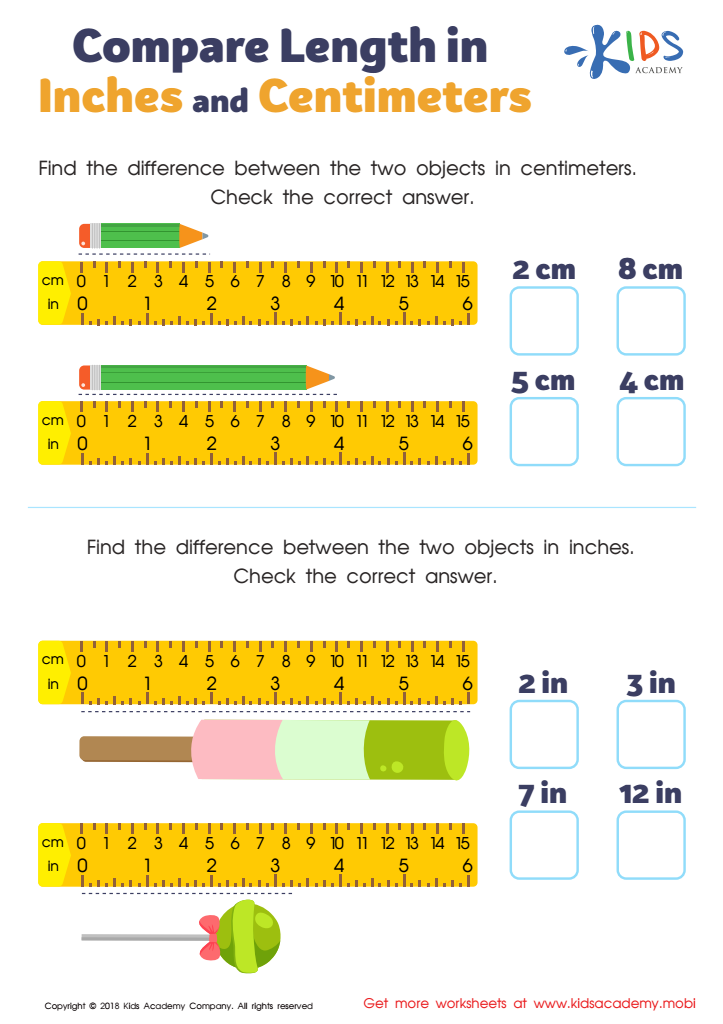
Compare Length in Inches and Centimeters Worksheet
This worksheet has your child measuring objects in both centimeters and inches. The first task requires measuring both objects in centimeters, then finding their difference. The second task is the same but in inches.
 Assign to My Students
Compare Length in Inches and Centimeters Worksheet
Worksheet
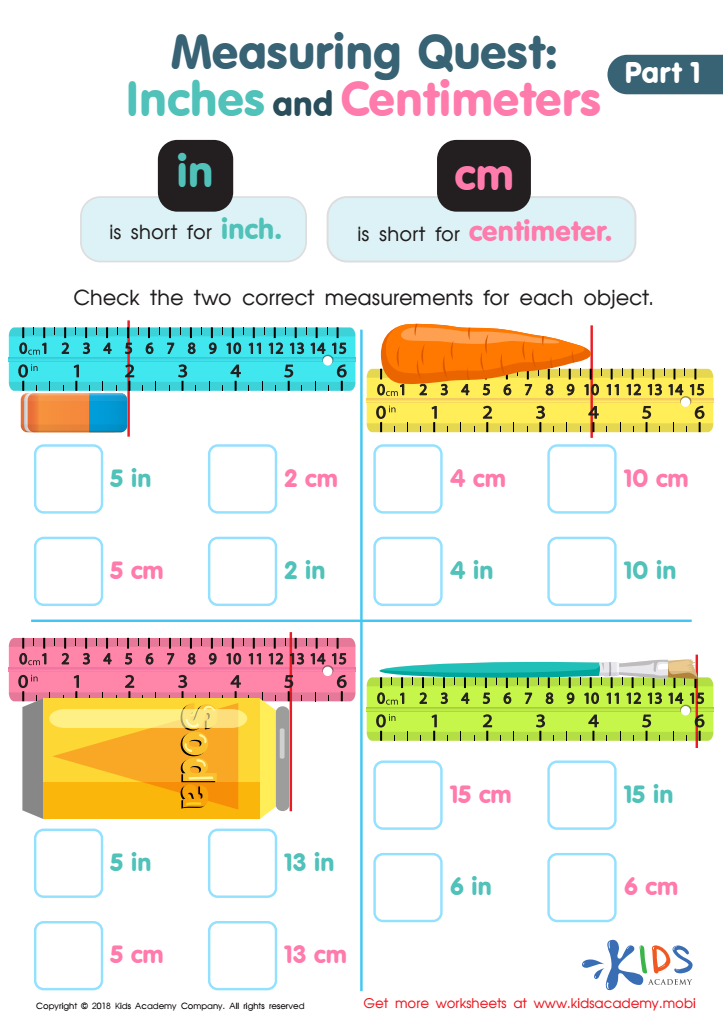
Measuring Quest: Inches and Centimeters Worksheet
Your child will measure items in both inches and centimeters and check the correct measurements from the options given. The metric ruler states 2.5 cm equals 1 inch, and 15 cm equals 6 inches. This worksheet helps ensure accurate measurements, despite the different figures.
Measuring Quest: Inches and Centimeters Worksheet
Worksheet
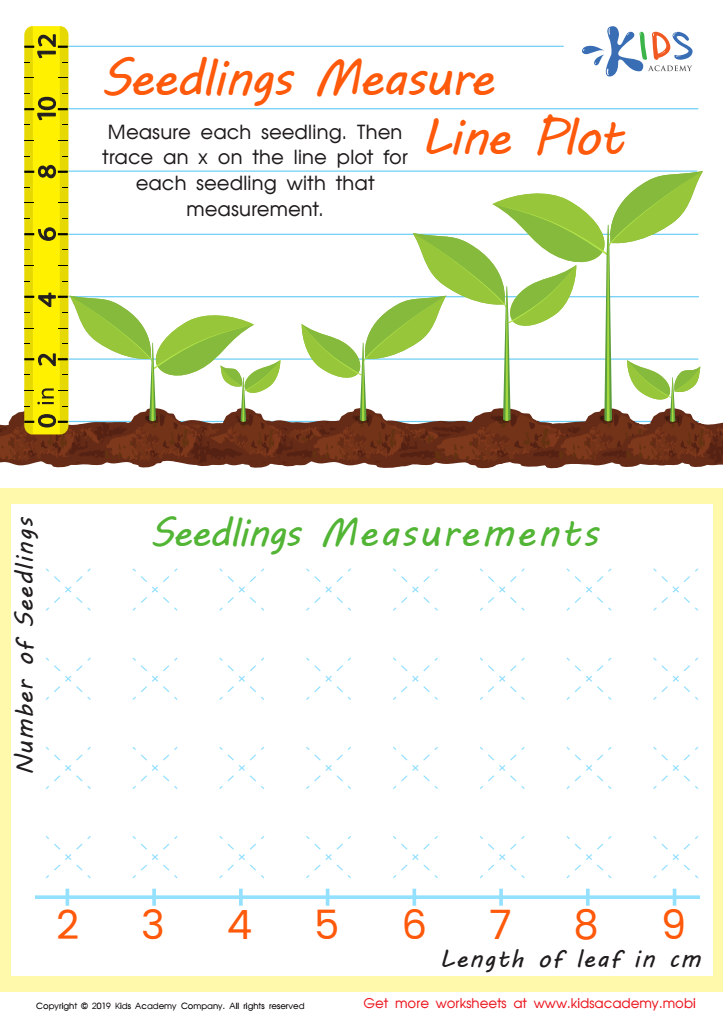
Seedling Measure Line Plot Worksheet
Help your kids adjust to learning line plots with this fun tracing sheet. Measure each seedling in the picture, then trace an x on the line plot for each one. Assist them in completing this easy exercise!
Seedling Measure Line Plot Worksheet
Worksheet
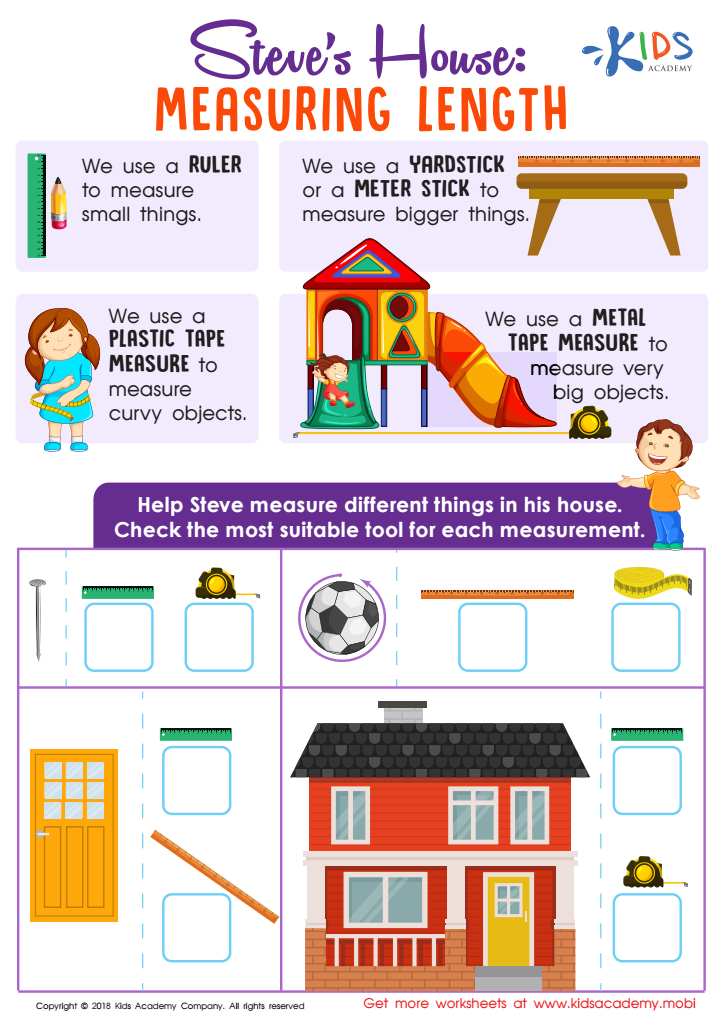
Steve's House: Measuring Length Worksheet
Introduce your kids to the various measuring tools and their uses. Explain how a ruler, plastic tape, yard stick, and metal tape measure are used to measure different objects. Guide them as they help Steve measure things in his home with the correct tool.
Steve's House: Measuring Length Worksheet
Worksheet
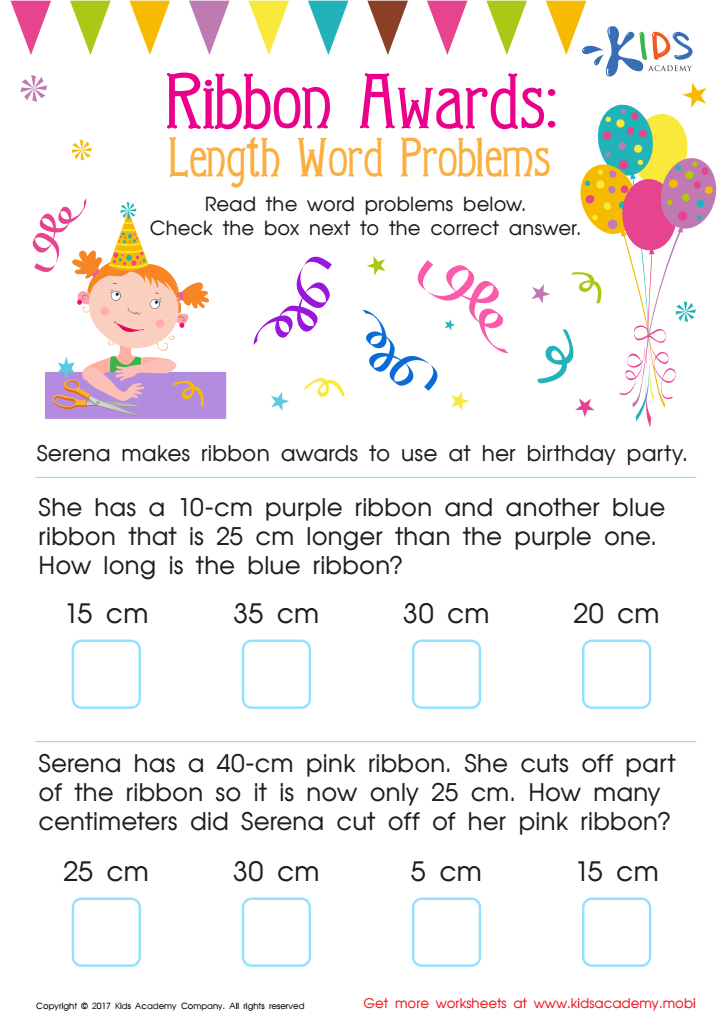
Length Word Problems Worksheet
Word problems help grade 2 students practice measurement using everyday scenarios. This worksheet provides practice in working with centimeters and inches, like measuring ribbon. It's a great way to learn and apply math skills.
Length Word Problems Worksheet
Worksheet
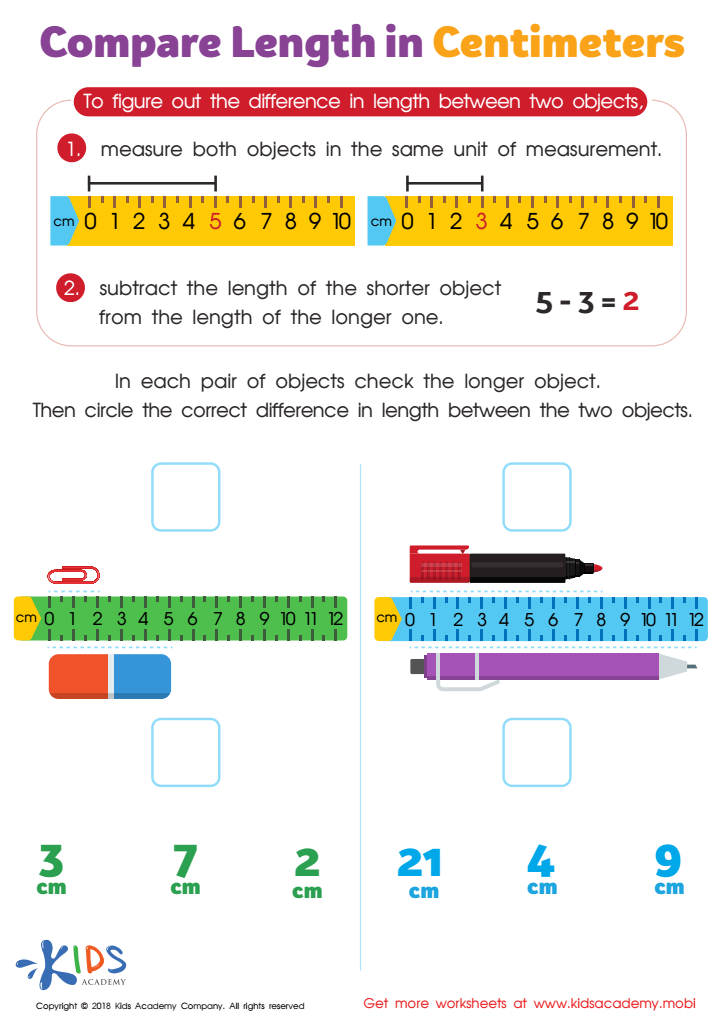
Compare Length in Centimeters Worksheet
To do this worksheet, your child needs to be able to measure accurately, add and subtract. They must measure both items and subtract the shorter from the longer to work out the difference in length.
Compare Length in Centimeters Worksheet
Worksheet
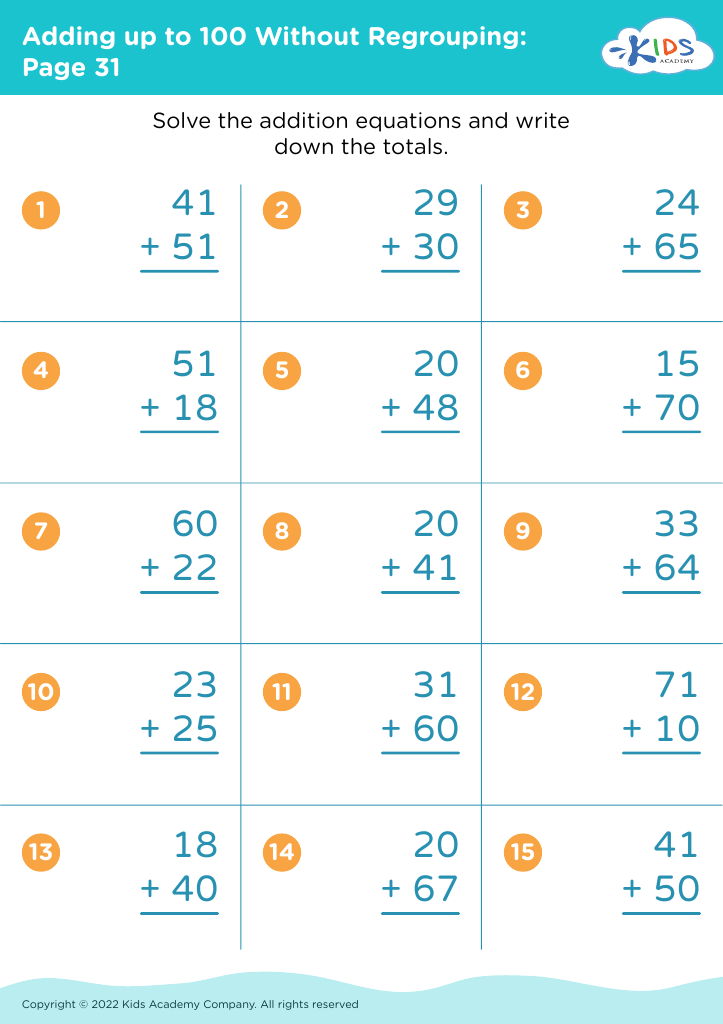
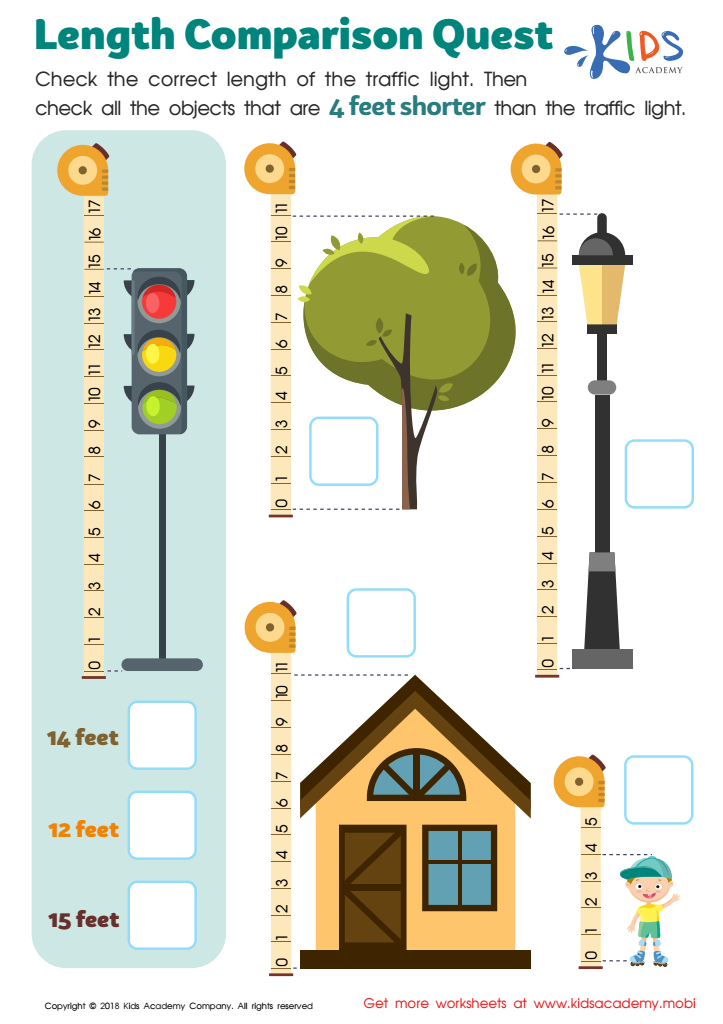
Length Comparison Quest Worksheet
Knowing measurement tools and how to use them is just the start. To be proficient, your kid must be able to accurately compare objects and their lengths. With the 'Length Comparison Quest' worksheet, they will check the correct length of the traffic light in the picture and then compare other objects to it, marking those that measure 4 feet shorter.
Length Comparison Quest Worksheet
Worksheet
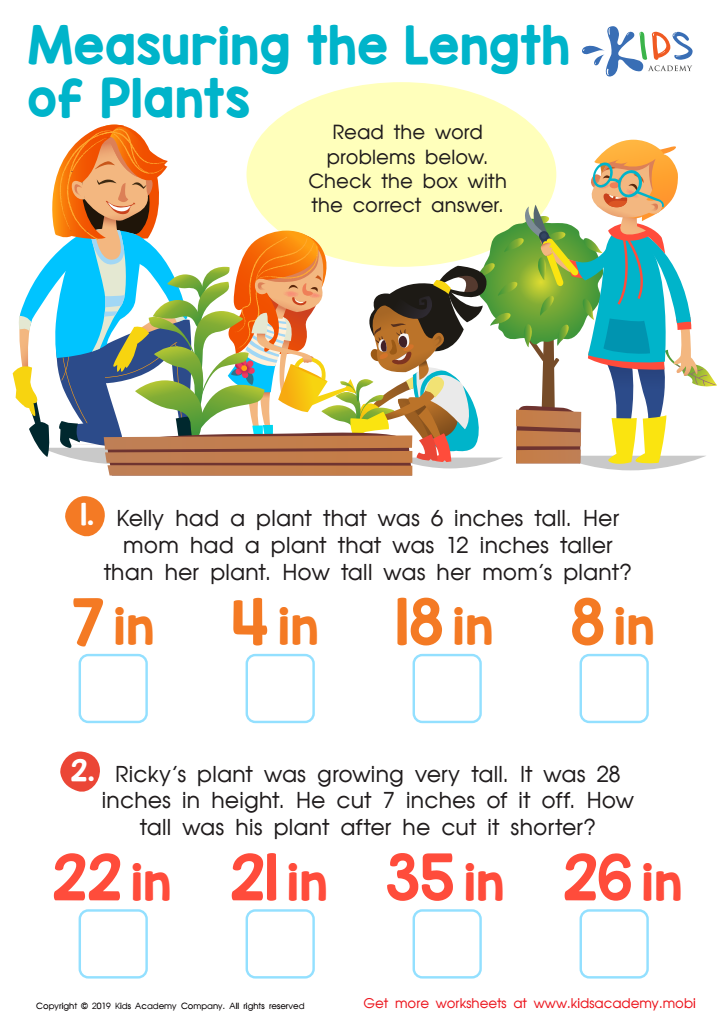
Measuring the Length of Plants Worksheet
Help your kids practice their math skills with this worksheet. Read the word problems in the picture and help them check the correct box. Word problems are equations written in sentence form, so they must be interpreted and understood to be solved correctly.
Measuring the Length of Plants Worksheet
Worksheet
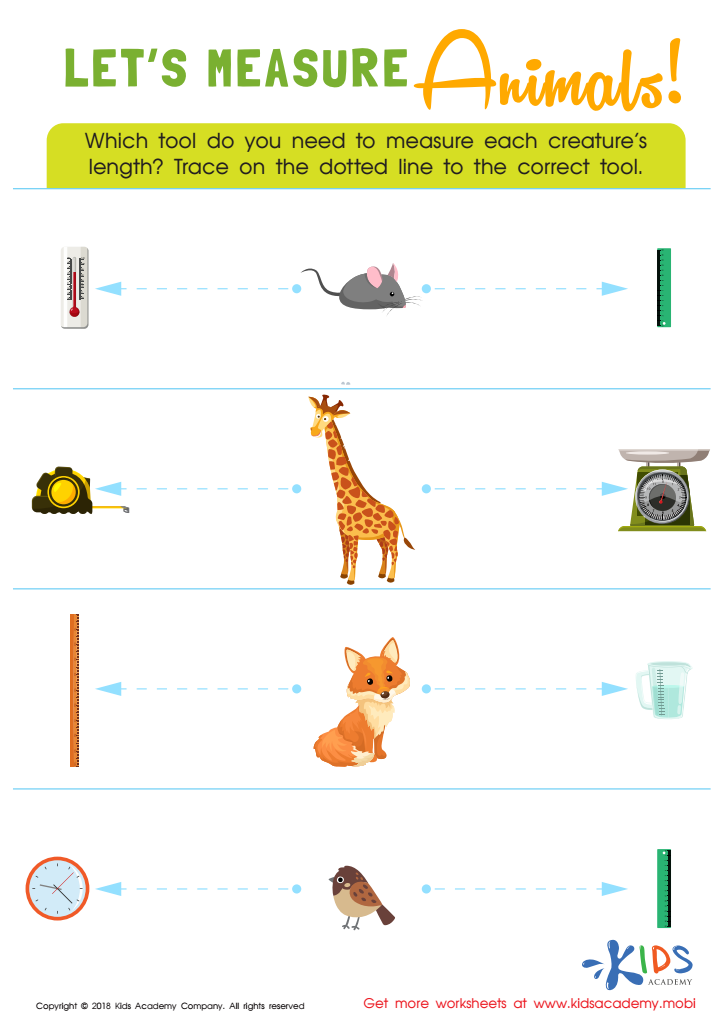
Let's Measure Animals! Worksheet
Have your students measure the length of animals like a mouse, giraffe, fox, and bird using this fun tracing sheet. They must carefully follow the dotted lines to the correct measuring tool, and by the end of the colorful worksheet, they'll know more about measuring and the different tools used.
Let's Measure Animals! Worksheet
Worksheet
Join Kids Academy for Free
Who is primarily going to use this learning content?






Parents and teachers should prioritize teaching 8-year-olds to compare lengths because it's a fundamental math skill essential for cognitive development and everyday problem-solving. At this age, children's brains are at a crucial stage where understanding basic concepts about measurements enhances their spatial awareness and logical thinking.
Firstly, comparing lengths helps solidify essential math concepts, such as addition and subtraction, by making abstract ideas more concrete. When children actively measure and compare objects, they start comprehending how numbers represent quantities and differences. This foundational understanding is critical for tackling more complex math problems as they progress in their education.
Furthermore, everyday tasks and practical life skills are embedded in the ability to compare lengths. Simple activities, such as determining whether a toy fits on a shelf or how many steps it takes to reach the playground, rely on length comparison. By mastering this skill, children become more confident and independent in solving real-life problems.
Additionally, early exposure builds a positive relationship with learning math. Engaging, hands-on activities like using rulers and measuring tapes make learning interactive and fun, reducing math anxiety and promoting a lifelong interest in the subject. Overall, comparing lengths is not merely an academic exercise; it's a valuable life skill that fosters critical thinking, problem-solving capabilities, and a love for learning.








