Numbers up to 100 Worksheets for Ages 3-9 - Page 3
50 filtered results
-
From - To
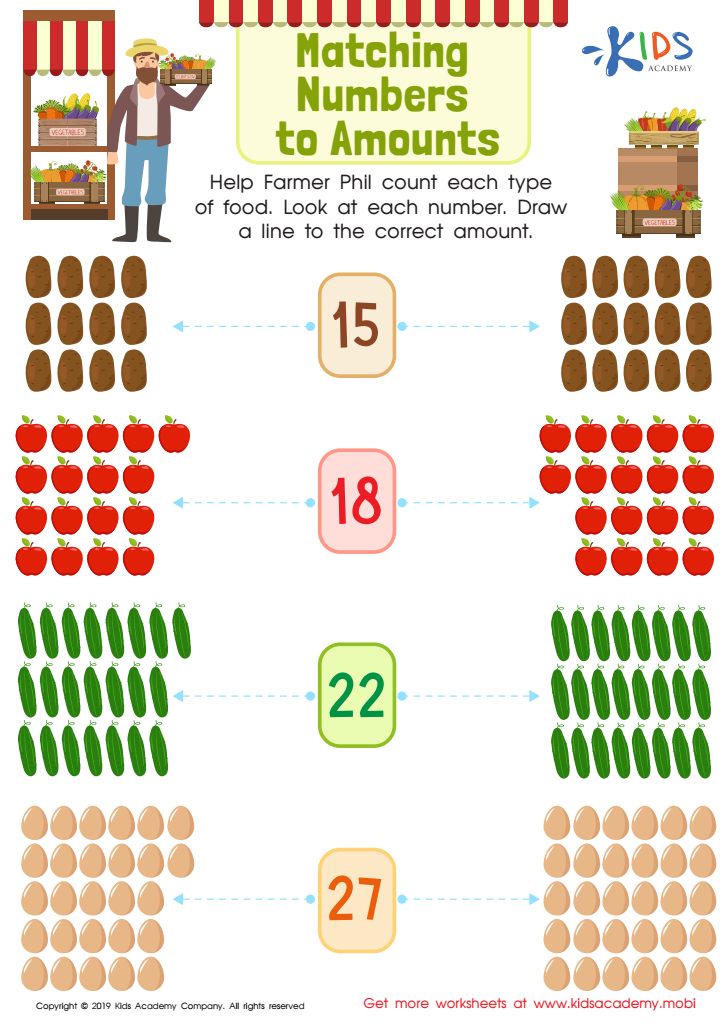
Matching Numbers to Amounts Worksheet
 Assign to My Students

Counting on the City Skyline: Dot-to-Dot Worksheet








Understanding numbers up to 100 is foundational for children aged 3-9, as it forms the basis for essential mathematical skills they will use throughout their education and daily lives. At this age, children are naturally curious and eager to learn, making it the perfect time to introduce them to numeracy concepts. Learning to recognize, count, and understand the significance of numbers helps in developing problem-solving skills and fosters logical thinking.
By mastering numbers within this range, children gain the ability to engage with basic addition and subtraction, which are critical for later mathematical concepts such as multiplication and division. Furthermore, familiarity with numbers enhances a child's ability to understand simple financial concepts, time management, and organization—skills that are invaluable in real-world scenarios.
Parents and teachers play a crucial role in cultivating a positive attitude toward math. Engaging children with fun and interactive activities—like counting objects, singing number songs, and playing number games—can stimulate interest and confidence. Emphasizing numbers in everyday situations, such as during shopping or cooking, makes learning relevant and practical. Ultimately, a strong grasp of numbers up to 100 empowers children to succeed academically and equips them with life skills they will carry into adulthood.