
Pronoun identification Normal Worksheets for Ages 4-8
3 filtered results
Difficulty Level
Grade
Age
-
From - To
Subject
Activity
Standards
Our "Pronoun Identification Normal Worksheets for Ages 4-8" are perfect for young learners beginning their grammar journey. These engaging and colorful activities are designed to help kids recognize and use pronouns correctly in sentences. Suitable for preschool to early elementary students, our worksheets provide a fun and interactive way to enhance essential learning skills. Available in printable format, they make an excellent addition to your teaching toolkit, facilitating both in-class learning and at-home practice. Empower your students with the foundational ability to identify and apply pronouns, boosting their confidence in language use!
Favorites
With answer key
Interactive
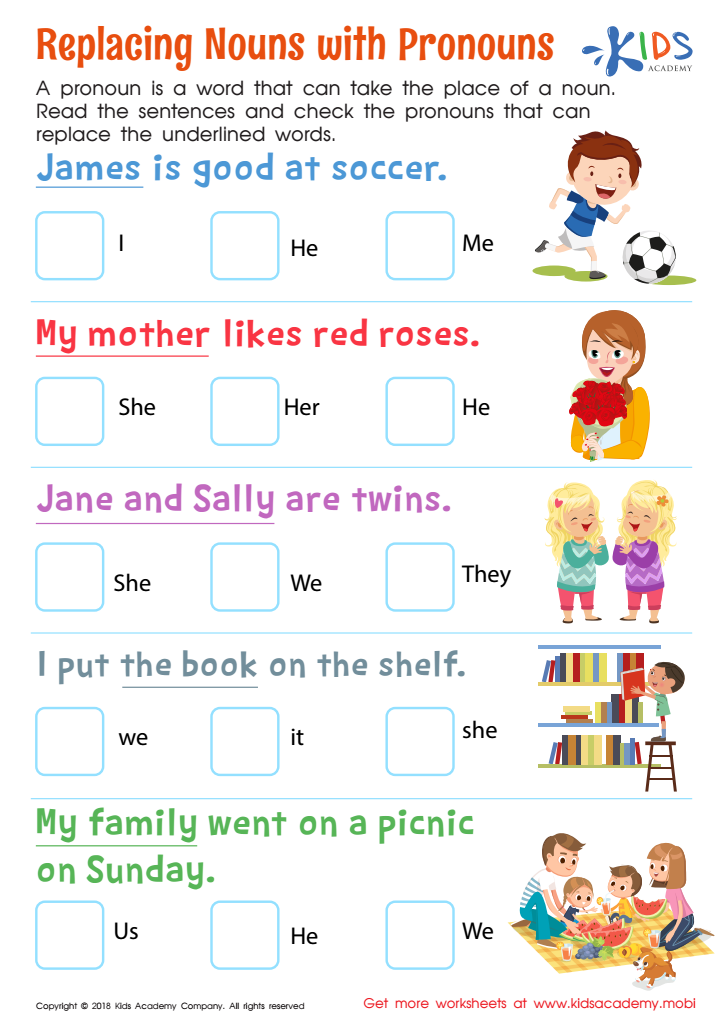
Replacing Nouns with Pronouns Worksheet
This colorful worksheet helps kids grow their writing skills by replacing nouns with pronouns. Read each sentence and select a pronoun for the underlined phrase. Then read the sentence again with the new pronoun.
 Assign to My Students
Replacing Nouns with Pronouns Worksheet
Worksheet
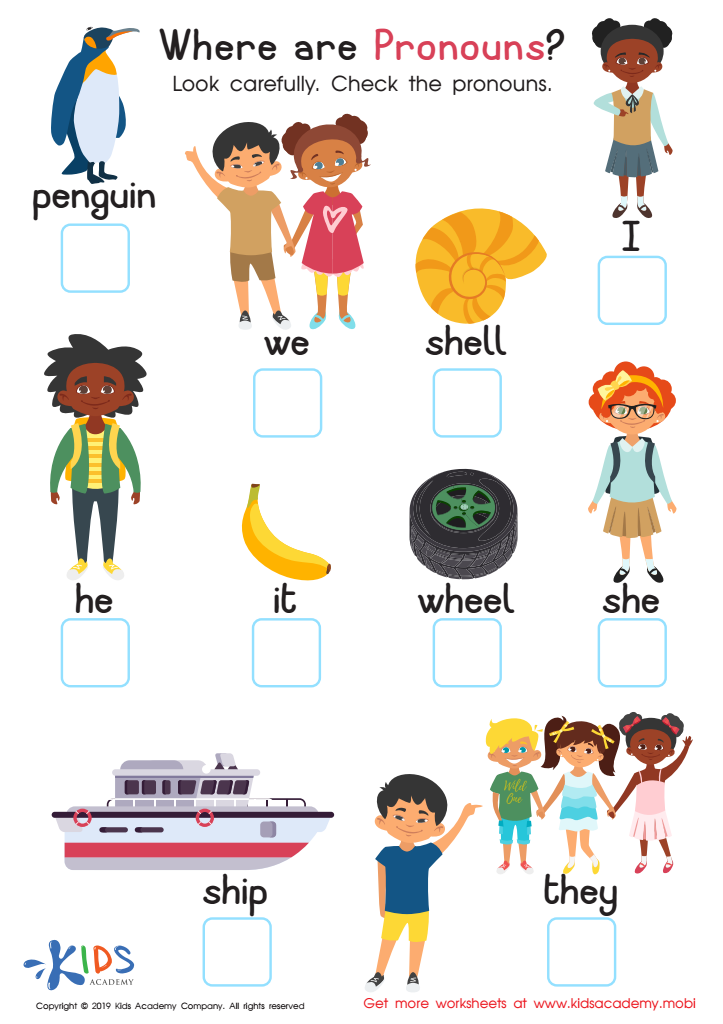
Where Are Pronouns? Worksheet
Pronouns make language flow, substituting "he" or "she" for names. Kids know and use them in their speech, but identifying pronouns in grammar helps build writing skills. This worksheet challenges kids to pick out pronouns from other nouns. Go through the worksheet, view the pictures and read the words. Ask kids to check boxes in front of pronouns to mark answers.
Where Are Pronouns? Worksheet
Worksheet
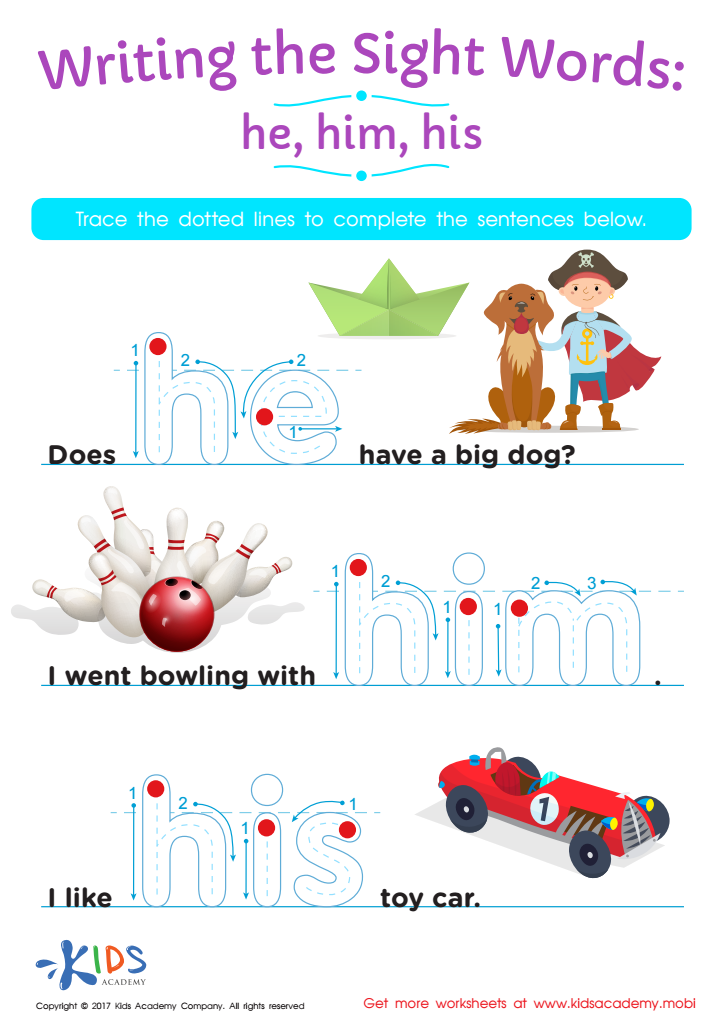
He, Him, His Printable Sight Words Worksheet
He, Him, His worksheet includes colorful pictures, simple sentences, and lots of fun. Guaranteed to engage and make learning enjoyable!
He, Him, His Printable Sight Words Worksheet
Worksheet
Join Kids Academy for Free
Who is primarily going to use this learning content?







Understanding pronouns is a foundational language skill crucial for young children ages 4-8. When children learn to identify and use pronouns correctly, they enhance their overall communication abilities, which lay the groundwork for complex language and literacy skills they will develop later. For parents and teachers, focusing on pronoun identification is essential as it helps children grasp the concept of replacing nouns with pronouns like "he," "she," "they," "it," and "we," which promotes ease in sentences and conversations.
First and foremost, proper pronoun usage contributes to more coherent and fluid speech, assisting children in expressing their thoughts clearly and accurately. This fluency is vital for their social interactions, where clear communication fosters positive relationships with peers and adults. Furthermore, understanding pronouns aids in reading comprehension and writing, enabling children to craft sentences that are not only grammatically correct but also engaging.
On a developmental level, mastering pronoun identification signals cognitive and linguistic maturity. Recognizing and applying gender-neutral pronouns like "they" and "them" also fosters inclusivity, sensitivity, and respect for diverse identities. Overall, such instruction not only supports academic success but also promotes empathetic and culturally aware individuals in our increasingly globalized society. Therefore, prioritizing pronoun identification during early education is an investment in both linguistic proficiency and social development.








