Filters

6 filtered results

Clear all filters
Favorites
With answer key
Interactive

6 filtered results

Difficulty Level

Grade


Explore our engaging Physical Science worksheets and activities designed for children aged 6-8! These fun and interactive resources are perfect for young learners, introducing them to essential concepts in physics and chemistry through hands-on experiments and colorful illustrations. Our worksheets cover topics like the states of matter, simple machines, and basic forces, making learning both enjoyable and educational. Ideal for homeschooling, classroom use, or extra practice at home, these activities will spark curiosity and excitement about the world of science. Visit our site to discover a wide range of printable worksheets that will help your child build a solid foundation in physical science!

Check out this FREE Physical Science Trial Lesson for age 6-8!

Match Objects that Fit Together

Favorites
With answer key
Interactive
  • Physical Science
  • 6-8
  • Interactive
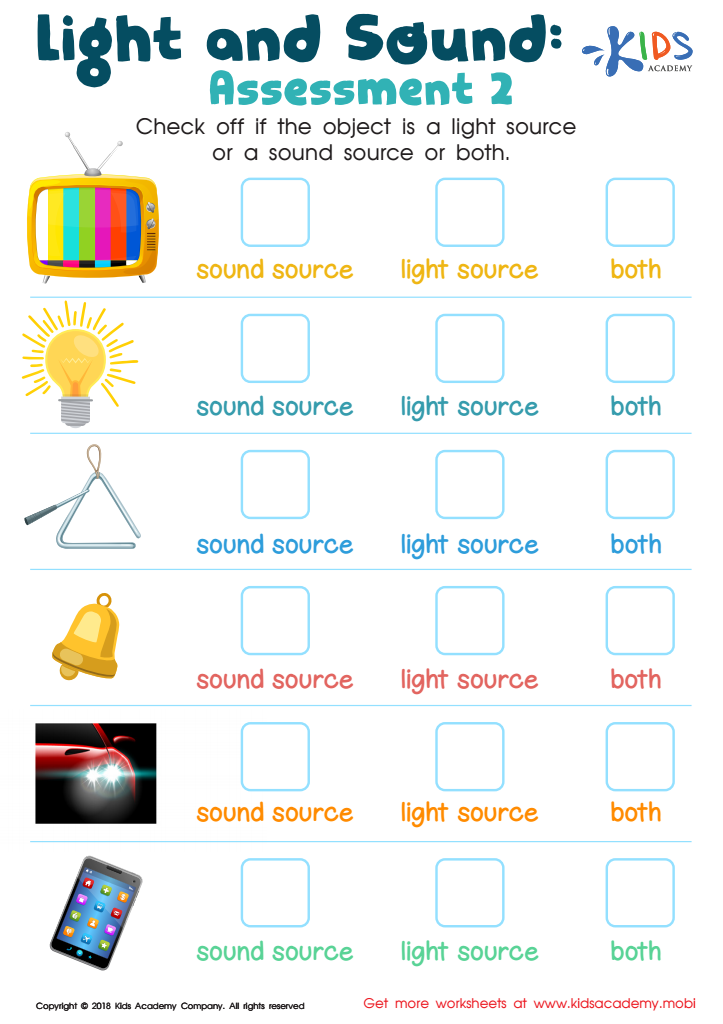
Light and Sound: Assessment 2 Worksheet

Light and Sound: Assessment 2 Worksheet

This worksheet introduces your kids to light and sound, with common sources of each. Identify the objects and help them check if it's a light source, a sound source, or both. Colourful and simple, it's a great way to teach your little ones! (80 words)
Light and Sound: Assessment 2 Worksheet
Worksheet
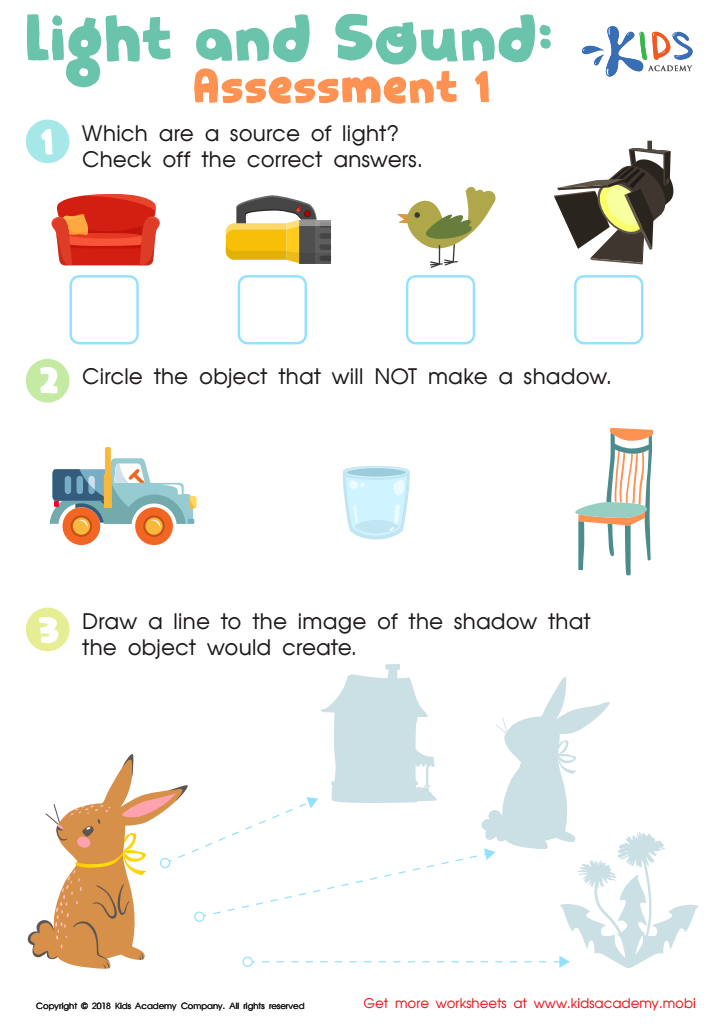
Light and Sound: Assessment 1 Worksheet

Light and Sound: Assessment 1 Worksheet

Can your kids name a light source? Challenge them to name the sun and moon, then point out objects they use when the sun sets. Look through the worksheet with them and ask them to identify the light sources. Help them check off the correct answers.
Light and Sound: Assessment 1 Worksheet
Worksheet
Matter: Assessment 2 Worksheet

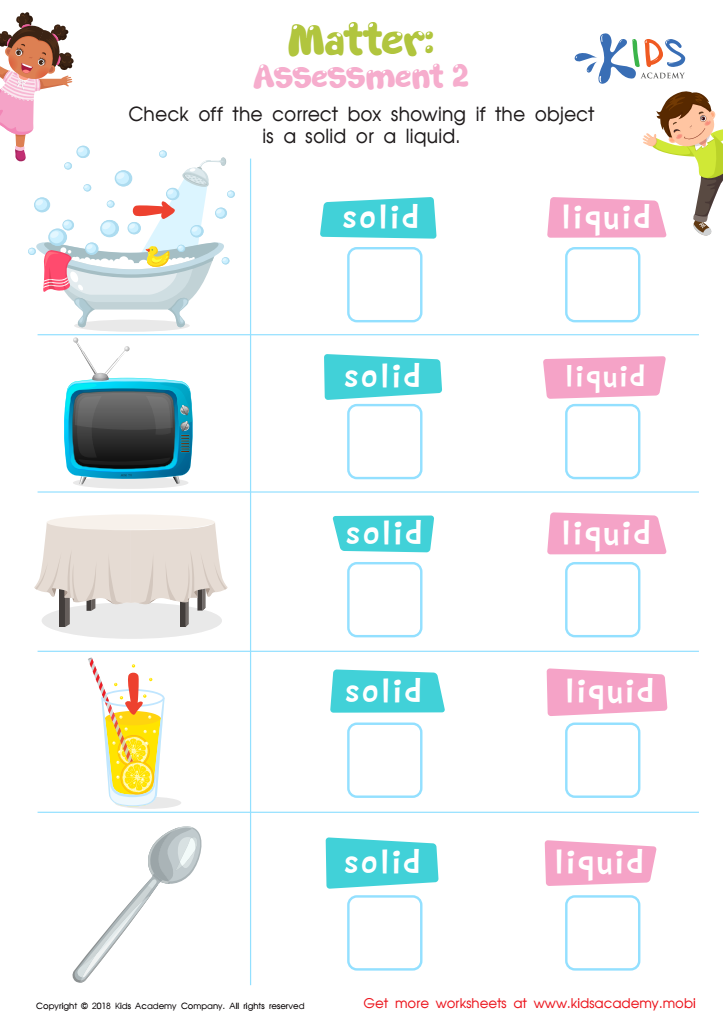
Matter: Assessment 2 Worksheet

Identify the five objects in this worksheet as either solid or liquid. Ask your kids to check the correct box. Melting changes solids to liquids while freezing transforms liquids to solids.
Matter: Assessment 2 Worksheet
Worksheet
Matter: Assessment 1 Worksheet

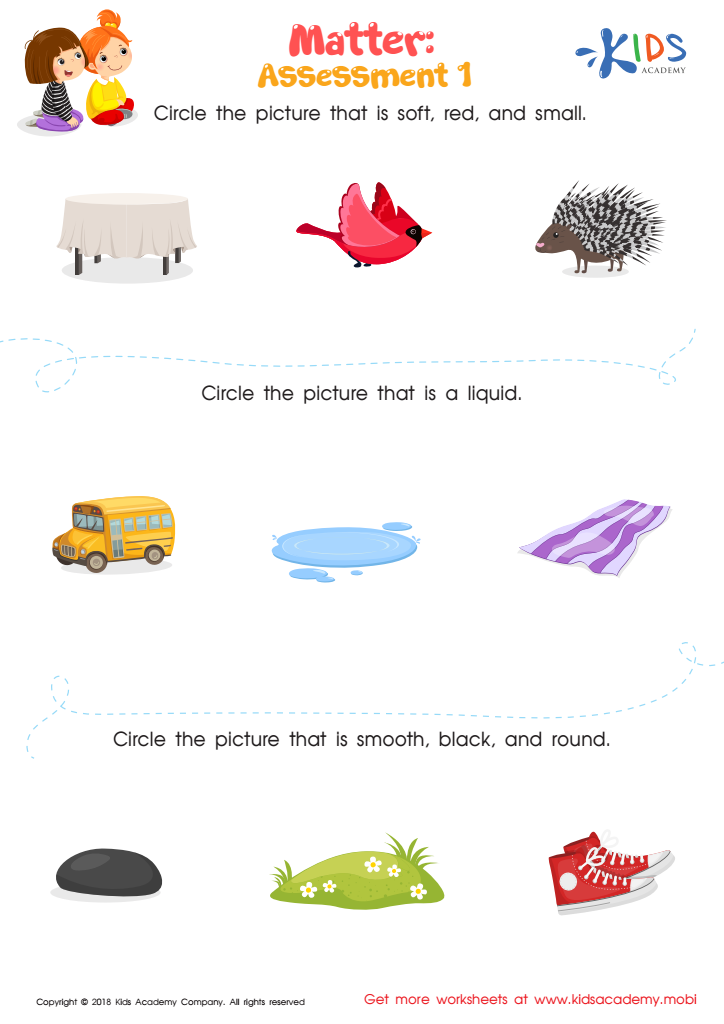
Matter: Assessment 1 Worksheet

Have your children learn that anything that has weight and takes up space is matter. Examples include buses, tables, people, animals, and more. Use this worksheet to help them identify the objects and circle the soft, red, and small one; the liquid; and the smooth, black, and round one.
Matter: Assessment 1 Worksheet
Worksheet
Force and Interactions: Assessment 2 Worksheet

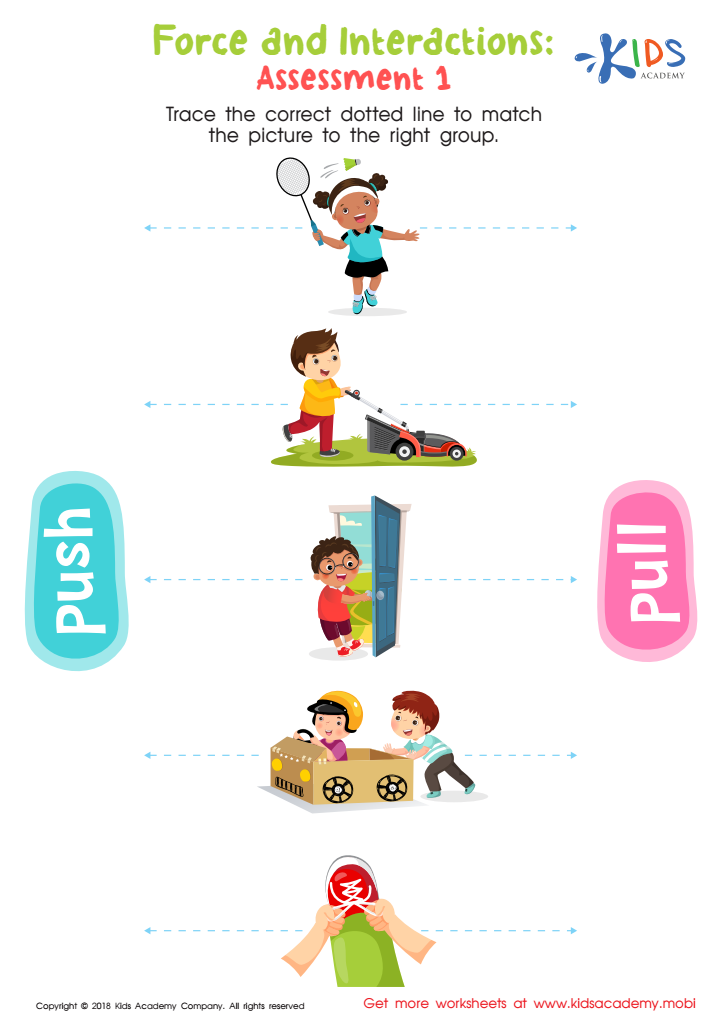
Force and Interactions: Assessment 2 Worksheet

Help your child see the difference between push and pull with this fun worksheet. Ask them to match each picture to the right group. The "push" is on the left and the "pull" is on the right. Assist them in tracing the activities and explain what it is the people are doing.
Force and Interactions: Assessment 2 Worksheet
Worksheet
Force and Interactions: Assessment 1 Worksheet


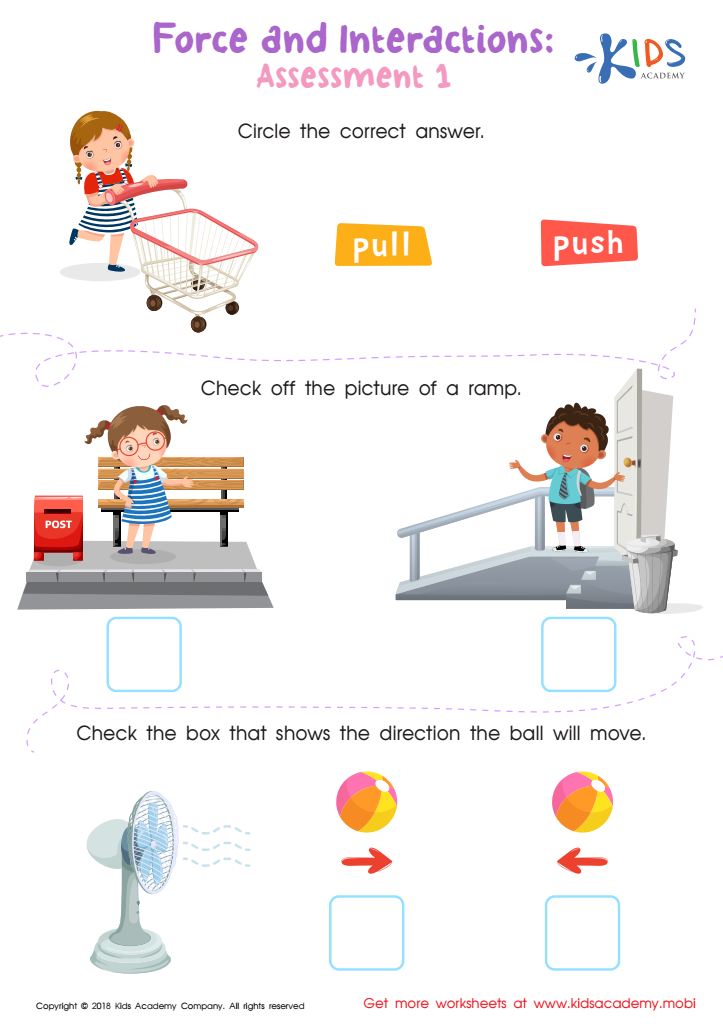
Force and Interactions: Assessment 1 Worksheet
Test your students' knowledge of pushing, pulling, ramps and wind with this worksheet. The first task requires them to identify push or pull pictures. The second asks them to identify a ramp and the third to explain which direction a ball will move when exposed to wind.
Force and Interactions: Assessment 1 Worksheet

Worksheet


Parents and teachers should prioritize Physical Science activities for children ages 6-8 because this foundational stage plays a critical role in developing curiosity, critical thinking, and an understanding of the world around them. At this age, children are naturally inquisitive, asking questions about how things work, which makes it an ideal time to introduce basic concepts of matter, energy, motion, and the scientific method.

Engaging in Physical Science activities helps children cultivate essential skills such as observation and experimentation. Through hands-on projects, like simple experiments involving water, magnets, and gravity, children learn to formulate hypotheses, conduct investigations, and draw conclusions, fostering independent thinking.

Moreover, these activities make learning fun and engaging, sparking interest in science and potentially shaping future career aspirations in STEM fields. A strong emphasis on physical science also promotes problem-solving abilities and resilience as children navigate challenges within their experimentation.

Ultimately, supporting Physical Science learning in early education offers children the tools they need to understand and navigate their environment, laying a foundation for lifelong learning and curiosity while ensuring preparedness for more complex scientific concepts in later education.