Subtraction Worksheets for Ages 3-5 - Page 3
49 filtered results
-
From - To
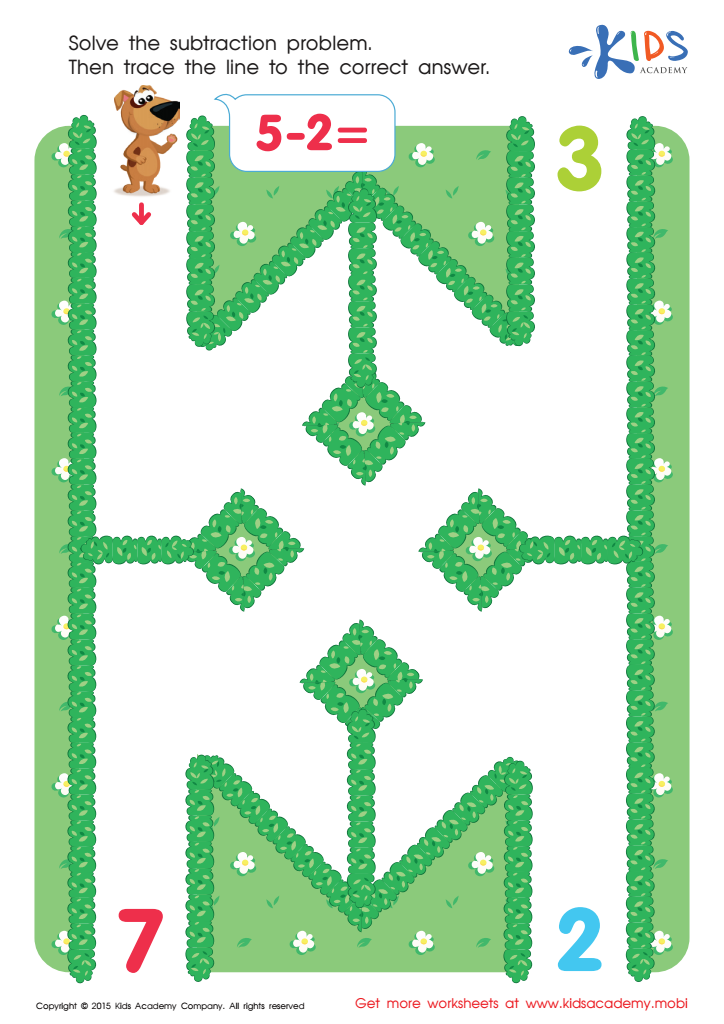
Five Minus Two Worksheet
 Assign to My Students








Subtraction worksheets designed specifically for ages 3-5 are an invaluable tool for early childhood education, playing a critical role in developing a child's foundational mathematical skills. At this formative stage, children are just beginning to understand basic concepts of numbers and arithmetic. Introducing subtraction through these tailored worksheets can make learning not only more accessible but also more engaging for young learners.
The beauty of subtraction worksheets for ages 3-5 lies in their ability to break down the concept of taking away into simple, easy-to-understand exercises. These worksheets are crafted with the cognitive and motor skills of preschoolers in mind, featuring colorful illustrations and straightforward problems that accommodate their short attention spans and encourage their natural curiosity.
Moreover, engaging with subtraction worksheets at an early age sets the stage for more complex mathematical thinking. It helps children grasp the idea that numbers can be manipulated in various ways, fostering a deeper understanding of mathematical relationships. This early exposure is crucial for building confidence in handling numbers, a skill they will carry with them throughout their educational journey.
Finally, subtraction worksheets for ages 3-5 are not just about learning to subtract; they are about developing problem-solving skills, improving concentration, and enhancing fine motor skills through the act of writing or marking answers. By incorporating these worksheets into a child’s learning routine, parents and educators can provide a solid foundation for a lifetime of mathematical learning and appreciation.








