Extra Challenge Skip Counting Worksheets for Ages 4-5
2 filtered results
-
From - To
Introducing our Extra Challenge Skip Counting worksheets, meticulously crafted for curious learners aged 4-5! These engaging worksheets are designed to spark the joy of learning through skip counting, laying a solid mathematical foundation while entertaining young minds. Tailored to challenge and stimulate, this collection encourages children to leap beyond traditional counting, fostering early arithmetic skills and confidence. With a variety of playful exercises, our Extra Challenge Skip Counting series promises to keep your little ones engaged, making learning an exciting adventure. Perfect for homeschooling or supplemental education, it’s an essential tool for young mathematicians eager to explore numbers in a fun, interactive way.
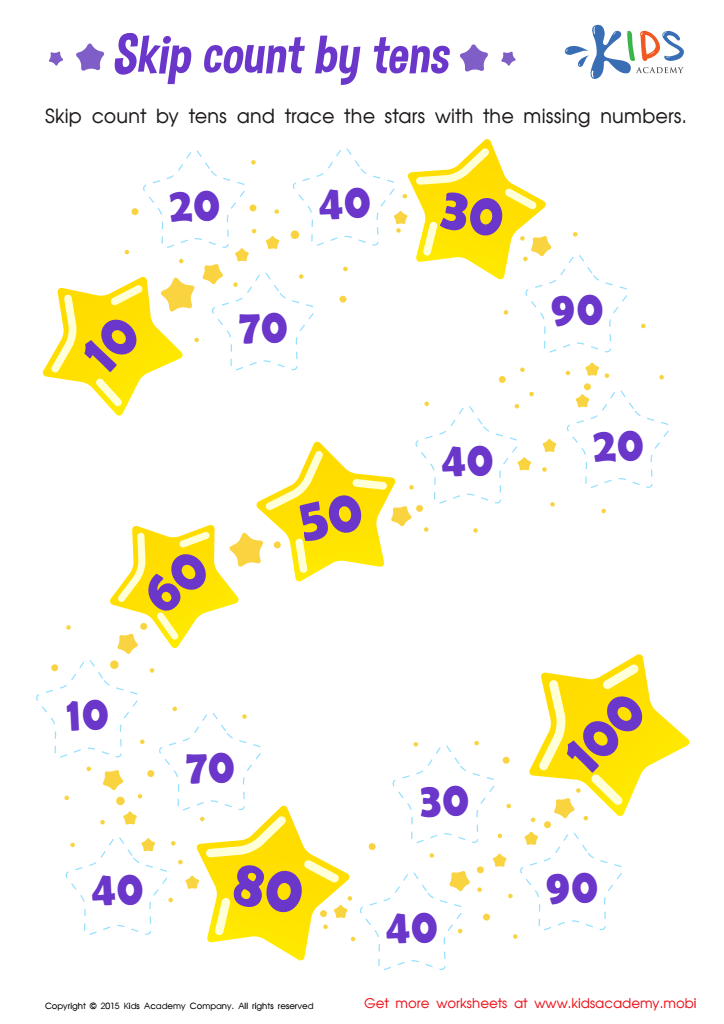
Learn dozens: Skip Count by Tens Printable
 Assign to My Students

Learn Dozens: Skip Counting by Tens Printable








Extra Challenge Skip Counting worksheets are specifically designed for children ages 4-5, providing a unique opportunity to boost their mathematical skills in a fun and engaging way. These worksheets are immensely useful for several reasons. Firstly, they introduce young learners to the foundational concept of skip counting, which is not just counting by ones but jumping ahead by 2s, 5s, or even 10s. This early exposure lays the groundwork for understanding multiplication and division in later years.
For children in the 4-5 age group, the Extra Challenge Skip Counting worksheets are tailored to their developmental stage, offering just the right balance of challenge and achievability. By engaging with these worksheets, children develop confidence in their counting abilities, enhancing their numerical fluency and setting a strong mathematical foundation.
Moreover, these worksheets are designed to keep young minds engaged. They incorporate colorful illustrations and interactive activities that turn learning into an enjoyable experience. This not only keeps children interested but also reinforces their learning through repetition in a playful manner.
In conclusion, Extra Challenge Skip Counting worksheets for Ages 4-5 are an invaluable resource for parents and educators. They not only make learning math fun but also prepare children for more complex mathematical concepts, all the while building their confidence and cognitive skills.








