Filters

669 filtered results

Clear all filters
Favorites
With answer key
Interactive

669 filtered results

Difficulty Level

Grade


Check out this FREE Trial Lesson for age 3-5!

Initial Positions on the Board

Favorites
With answer key
Interactive
  • 3-5
  • Interactive
  • Normal
Promoting a Pawn Worksheet

Promoting a Pawn Worksheet

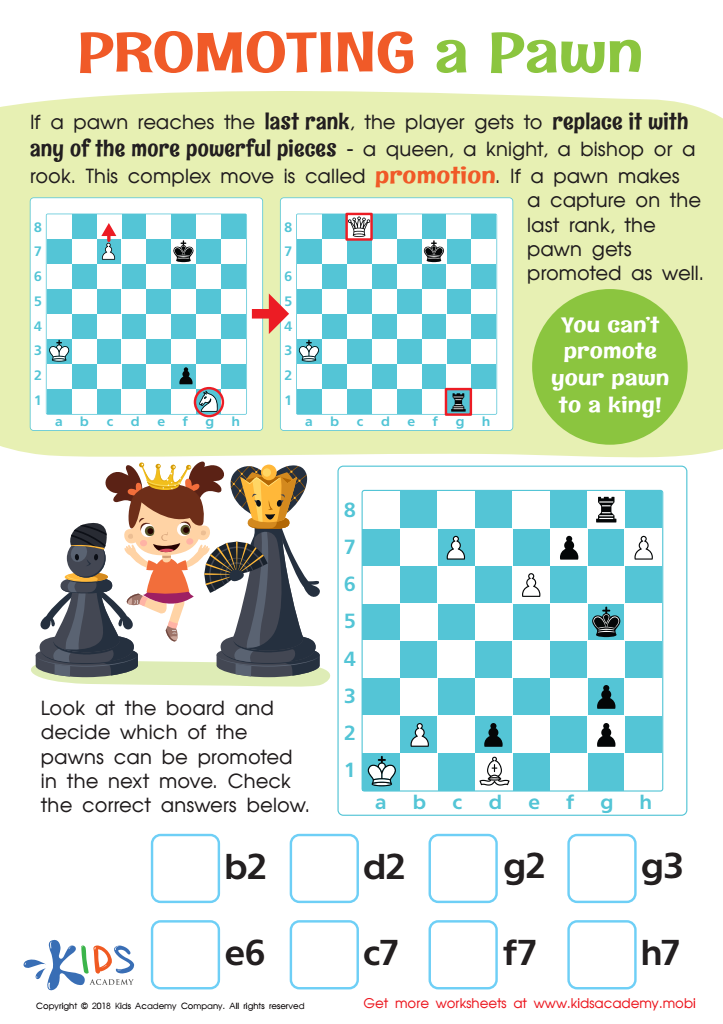
Teach your kids all about pawns with this fun worksheet! Pawns may seem restricted, but experienced players can guide them across the board. If a pawn reaches the last rank, the player can upgrade it to a more powerful piece (e.g. queen, knight), or promote it if it captures an enemy piece. Give them the tools to master the game!
Promoting a Pawn Worksheet
Worksheet
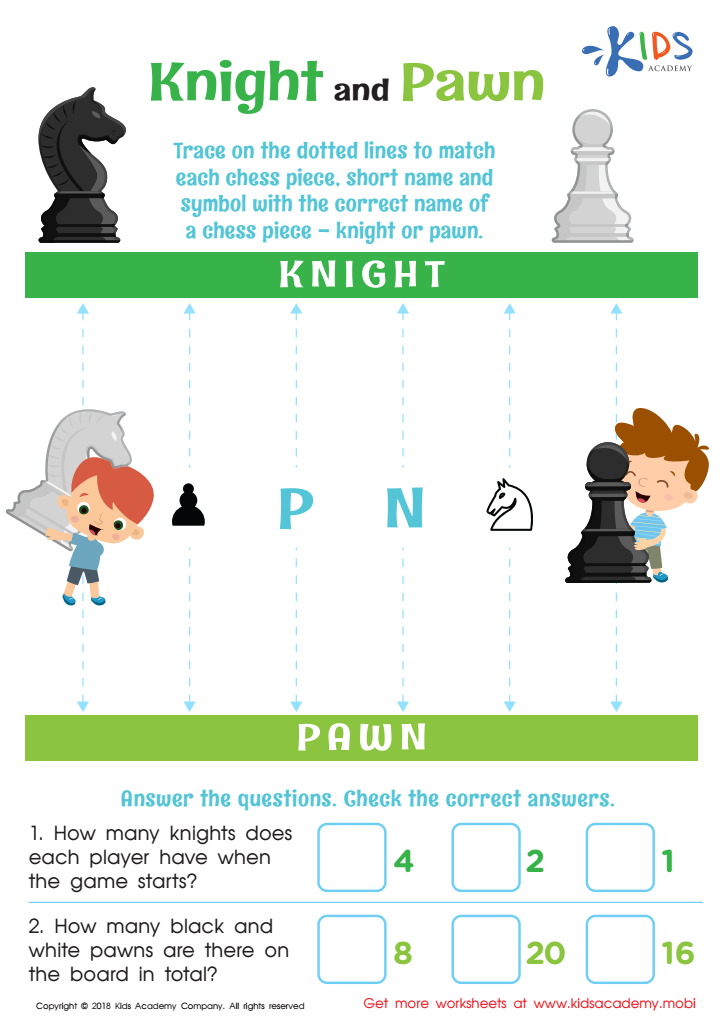
Knight and Pawn Worksheet
Knight and Pawn Worksheet

This tracing worksheet teaches kids about chess. They trace the dotted lines to match pieces, names and symbols to the correct chess piece. Questions at the bottom test their understanding. It's a simple exercise for a fun way to learn.
Knight and Pawn Worksheet
Worksheet
King and Queen Worksheet

King and Queen Worksheet

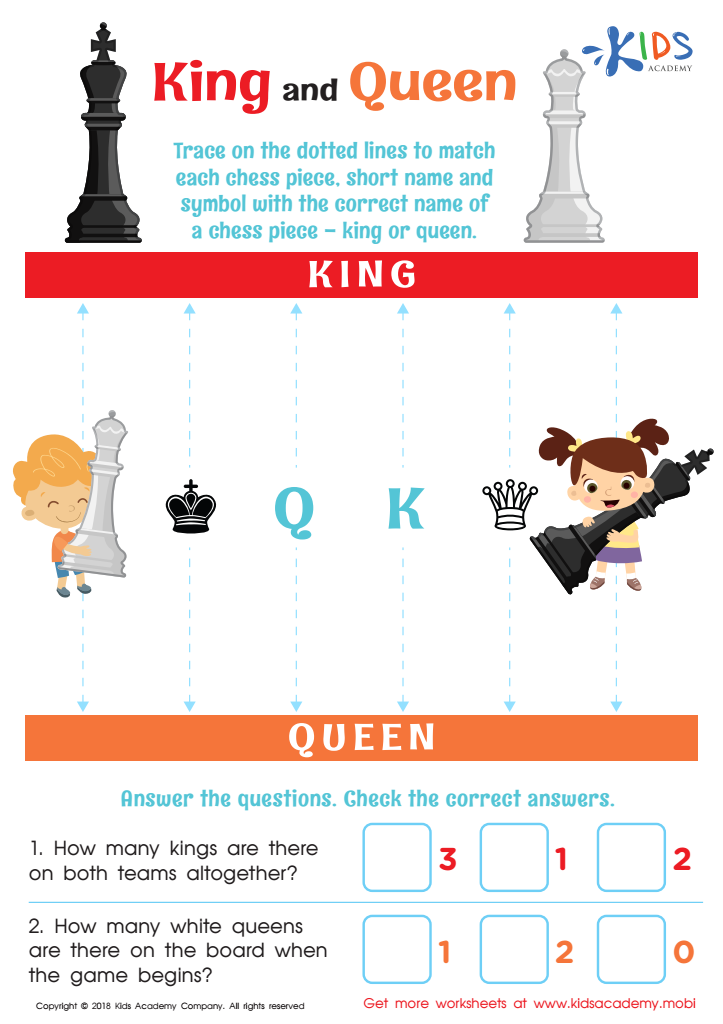
Instruct your kids to trace the dotted lines to match each chess piece, short name, and symbol with either king or queen.Answer the questions at the bottom and check the answers. This exercise will help your children to differentiate between a king and queen chess piece and know their symbols.
King and Queen Worksheet
Worksheet
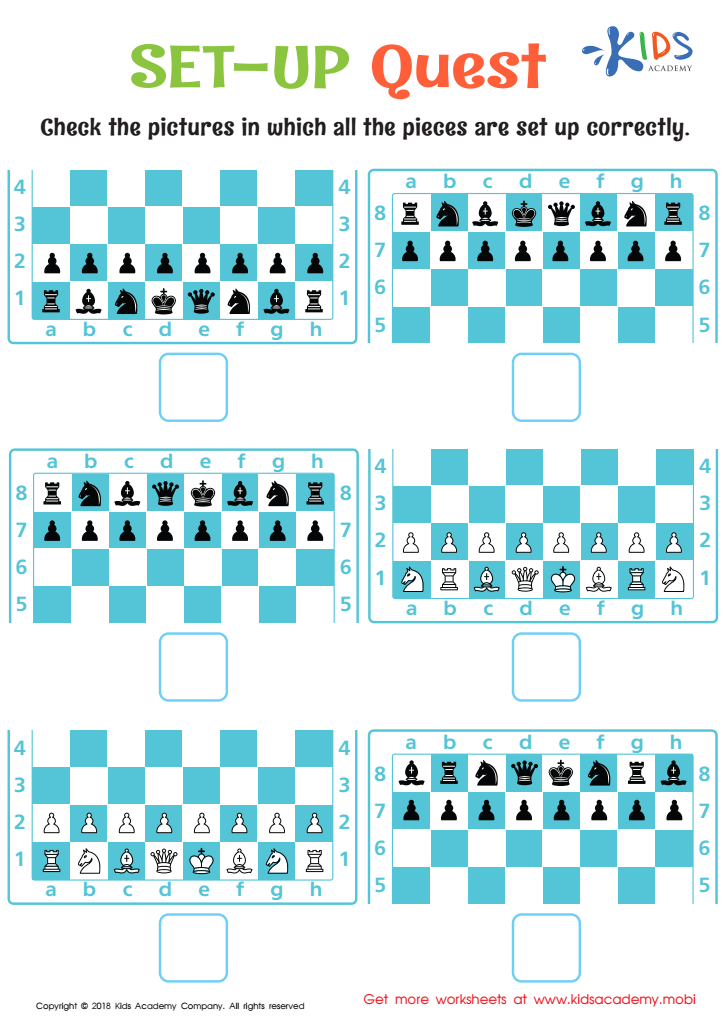
Set-up Quest Worksheet

Set-up Quest Worksheet

Have your students mastered checkmates? However, they may not know the proper way to set up a chessboard. Ask them if they know how and show them images of the correct set-up.
Set-up Quest Worksheet
Worksheet
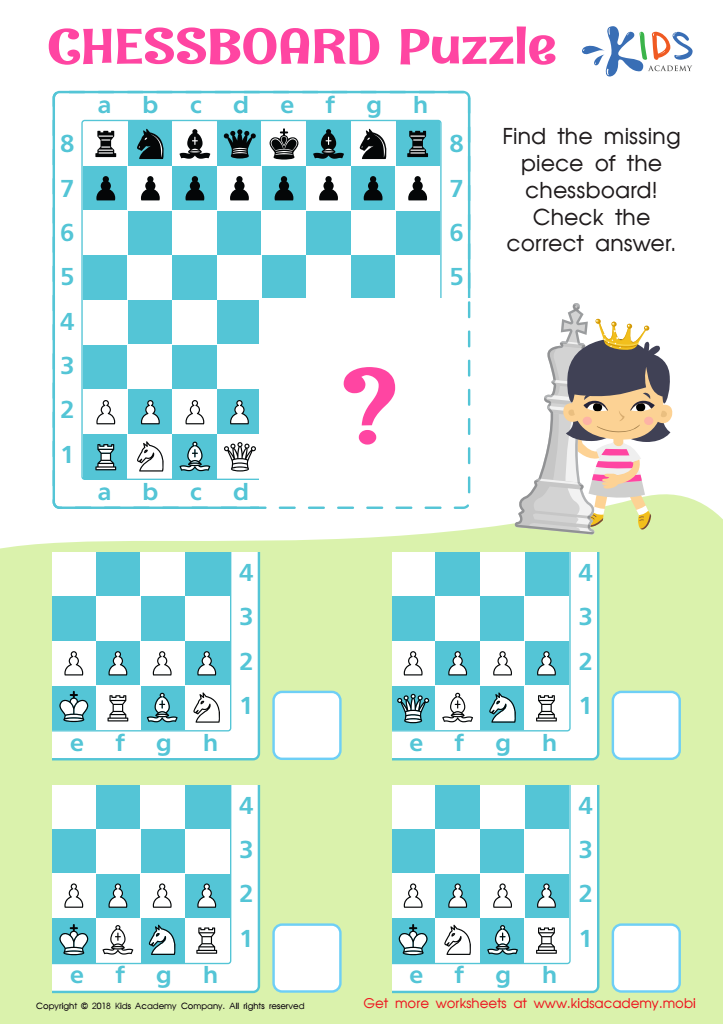
Chessboard Puzzle Worksheet

Chessboard Puzzle Worksheet

Test your child's chess prowess with this simple worksheet. They must find the missing pieces to complete the white side of an empty chessboard. The black pieces are already arranged properly on the board. Correct answers are provided so you can see how they did!
Chessboard Puzzle Worksheet
Worksheet
Setting up the Chessboard: Part 2 Worksheet

Setting up the Chessboard: Part 2 Worksheet

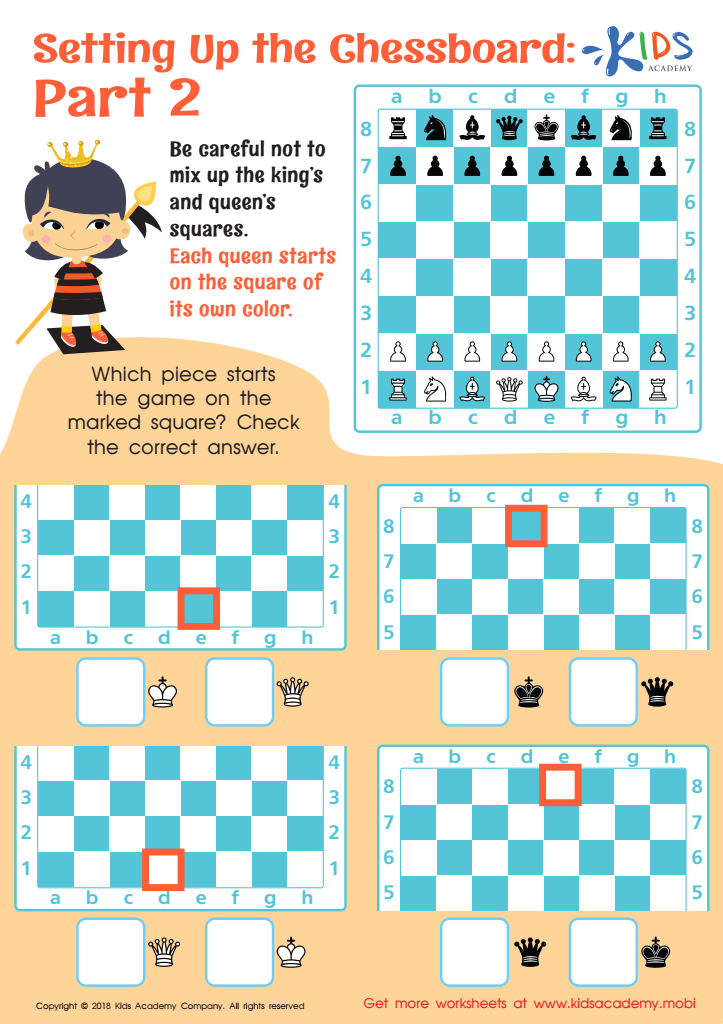
Before starting the game, make sure your child knows how to correctly set up the chessboard. Point to each square and ask them to name the piece that should be there. If they don't know, the printout can help. Remind them the queens should be on their own colour's square, then have them check the correct answers for the other pieces.
Setting up the Chessboard: Part 2 Worksheet
Worksheet
Setting up the Chessboard: Part 1 Worksheet

Setting up the Chessboard: Part 1 Worksheet

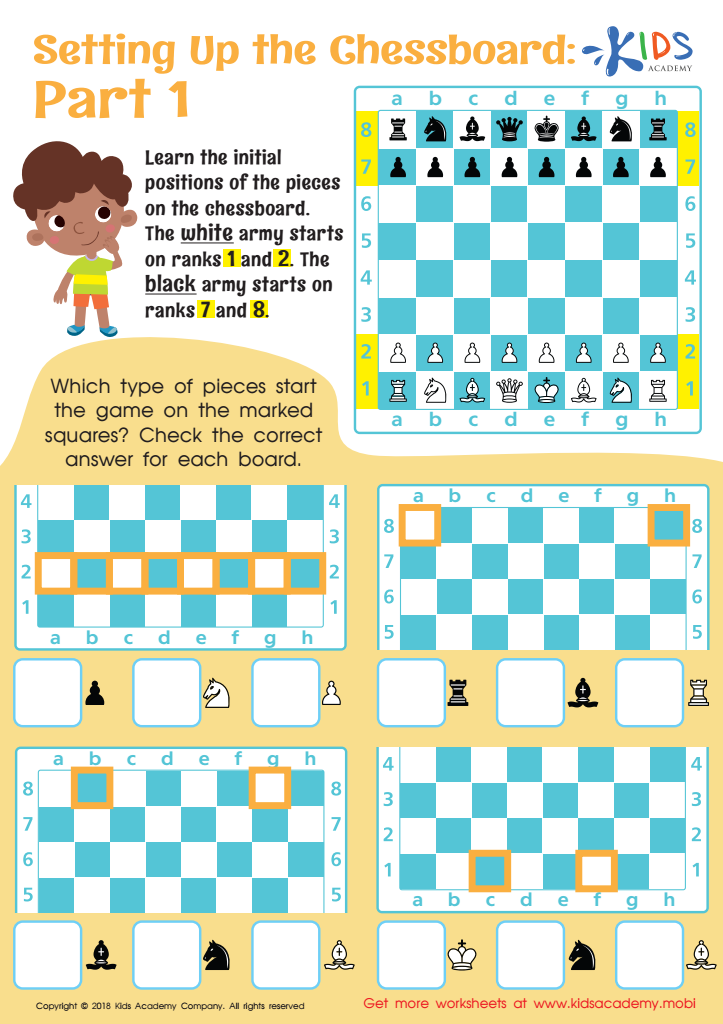
Teach your child the starting positions of the black and white armies on the chessboard. Black pieces are placed on ranks 7 and 8, and white pieces on ranks 1 and 2. Have them check the highlighted boxes on the chessboard to make sure they know the correct pieces to start with.
Setting up the Chessboard: Part 1 Worksheet
Worksheet
Find Diagonals Worksheet

Find Diagonals Worksheet

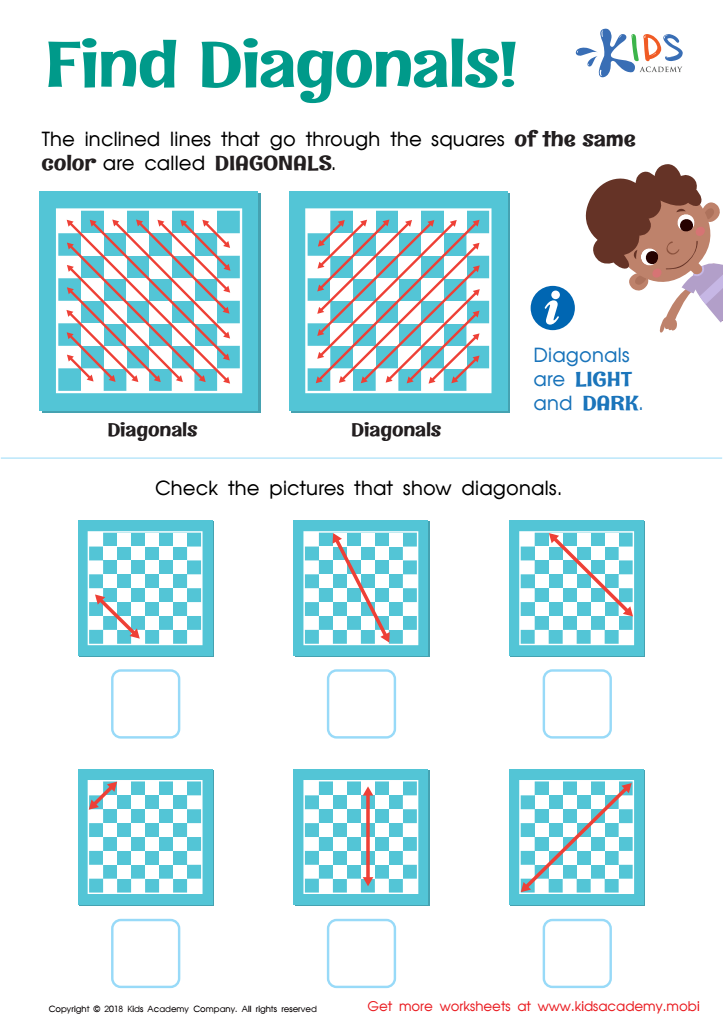
Help your child learn the name of the lines that go through squares with this fun worksheet. Diagonals slant in left or right directions and create the same shape. Ask your child to identify the pictures with correctly drawn diagonals.
Find Diagonals Worksheet
Worksheet
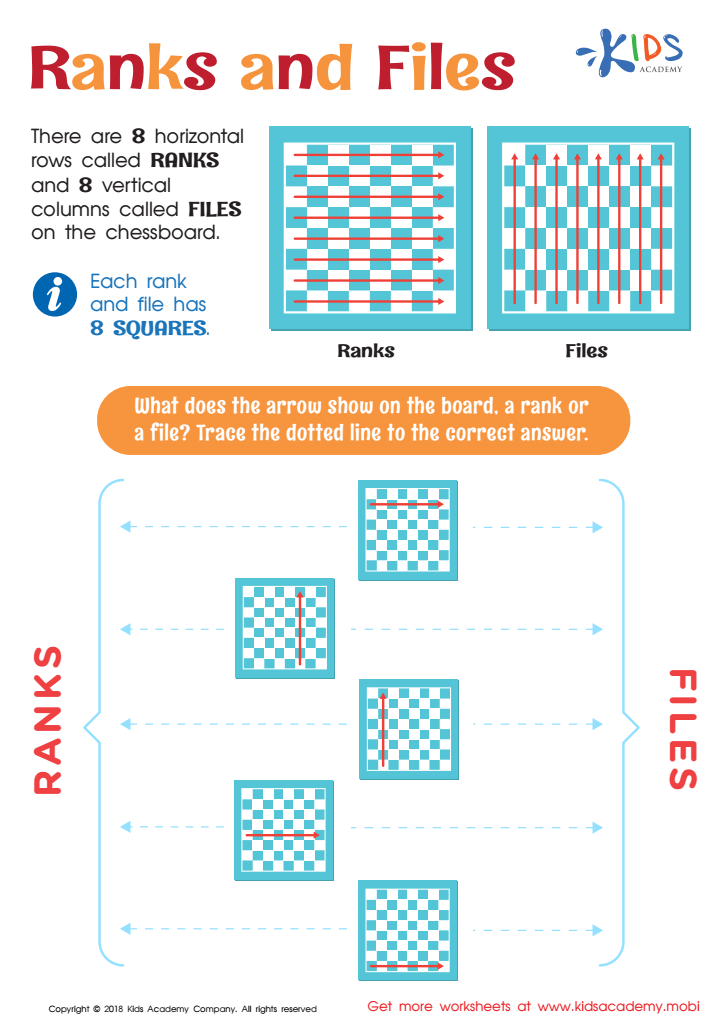
Ranks and Files Worksheet

Ranks and Files Worksheet

A chessboard has 8 horizontal ranks and 8 vertical files, each with 8 squares. Test your child's understanding of these directions with this fun worksheet!
Ranks and Files Worksheet
Worksheet
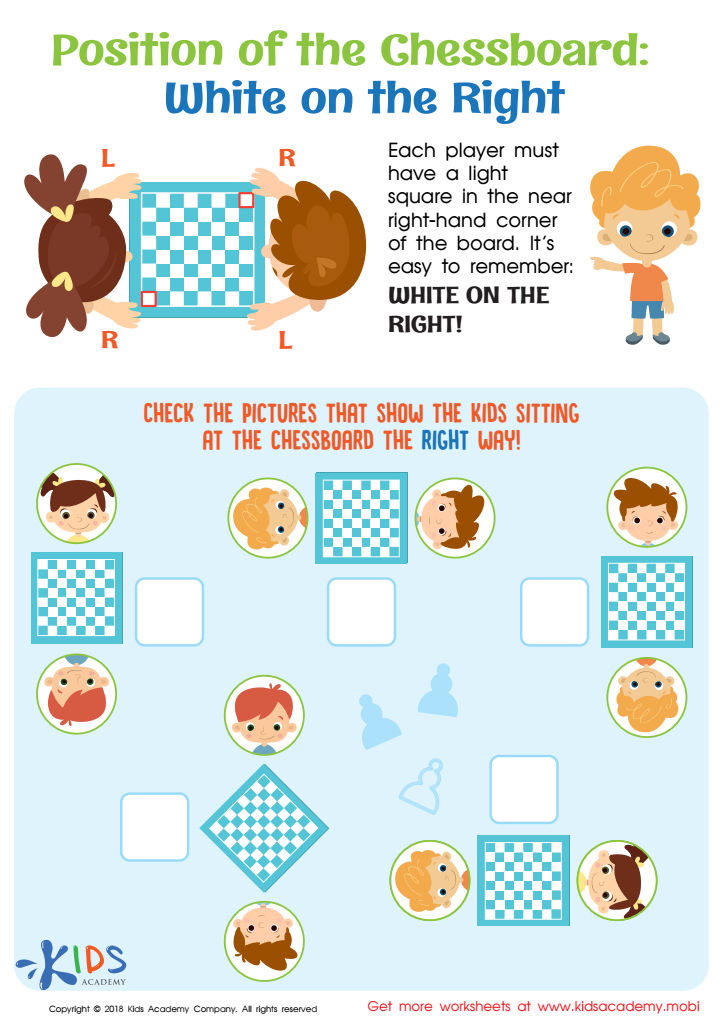
Position of the Chessboard: White on the Right Worksheet

Position of the Chessboard: White on the Right Worksheet

Proper positioning of the chessboard and players is key. Before the game, make sure the white square is in the right-hand corner. A simple rhyme can help: "White on the right". Check pictures of kids at the chessboard to ensure correct positioning.
Position of the Chessboard: White on the Right Worksheet
Worksheet
How Pawns Move: Part I Worksheet

How Pawns Move: Part I Worksheet

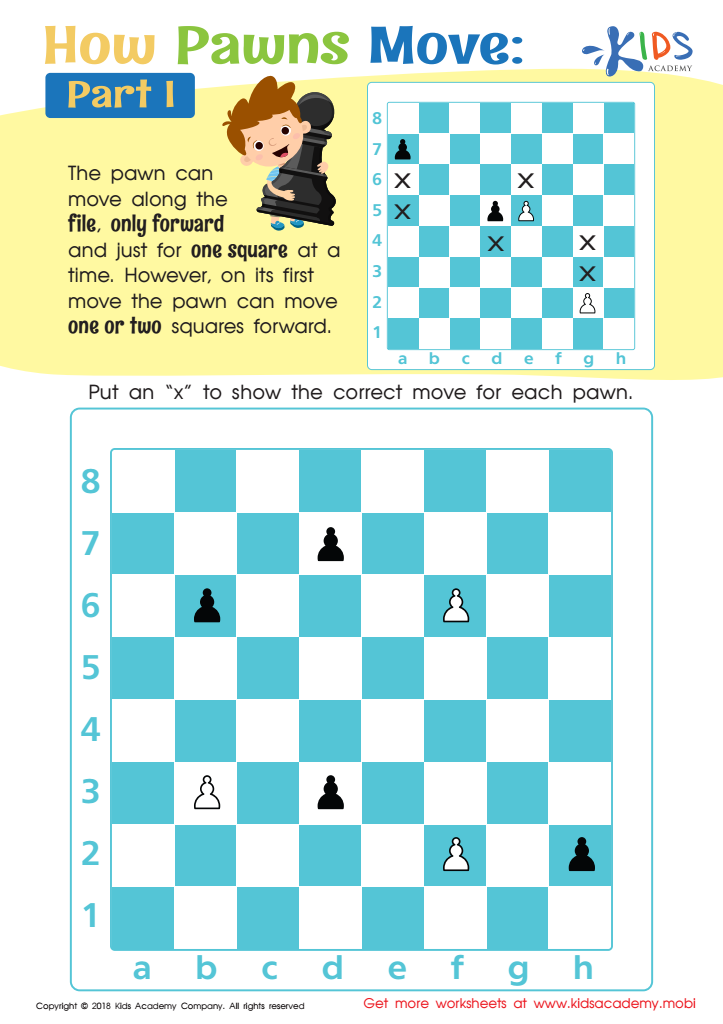
Pawns can only move forward along the file one square at a time. For its first move, a pawn can move one or two squares. Show your child how to move pawns by asking them to put an X for the correct move on this worksheet. This exercise will help them gain confidence in using pawns.
How Pawns Move: Part I Worksheet
Worksheet
How Pawns Capture Worksheet

How Pawns Capture Worksheet

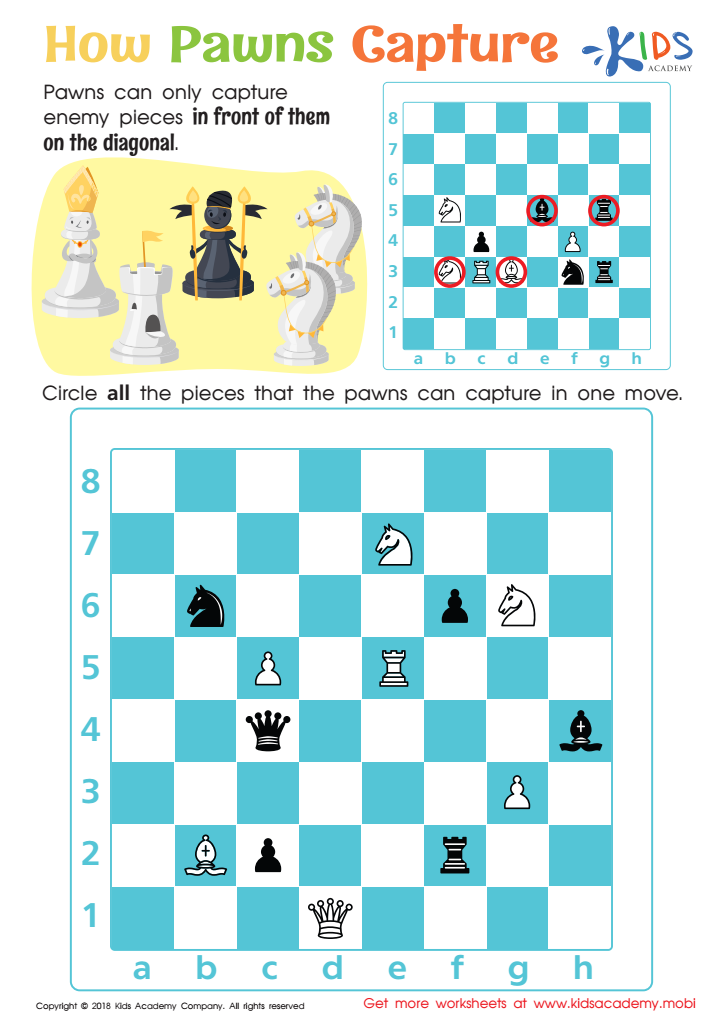
Ask your child to circle all the places a pawn can capture in one move on the diagonal. Pawns are limited in the moves they can make, but can still capture enemy pieces. This worksheet will help brush up on their knowledge of the rules of chess.
How Pawns Capture Worksheet
Worksheet
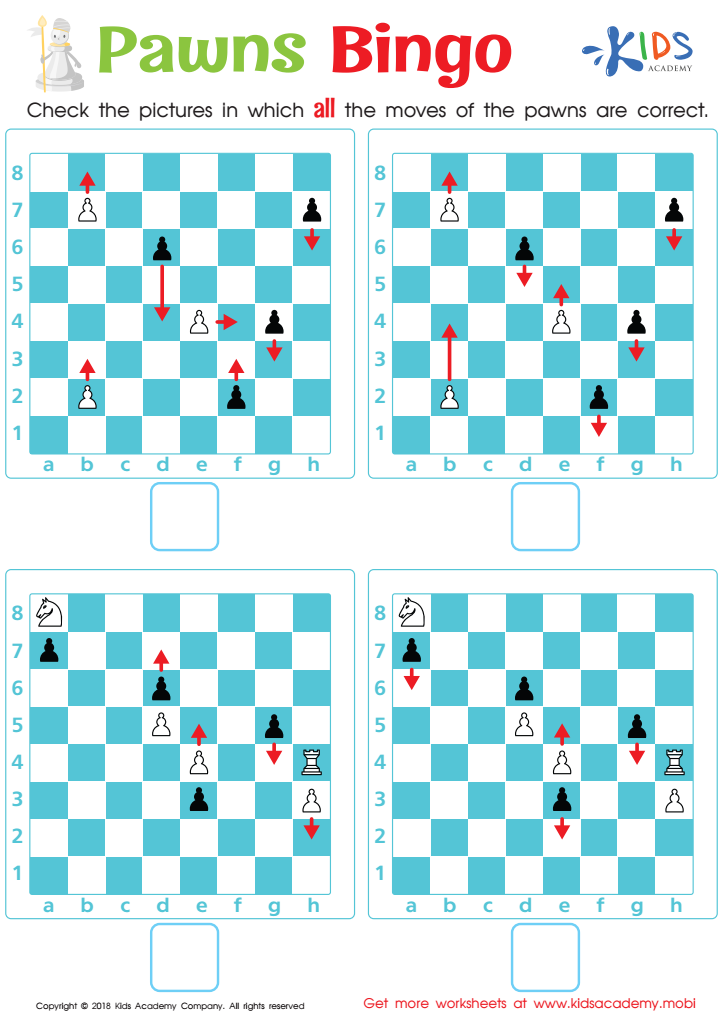
Pawns Bingo Worksheet

Pawns Bingo Worksheet

Test your students' knowledge of chess pawns. Present them with a worksheet featuring a picture, and ask them to identify the correct pawn moves. Afterward, they'll be better equipped to maneuver strategically on the chessboard.
Pawns Bingo Worksheet
Worksheet
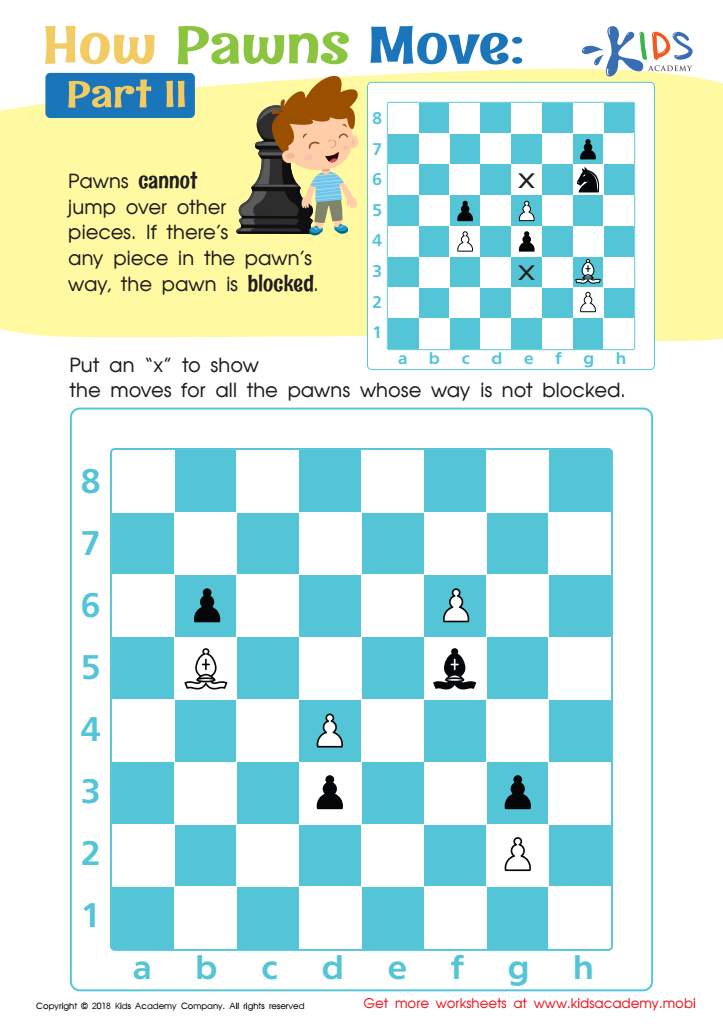
How Pawns Move: Part II Worksheet

How Pawns Move: Part II Worksheet

Pawns are the first to attack in chess and each player has the most pieces. They can't jump over other pieces, so if there's an obstacle, the pawn can't move. Ask your child to put an X to show all possible moves for the pawns not blocked by other pieces. (80)
How Pawns Move: Part II Worksheet
Worksheet
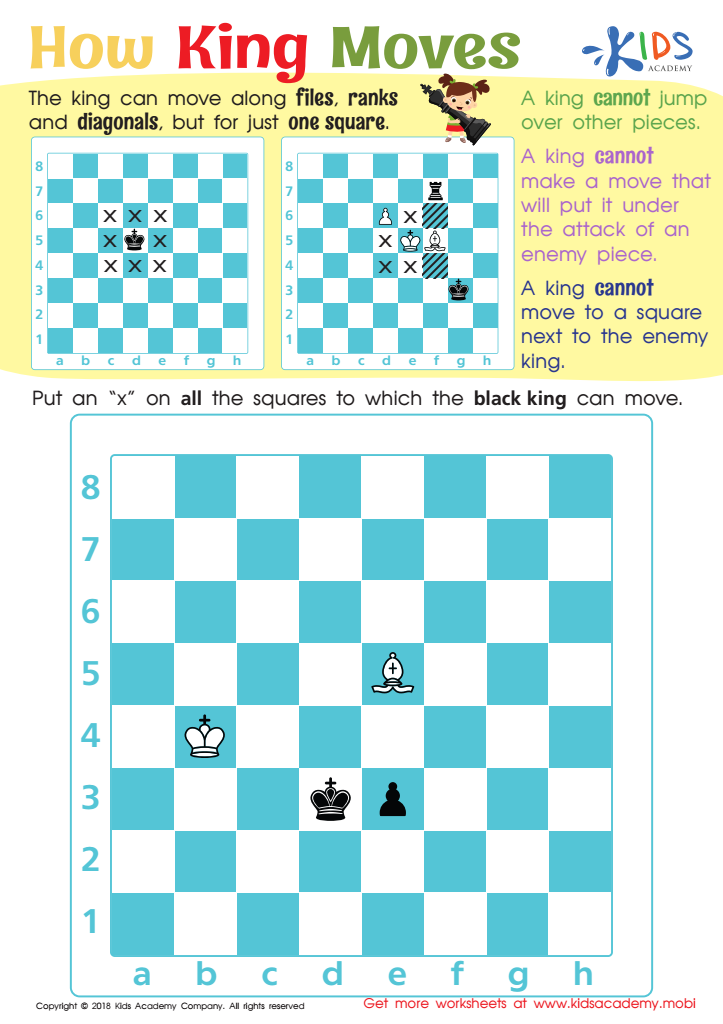
How King Moves Worksheet

How King Moves Worksheet

Teach your kids the fundamentals of chess with this worksheet! The goal is to checkmate the opponent's king, so it must be protected at all times. The king moves along files, ranks, and diagonals (except one square at a time), and cannot move to a square next to the enemy king. Your kids will soon master the art of checkmate!
How King Moves Worksheet
Worksheet
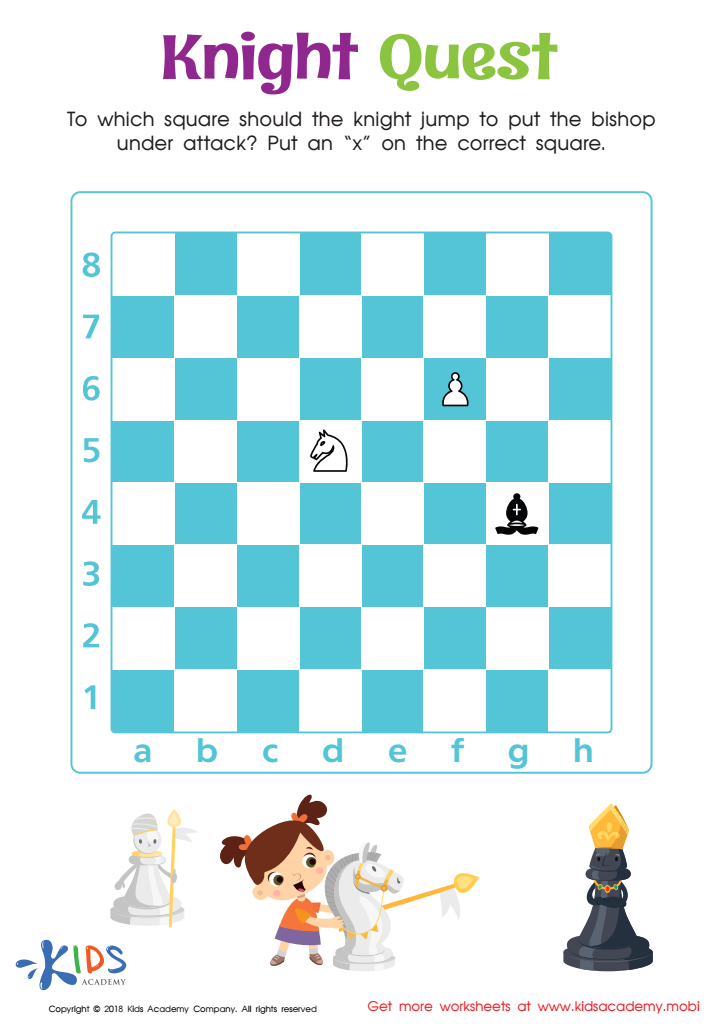
Knight Quest Worksheet

Knight Quest Worksheet

Testing your child's strategic planning and chess skills? Give them this worksheet: Ask them to mark an 'x' on the square where the knight should jump to attack the enemy bishop. See how well they plan for a win! (80 words)
Knight Quest Worksheet
Worksheet
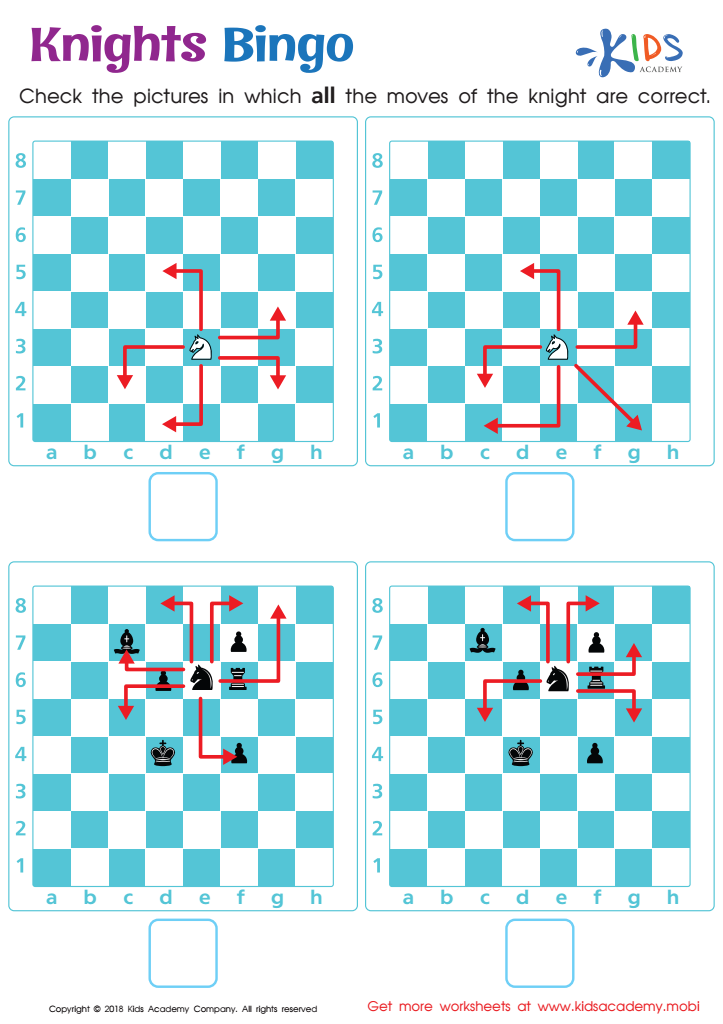
Knights Bingo Worksheet

Knights Bingo Worksheet

Help your child identify legal knight moves in this easy worksheet. Review each picture with them, questioning if the knight moves are correct. Then have them verify pictures with correct moves.
Knights Bingo Worksheet
Worksheet
How Knights Move Worksheet

How Knights Move Worksheet

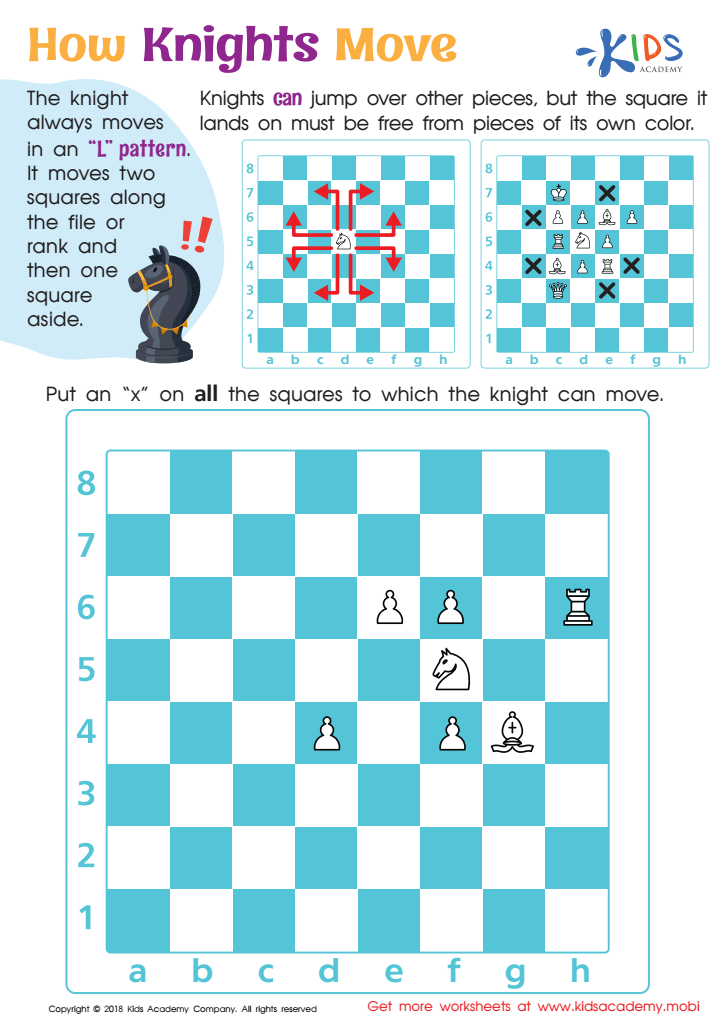
Get your kids to tell you how a knight moves in chess. If they need help, explain that a knight moves in an «L» pattern - two squares on the file/rank, one square aside. It may also jump over other pieces, as long as the landing square is unoccupied. Have them mark the squares where the knight can move in the exercise.
How Knights Move Worksheet
Worksheet
How Knight Captures Worksheet

How Knight Captures Worksheet

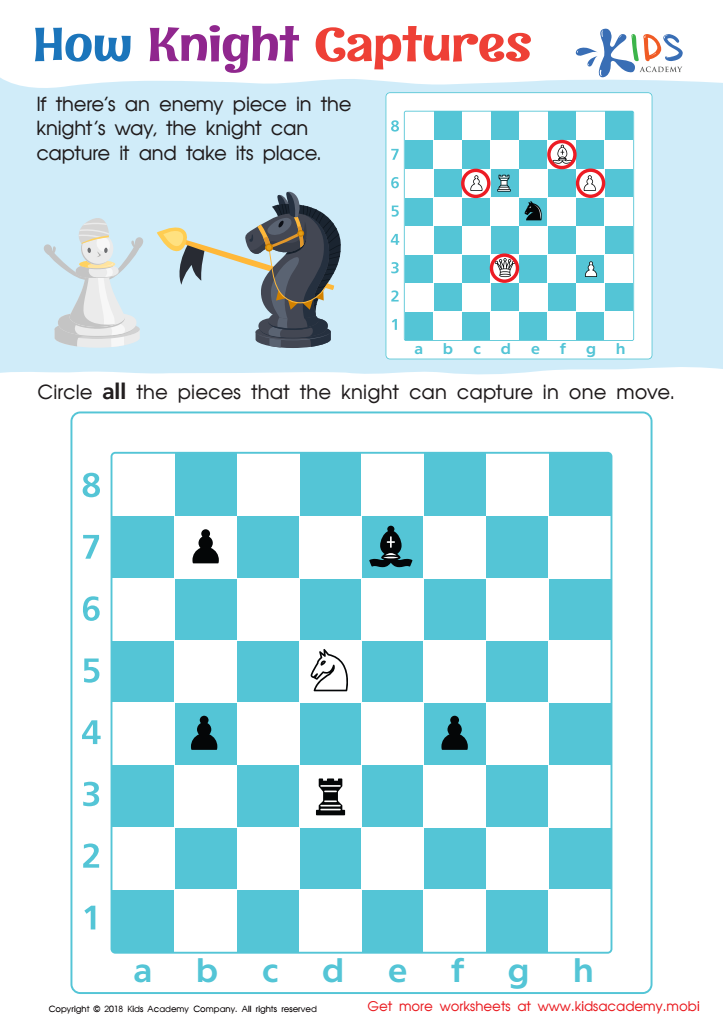
Test your child's knowledge of chess pieces by asking them to identify the knight. It is shaped like a horse and its goal is to capture the enemy king in order to win the game. The knight has the advantage of being able to jump over other pieces, taking them out and taking their place. See how many pieces the knight can capture in one move with this worksheet.
How Knight Captures Worksheet
Worksheet
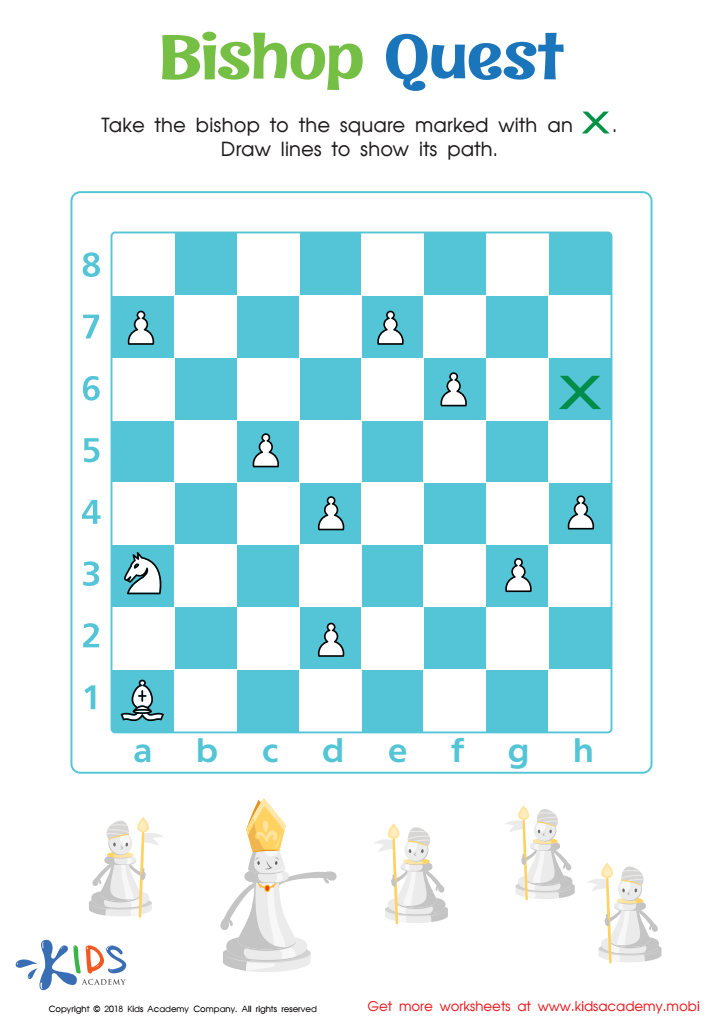
Bishop Quest Worksheet

Bishop Quest Worksheet

Show kids the board and ask them to identify the bishop. Then ask them to move it to the square marked 'x', drawing lines to show its path. This worksheet helps teach kids how to move the bishop on a chessboard.
Bishop Quest Worksheet
Worksheet
How Bishops Move Worksheet


How Bishops Move Worksheet

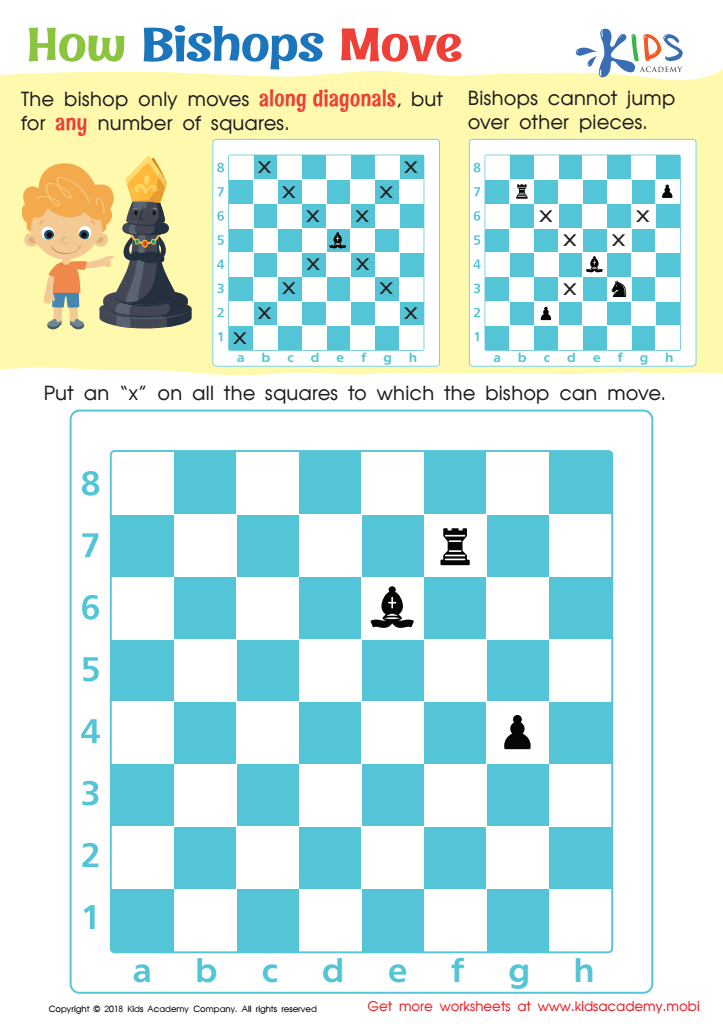
There is no such thing as too much sharpening of skills. Encourage your child to learn more about chess technicalities with this simple worksheet. It shows them how a bishop moves: along diagonals any number of squares, but it can't jump over other pieces.
How Bishops Move Worksheet
Worksheet
Rook Quest Worksheet

Rook Quest Worksheet

Is your child a chess whiz? Check their progress with this rook quest: get the enemy's pawn piece in just two moves. Have them draw the lines for the moves they'll make. See how quickly they master it!
Rook Quest Worksheet
Worksheet
How Rooks Move Worksheet

How Rooks Move Worksheet

Help your kids master chess with this worksheet! Explain how rook pieces move along ranks and files, and have them mark the squares it can move to. Note that it can't jump over other pieces. With your guidance, they'll soon understand the game they love.
How Rooks Move Worksheet
Worksheet
Queen Quest Worksheet

Queen Quest Worksheet

Want to test your child's chess skills? See if they know how the queen, king, knights, rooks, and pawns move. This worksheet challenges your young one to capture a rook with the queen in two moves. Draw lines to show the queen's moves to complete the task.
Queen Quest Worksheet
Worksheet


Normal worksheets designed for children ages 3-5 play a crucial role in early childhood education. These carefully crafted educational tools are not merely sheets of paper; they are gateways to a world of foundational learning and development. For children in this pivotal age group, normal worksheets serve as an engaging platform to explore basic concepts that are instrumental in their cognitive, motor, and emotional growth.

Firstly, these worksheets are tailored to captivate the young minds of ages 3-5, keeping them engrossed with vibrant visuals and interactive tasks. This age-specific design ensures that the learning material is neither too simplistic to bore them nor too complex to overwhelm them. By striking this delicate balance, normal worksheets foster a love for learning from an early age.

Moreover, these worksheets cover a broad spectrum of essential skills, from fundamental math and language arts to fine motor skills and problem-solving. Through repetitive and varied exercises, children gain confidence in their abilities, setting a solid foundation for their academic journey ahead. Additionally, the hands-on nature of working through worksheets encourages independence and self-paced learning, allowing children to explore their interests and learn at their own speed.

In conclusion, normal worksheets for ages 3-5 are indispensable tools in early childhood education. They not only make learning fun and engaging but also lay down the building blocks for future academic success and lifelong curiosity.