Filters

52 filtered results

Clear all filters
Favorites
With answer key
Interactive

52 filtered results

Difficulty Level

Grade


Check out this FREE Trial Lesson on Numbers for age 4-9!

Represent Data Tally Marks

Favorites
With answer key
Interactive
  • 4-9
  • Problem-Solving Skills
  • Numbers
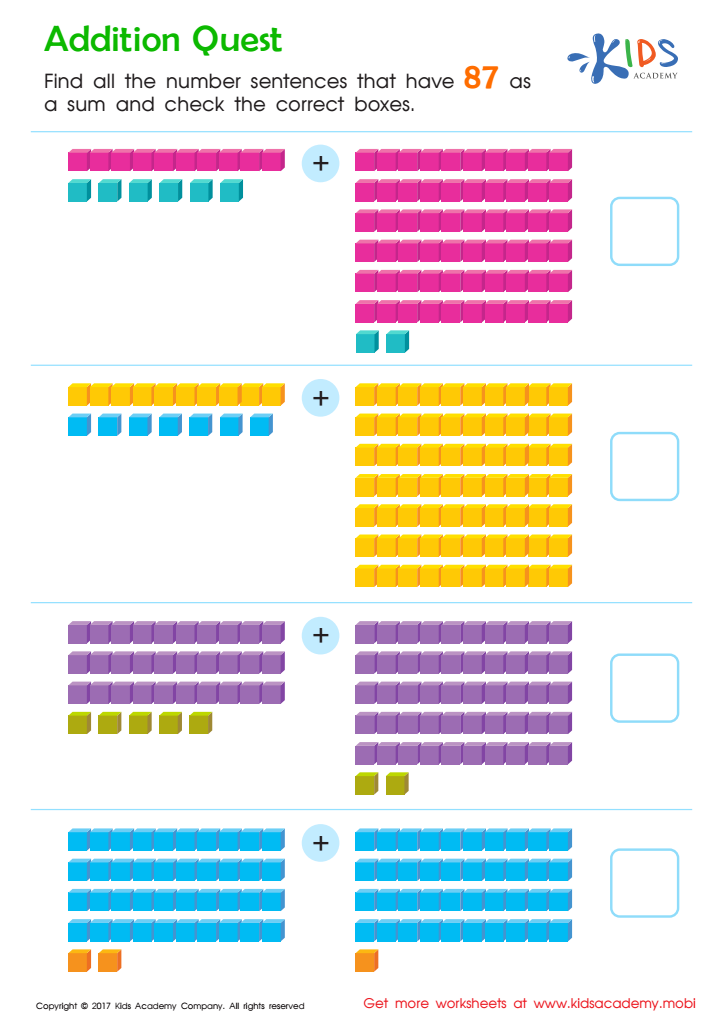
Addition Quest Worksheet: Part 1

Addition Quest Worksheet: Part 1

Send your child on a mission to find the equations that equal 87 with base ten blocks! Download the worksheet to help them add each grouping of blocks and check the correct boxes for the answers. Fun and educational!
Addition Quest Worksheet: Part 1
Worksheet
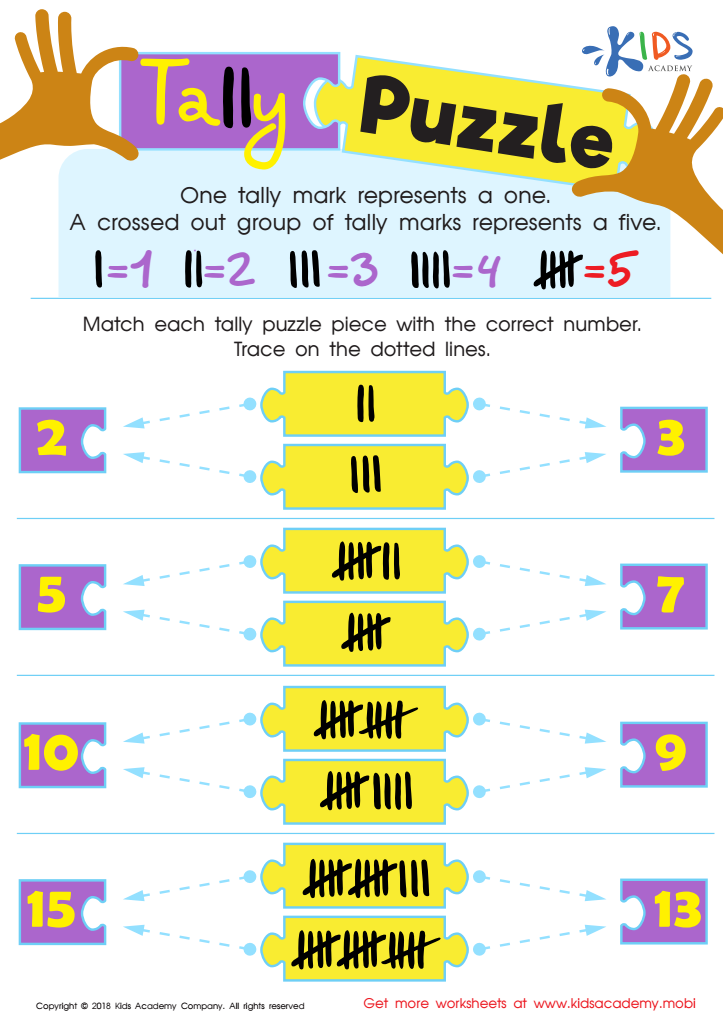
Tally Puzzle Worksheet

Tally Puzzle Worksheet

Kids love puzzles, and this bright worksheet will let them practice tallies and matching numbers. It teaches them to count and assign values, critical for doing math problems quickly and accurately later. It also leads to strategies like counting by 5s.
Tally Puzzle Worksheet
Worksheet
Haystack Steps Worksheet

Haystack Steps Worksheet

Have your kids ever visited a farm? What activities and sights did they enjoy? Farmers are essential to our lives, growing food and providing us with dairy and eggs. In this worksheet, a farmer has made a haystack for his animals to climb into the barn. Ask your kids to add an extra layer to the stack to make the climb easier.
Haystack Steps Worksheet
Worksheet
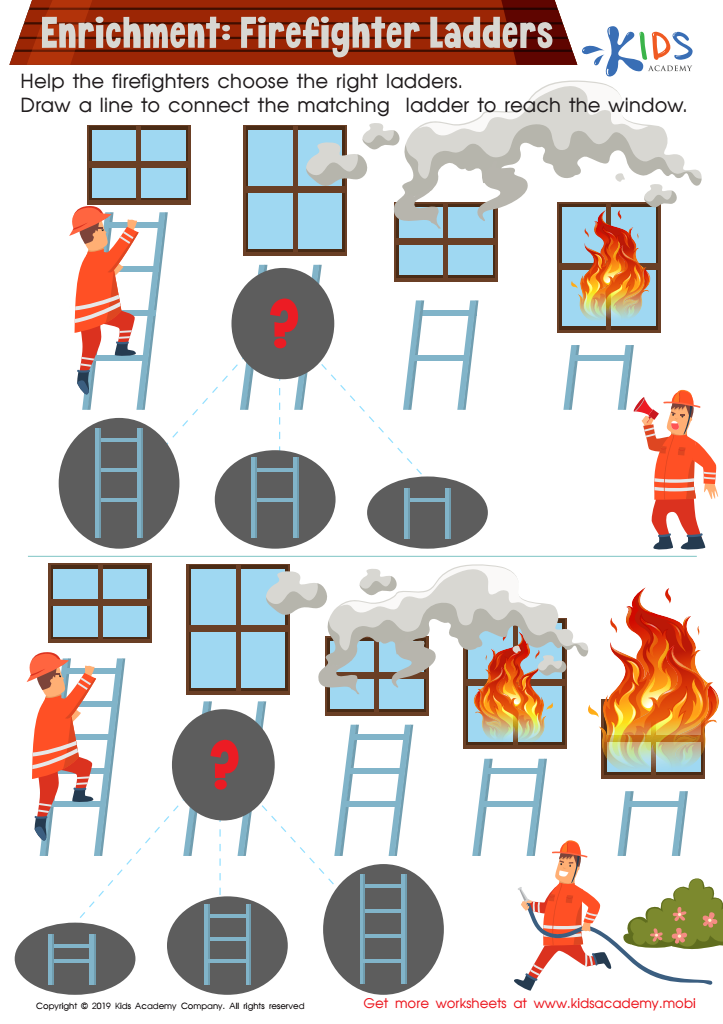
Enrichment: Firefighter Ladders Worksheet


Enrichment: Firefighter Ladders Worksheet

Firefighters are vital to their communities. If your kids want to become firefighters, they'll love this worksheet. Ask them to spot the firemen in the picture. Then, help the firemen pick the right ladders to reach the windows. Draw lines to connect the ladders that match. It's a great learning activity!
Enrichment: Firefighter Ladders Worksheet

Worksheet


... 2 3

Problem-solving skills in young children, particularly between the ages of 4-9, are crucial for their cognitive, emotional, and social development. At this stage, children start to encounter challenges that require critical thinking and reasoning. Developing these skills helps them navigate everyday situations, from simple tasks like sharing toys to more complex problems in schoolwork.

Parents and teachers play a pivotal role in nurturing these abilities. Engaging children in problem-solving activities fosters creativity and resilience, encouraging them to think independently and explore various solutions. This not only enhances their mathematical understanding but also reinforces essential life skills such as persistence and adaptability.

Children who learn to solve problems effectively are more likely to excel academically, as these skills translate into better comprehension of subjects, especially in math and science. Moreover, problem-solving promotes teamwork and communication, as children often work through solutions in groups, enhancing their social skills.

Ultimately, fostering problem-solving skills lays a strong foundation for lifelong learning, preparing children to tackle more complex challenges as they grow. By prioritizing these skills, parents and teachers help cultivate confident, capable learners who are better equipped to thrive in an ever-evolving world.