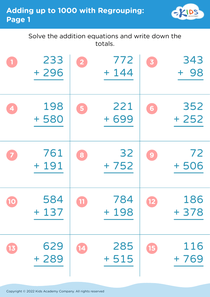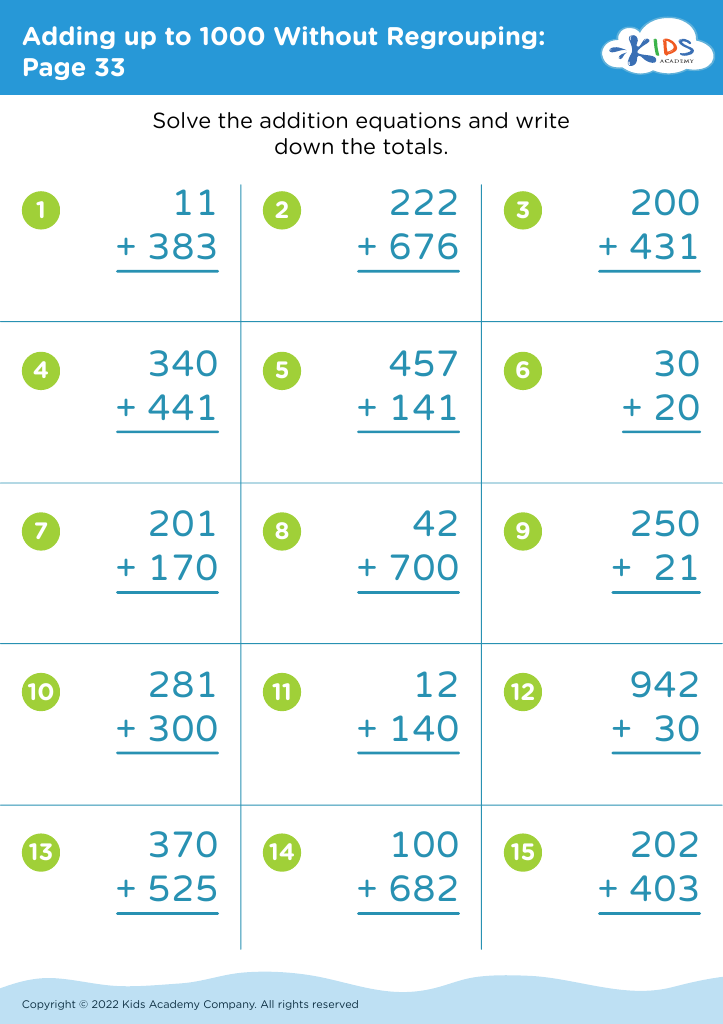



Parents and teachers play critical roles in early childhood education, particularly in foundational math skills. Adding up to 1000 without regrouping for ages 5-7 can seem like an advanced concept, but it's beneficial in essential ways. First, tackling this type of addition helps build strong numerical reasoning and confidence in dealing with larger numbers. It introduces young learners to more complex mathematical structures, steering away from simplistic single or double-digit addition and encouraging a deeper understanding of place value.
Without the challenge of regrouping, children concentrate on addition logic and patterns. This fundamental practice ensures that basic arithmetic principles solidify without the potential distraction or confusion that regrouping can introduce. Establishing this strong arithmetic base at an early age fosters smooth progression to more advanced concepts like regrouping and carrying over.
Moreover, this skill paves the way for problem-solving proficiency. When kids grow comfortable adding large numbers, overcoming initial fears of large-scale calculations enhances their capability to tackle future numerical challenges with more significant confidence.
Finally, fostering mathematical competence from a young age impacts overall cognitive development positively. The ability and willingness to engage with these problems can translate to better performance in various subjects, promoting academically well-rounded and proficient learners.