Understanding magnetism Science Worksheets for 8-Year-Olds
3 filtered results
-
From - To
Explore the fascinating world of magnetism with our engaging science worksheets tailored for 8-year-olds. Designed by education experts, these printable resources from Kids Academy bring complex concepts to life with age-appropriate activities, colorful illustrations, and hands-on experiments. Young learners will discover the properties of magnets, understand poles, and investigate magnetic fields through fun and interactive exercises. Enhance critical thinking and scientific curiosity while aligning with educational standards. Perfect for both classroom and home use, our worksheets make learning about magnetism a captivating adventure for second graders. Unlock the wonders of science today!
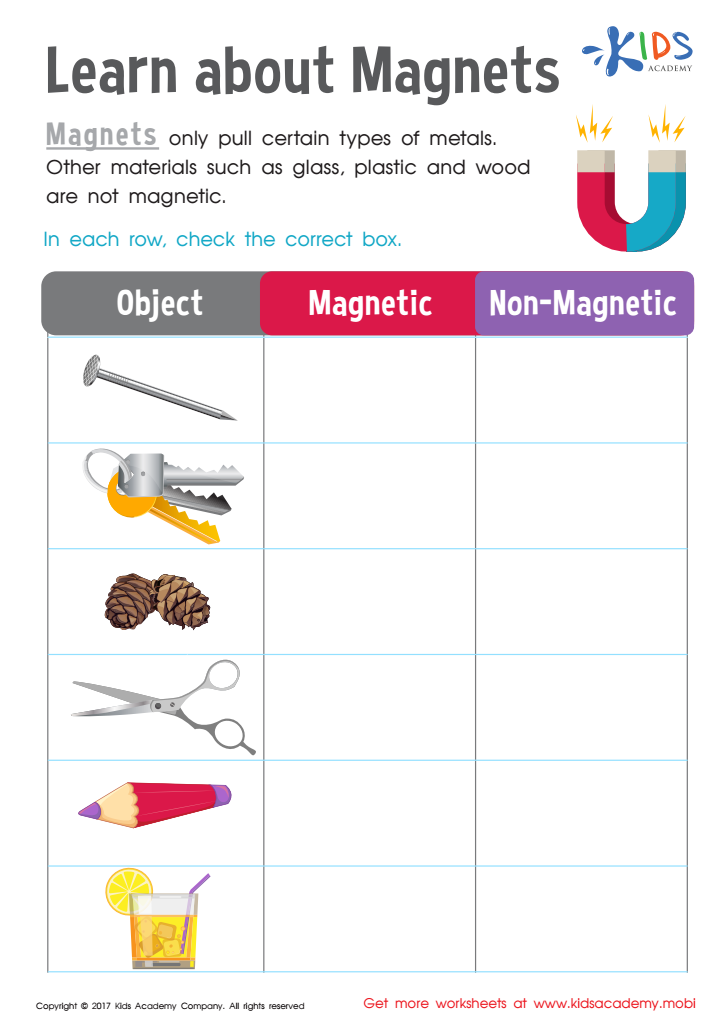
Magnetic Or Not Worksheet
 Assign to My Students
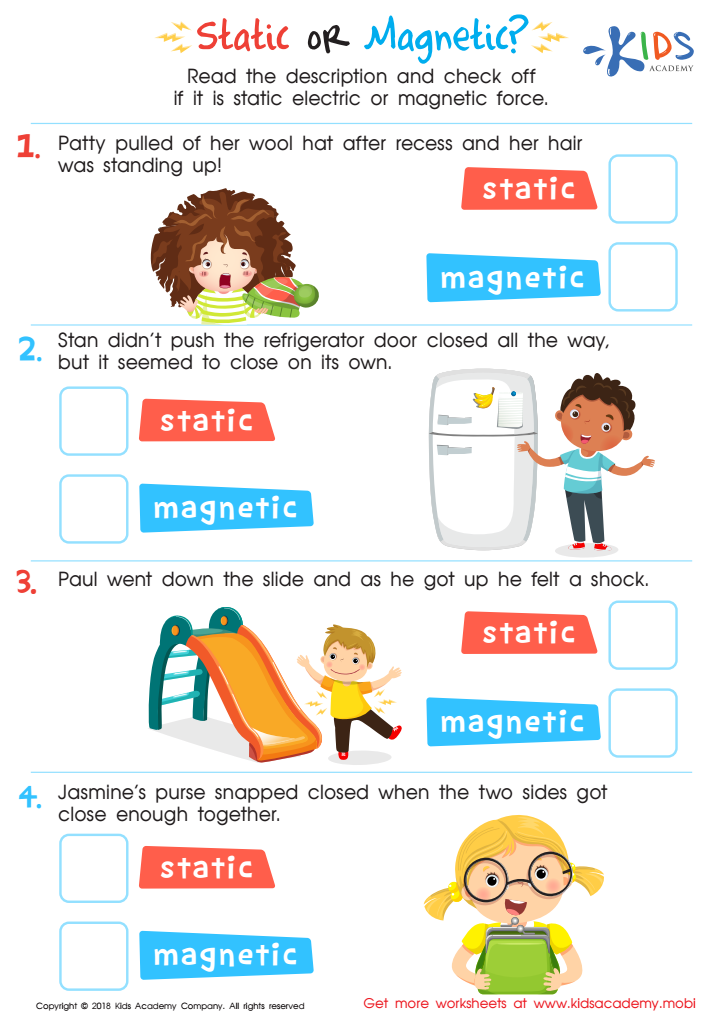
Static or Magnetic Printable Worksheet
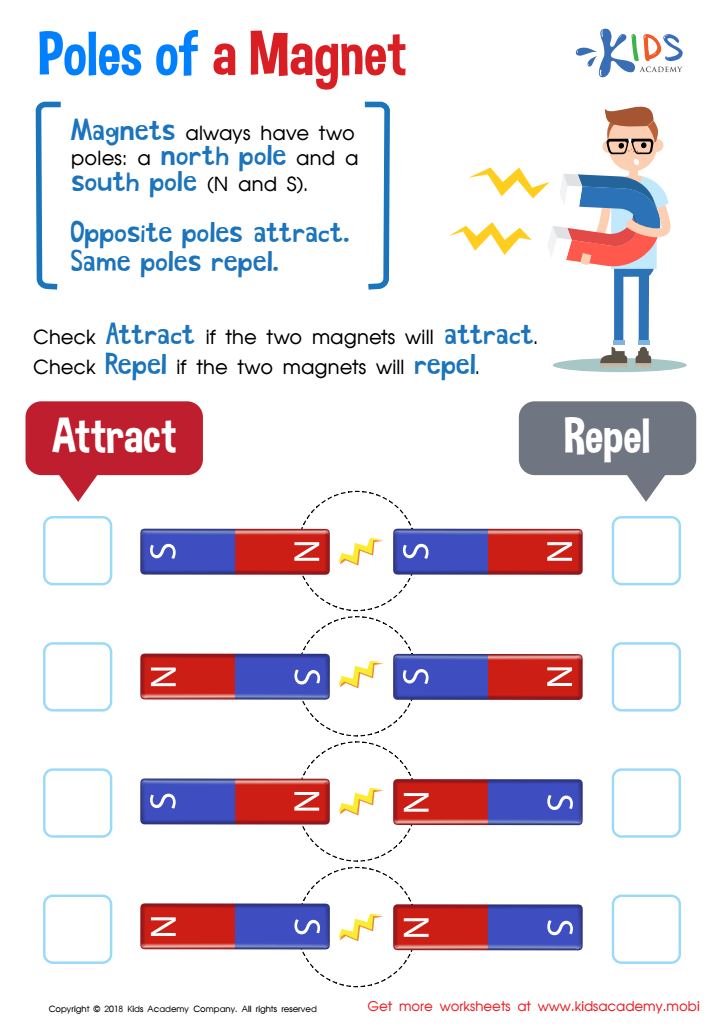
Magnet Poles Attract or Repel Worksheet







Understanding magnetism is fundamental for 8-year-olds, as it forms the bedrock for learning about physics, engineering, and chemistry. For parents and teachers, it's crucial to foster this understanding early on. Magnetism captivates young minds through engaging and hands-on experiences that link everyday observations to scientific principles. This sets the stage for inquisitiveness and critical thinking.
Magnetism's practical applications are all around us, from refrigerator magnets to electronic devices. Early exposure helps children grasp the importance of scientific principles in daily life. By exploring concepts like attraction, repulsion, and magnetic fields, kids learn about cause and effect, prediction, and experimentation—which are essential for scientific reasoning.
Additionally, fostering an understanding of magnetism can strengthen problem-solving skills. Children learn to ask questions, hypothesize, conduct experiments, and draw conclusions. These skills not only build a strong foundation for future STEM learning but also enhance cognitive development across other subjects.
Teachers and parents should create enriching environments that encourage curiosity about the physical world. Simple experiments with magnets can stimulate a sense of wonder and make learning fun. In this context, understanding magnetism becomes more than just a unit in a science class—it becomes a means of broadening a child's horizons and laying the groundwork for lifelong learning and discovery.







