Numbers up to 100 Worksheets for Ages 3-7 - Page 3
50 filtered results
-
From - To
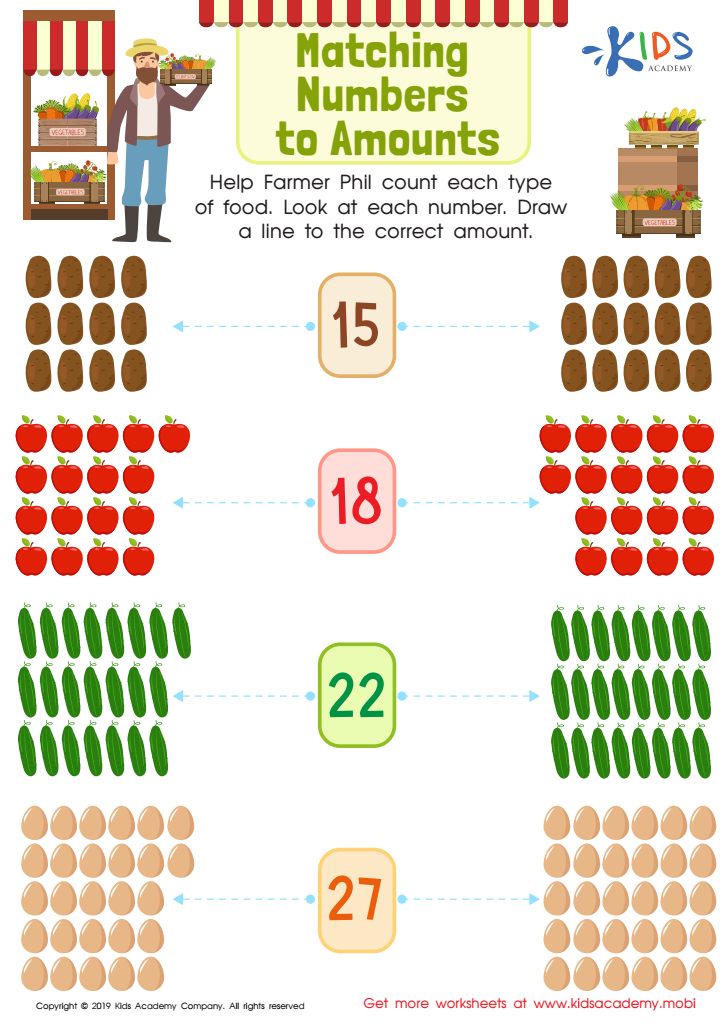
Matching Numbers to Amounts Worksheet
 Assign to My Students

Counting on the City Skyline: Dot-to-Dot Worksheet







Understanding numbers up to 100 is foundational for children ages 3-7 and serves as a vital stepping stone in their mathematical development. At this formative age, young learners are naturally curious, and their brains are highly receptive to new information. Introducing numbers up to 100 at this stage lays the groundwork for more complex mathematical concepts they will encounter later, such as addition, subtraction, multiplication, and division.
Firstly, learning numbers up to 100 helps children grasp the idea of quantity and develop a sense of numerical order, which is essential for logical thinking and problem-solving. It also improves their ability to recognize patterns and sequences, which are critical skills in mathematics and other areas such as reading and systematic organization.
Secondly, a solid understanding of numbers enhances a child's confidence and enthusiasm for learning. When children see numbers everywhere—in counting objects, during play, or on road signs—they begin to connect math with their everyday experiences, making learning both relevant and engaging.
Finally, early numeracy skills are predictive of later academic achievement. Children who have a strong number sense are better prepared for the challenges of more advanced math and science courses. Therefore, parents and teachers should dedicate time and effort to nurture a child's understanding of numbers up to 100, providing them with a strong academic foundation and fostering a lifetime love for learning.








