Extra Challenge Tracing Shapes Worksheets for Ages 6-7
4 filtered results
Difficulty Level
Grade
Age
-
From - To
Subject
Activity
Standards
Introducing the Extra Challenge Tracing Shapes worksheets, meticulously designed for curious minds aged 6-7! Perfect for honing fine motor skills and geometric understanding, this collection invites young learners on a delightful journey through the world of shapes. Each page is a new adventure, offering an engaging mix of complexity and fun to challenge and captivate. From mastering the basics to exploring intricate patterns, these worksheets are crafted to inspire confidence and creativity. Unlock your child's potential and watch them flourish with our Extra Challenge Tracing Shapes for Ages 6-7, where learning meets enjoyment in every line traced!
Favorites
With answer key
Interactive
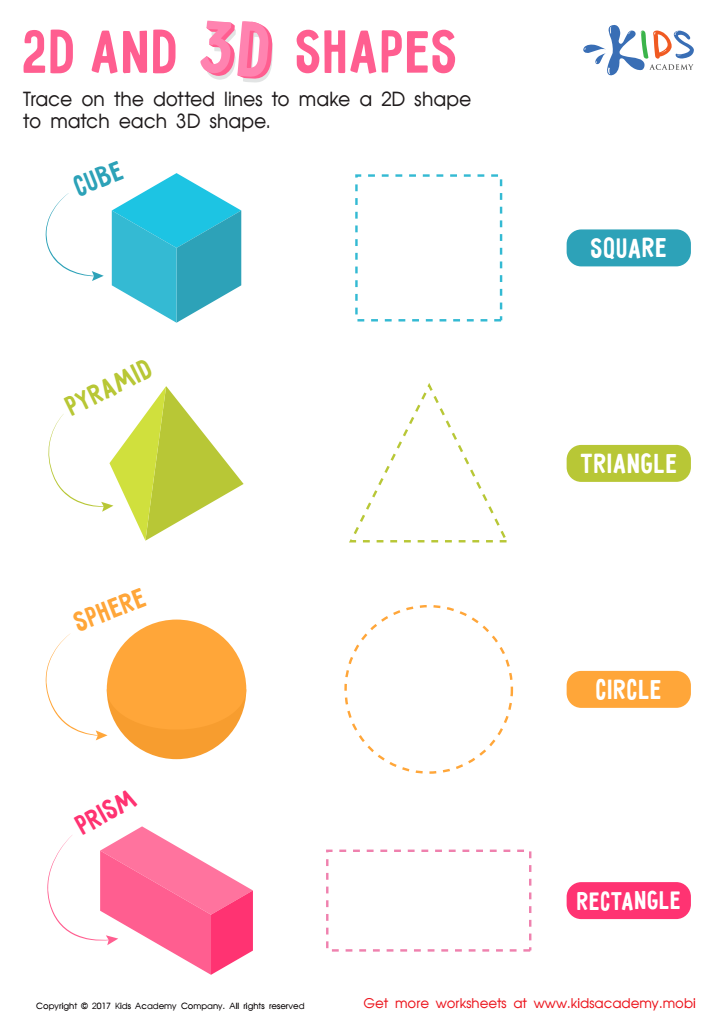
2D and 3D Shapes Worksheet
Introduce your child to 3D and 2D with this traceable worksheet. With dotted lines, help them trace and make a 2D shape for each 3D shape: square, triangle, rectangle, and circle. Show them there's more than one way to draw! You may have taken them to a 3D movie, or they've seen some fantastic 3D art. Now they can wonder no more.
 Assign to My Students
2D and 3D Shapes Worksheet
Worksheet
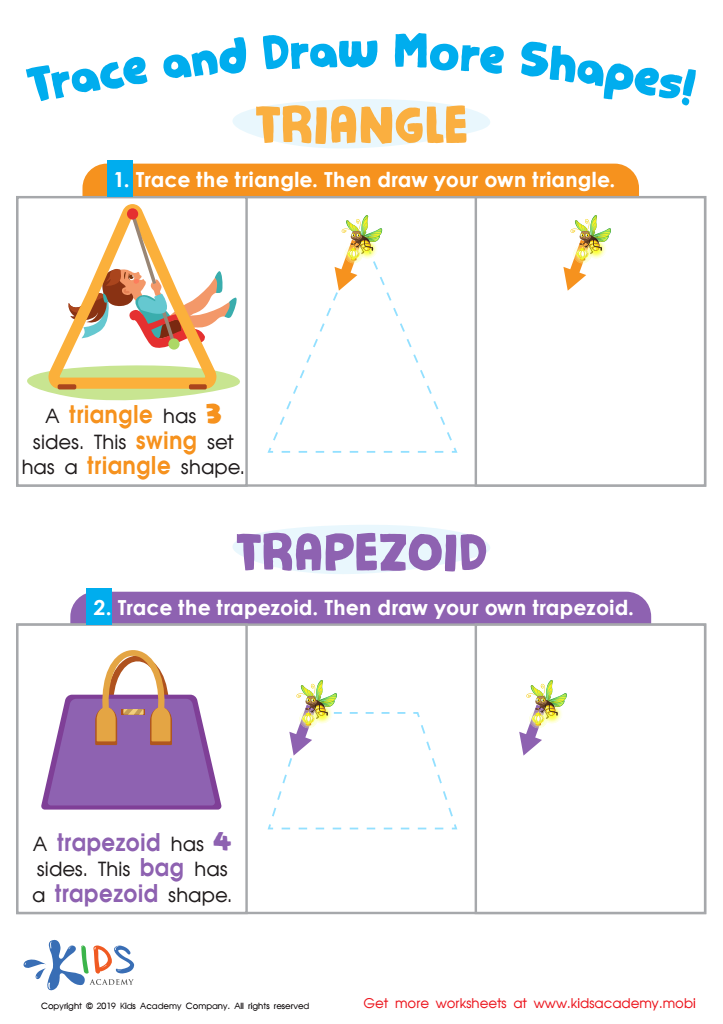
Trace and Draw More Shapes Worksheet
Help your kids with more learning! Look at images in the worksheet, read facts about the shapes, then help your kids trace and draw. This reinforces that learning is never done; use this simple worksheet to help your kids with school homework and more!
Trace and Draw More Shapes Worksheet
Worksheet
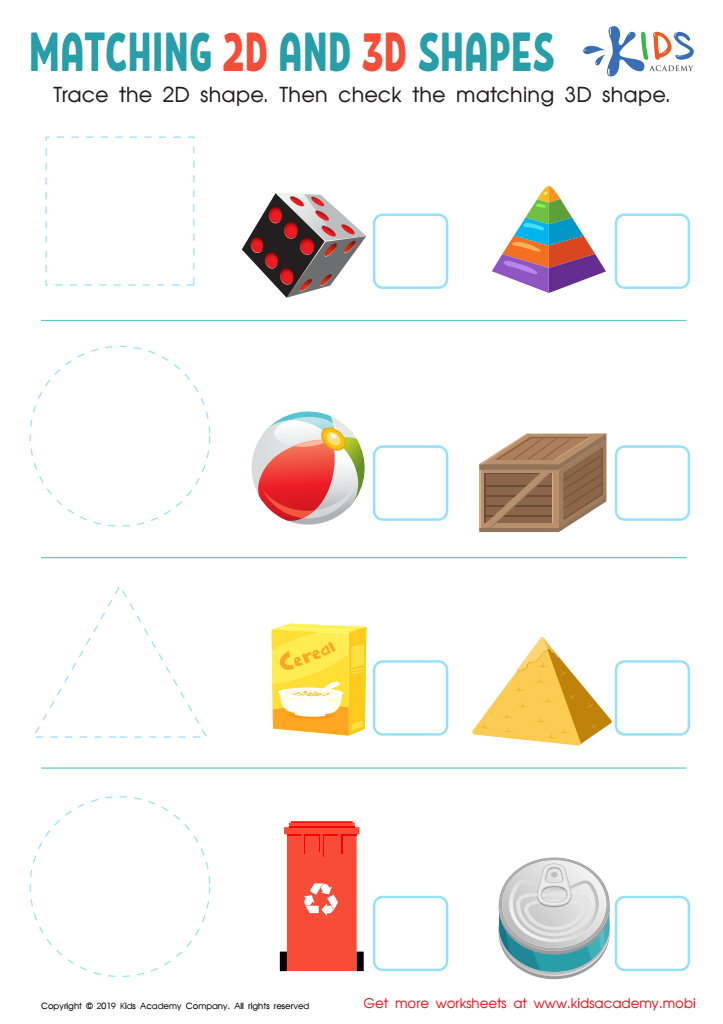
Matching 2D and 3D Shapes Worksheet
Before starting this worksheet, ask your kids what shapes they know and point out the 2D and 3D shapes on it. Help your kids trace the 2D shapes and then match them to the 3D versions. It'll be a fun new world for your kids to explore!
Matching 2D and 3D Shapes Worksheet
Worksheet
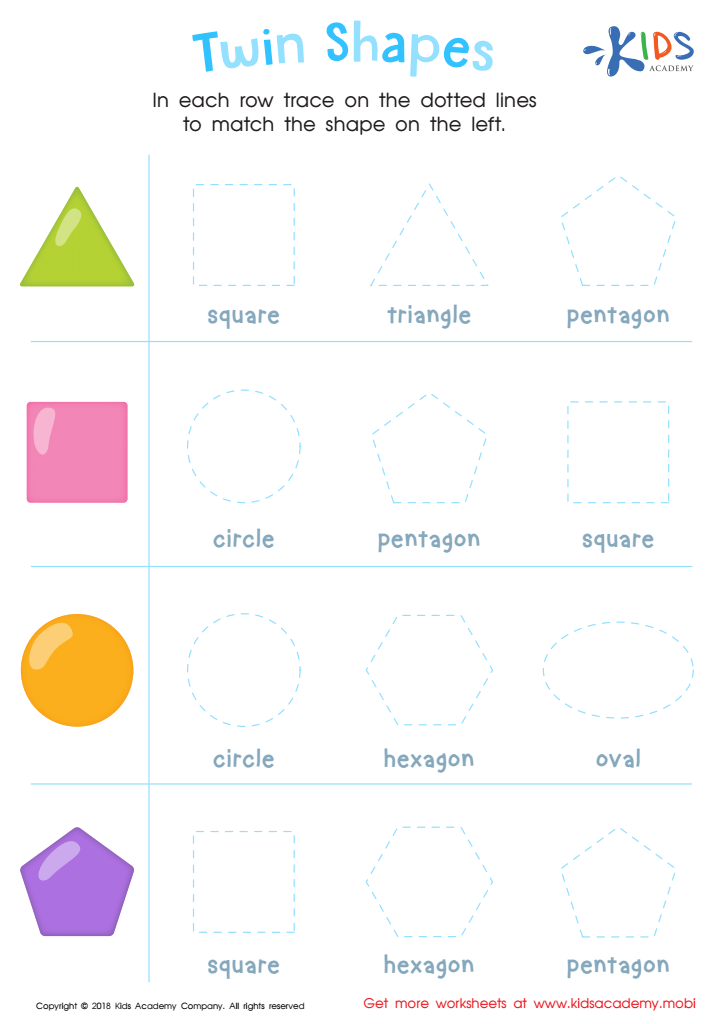
Twin Shapes Dot-to-Dot Worksheet
Test your child's ability to copy with this worksheet. Ask them to find and name the four shapes on the left. Then, they must match each with the dotted lines on the right. Help your child with all four shapes in this fun exercise.
Twin Shapes Dot-to-Dot Worksheet
Worksheet
Join Kids Academy for Free
Who is primarily going to use this learning content?








Extra Challenge Tracing Shapes worksheets for Ages 6-7 are a pivotal resource in the development of young learners. At this developmental stage, children are refining their fine motor skills, and these specially designed worksheets provide the perfect platform for practice. By engaging in tracing activities, children enhance their hand-eye coordination, which is crucial for tasks that range from writing to sports.
Moreover, the Extra Challenge Tracing Shapes worksheets are carefully tailored for children aged 6 to 7, ensuring that the activities are both age-appropriate and stimulating. This ensures that children are not only practicing essential skills but are also challenged in a way that promotes cognitive development. The intricate shapes and patterns are designed to keep children engaged, fostering a love for learning and an enthusiasm for tackling new challenges.
These worksheets are not just about tracing; they are a gateway to understanding geometric concepts and spatial awareness. By tracing various shapes, children begin to recognize and differentiate between them, laying a foundational understanding of geometry that will benefit them in their future mathematics learning.
In conclusion, Extra Challenge Tracing Shapes worksheets for Ages 6-7 are an invaluable tool in a child's learning arsenal. They combine skill development with fun, ensuring that children are both learning and enjoying the process. This balance is essential for fostering a positive learning environment and encouraging a lifelong love of learning.