
Extra Challenge Skip Counting Worksheets for 3-Year-Olds
2 filtered results
Difficulty Level
Grade
Age
-
From - To
Subject
Activity
Standards
Introducing our Extra Challenge Skip Counting worksheets, specially designed for the curious minds of 3-Year-Olds! These engaging and colorful worksheets are perfect for young learners ready to embark on their mathematical journey with a fun twist. Our carefully crafted activities encourage early numeracy skills, focusing on the foundational concept of skip counting. With each page, your child will explore numbers in a playful and stimulating environment, building confidence and critical thinking skills. Whether at home or on-the-go, our Extra Challenge Skip Counting for 3-Year-Olds worksheets are your child's perfect companion for an exciting educational adventure. Start the fun today!
Favorites
With answer key
Interactive
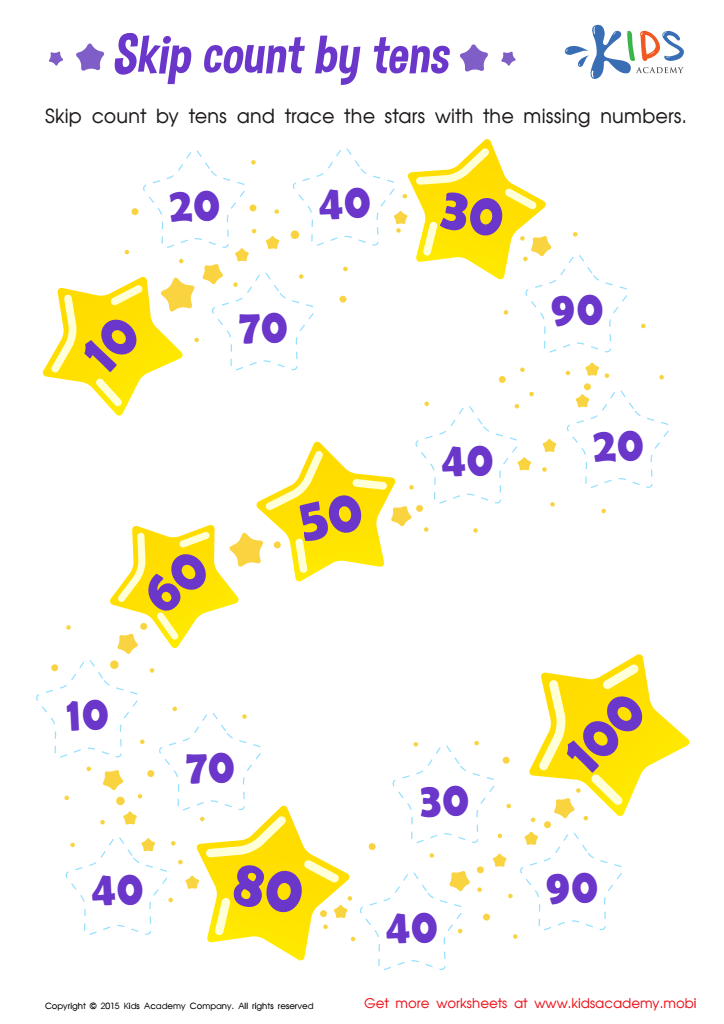
Learn dozens: Skip Count by Tens Printable
Follow a shooting star on an adventure of skip counting by 10s. Strengthen math skills with this fun and colorful worksheet. Kids will solve a puzzle, exercise logical reasoning and problem-solving skills. Get them ready for multiplication and division through increased skip counting abilities. Print this worksheet and take your star to the next level!
 Assign to My Students
Learn dozens: Skip Count by Tens Printable
Worksheet
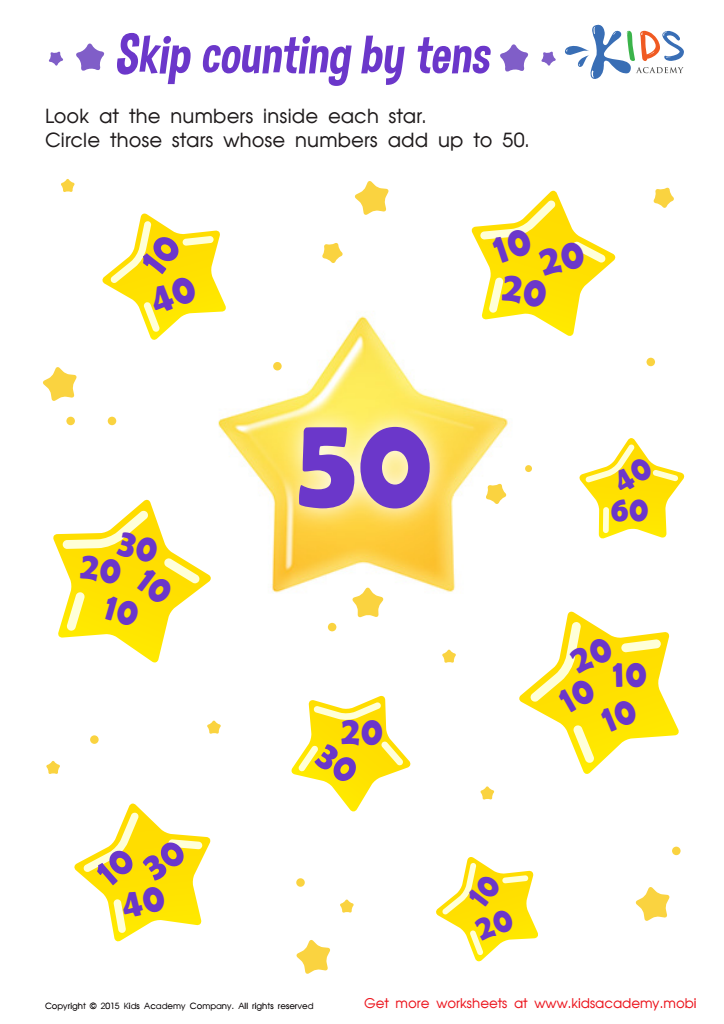
Learn Dozens: Skip Counting by Tens Printable
This skip counting by 10 worksheet helps kids strengthen fluency, practice addition & build number sense. They'll use problem-solving skills to find the correct answer, which is revealed by stars. This worksheet is a fun way to practice crucial foundational math skills.
Learn Dozens: Skip Counting by Tens Printable
Worksheet
Join Kids Academy for Free
Who is primarily going to use this learning content?


.jpg)





Extra Challenge Skip Counting worksheets for 3-Year-Olds are an incredibly resourceful tool for early childhood education. At this pivotal age, children are just beginning to grasp the fundamentals of numbers and counting. Incorporating Extra Challenge worksheets specifically tailored for skip counting enhances their learning curve, making it not only more engaging but also more effective.
Skip counting is a foundational skill that goes beyond simple number recognition and counting. It lays the groundwork for understanding more complex mathematical concepts such as multiplication and division. By introducing 3-year-olds to Extra Challenge Skip Counting worksheets, we're not just teaching them to count; we're opening their minds to patterns in numbers, enhancing their problem-solving skills, and boosting their memory recall.
Moreover, these worksheets are designed with 3-year-olds in mind, meaning they're created to be both fun and educational. The colorful illustrations and interactive elements keep young learners interested and motivated. Through repetition and practice, children quickly gain confidence in their counting abilities, fostering a love for learning from an early age.
In essence, Extra Challenge Skip Counting worksheets for 3-Year-Olds are a fantastic way of laying a strong mathematical foundation. They encourage curiosity, develop critical thinking skills, and prepare children for more advanced mathematical concepts, all while keeping learning enjoyable and accessible.








