Extra Challenge Tracing Shapes Worksheets for Ages 5-9
4 filtered results
Difficulty Level
Grade
Age
-
From - To
Subject
Activity
Standards
Discover our "Extra Challenge Tracing Shapes Worksheets" designed specifically for children aged 5-9. These engaging worksheets not only help young learners develop fine motor skills through tracing but also enhance their shape recognition and spatial awareness. With a variety of fun and challenging designs, kids can practice tracing circles, squares, triangles, and more, fostering their creativity and critical thinking. Perfect for at-home learning or classroom activities, these worksheets also support early math foundations. Watch your child's confidence soar as they master shapes with our interactive and educational resources! Ideal for parents and educators seeking to boost essential skills in a playful way.
Favorites
With answer key
Interactive
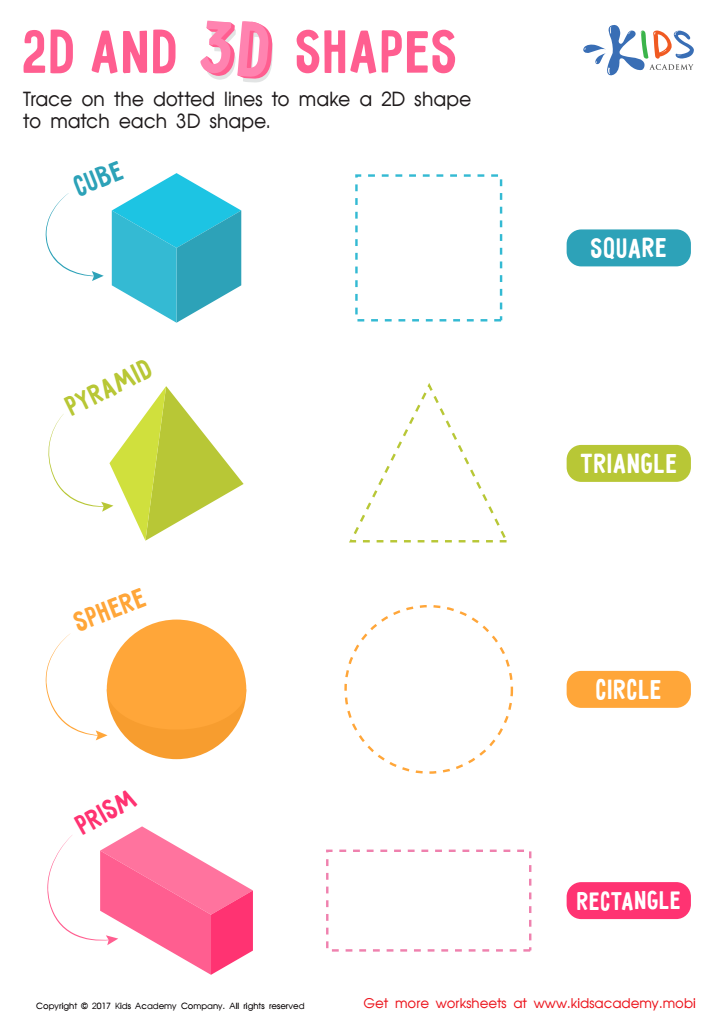
2D and 3D Shapes Worksheet
Introduce your child to 3D and 2D with this traceable worksheet. With dotted lines, help them trace and make a 2D shape for each 3D shape: square, triangle, rectangle, and circle. Show them there's more than one way to draw! You may have taken them to a 3D movie, or they've seen some fantastic 3D art. Now they can wonder no more.
 Assign to My Students
2D and 3D Shapes Worksheet
Worksheet
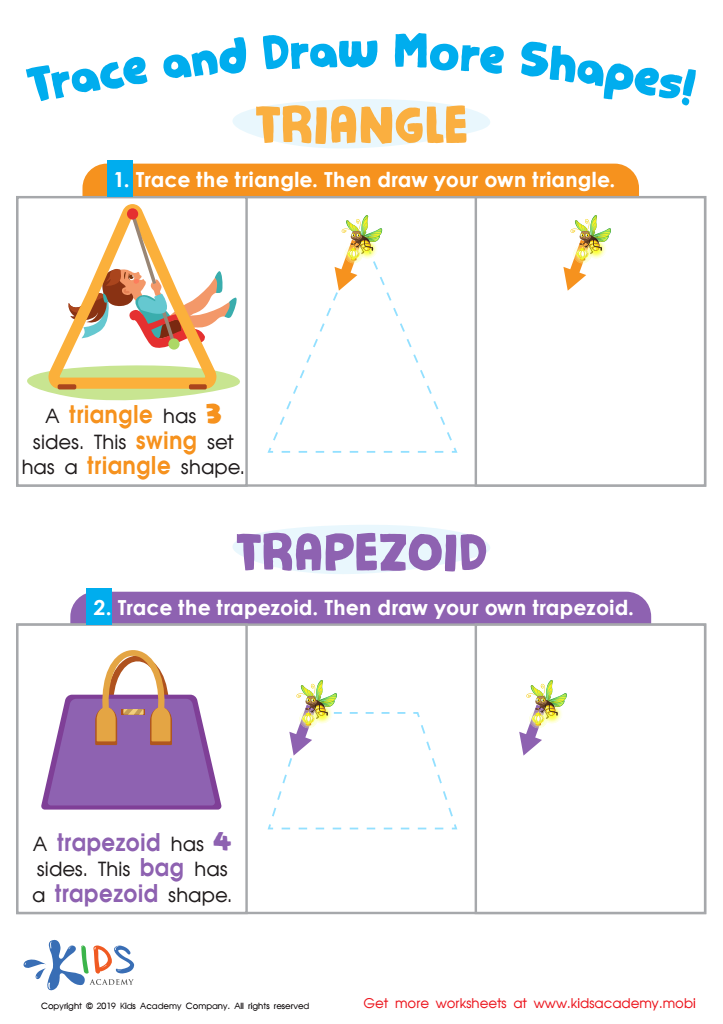
Trace and Draw More Shapes Worksheet
Help your kids with more learning! Look at images in the worksheet, read facts about the shapes, then help your kids trace and draw. This reinforces that learning is never done; use this simple worksheet to help your kids with school homework and more!
Trace and Draw More Shapes Worksheet
Worksheet
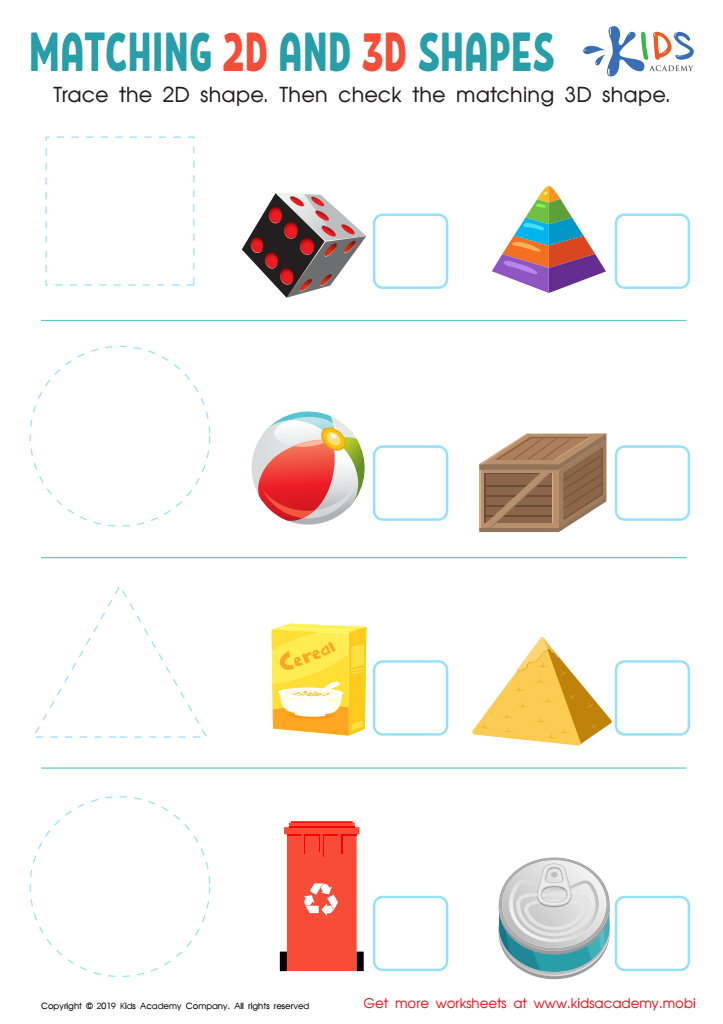
Matching 2D and 3D Shapes Worksheet
Before starting this worksheet, ask your kids what shapes they know and point out the 2D and 3D shapes on it. Help your kids trace the 2D shapes and then match them to the 3D versions. It'll be a fun new world for your kids to explore!
Matching 2D and 3D Shapes Worksheet
Worksheet
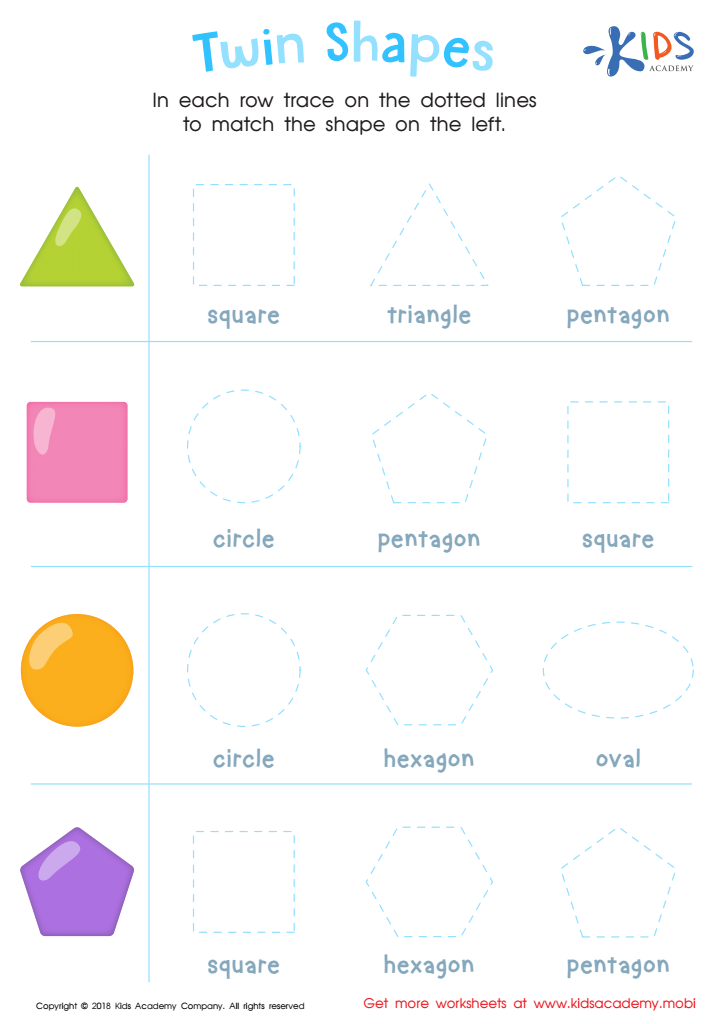
Twin Shapes Dot-to-Dot Worksheet
Test your child's ability to copy with this worksheet. Ask them to find and name the four shapes on the left. Then, they must match each with the dotted lines on the right. Help your child with all four shapes in this fun exercise.
Twin Shapes Dot-to-Dot Worksheet
Worksheet
Join Kids Academy for Free
Who is primarily going to use this learning content?








Extra Challenge Tracing Shapes for Ages 5-9 is an invaluable resource for parents and teachers dedicated to developing essential skills in young learners. At this crucial developmental stage, children are not only enhancing their hand-eye coordination but also building fine motor skills that are foundational for future tasks like writing and drawing. Tracing shapes helps them understand basic geometric forms, which are essential building blocks for more complex mathematical concepts later on.
Furthermore, shape tracing promotes cognitive development by encouraging pattern recognition, spatial awareness, and critical thinking as children learn to identify and differentiate between shapes. Engaging in tracing activities enhances concentration and encourages a sense of accomplishment, boosting self-esteem as they see their progress.
Additionally, this activity can serve as an effective bridge to integration with other subjects, laying the groundwork for lessons in art, math, and science. Parents and teachers can engage children in discussions about shapes in real-world contexts, reinforcing their learning. Ultimately, the Extra Challenge Tracing Shapes not only supports academic growth but also helps in developing creative problem solvers, ensuring children are well-prepared for the complexities of future learning. Investing time in these activities is an investment in a child’s holistic development.