Filters

2423 filtered results

Clear all filters
Favorites
With answer key
Interactive

2423 filtered results

Difficulty Level

Grade


Check out this FREE Trial Lesson for age 5-7!

Addition with Arrays - Part 1

Favorites
With answer key
Interactive
  • 5-7
  • Interactive
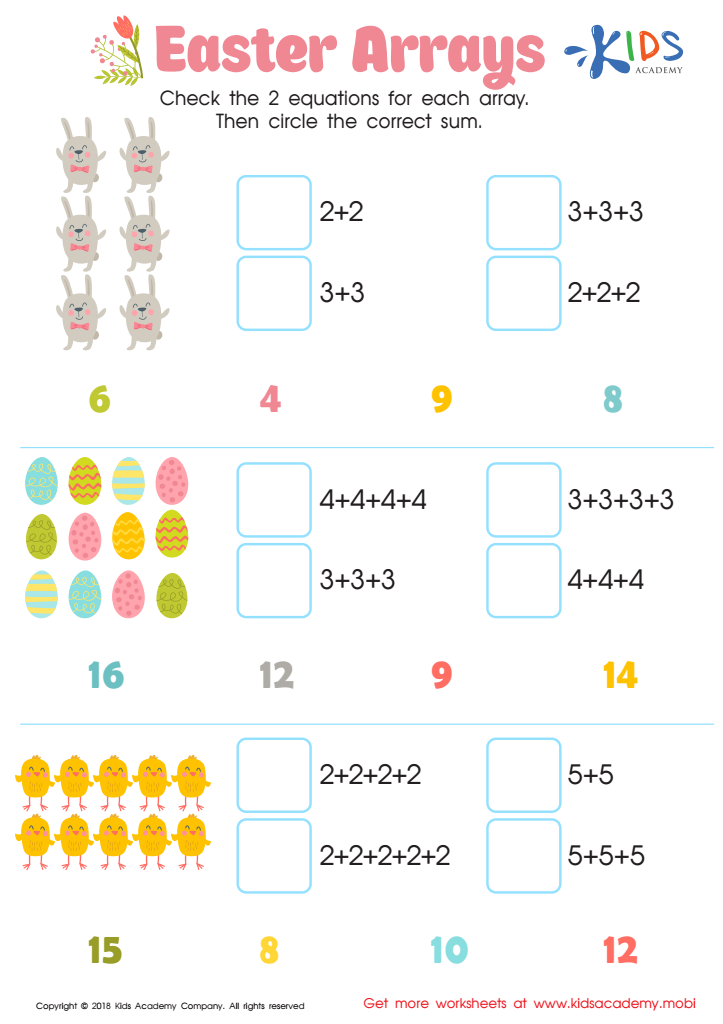
Easter Arrays Worksheet

Easter Arrays Worksheet

Does your child love Easter? Do they adore the Easter bunny and egg hunts? Help them have fun with this worksheet! Go through it with them and check the equations for each array. Then, have them circle the correct sum. It's a great way to make the holiday extra exciting!
Easter Arrays Worksheet
Worksheet
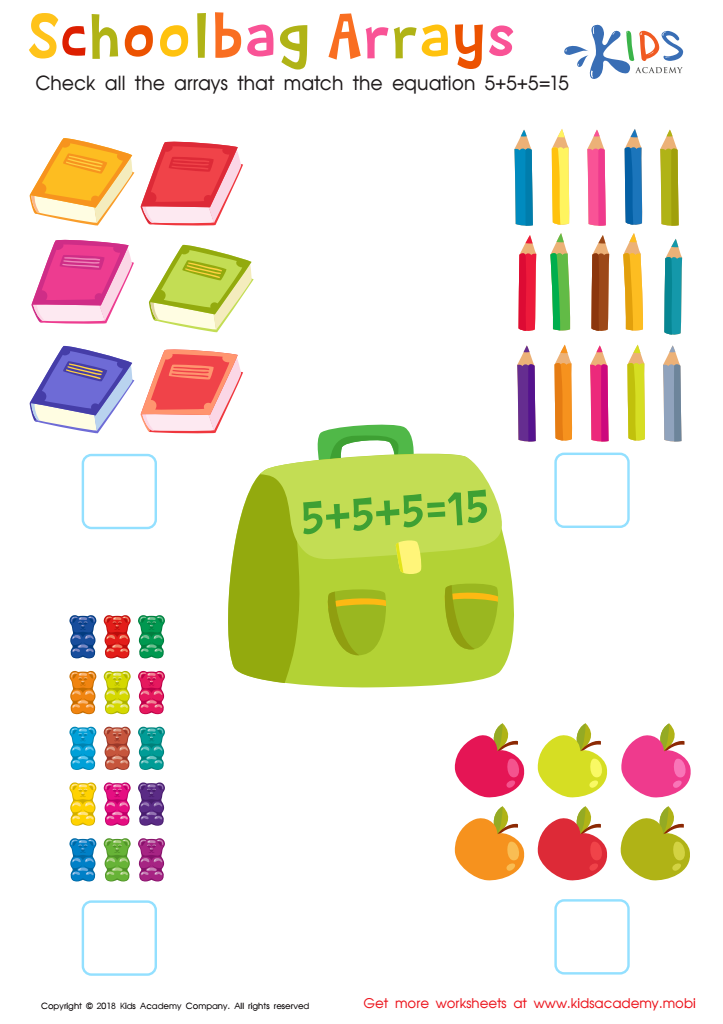
Schoolbag Arrays Worksheet
Schoolbag Arrays Worksheet

Help your child spot the correct arrays in this worksheet: having them count the items in each and check the boxes for the ones with 15 objects. Ask them to differentiate between rows and columns and explain which ones match the equation 5+5+5=15.
Schoolbag Arrays Worksheet
Worksheet
Arrays and Equations Worksheet

Arrays and Equations Worksheet

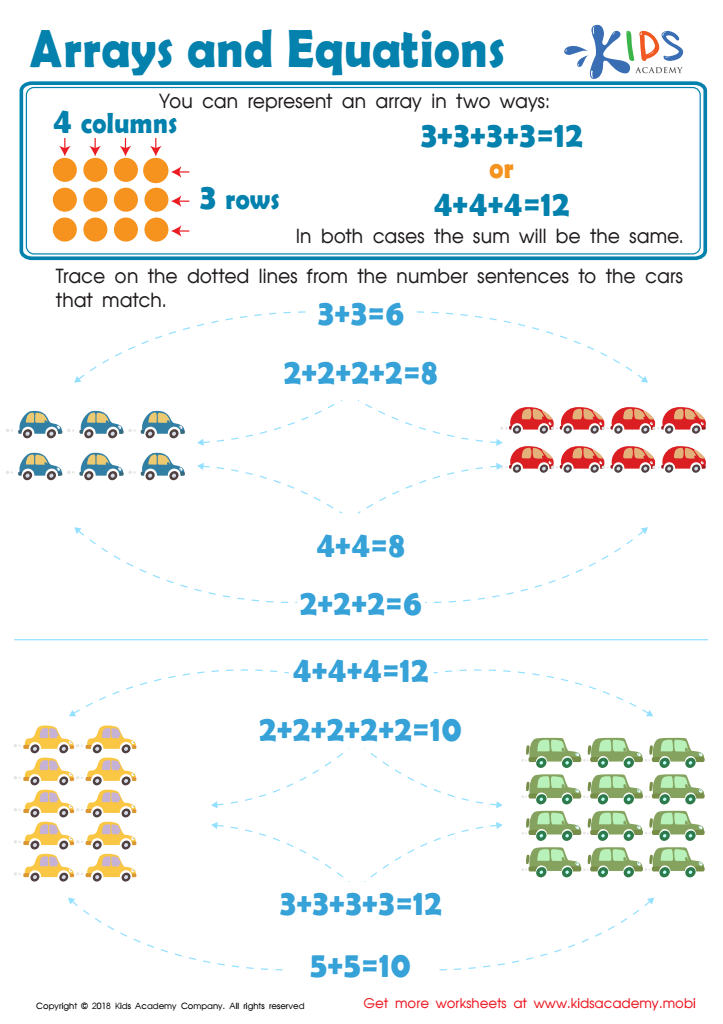
An array is objects, pix, or numbers organized in rows and columns. Show kids two ways to interpret this: 3 rows in 4 places = 12 and 4 columns in 3 places = 12. Help your child trace the number sentences to the matching cars. All equations always add up to the same amount.
Arrays and Equations Worksheet
Worksheet
Representing Arrays with Number Sentences Worksheet

Representing Arrays with Number Sentences Worksheet

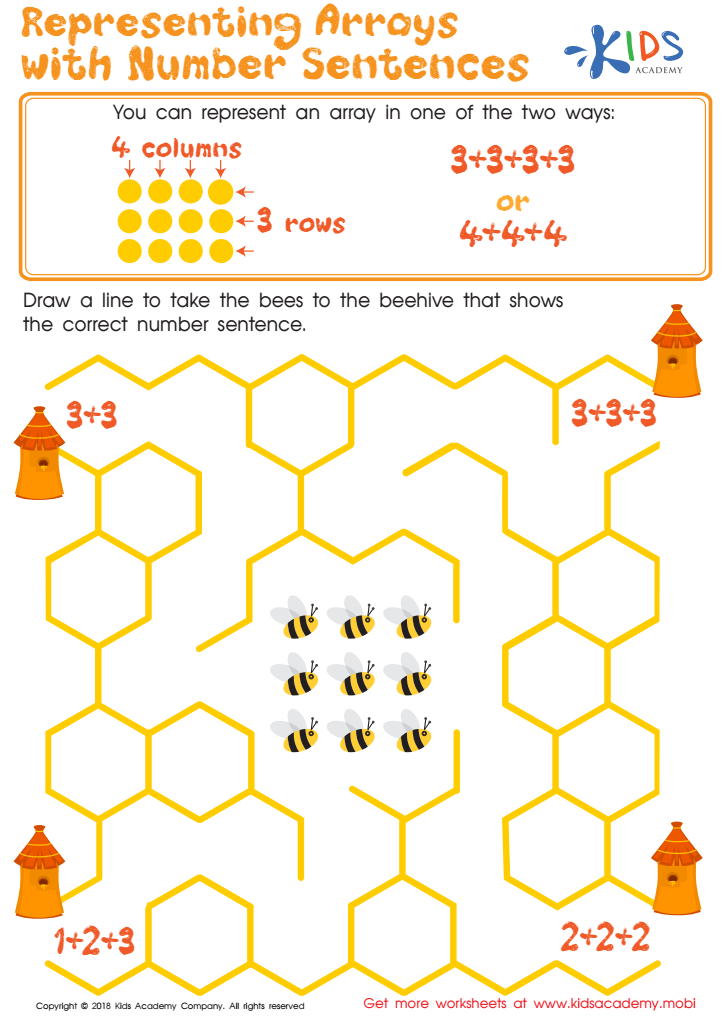
An array is a collection of objects, pictures or numbers arranged in rows and columns. Teach your kids two ways to interpret an array with this fun worksheet. Represent it in terms of rows or columns then have your student draw a line to the beehive to discover the correct number sentence.
Representing Arrays with Number Sentences Worksheet
Worksheet
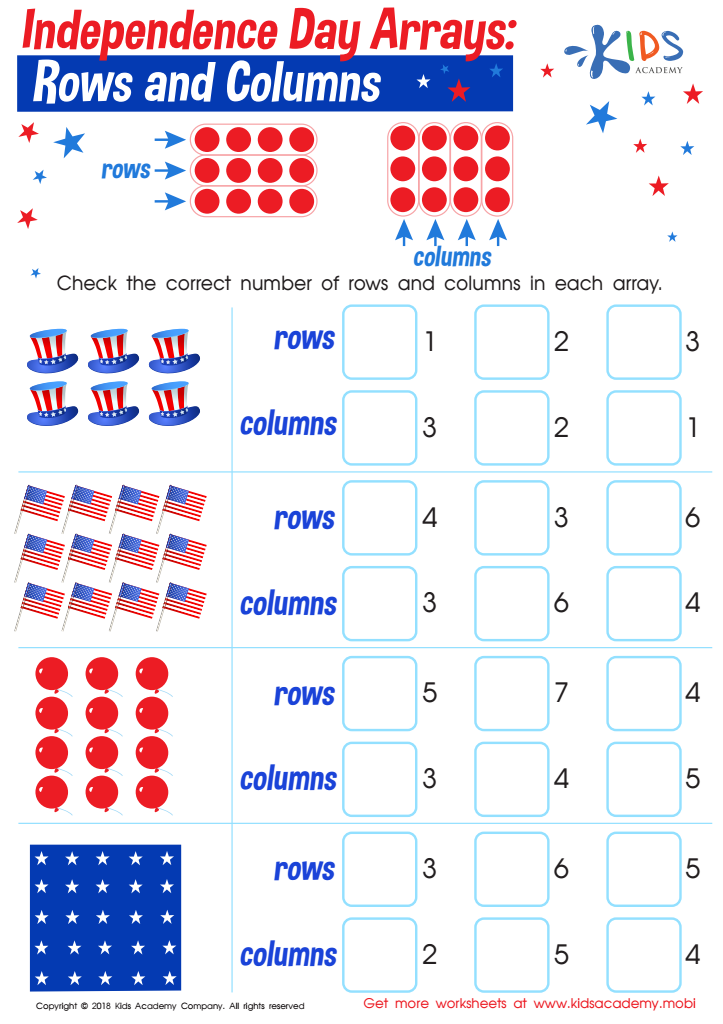
Independence Day Arrays: Rows and Columns Worksheet

Independence Day Arrays: Rows and Columns Worksheet

Does your child know when Independence Day is? They might love the family picnics and fireworks, or they may not understand the significance of the holiday. After this worksheet, they'll comprehend it better. Help them look at the images and count the number of rows and columns in each array.
Independence Day Arrays: Rows and Columns Worksheet
Worksheet
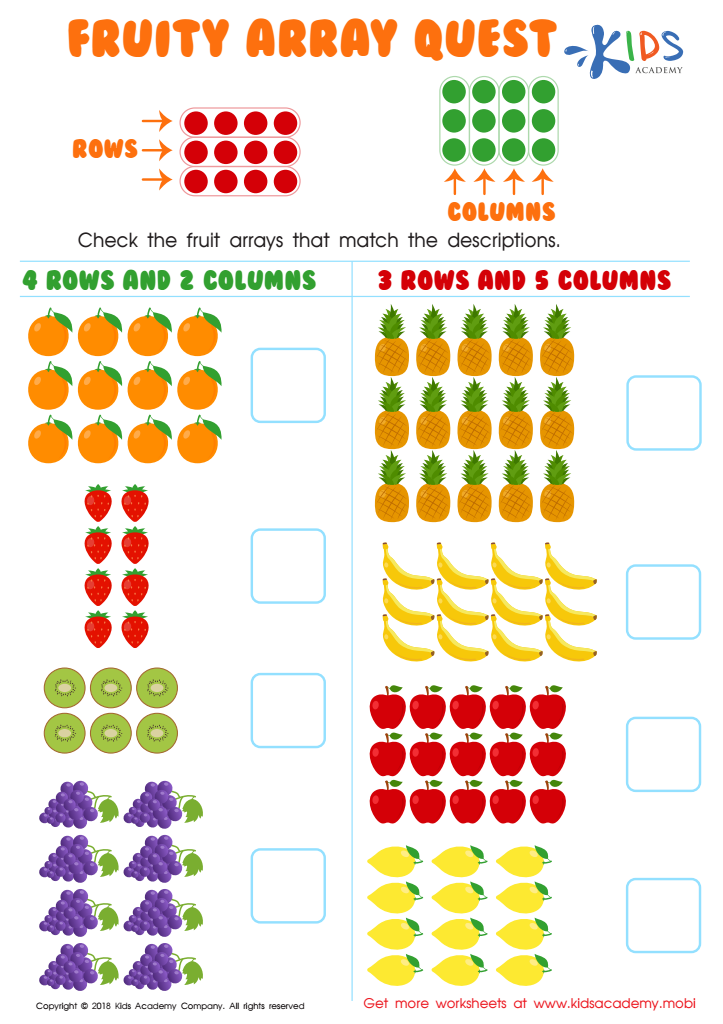
Fruity Array Quest Worksheet

Fruity Array Quest Worksheet

Explain rows (horizontal) and columns (vertical) to your child before starting the worksheet. Show them the picture and the arrows indicating direction. Your child should be able to answer the questions easily after that. Help them match the fruit arrays that match the descriptions.
Fruity Array Quest Worksheet
Worksheet
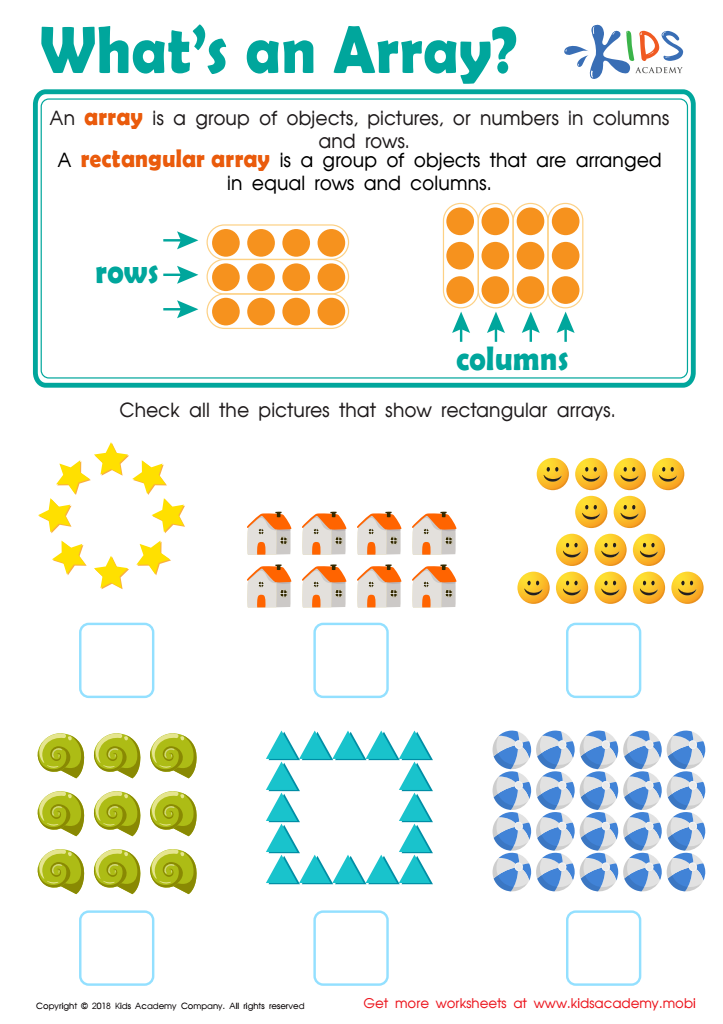
What's an Array? Worksheet

What's an Array? Worksheet

Explain to your child that an array is a group of objects, pictures, or numbers in columns and rows. Show them a rectangular array is a group of objects in equal rows and columns. Guide them to check the pictures in the worksheet to spot any rectangular arrays. Help them remember this concept.
What's an Array? Worksheet
Worksheet
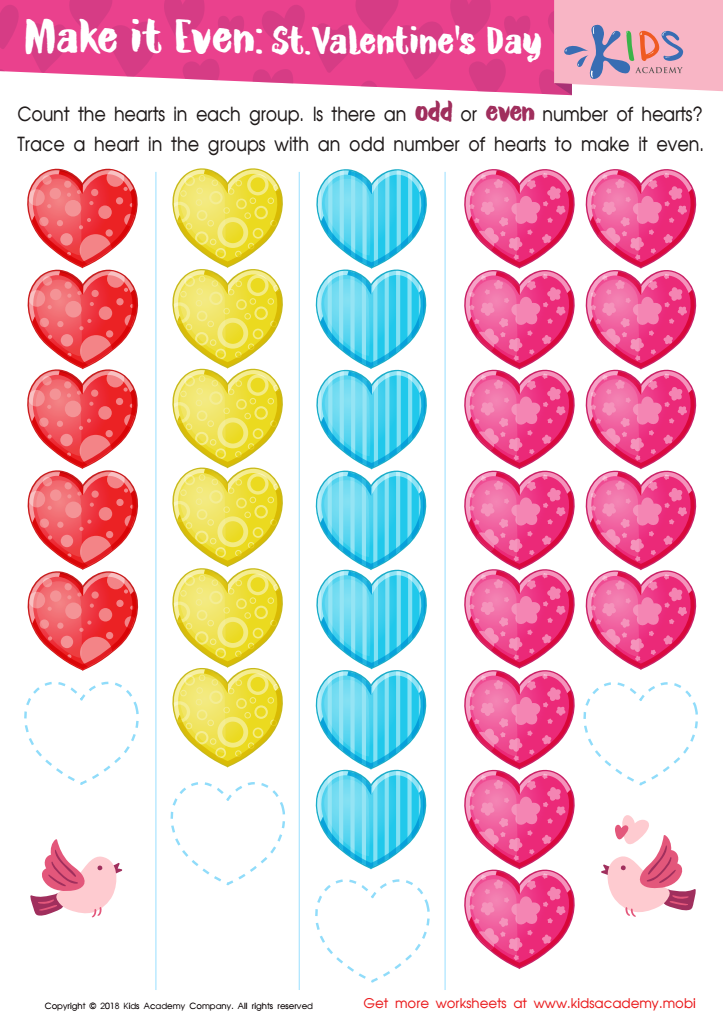
Make it Even: St. Valentine's Day Worksheet

Make it Even: St. Valentine's Day Worksheet

Does your child love Valentine's Day? Make it special with this worksheet! Kids can use their counting skills to determine if each group has an even or odd number of hearts, then trace a heart in the odd groups. Help them make it even and have fun!
Make it Even: St. Valentine's Day Worksheet
Worksheet
Counting Birds Worksheet

Counting Birds Worksheet

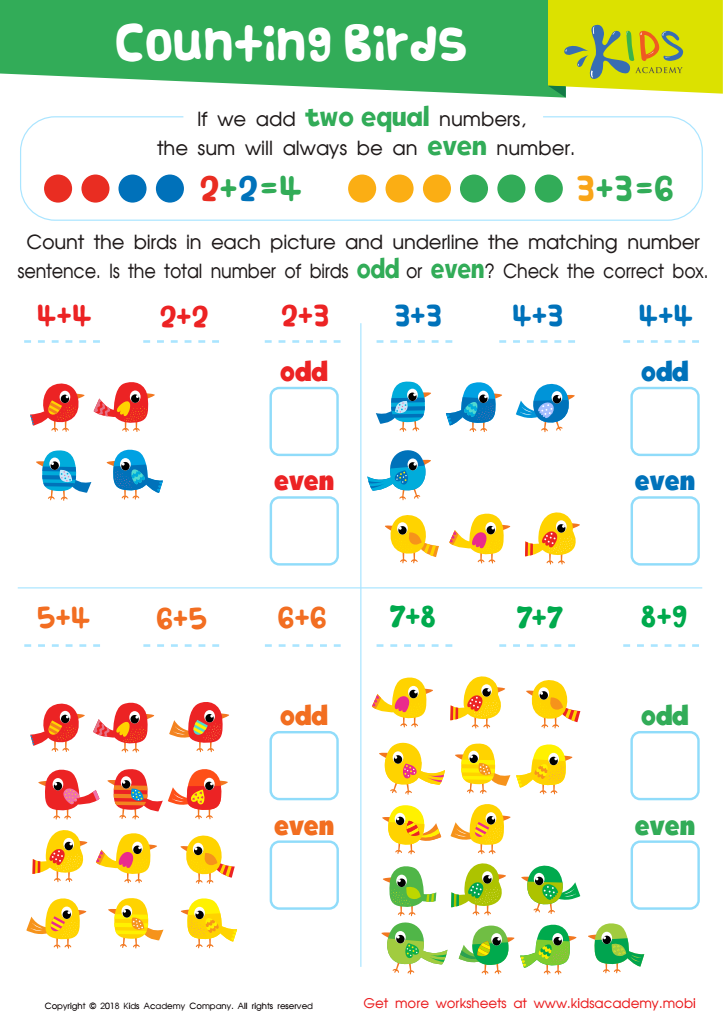
Help your child count and underline the matching number sentence in the worksheet. Ask them if the total number of birds in each picture is odd or even, then check the correct box. When two equal numbers are added, the sum is always an even number (e.g. 2+2=4, 4+4=8, both divisible by 2).
Counting Birds Worksheet
Worksheet
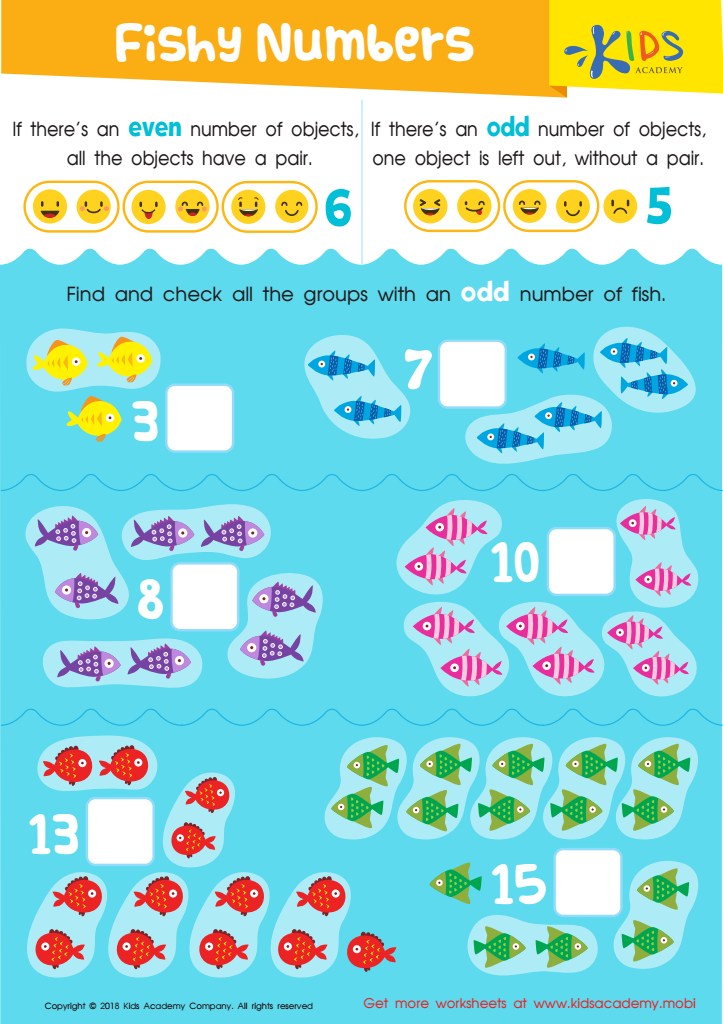
Fishy Numbers Worksheet

Fishy Numbers Worksheet

Explain to your kids even and odd numbers using this worksheet. All objects in a group of even numbers can be paired in twos, while an odd number leaves one object unpaired. Ask your students to find and check the groups with an odd number of fish, counting and figuring out which ones are odd.
Fishy Numbers Worksheet
Worksheet
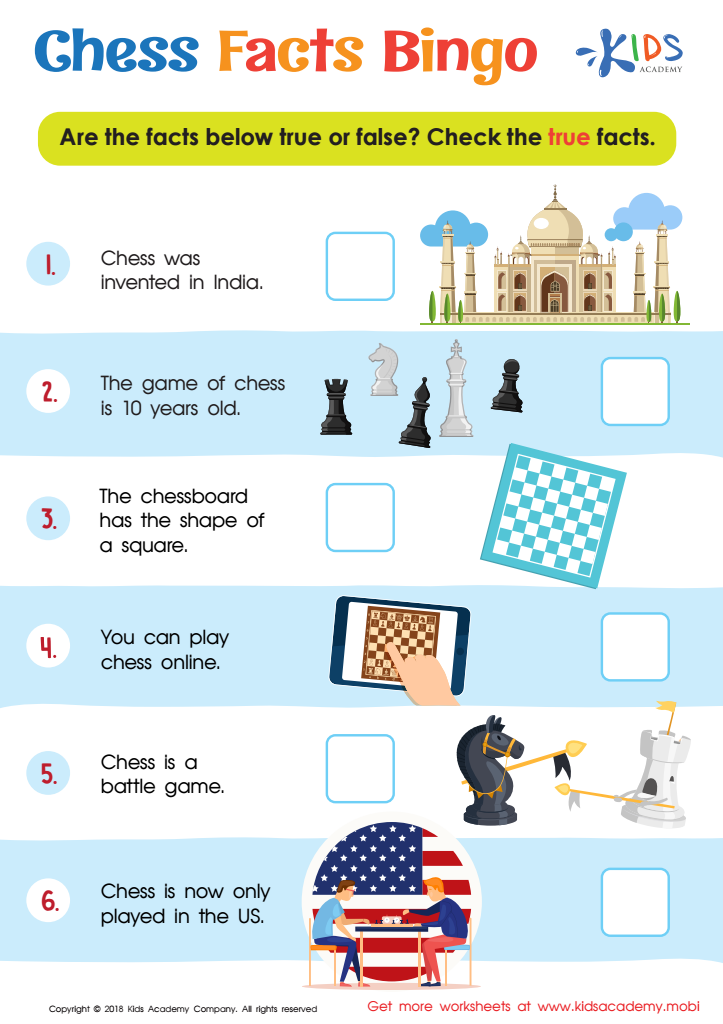
Chess Facts Bingo Worksheet

Chess Facts Bingo Worksheet

Help your child assess their knowledge of chess with our simple worksheet. It contains six questions; read them to your child and ask them if the statements are true or false. Once they check the boxes for the true statements, you'll have a better understanding of their understanding of the game.
Chess Facts Bingo Worksheet
Worksheet
Chess Manners Worksheet

Chess Manners Worksheet

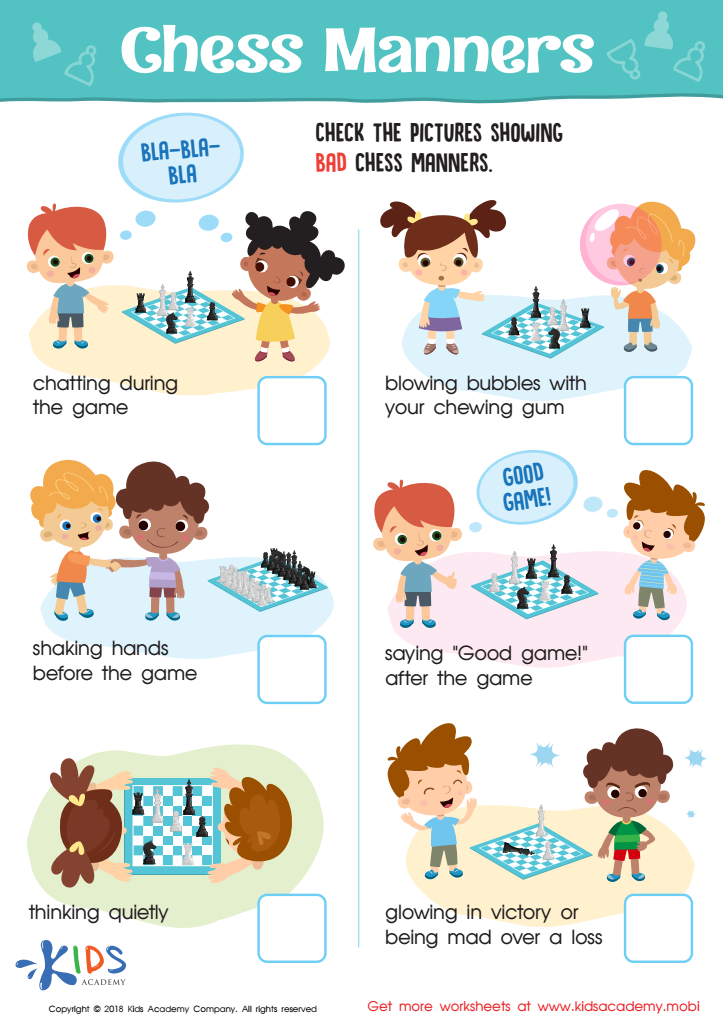
Teach your child chess manners in addition to table and social ones. Chess has clear rules and etiquette which must be followed for a proper game. Review this worksheet with your kid and discuss the pictures that show inappropriate behaviours. This will help them understand how to play the game correctly and with good manners.
Chess Manners Worksheet
Worksheet
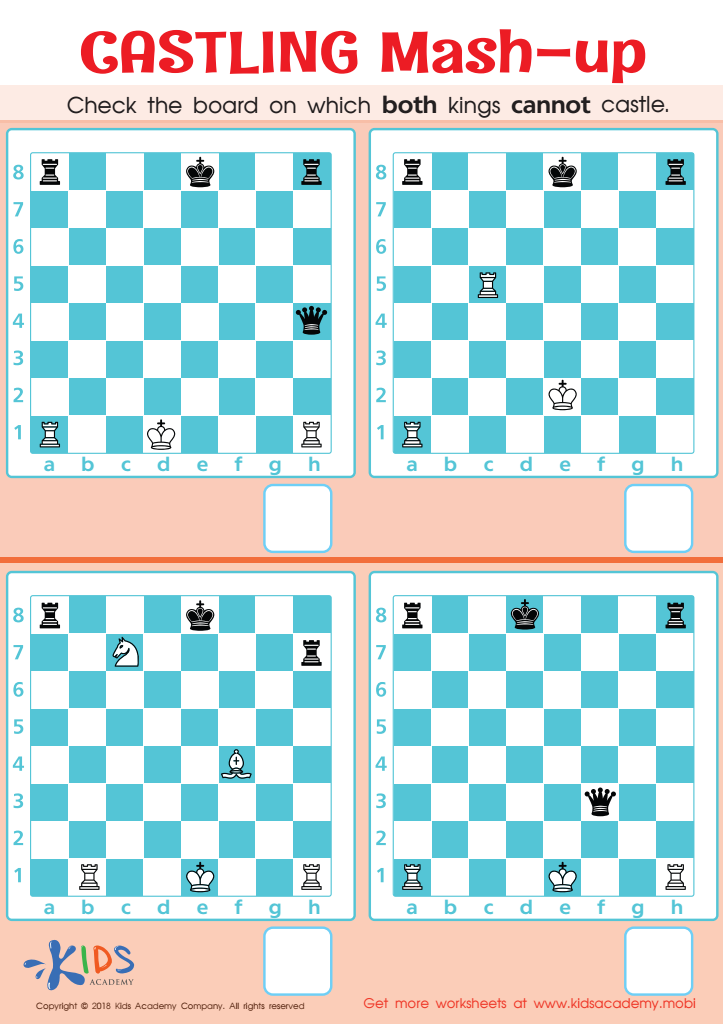
Castling Mash–up Worksheet

Castling Mash–up Worksheet

Before starting the worksheet, ensure your child understands castling in chess. If not, take time to explain it. Once they have a clear grasp of the rules, help them complete the exercise. Check the board to ensure that neither king can castle.
Castling Mash–up Worksheet
Worksheet
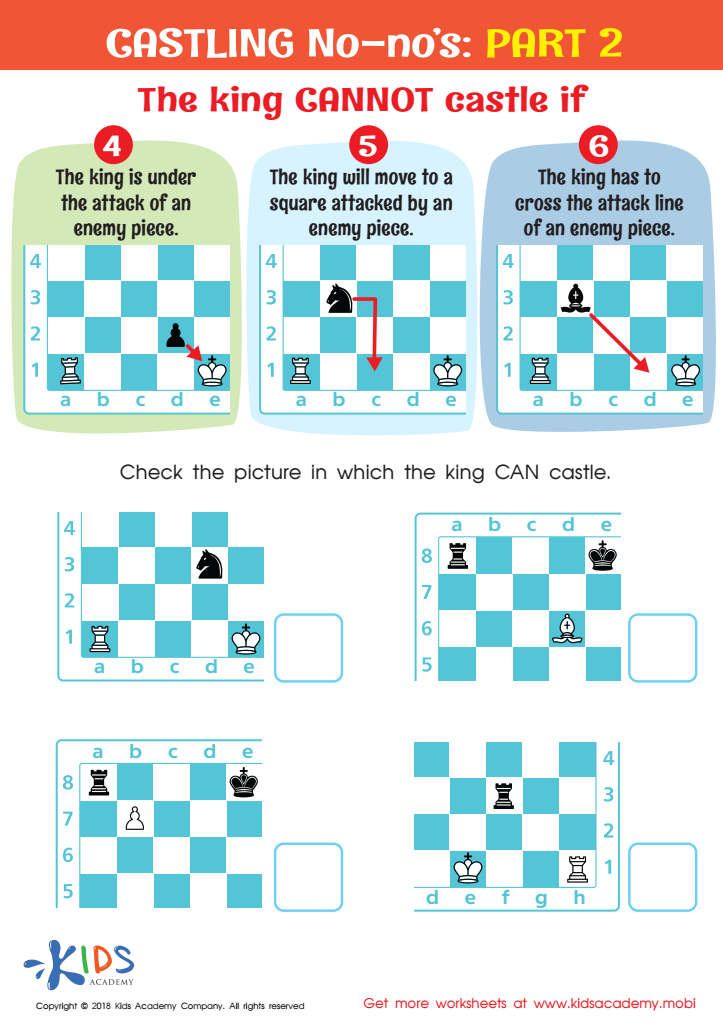
Castling No - no's: Part 2 Worksheet

Castling No - no's: Part 2 Worksheet

Teach your child the rules of castling: no castling if the king is under attack or will move onto an attacked square, or cross an attack line. To prepare for a game of chess, help your child complete the exercise of identifying when the king can castle – check the pictures.
Castling No - no's: Part 2 Worksheet
Worksheet
Castling: Protecting the King Worksheet

Castling: Protecting the King Worksheet

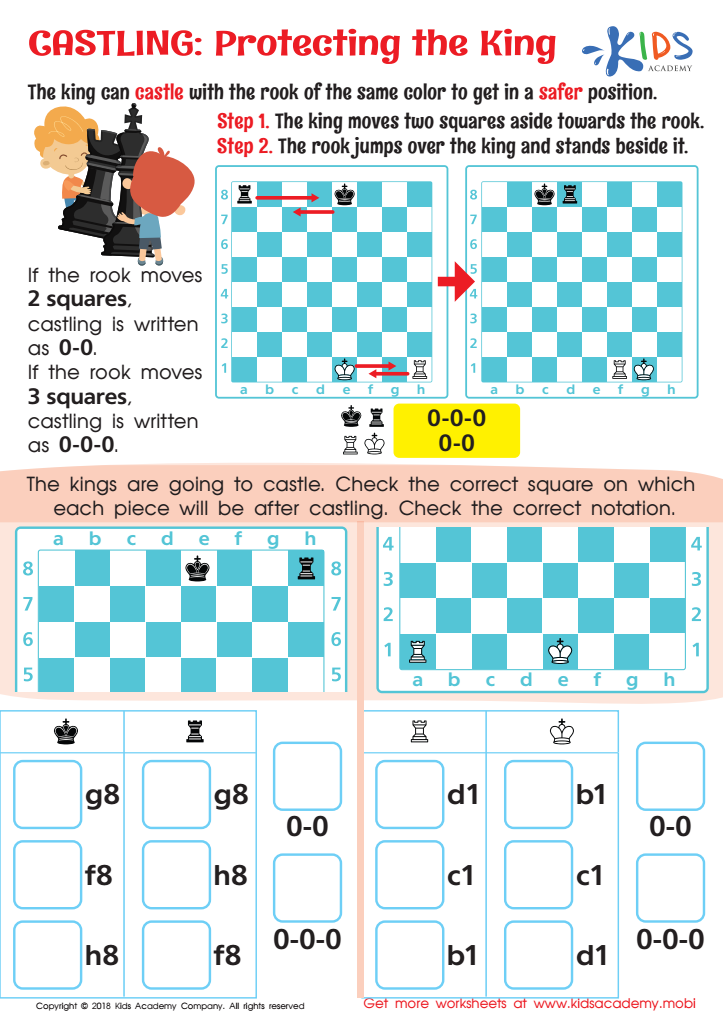
Castle your king with the rook to get into a safer position! Write 0-0 for a two-square move, or 0-0-0 for a three-square move. Look at the worksheet with your child; on the first chessboard, the king has moved two squares and the rook is beside it. On the second, the rook has jumped over the king. Let your child use their castling knowledge to answer the questions in the easy pdf.
Castling: Protecting the King Worksheet
Worksheet
Castling No–no's: Part 1 Worksheet

Castling No–no's: Part 1 Worksheet

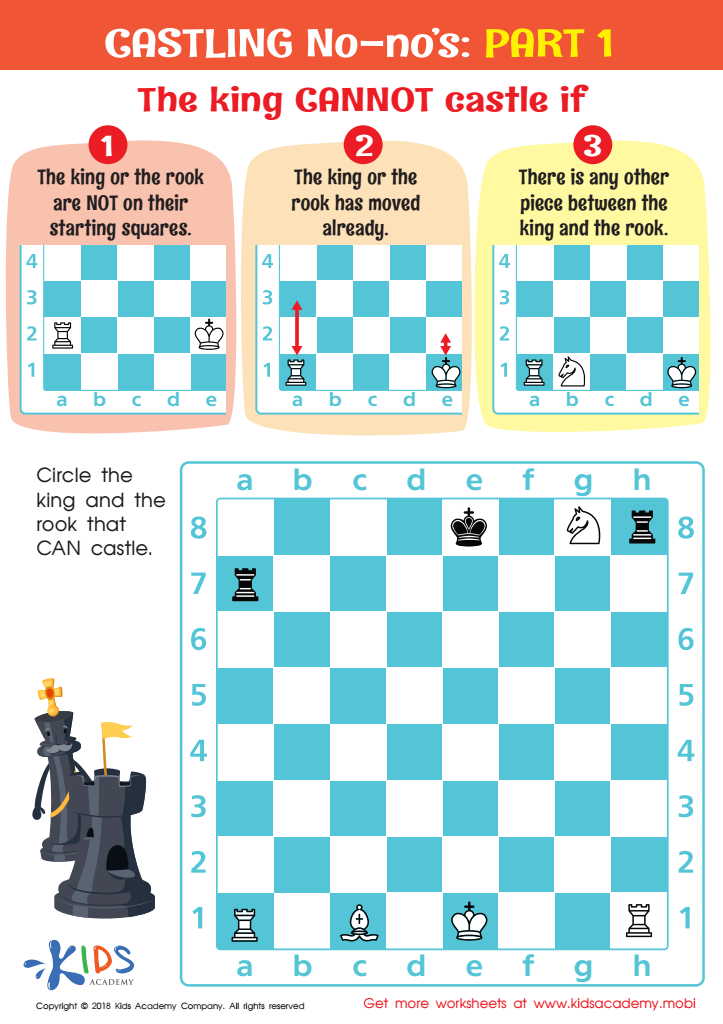
Help your child learn how to play chess by using this worksheet. Ask them to circle the king and rook that can castle in the picture. Explain that a king cannot castle if the king or rook has moved, or if there is any other piece between them. Knowing these rules will make playing a lot easier!
Castling No–no's: Part 1 Worksheet
Worksheet
Notation Quest Worksheet

Notation Quest Worksheet

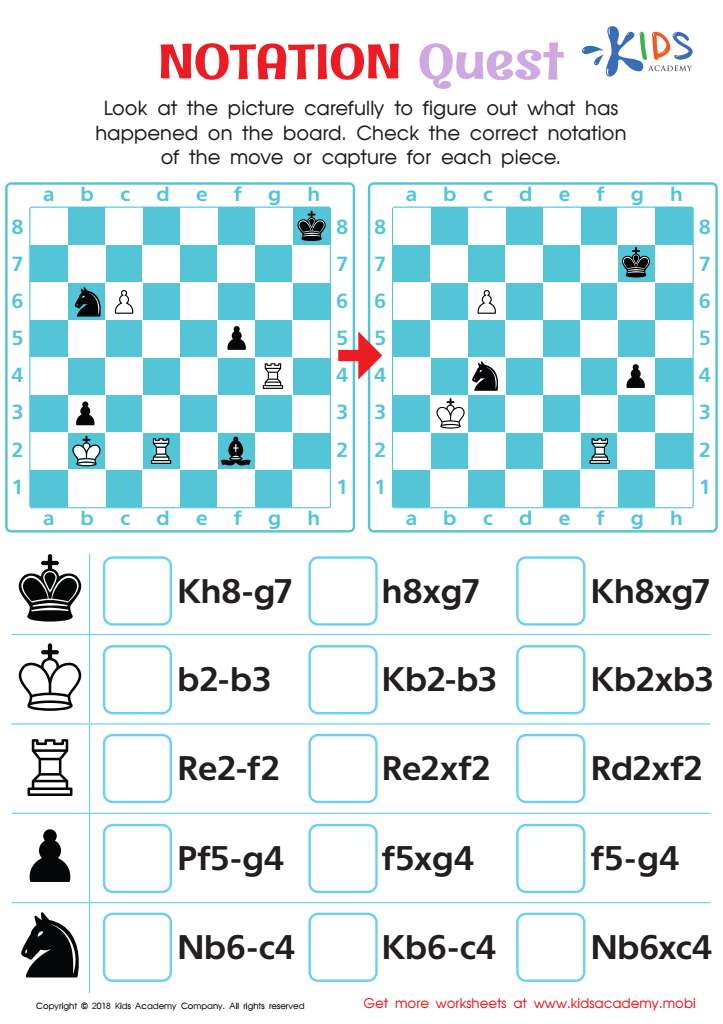
Examine the two chess boards with your kids. On one, chess pieces haven't moved; on the other, pieces have captured each other. Get your child to note the moves and captures with this simple worksheet.
Notation Quest Worksheet
Worksheet
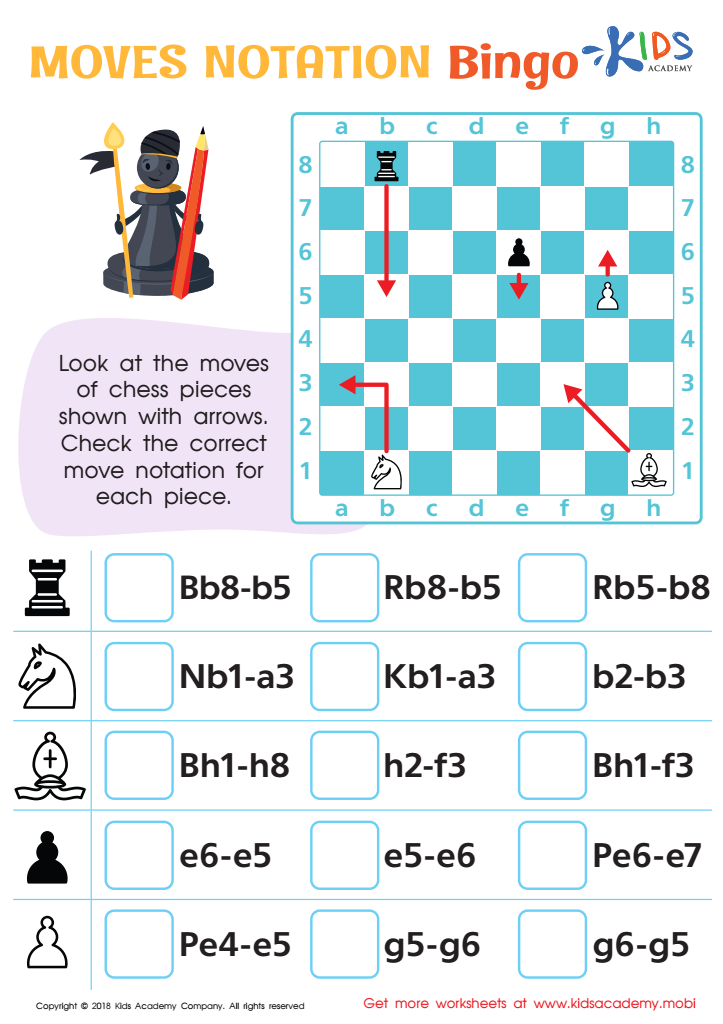
Moves Notation Bingo Worksheet

Moves Notation Bingo Worksheet

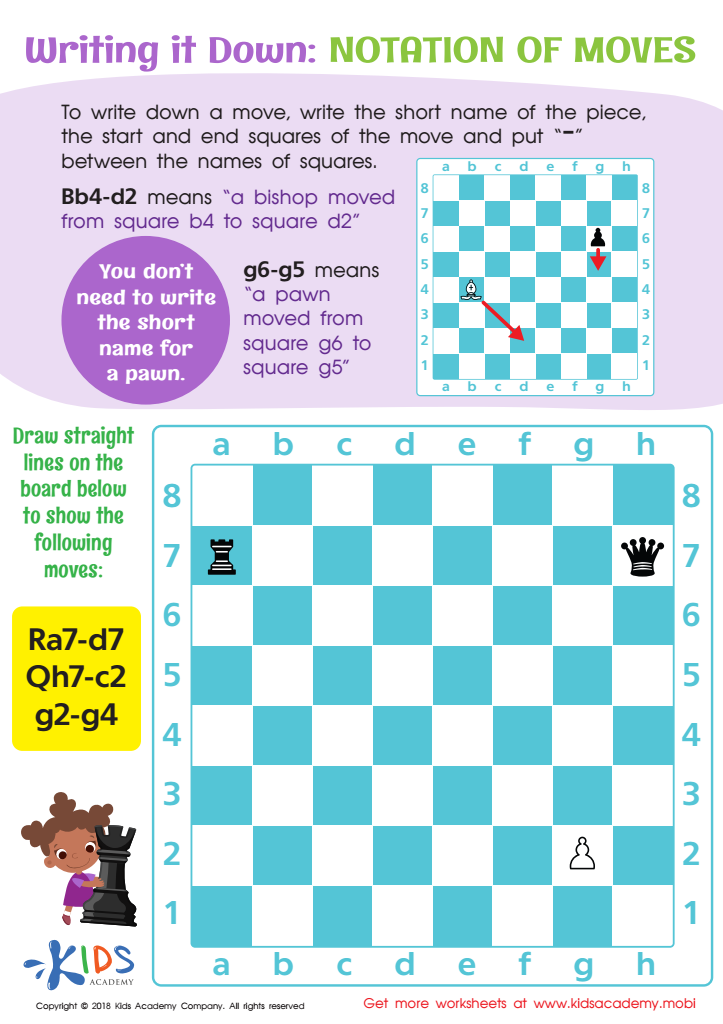
Test your child's chess notation skills with this simple worksheet. Download the PDF which shows a chess board and arrows pointing to pieces. Ask your child to identify the moves and note them down correctly. The notations needed are for bishop, pawn, rook and knight. Up to 80 words.
Moves Notation Bingo Worksheet
Worksheet
Notation of Moves Writing it Down Worksheet

Notation of Moves Writing it Down Worksheet

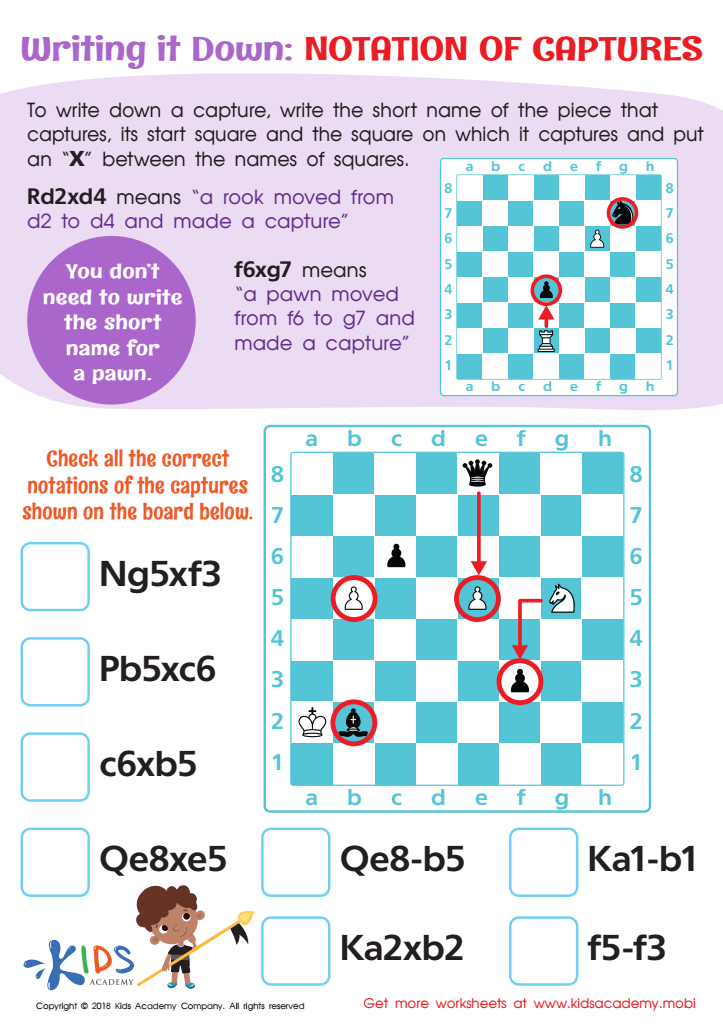
Notating chess moves can be tricky for kids to learn. This worksheet will help them better understand it. To notate a move, write the piece's short name, start and end squares, and separate them with a "-". For instance, Bd4-d2 means a bishop moved from b4 to d2. No need to write pawns' short names.
Notation of Moves Writing it Down Worksheet
Worksheet
Notation of Captures Writing it Down Worksheet

Notation of Captures Writing it Down Worksheet

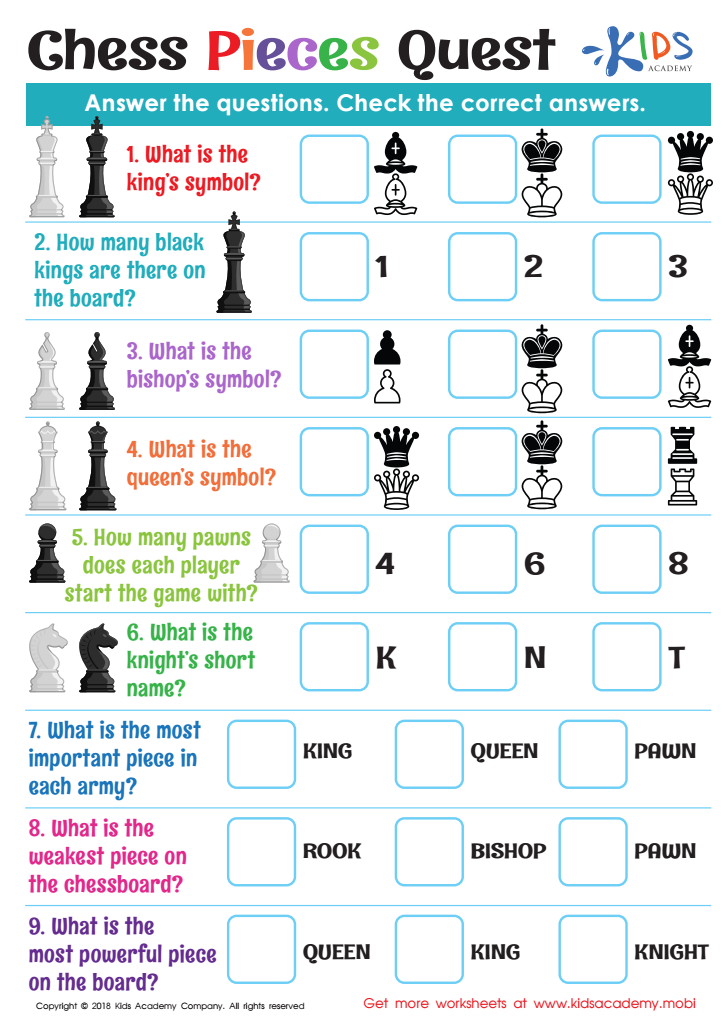
To teach students how to record captures in chess, use this worksheet. Write down the piece's short name, start sq., and the sq. where it captures, separating them with an X. For example, Rd2Xd4 means a rook moved d2 to d4 and took a piece. Pawn captures don't need a name.
Notation of Captures Writing it Down Worksheet
Worksheet
Chess Pieces Quest Worksheet

Chess Pieces Quest Worksheet

Help your child prepare for the chess quest by refreshing their knowledge of the symbols and characteristics of each chess piece. Then, have them try the 9 questions on this worksheet. These questions will assess their understanding of the symbols and how many pieces each player starts with.
Chess Pieces Quest Worksheet
Worksheet
What's My Name? Worksheet

What's My Name? Worksheet

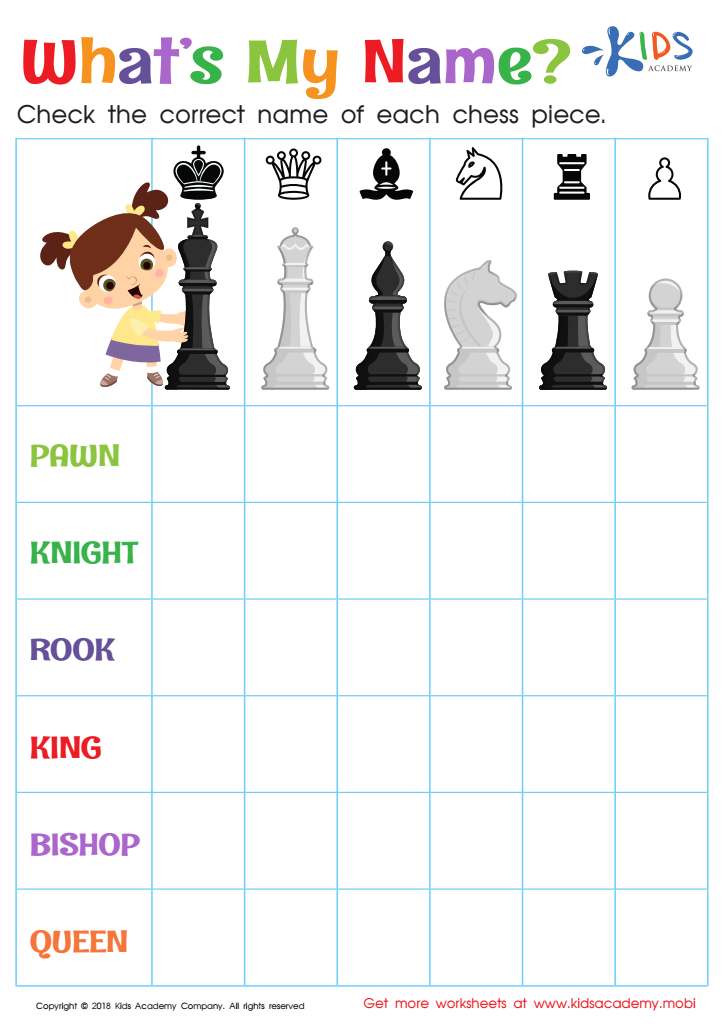
Test your child's chess knowledge with this colorful worksheet! There are six pieces lined up with names underneath. Ask your child to name each piece, then check if it's correct. Help them succeed by brushing up on the different pieces and their names.
What's My Name? Worksheet
Worksheet
Rook and Bishop Worksheet

Rook and Bishop Worksheet
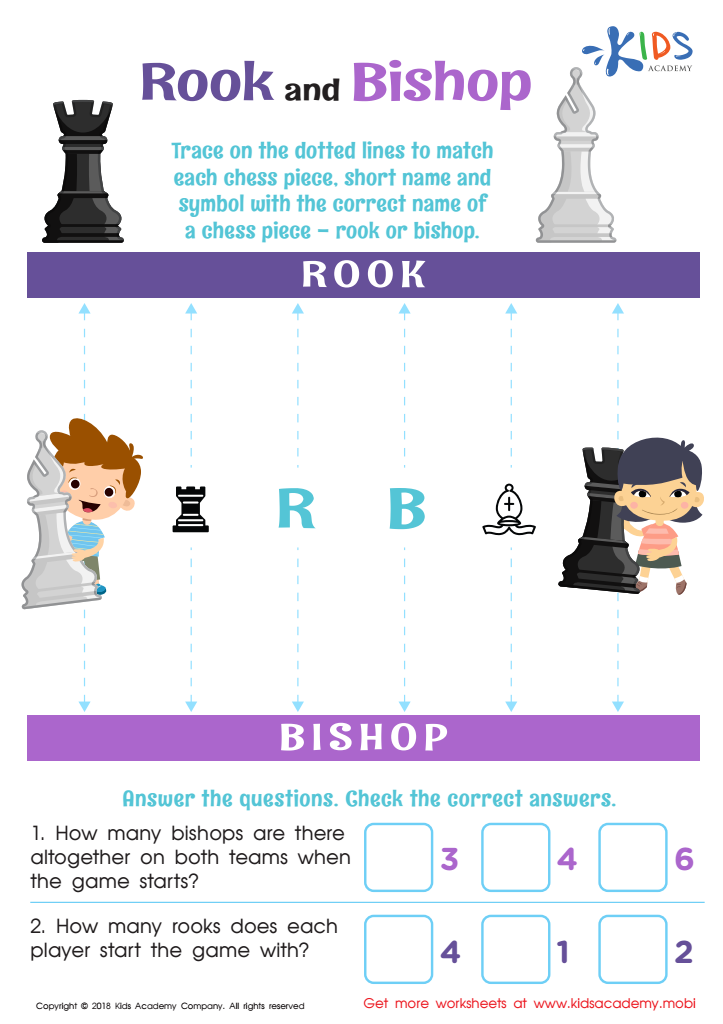
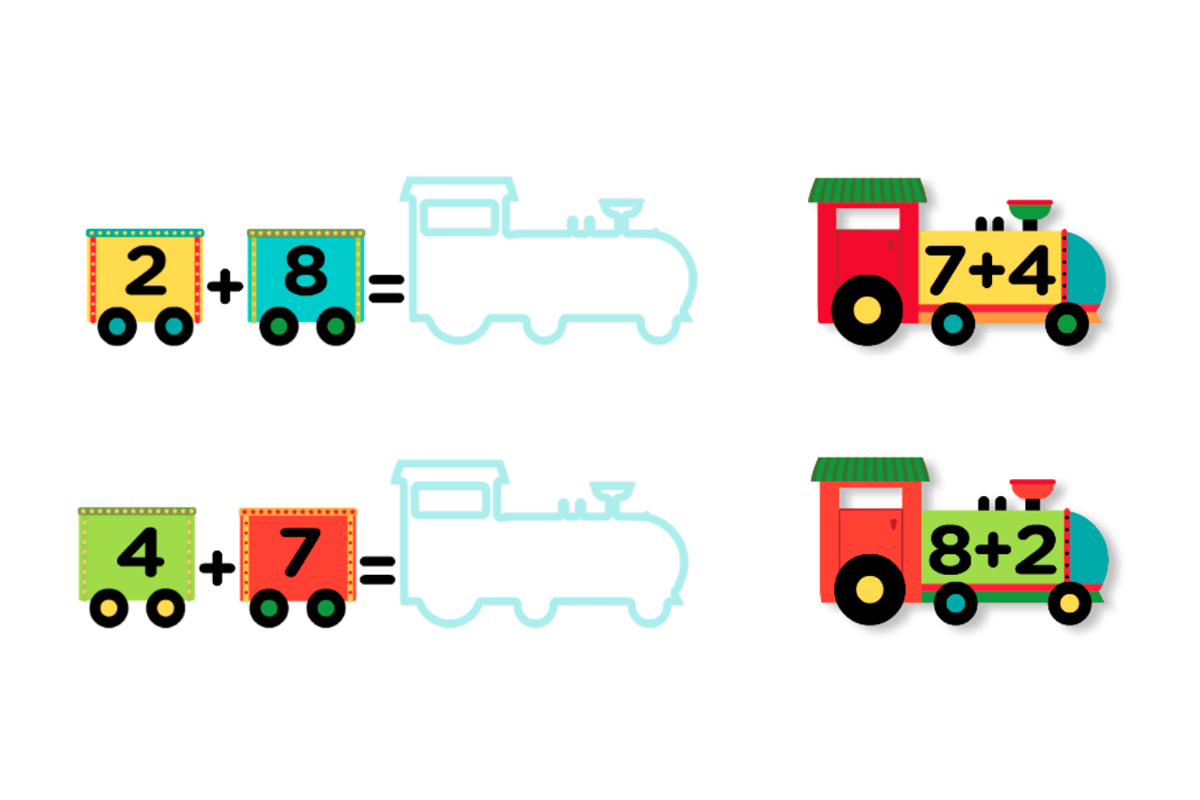
This tracing sheet helps your child learn chess pieces by matching each piece, short name and symbol to the correct name. After tracing, have them answer the questions and check their answers. It's a great way for them to become familiarized with chess.
Rook and Bishop Worksheet
Worksheet
=
=

Drawing by Squares Worksheet

Test your child's chess skills and ability to name squares with this worksheet. Have them draw a chess piece from the squares at the top of the chessboard in the picture. Guide them to draw lines between the given squares for the correct outline of a chess piece.
Drawing by Squares Worksheet
Worksheet


Parents and teachers should prioritize the educational development of children aged 5-7 because this period is critical for cognitive, emotional, and social growth. During these early years, children form foundational skills such as reading, writing, and basic mathematics, which are essential for future learning. Research shows that early intervention and support can lead to improved academic performance throughout their educational journey.

Furthermore, this age group is characterized by rapid brain development, making it an ideal time for instilling a love for learning. Engaging in interactive and playful learning experiences fosters curiosity and creativity, helping children build confidence in their abilities. Additionally, social skills developed during this time, such as sharing, cooperation, and communication, are vital for peer interactions and overall emotional well-being.

By investing time and resources into nurturing this critical stage of development, parents and teachers can significantly impact a child's trajectory, paving the way for lifelong learning and success. Moreover, early support can help identify and address any learning challenges, ensuring that all children have equal opportunities to thrive. Ultimately, fostering a positive and enriching environment for children ages 5-7 lays a strong foundation for their academic and personal growth.